COLLATERAL | April 17, 2020

IOActive Services Overview

Security services for your business, situation, and risks.

With our breadth and depth of services offerings across more environments than any other firm today, we can deliver specific, high-value recommendations based on your business, unique situation, and the risk you face. We are a pure-play security services provider, offering services across the spectrum to include: cybersecurity advisory, full-stack security assessments, SDL, red/purple team and security team development (training) services.

ADVISORIES | April 23, 2018

HooToo Security Advisory

HT-TM05 is vulnerable to unauthenticated remote code execution in the /sysfirm.csp CGI endpoint, which allows an attacker to upload an arbitrary shell script that will be executed with root privileges on the device. (more…)

ADVISORIES | October 17, 2017

Microsoft Kernel Graphic Driver Kernel Memory Address Disclosure

The latest version of Microsoft Basic Render Driver (BasicRender.sys 10.0.15063.413) is vulnerable to information disclosure. This issue allows an unprivileged user to map the kernel memory layout. (more…)

ADVISORIES | July 26, 2017

Physical and Authentication Bypass in Diebold Opteva ATM

Historically, ATMs have been designed without privileged separation between the safe and the internal operating system. In an attempt to address this security concern, Diebold developed the AFD platform. The Opteva line of ATMs with the AFD platform contain an upper cabinet for the operating system and a lower cabinet for the safe, each with its own authentication requirements.

Using reverse engineering and protocol analysis, IOActive found a critical vulnerability in the tested version of the Opteva ATM with the AFD platform. Despite its separation of privilege and authentication requirements, the ATM is still vulnerable to a malicious attacker, compromising its integrity and causing unauthenticated vending from the AFD. (more…)

RESEARCH | July 19, 2017

Multiple Critical Vulnerabilities Found in Popular Motorized Hoverboards

Not that long ago, motorized hoverboards were in the news – according to widespread reports, they had a tendency to catch on fire and even explode. Hoverboards were so dangerous that the National Association of State Fire Marshals (NASFM) issued a statement recommending consumers “look for indications of acceptance by recognized testing organizations” when purchasing the devices. Consumers were even advised to not leave them unattended due to the risk of fires. The Federal Trade Commission has since established requirements that any hoverboard imported to the US meet baseline safety requirements set by Underwriters Laboratories.

Since hoverboards were a popular item used for personal transportation, I acquired a Ninebot by Segway miniPRO hoverboard in September of 2016 for recreational use. The technology is amazing and a lot of fun, making it very easy to learn and become a relatively skilled rider.

The hoverboard is also connected and comes with a rider application that enables the owner to do some cool things, such as change the light colors, remotely control the hoverboard, and see its battery life and remaining mileage. I was naturally a little intrigued and couldn’t help but start doing some tinkering to see how fragile the firmware was. In my past experience as a security consultant, previous well-chronicled issues brought to mind that if vulnerabilities do exist, they might be exploited by an attacker to cause some serious harm.

When I started looking further, I learned that regulations now require hoverboards to meet certain mechanical and electrical specifications with the goal of preventing battery fires and various mechanical failures; however, there are currently no regulations aimed at ensuring firmware integrity and validation, even though firmware is also integral to the safety of the system.

Let’s Break a Hoverboard

Using reverse engineering and protocol analysis techniques, I was able to determine that my Ninebot by Segway miniPRO (Ninebot purchased Segway Inc. in 2015) had several critical vulnerabilities that were wirelessly exploitable. These vulnerabilities could be used by an attacker to bypass safety systems designed by Ninebot, one of the only hoverboards approved for sale in many countries.

Using protocol analysis, I determined I didn’t need to use a rider’s PIN (Personal Identification Number) to establish a connection. Even though the rider could set a PIN, the hoverboard did not actually change its default pin of “000000.” This allowed me to connect over Bluetooth while bypassing the security controls. I could also document the communications between the app and the hoverboard, since they were not encrypted.

Additionally, after attempting to apply a corrupted firmware update, I noticed that the hoverboard did not implement any integrity checks on firmware images before applying them. This means an attacker could apply any arbitrary update to the hoverboard, which would allow them to bypass safety interlocks.

Upon further investigation of the Ninebot application, I also determined that connected riders in the area were indexed using their smart phones’ GPS; therefore, each riders’ location is published and publicly available, making actual weaponization of an exploit much easier for an attacker.

To show how this works, an attacker using the Ninebot application can locate other hoverboard riders in the vicinity:


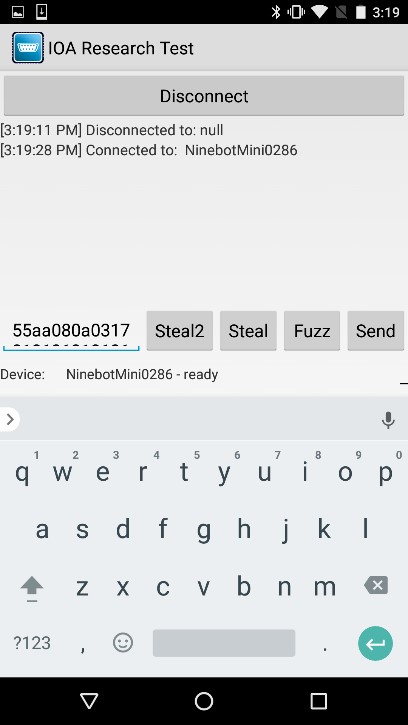
An attacker could then connect to the miniPRO using a modified version of the Nordic UART application, the reference implementation of the Bluetooth service used in the Ninebot miniPRO. This application allows anyone to connect to the Ninebot without being asked for a PIN.By sending the following payload from the Nordic application, the attacker can change the application PIN to “111111”:
unsigned char payload[13] =
{0x55, 0xAA, 0x08, 0x0A, 0x03, 0x17, 0x31, 0x31, 0x31, 0x31, 0x31, 0x31, 0xAD, 0xFE}; // Set The Hoverboard Pin to “111111”


Figure 1 – miniPRO PIN Theft


Using the pin “111111,” the attacker can then launch the Ninebot application and connect to the hoverboard. This would lock a normal user out of the Ninebot mobile application because a new PIN has been set.

Using DNS spoofing, an attacker can upload an arbitrary firmware image by spoofing the domain record for apptest.ninebot.cn. The mobile application downloads the image and then uploads it to the hoverboard:

In http://apptest.ninebot.cn change the /appversion/appdownload/NinebotMini/version.json file to match your new firmware version and size. The example below forces the application to update the control/mainboard firmware image (aka driver board firmware) to v1.3.3.7, which is 50212 bytes in size.

“CtrlVersionCode”:[“1337″,”50212”]

Create a matching directory and file including the malicious firmware (/appversion/appdownload/NinebotMini/v1.3.3.7/Mini_Driver_v1.3.3.7.zip) with the modified update file Mini_Driver_V1.3.3.7.bin compressed inside of the firmware update archive.


When launched, the Ninebot application checks to see if the firmware version on the hoverboard matches the one downloaded from apptest.ninebot.cn. If there is a later version available (that is, if the version in the JSON object is newer than the version currently installed), the app triggers the firmware update process.

Analysis of Findings
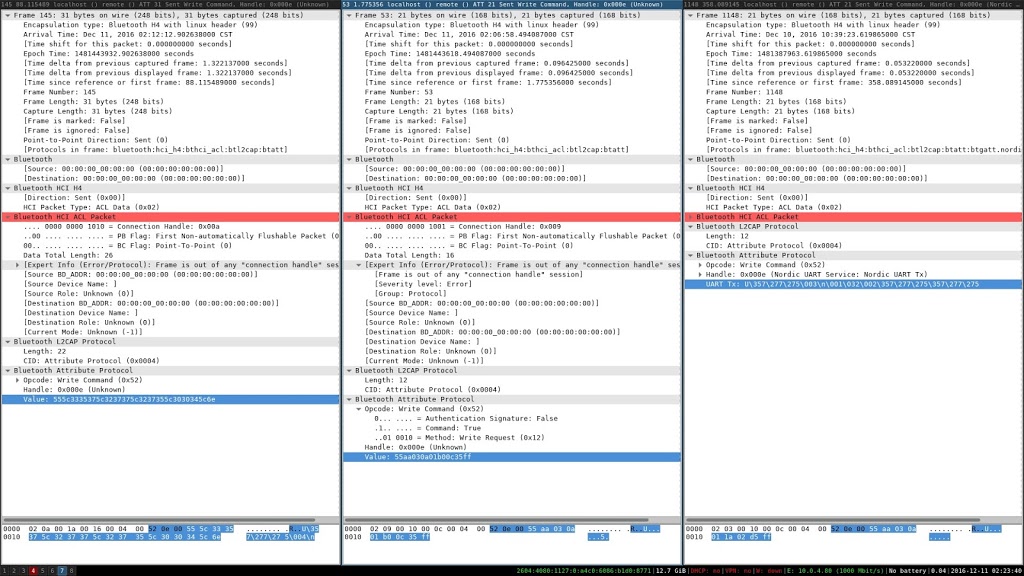
Even though the Ninebot application prompted a user to enter a PIN when launched, it was not checked at the protocol level before allowing the user to connect. This left the Bluetooth interface exposed to an attack at a lower level. Additionally, since this device did not use standard Bluetooth PIN-based security, communications were not encrypted and could be wirelessly intercepted by an attacker.

Exposed management interfaces should not be available on a production device. An attacker may leverage an open management interface to execute privileged actions remotely. Due to the implementation in this scenario, I was able to leverage this vulnerability and perform a firmware update of the hoverboard’s control system without authentication.

Firmware integrity checks are imperative in embedded systems. Unverified or corrupted firmware images could permanently damage systems and may allow an attacker to cause unintended behavior. I was able to modify the controller firmware to remove rider detection, and may have been able to change configuration parameters in other onboard systems, such as the BMS (Battery Management System) and Bluetooth module.

 Figure 2 – Unencrypted Communications between
Hoverboard and Android Application


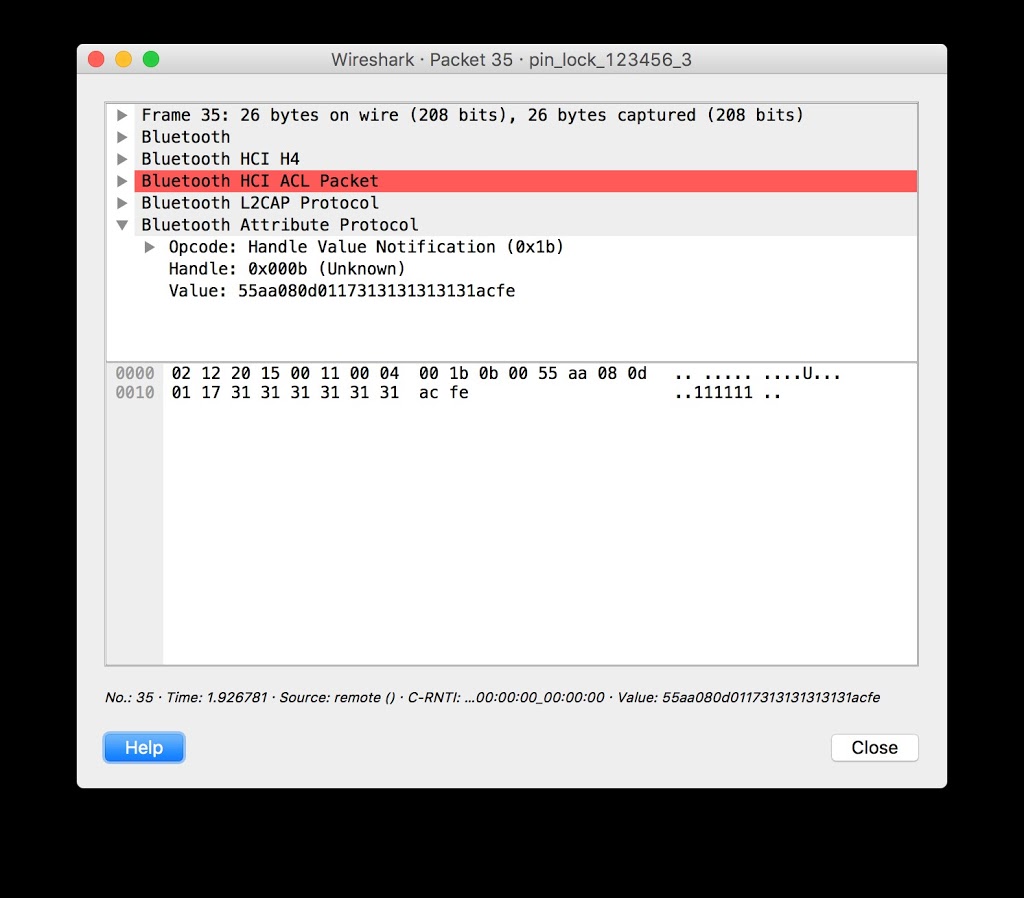
Figure 3 – Interception of Android Application Setting PIN Code to “111111”
 
Mitigation
As a result of the research, IOActive made the following security design and development recommendations to Ninebot that would correct these vulnerabilities:
  • Implement firmware integrity checking.
  • Use Bluetooth Pre-Shared Key authentication or PIN authentication.
  • Use strong encryption for wireless communications between the application and hoverboard.
  • Implement a “pairing mode” as the sole mode in which the hoverboard pairs over Bluetooth.
  • Protect rider privacy by not exposing rider location within the Ninebot mobile application. 

IOActive recommends that end users stay up-to-date with the latest versions of the app from Ninebot. We also recommend that consumers avoid hoverboard models with Bluetooth and wireless capabilities.

Responsible Disclosure
After completing the research, IOActive subsequently contacted and disclosed the details of the vulnerabilities identified to Ninebot. Through a series of exchanges since the initial contact, Ninebot has released a new version of the application and reported to IOActive that the critical issues have been addressed.

  • December 2016: IOActive conducts testing on Ninebot by Segway miniPro hoverboard.
  • December 24, 2016: Ioactive contacts Ninebot via a public email address to establish a line of communication.
  • January 4, 2017: Ninebot responds to IOActive.
  • January 27, 2017: IOActive discloses issues to Ninebot.
  • April 2017: Ninebot releases an updated application (3.20), which includes fixes that address some of IOActive’s findings.
  • April 17, 2017: Ninebot informs IOActive that remediation of critical issues is complete.
  • July 19, 2017: IOActive publishes findings.
For more information about this research, please refer to the following additional materials:

ADVISORIES |

Ninebot by Segway miniPRO Vulnerabilities

Ninebot Limited, which purchased Segway Inc. in 2015, sells a line of self-balancing motorized electric scooters used for transportation under 30km/h. Recently, issues regarding the safety of scooters have surfaced, primarily caused by poor manufacturing quality or a general lack of safety-centered design. (more…)

INSIGHTS | May 20, 2017

Post #WannaCry Reaction #127: Do I Need a Pen Test?

In the wake of WannaCry and other recent events, everyone from the Department of Homeland Security to my grandmother is recommending penetration tests as a silver bullet to prevent falling victim to the next cyberattack. But a penetration test is not a silver bullet, nor is it universally what is needed for improving the security posture of an organization. There are several key factors to consider. So I thought it might be good to review the difference between a penetration test and a vulnerability assessment since this is a routine source of confusion in the market. In fact, I’d venture to say that while there is a lot of good that comes from a penetration test, what people actually more often need is a vulnerability assessment.

First, let’s get the vocabulary down:

Vulnerability Assessments

Vulnerability Assessments are designed to yield a prioritized list of vulnerabilities and are generally best for organizations that understand they are not where they want to be in terms of security. The customer already knows they have issues and need help identifying and prioritizing them.

With a vulnerability assessment, the more issues identified the better, so naturally, a white box approach should be embraced when possible. The most important deliverable of the assessment is a prioritized list of vulnerabilities identified (and often information on how best to remediate).

Penetration Tests

Penetration Tests are designed to achieve a specific, attacker-simulated goal and should be requested by organizations that are already at their desired security posture. A typical goal could be to access the contents of the prized customer database on the internal network or to modify a record in an HR system.

The deliverable for a penetration test is a report on how security was breached in order to reach the agreed-upon goal (and often information on how best to remediate).

Why does it matter? In short, you get what you pay for. 

No organization has an unlimited budget for security. Every security dollar spent is a trade-off. For organizations that do not have a highly developed security program in place, vulnerability assessments will provide better value in terms of knowing where you need to improve your security posture even though pen tests are generally a less expensive option. A pen test is great when you know what you are looking for or want to test whether a remediation is working and has solved a particular vulnerability.

Here is a quick chart to help determine what your organization may need.

VULNERABILITY ASSESSMENT
PENETRATION TEST
Organizational Security Program Maturity Level
Low to Medium. Usually requested by organizations that already know they have issues, and need help getting started.
High. The organization believes their defenses to be strong, and wants to test that assertion.
Goal
Attain a prioritized list of vulnerabilities in the environment so that remediation can occur.
Determine whether a mature security posture can withstand an intrusion attempt from an advanced attacker with a specific goal.
Focus
Breadth over depth.
Depth overbreadth.

So what now?

Most security programs benefit from utilizing some combination of security techniques. These can include any number of tasks, including penetration tests, vulnerability assessments, bug bounties, white/grey/black testing, code review, and/or red/blue/purple team exercises.

We’ll peel back the different tools and how you might use them in a future post. Until then, take a look at your needs and make sure the steps you take in the wake of WannaCry and other security incidents are more than just reacting to the crisis of the week.

RESEARCH | April 20, 2017

Linksys Smart Wi-Fi Vulnerabilities

By Tao Sauvage

Last year I acquired a Linksys Smart Wi-Fi router, more specifically the EA3500 Series. I chose Linksys (previously owned by Cisco and currently owned by Belkin) due to its popularity and I thought that it would be interesting to have a look at a router heavily marketed outside of Asia, hoping to have different results than with my previous research on the BHU Wi-Fi uRouter, which is only distributed in China.

Smart Wi-Fi is the latest family of Linksys routers and includes more than 20 different models that use the latest 802.11N and 802.11AC standards. Even though they can be remotely managed from the Internet using the Linksys Smart Wi-Fi free service, we focused our research on the router itself.

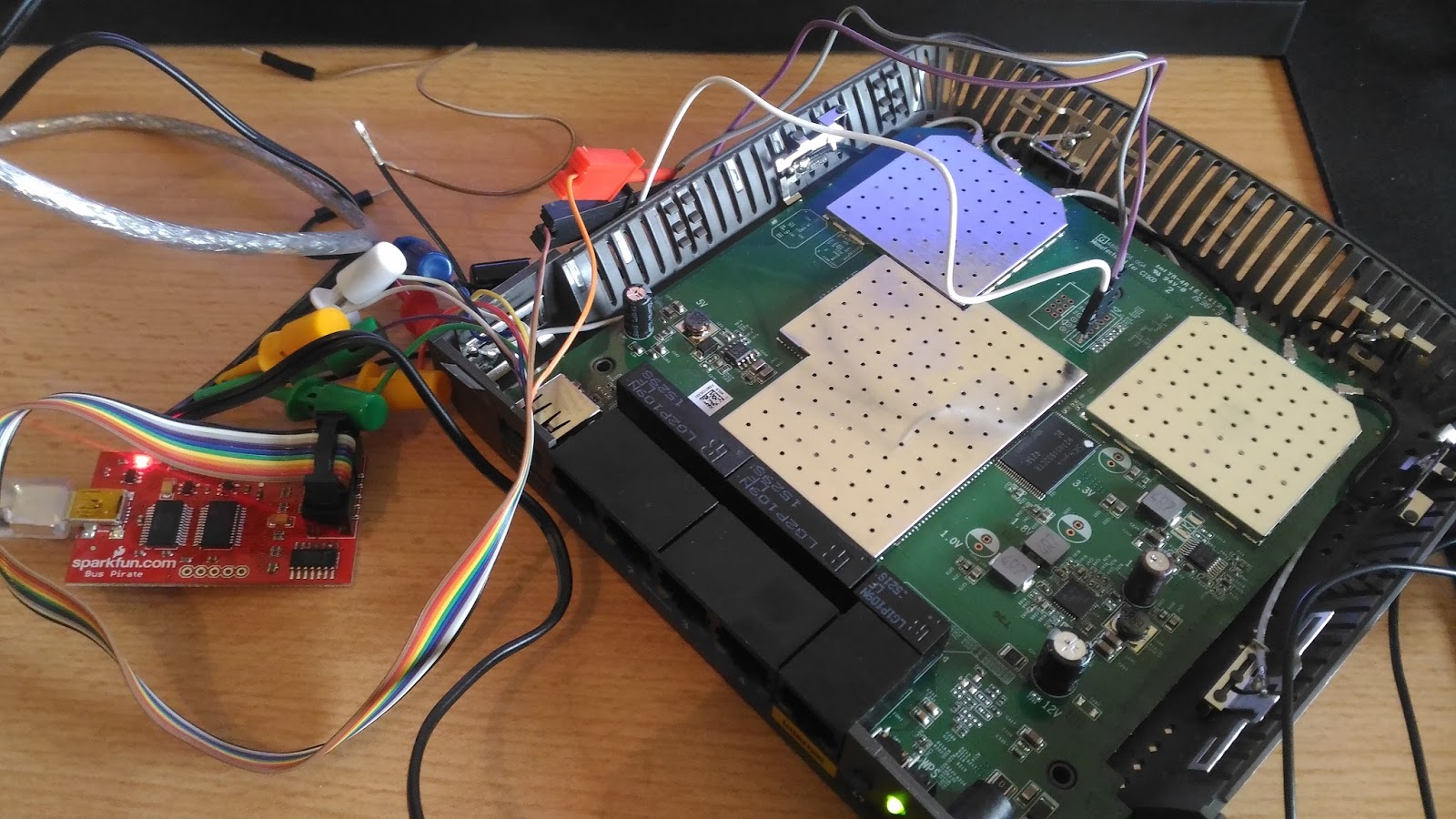
Figure 1: Linksys EA3500 Series UART connection

With my friend @xarkes_, a security aficionado, we decided to analyze the firmware (i.e., the software installed on the router) in order to assess the security of the device. The technical details of our research will be published soon after Linksys releases a patch that addresses the issues we discovered, to ensure that all users with affected devices have enough time to upgrade.

In the meantime, we are providing an overview of our results, as well as key metrics to evaluate the overall impact of the vulnerabilities identified.

Security Vulnerabilities

After reverse engineering the router firmware, we identified a total of 10 security vulnerabilities, ranging from low- to high-risk issues, six of which can be exploited remotely by unauthenticated attackers.

Two of the security issues we identified allow unauthenticated attackers to create a Denial-of-Service (DoS) condition on the router. By sending a few requests or abusing a specific API, the router becomes unresponsive and even reboots. The Admin is then unable to access the web admin interface and users are unable to connect until the attacker stops the DoS attack.

Attackers can also bypass the authentication protecting the CGI scripts to collect technical and sensitive information about the router, such as the firmware version and Linux kernel version, the list of running processes, the list of connected USB devices, or the WPS pin for the Wi-Fi connection. Unauthenticated attackers can also harvest sensitive information, for instance using a set of APIs to list all connected devices and their respective operating systems, access the firewall configuration, read the FTP configuration settings, or extract the SMB server settings.

Finally, authenticated attackers can inject and execute commands on the operating system of the router with root privileges. One possible action for the attacker is to create backdoor accounts and gain persistent access to the router. Backdoor accounts would not be shown on the web admin interface and could not be removed using the Admin account. It should be noted that we did not find a way to bypass the authentication protecting the vulnerable API; this authentication is different than the authentication protecting the CGI scripts.

Linksys has provided a list of all affected models:

  • EA2700
  • EA2750
  • EA3500
  • EA4500v3
  • EA6100
  • EA6200
  • EA6300
  • EA6350v2
  • EA6350v3
  • EA6400
  • EA6500
  • EA6700
  • EA6900
  • EA7300
  • EA7400
  • EA7500
  • EA8300
  • EA8500
  • EA9200
  • EA9400
  • EA9500
  • WRT1200AC
  • WRT1900AC
  • WRT1900ACS
  • WRT3200ACM

Cooperative Disclosure
We disclosed the vulnerabilities and shared the technical details with Linksys in January 2017. Since then, we have been in constant communication with the vendor to validate the issues, evaluate the impact, and synchronize our respective disclosures.

We would like to emphasize that Linksys has been exemplary in handling the disclosure and we are happy to say they are taking security very seriously.

We acknowledge the challenge of reaching out to the end-users with security fixes when dealing with embedded devices. This is why Linksys is proactively publishing a security advisory to provide temporary solutions to prevent attackers from exploiting the security vulnerabilities we identified, until a new firmware version is available for all affected models.

Metrics and Impact 

As of now, we can already safely evaluate the impact of such vulnerabilities on Linksys Smart Wi-Fi routers. We used Shodan to identify vulnerable devices currently exposed on the Internet.


Figure 2: Repartition of vulnerable Linksys routers per country

We found about 7,000 vulnerable devices exposed at the time of the search. It should be noted that this number does not take into account vulnerable devices protected by strict firewall rules or running behind another network appliance, which could still be compromised by attackers who have access to the individual or company’s internal network.

A vast majority of the vulnerable devices (~69%) are located in the USA and the remainder are spread across the world, including Canada (~10%), Hong Kong (~1.8%), Chile (~1.5%), and the Netherlands (~1.4%). Venezuela, Argentina, Russia, Sweden, Norway, China, India, UK, Australia, and many other countries representing < 1% each.

We performed a mass-scan of the ~7,000 devices to identify the affected models. In addition, we tweaked our scan to find how many devices would be vulnerable to the OS command injection that requires the attacker to be authenticated. We leveraged a router API to determine if the router was using default credentials without having to actually authenticate.

We found that 11% of the ~7000 exposed devices were using default credentials and therefore could be rooted by attackers.

Recommendations

We advise Linksys Smart Wi-Fi users to carefully read the security advisory published by Linksys to protect themselves until a new firmware version is available. We also recommend users change the default password of the Admin account to protect the web admin interface.

Timeline Overview

  • January 17, 2017: IOActive sends a vulnerability report to Linksys with findings 
  • January 17, 2017: Linksys acknowledges receipt of the information
  • January 19, 2017: IOActive communicates its obligation to publicly disclose the issue within three months of reporting the vulnerabilities to Linksys, for the security of users
  • January 23, 2017: Linksys acknowledges IOActive’s intent to publish and timeline; requests notification prior to public disclosure
  • March 22, 2017: Linksys proposes release of a customer advisory with recommendations for  protection
  • March 23, 2017: IOActive agrees to Linksys proposal
  • March 24, 2017: Linksys confirms the list of vulnerable routers
  • April 20, 2017: Linksys releases an advisory with recommendations and IOActive publishes findings in a public blog post
ADVISORIES | March 8, 2017

Secure Messaging Application Vulnerabilities Identified

IOActive security researchers tested versions 1.4.2 for Windows and OS X and 4.0.4 for Android, of the Confide messaging application by reverse engineering the published application, observing its behavior, and interacting with the public API.

During the evaluation, multiple security vulnerabilities of varying severities were identified, with corresponding attacker exploitation risks ranging from account impersonation and message tampering, to exposing user contact details and hijacking accounts.

The issues were reported to the vendor through responsible disclosure and many, including those identified as being critical, were subsequently addressed and resolved quickly by Confide. (more…)

ADVISORIES | December 7, 2016

Security Vulnerabilities in Routers

The LB-LINK BL-WR2000 router, manufactured in China and sold world-wide, contains a critical vulnerability that allows an attacker to extract the admin credentials from the login page and gain access to the web admin interface.

IOActive has identified 3 high to critical vulnerabilities in the product. An attacker could exploit these issues to fully compromise the device. (more…)