INSIGHTS | October 29, 2026

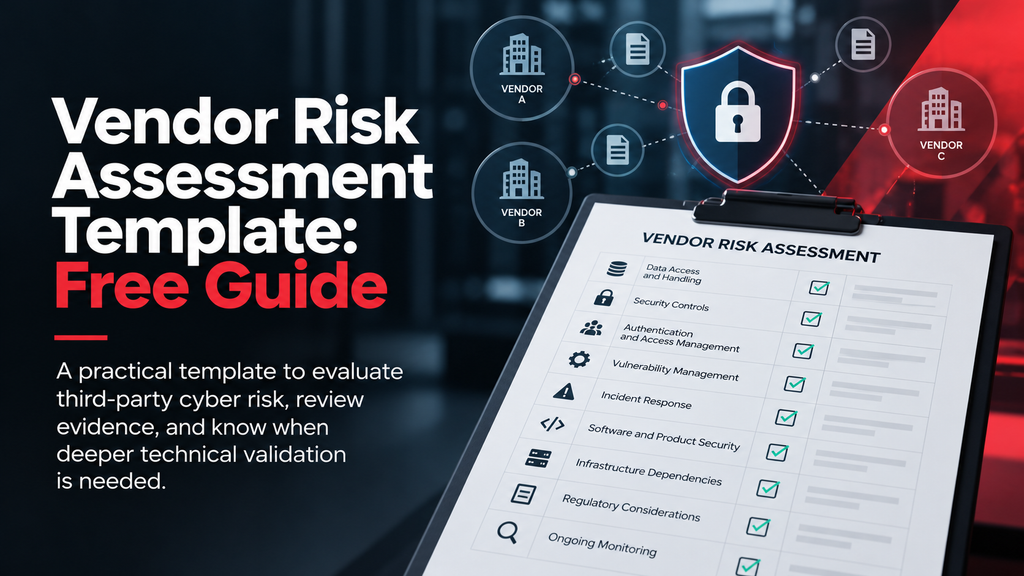
Vendor Risk Assessment Template: Free Guide

“A vendor risk assessment should help organizations identify where third-party access, technology, and dependencies could introduce meaningful security exposure.” – IOActive Security Team

Vendors may have security policies in place, but those policies do not always show how much risk their access and technology create for your organization. A useful assessment looks beyond the policy document to the attack paths a compromised vendor could open.

Use this vendor risk assessment template free of charge to establish scope, test evidence quality, and determine when a vendor relationship warrants technical validation. This framework aligns with NIST SP 800-161 Rev. 1, which addresses the identification, assessment, and mitigation of cybersecurity supply chain risk, and the NIST Cybersecurity Framework 2.0 C-SCRM guidance, which prioritizes vendors by criticality and expects vendor risk to be monitored throughout the relationship.

Vendor Risk Assessment Template

The matrix below is the core template. Add an owner, a due date, and a progress update for each follow-up item.

Core Vendor Risk Assessment Template

Assessment domainQuestions to askEvidence to requestEscalate when
Data access and handlingWhat data is collected, stored, transmitted, or generated?Data-flow diagram, retention policy, subprocessorsSensitive data leaves approved regions or lacks deletion controls
Authentication and accessHow are workforce, customer, privileged, and service accounts protected?Multi-factor authentication (MFA) standard, access review record, privileged access designShared accounts, unmanaged service accounts, or weak recovery paths appear
Security controlsWhich preventive, detective, and corrective controls protect the service?SOC 2 report, ISO 27001 certificate, control summaryEvidence is expired, narrow in scope, or vague
Vulnerability managementHow are flaws found, triaged, fixed, and communicated?Vulnerability policy, scan summary, remediation targetsCritical issues lack owners, deadlines, or customer notification rules
Incident responseHow will the vendor detect, contain, investigate, and report an incident?Incident plan, notification terms, exercise summaryNo tested process or clear customer communication path exists
Software and product securityHow are code, dependencies, builds, updates, and releases secured?Secure development lifecycle (SDL) overview, Software Bill of Materials (SBOM), secure release controlsThe vendor cannot explain update integrity or dependency risk
Infrastructure dependenciesWhich cloud, hosting, identity, network, and fourth-party providers support delivery?Architecture diagram, resilience plan, dependency listA hidden dependency can interrupt a critical service
Regulatory considerationsWhich contractual, privacy, sector, or geographic requirements apply?Compliance mapping, data-processing terms, audit rightsRequirements are treated as badges rather than operating controls
Ongoing monitoringWhat changes trigger reassessment, notification, or approval?Review cadence, change process, service metricsRisk is reviewed only at onboarding or renewal

The escalation column is the operational center of the template. It converts a completed questionnaire into decisions about access, evidence, remediation, and technical validation.

1. Data Access, Handling, and Authentication

Start with the path to impact. Determine what a compromised vendor account, integration, administrator, service account, or update process could reach from the relationship. Do not accept “the vendor encrypts data” as a complete control description. Identify where encryption begins and ends, who can decrypt the data, how keys are governed, and whether support personnel can access production records.

Apply the same discipline to authentication. “Multi-factor authentication enabled” is incomplete if privileged access, API keys, recovery flows, and non-human accounts follow different rules.

Access and Authentication Signals

SignalWhat it may indicateUseful follow-up
Broad network connectivityA vendor compromise could become a pivot into internal systemsRequest segmentation and least-privilege diagrams
Production access for support personnelHuman or credential abuse could affect live dataReview just-in-time access, approvals, and session logging
Long-lived API keysStolen credentials may remain useful after personnel changesAsk about rotation, scope, expiration, and detection
Unclear data deletionData may persist after the contract endsConfirm deletion timelines, backups, and verification

These signals distinguish a limited data-processing role from a viable route into higher-value assets. The next step is to test whether the stated controls cover that route.

2. Security Controls and Vulnerability Management

Assess whether controls operate in the systems that support your relationship. Request enough detail to establish ownership, coverage, operating frequency, exceptions, and evidence retention.

For vulnerability management, ask how the vendor handles flaws in proprietary code, open-source components, cloud configuration, and externally exposed services. The relevant question is whether it can discover, prioritize, remediate, and communicate weaknesses before they create downstream exposure.

Control Evidence Matrix

Control areaEvidence that helpsWarning sign
Asset inventoryScope statement and inventory ownershipThe vendor cannot define what is in scope
Vulnerability managementRemediation policy and recent summarySeverity is tracked without business impact
Configuration securityBaselines, review records, or cloud controlsDefaults remain in production without justification
Logging and detectionCoverage map and retention detailsCritical actions are not attributable to a user or service
Backup and recoveryRecovery objectives and exercise resultsRecovery claims are not tested
ExceptionsRisk acceptance records and expiry datesExceptions have no owner or end date

A SOC 2 report, an ISO 27001 certificate, a penetration test summary, or a similar document can support an answer. It does not establish that every system relevant to your relationship is secure today. Check the assessment period, scope, exclusions, testing method, and unresolved findings.

Once control coverage and evidence quality are understood, the assessment should address the vendor’s ability to coordinate in the event of a compromise or service disruption.

3. Incident Response and Operational Resilience

A vendor incident can become a major problem when its systems process your data, connect to your network, or support a critical business function. The assessment should therefore examine coordination, evidence preservation, notification, and recovery, not only the existence of an internal response plan.

Ask who contacts your organization, how quickly the vendor must notify you, what evidence will be preserved, and how your teams will participate in containment. Confirm whether the vendor has exercised scenarios involving credential theft, ransomware, cloud compromise, data exposure, and loss of a key subprocessor.

Incident Readiness Matrix

QuestionStronger answerDeeper investigation trigger
Who declares an incident?Named decision-makers and an escalation treeResponsibility depends on an unnamed team
How are customers notified?Contract terms and tested communication channelsNotification is “as soon as practical” with no process
What evidence is preserved?Defined logs, timestamps, and retention rulesForensic support is not addressed
How does service recover?Recovery objectives supported by exercisesRecovery depends on an untested assumption
How are lessons tracked?Post-incident actions have owners and deadlinesReports close without corrective action

These answers determine whether your organization can make informed decisions during an incident. Because NIST treats supply chain risk as a lifecycle concern, resilience and incident coordination belong in vendor governance, not only in the security team’s incident plan. The assessment can then move below the policy layer to examine the software, products, and infrastructure that create the vendor’s attack surface.

4. Software, Product Security, and Infrastructure Dependencies

Questionnaires provide limited assurance when the relationship depends on complex technology. If a vendor ships software, manages infrastructure, or embeds components in a product, assess how it engineers and maintains security across the lifecycle.

For SaaS applications, review tenant isolation, identity integration, logging, administrative access, and customer-data boundaries. For software, review the development lifecycle, code review, dependency management, build pipeline, release signing, update process, and vulnerability disclosure path. For hardware or embedded products, include firmware, debug interfaces, default credentials, update mechanisms, and manufacturing or support channels.

For infrastructure, map the services beneath the vendor’s service. A cloud provider, identity platform, managed service provider, hosting region, or fourth-party dependency may become a constraint that the vendor cannot quickly replace.

Technology Relationship Review

Technology relationshipExamineValidate when
SaaS applicationTenant isolation, identity, logging, integrationsThe service connects to privileged systems or sensitive data
Software componentBuild pipeline, dependencies, release integrity, Software Bill of Materials (SBOM)The component runs in production or handles trusted input
Hardware or embedded productFirmware, update path, debug access, support channelsThe product controls physical processes or safety functions
Managed infrastructureSegmentation, administrator access, resilience, fourth-party providersOutage or compromise would interrupt critical operations

An attacker-oriented assessment can expose assumptions that documentation leaves untested. Ask which trust boundary an attacker would target first, which control would be bypassed, and which asset would be exposed if that control failed.

For example, a vendor may require remote support access, expose an administrative API, and rely on a fourth-party identity provider. Those dependencies can combine into an attack path that is not visible in any single questionnaire response. The answers inform the regulatory and monitoring requirements that govern the relationship.

5. Regulatory Considerations and Ongoing Monitoring

Regulatory requirements should shape the assessment, but they should not substitute for it. Identify the laws, sector rules, contractual duties, data-location limits, breach obligations, retention requirements, and audit rights that apply to the relationship.

Then convert each requirement into an operating question.

  1. Who owns the control?
  2. Which system enforces it?
  3. What record proves it operated?
  4. What happens when the vendor changes a subprocessor, moves data, introduces a new integration, or experiences a material incident?

The NIST CSF 2.0 C-SCRM guidance calls for due diligence before a relationship begins. NIST CSF 2.0 also calls for understanding, recording, prioritizing, assessing, addressing, and monitoring vendor risks over time.

Lifecycle Monitoring Matrix

Change eventReassess this areaMinimum action
New data type or useData handling and privacyUpdate the data flow and contract terms
New integrationAccess, authentication, and segmentationReview permissions and test the connection
Acquisition or ownership changeGovernance, personnel, and dependenciesRequest an updated risk profile
New subprocessorFourth-party dependency and geographic exposureReview the subprocessor before approval
Material incidentDetection, response, and residual riskTrack corrective actions to closure
Major product releaseSoftware, product, and update securityReview release and change controls

An annual review may be appropriate for a low-impact vendor. It is not a universal control. Continuous monitoring should track material changes, while formal reassessment should occur according to access, criticality, change rate, and plausible business impact.

These triggers identify when a questionnaire requires technical validation. A vendor’s risk profile changes with its architecture, ownership, software, or data flows.

6. When a Questionnaire Is Not Enough

A questionnaire is insufficient when the answer depends on technical behavior that the vendor cannot demonstrate with policy documents. This does not mean every vendor requires a penetration test. It means the assurance method must correspond to the consequence of being wrong.

Use targeted technical validation when the vendor has privileged access, handles sensitive or regulated data, supports a critical process, ships software or hardware, exposes internet-facing services, relies on opaque fourth-party providers, or provides evidence that is incomplete, stale, or outside the relevant scope.

These scenarios are illustrative, not a severity ranking. Use the vendor’s access, criticality, evidence quality, and business impact to determine the escalation path.

Evidence Sufficiency and Escalation Matrix

Questionnaire resultWhat does it tell youBetter next step
Complete answers, low-impact serviceBasic risk is understoodRecord the decision and monitor material changes
Strong documents, high-impact accessControl design may be credibleValidate scope, access paths, and technical assumptions
Vague answers, critical dependencyRisk is not measurableRequire evidence before onboarding or restrict access
Product with update or build authorityThe vendor can influence trusted codeReview product security, release integrity, and dependencies
Repeated exceptions or delayed remediationRisk may be systemicConduct targeted testing or an independent assessment
Major incident with unclear lessonsResidual risk is unknownRequire root-cause evidence and corrective-action tracking

Possible validation methods include architecture review, configuration review, attack-surface analysis, secure code review, product security testing, cloud control validation, adversary simulation, and targeted penetration testing. Select the method according to the attack path, not the vendor’s preferred deliverable, and record the rationale for the escalation decision.

7. Scoring and Prioritizing Findings

Avoid a single score that conceals the reason for the risk. Record business criticality, access level, data sensitivity, and confidence in the evidence. A high-impact vendor with strong evidence may be acceptable, while a lower-impact vendor with privileged access and weak evidence may warrant faster intervention. The score should support a decision, not create false precision.

Vendor Risk Decision Matrix

PriorityTypical conditionDecision
LowLimited access, low-impact service, clear evidenceApprove with routine monitoring
ModerateSensitive data or meaningful integration, controls mostly supportedApprove with tracked remediation
HighPrivileged access, critical dependency, or major evidence gapsEscalate to security and business owners
CriticalPlausible path to material compromise with no timely mitigationDelay, restrict, or reject the relationship

For every finding, record the affected asset, attack path, business consequence, evidence, owner, due date, and acceptance authority. A finding without an owner is a future repeat finding.

This structure distinguishes inherent risk, control effectiveness, residual risk, and management acceptance before approval or renewal.

IOActive helps organizations assess vendor and supply chain risk from an attacker’s perspective, identifying technical exposure across third-party products, software, infrastructure, and access pathways.


INSIGHTS | October 20, 2026

Cyber Risk Management Strategies for Enterprises

Cybersecurity war room.

“The most effective cyber risk management strategies prioritize business impact alongside technical risk.” – IOActive Security Team

The strongest cyber risk management strategies begin with a business question. Which failures could stop a critical business service, harm people, cut revenue, or damage trust? A list of flaws cannot answer that question. Leaders need to see how weaknesses combine, which services they threaten, and what action will cut the risk.

This framework focuses on five decisions:

  1. Link technical risk to business impact.
  2. Test real attack paths through offensive security assessments.
  3. Treat third parties and Operational Technology (OT) as business dependencies.
  4. Set risk rules for each AI use case.
  5. Make continuous validation part of governance.

Use this framework during annual planning, major technology changes, supplier reviews, and new AI approvals. It gives executives a shared way to rank risk. It provides technical teams with a testable set of assumptions and service owners with a clear role. The result is a shorter path from a security finding to a funded business decision. It also helps separate risks that need immediate action from risks that can be tracked.

Start With Business Impact, Not a Finding Count

The NIST Cybersecurity Framework (CSF) 2.0 organizes security work into six functions: Govern, Identify, Protect, Detect, Respond, and Recover. Together, these functions help a company set priorities, reduce risk, spot failures, respond to incidents, and restore key services. They become most useful when the organization applies them to the services it must keep running.

Start with the services the business must protect. A factory may depend on production uptime, safe machine control, maintenance access, and a safe stop. A bank may depend on payments, administrative access, market links, and customer login. The same flaw can demand a different response based on its place in that service chain.

Business Impact Risk Prioritization Matrix

Decision factorLowMediumHigh
Business impactLocal inconvenienceService degradationSafety, revenue, or regulated-service interruption
Attack pathRare conditions requiredSeveral prerequisitesDirect or demonstrated path
Control confidenceTested and reliablePartly validatedUnknown, bypassed, or contradicted by evidence
Dependency exposureIsolated assetShared serviceSingle point of failure
Time to consequenceWeeks or monthsDaysHours or less
Executive actionTrack and reviewFund targeted reductionEscalate, assign an owner, and set a deadline

Use the matrix to direct resources toward paths that could interrupt a critical business service. A demonstrated path to that service deserves faster action than an isolated flaw on a test system.

Test the Risk Model Through Offensive Security Assessments

A risk model contains assumptions. It assumes that a control will block an attack, a team will spot it, and a restore process will work under pressure. An offensive security assessment tests those assumptions. It checks whether an attacker can connect separate weaknesses into a path to a critical business service.

A flaw scan may find an exposed system, but it does not show what an attacker can do with that access. An offensive assessment goes further: Which account or network boundary does the access bypass? What can the attacker reach? Could the result affect the business?

This distinction also clarifies the roles of Red Team and Purple Team engagements. Red Team work simulates adversary behavior, while Purple Team work brings offensive and defensive teams together to test controls, improve detection, and close response gaps.

A well-scoped assessment should answer four questions:

  1. Can an intruder reach a critical business service? Map the route from first access to the service. Look for account escalation, weak network limits, admin rights, exposed admin tools, and third-party access.
  2. Which controls should stop or flag the path? Name each expected prevention and detection point. Then name its owner and the proof that it worked.
  3. How quickly would the company know? Compare alert and triage time with the time an attacker would need to cause harm. Look for blind spots and unclear response paths.
  4. What action would limit harm? Define the contain, restore, or safe-stop action that protects the service under attack conditions.

IOActive’s research covers embedded devices, industrial control systems, aviation systems, vehicles, hardware, and connected products. That research can expose gaps where software, hardware, physical access, and safety meet.

Treat Third Parties and Operational Technology (OT) as Business Dependencies

Third-party risk should not stop at a questionnaire or contract clause. Cloud platforms, managed service firms, software suppliers, industrial integrators, and logistics partners may hold access, support a critical business service, or affect restoration if the company cannot replace them quickly.

For each third-party dependency, document what the party can see, change, or stop. Then assess its access path, data exposure, restore role, single points of failure, and exit options. The 2025 Verizon Data Breach Investigations Report found that third parties were involved in 30% of the breaches analyzed. That was twice the prior year’s share.

Operational technology (OT) needs the same business lens, with extra attention to safety, uptime, physical processes, and change control. Review asset lists and network separation with operators and engineers, not only with IT staff. CISA links accurate OT asset knowledge with security, maintenance, and uptime. CISA and its partners also recommend limiting OT access to what each user needs.

Third-Party and OT Evidence Matrix

DependencyEvidence to requestDecision it should support
Cloud or SaaS providerRecovery evidence, access review, and logging coverageWhether the service can support a critical process
Managed service providerPrivilege map, access approvals, and logging testWhether provider access is limited and observable
Software supplierUpdate checks and vulnerability handlingWhether updates create unacceptable exposure
Industrial integratorOT attack-path review and remote-access controlsWhether maintenance access could affect safe operations
Logistics partnerAlternate-process test and dependency mapWhether the business can continue during supplier failure

Use the evidence to set a fix, name the risk owner, and test the restore plan where needed.

Govern AI Adoption by Use Case

AI is not a single risk category. A public chatbot, coding assistant, customer-facing model, and plant-support application have different users, data, permissions, failure modes, and business impact. Treating them as one program can hide the controls each use case needs.

NIST’s AI Risk Management Framework supports managing AI risks during development and use. Before approval, the owner should state the purpose, users, and data access. The owner should also define decision power, likely misuse, human checks, logs, and a rollback plan. IOActive’s AI security services describe support from concept through deployment. That lifecycle view helps teams test risk during buying, data preparation, model use, integrations, and live operations.

AI Use-Case Risk Gate

AI gateEvidence to requestApproval question
PurposeBusiness outcome and affected usersIs the use case necessary and bounded?
DataPermissions, retention, and sensitive contentCan the system access only needed data?
BehaviorAbuse cases, output tests, and failure modesWhat could it produce or recommend incorrectly?
AuthorityActions the system can recommend or initiateWhich actions require human approval?
ResilienceMonitoring, rollback, and incident playbookHow will the team stop or restore it?

Approved systems still need checks after launch. A change in the model, data, integration, user group, or authority can change the risk.

Make Continuous Validation Part of Cyber Risk Management Strategies

A risk plan loses value when its proof becomes old. Systems change. Third parties gain access. Cloud accounts grow. AI goes live. New research changes a threat model. A control that worked during a test may not protect the same critical business service after a design or process change.

Continuous checks do not mean scanning every system at all times. They mean checking the controls that protect critical business services. NIST CSF 2.0 treats security risk management as an ongoing practice. It includes continuous monitoring within the Detect function.

Continuous Validation Trigger Matrix

TriggerValidation actionOwner or participant
Major design changeUpdate attack paths and control assumptionsSecurity architecture and service owner
New third-party accessReview privileges, logs, and restore dependencyVendor owner and security
AI system enters productionTest abuse cases, permissions, logs, and rollbackAI owner, privacy, and security
OT process or firmware changeReview safety limits, network separation, and remote accessEngineering, operations, and security
Completed fixRetest the original attack path and remaining accessControl owner and assessor

For board and executive reports, track the share of critical business services with tested attack paths and overdue high-priority fixes. Also track time to detect and contain a tested path and the share of restore exercises that meet their goals.

Put Cyber Risk Management Strategies Into Practice

The most effective cyber risk management strategies connect technical evidence to business consequences. IOActive combines threat research, adversarial testing, and security advice to help organizations test the assumptions behind their plans.

Sources

INSIGHTS | October 6, 2026

Cyber Risk Management Strategies: Six Ways to Align Security With Business Priorities

Cybersecurity analyst reviewing business systems as part of a cyber risk management strategies.

Recent IOActive research on 2026 attack trends points to a recurring problem: attackers target systems that companies rely on the most, but watch the least, including operational technology (OT), firmware supply chains, and AI-enabled development. That raises a difficult question for security leaders: Which risks deserve investment first?

The answer is not always the vulnerability with the highest technical severity. A useful cyber risk management strategy links technical risk to business impact, tests whether attack paths are realistic, and directs funding toward the risks most likely to disrupt the business.

“The most effective cyber risk management strategies prioritize business impact alongside technical risk.” – IOActive Security Team

Six Pillars of Business-Aligned Cyber Risk Management Strategies

PillarsWhere to StartKey Areas CoveredQuestion to Consider
Link risk to business impactFocus on risks that could disrupt critical operationsCritical services, dependencies, recoveryWhich services and dependencies need protection first?
Test priorities through offensive securityTest whether realistic attack paths can achieve business objectivesPenetration testing, Red Team, threat researchHow well do controls detect and respond to realistic attacks?
Manage connected exposureEvaluate risks beyond the organization’s direct controlThird parties, supply chains, OTWhich dependencies could affect resilience?
Govern AI by impactMatch oversight to the impact of failure or misuseAI-generated code, automation, dataWhere are more controls required?
Turn findings into decisionsEstablish ownership, thresholds, and funding prioritiesGovernance, risk appetite, reportingWhat should be fixed, accepted, or escalated?
Keep testing securityConfirm that controls remain effective as conditions changeRetesting, Purple Team, detection, recoveryHow does the organization know risk is improving?

These six pillars move from prioritization to validation, giving leaders a repeatable way to decide what to test, fund, and revisit.

A cyber risk management strategy should begin with the business services that cannot tolerate long outages, like production, payments, clinical operations, customer access, or safety processes.

Why it is essential

A vulnerability’s priority depends on what it could affect. Business impact may include lost revenue, downtime, safety consequences, regulatory exposure, reputational harm, data-integrity problems, or recovery difficulty. A moderate weakness may deserve urgent attention if it sits between an attacker and a critical process.

The key question is not simply, “How severe is this vulnerability?” It is, “Could this weakness create a credible path to business failure?”

What to do next

For each critical service, identify the dependencies that would have to fail for the service to stop or operate unsafely. Then rank those dependencies according to access, consequence, recoverability, and the likelihood that an attacker could reach them.

One useful way to structure this conversation is the NIST Cybersecurity Framework 2.0. The framework gives security, technology, risk, and business leaders a shared language for identifying, governing, protecting, detecting, responding to, and recovering from cybersecurity risk.

Used this way, the framework helps turn isolated findings into priorities the business can understand and fund.

Test Priorities Through Offensive Security

Offensive security tests whether realistic attack paths could reach a defined business objective. It provides evidence that a risk register or compliance assessment cannot provide on its own.

Why it is essential

An attacker may need to combine several moderate weaknesses to reach a sensitive system. A penetration test can validate a defined application, network, or product. A Red Team exercise can test whether an attacker can reach a business goal across technical, physical, and human layers. A Purple Team exercise can then bring offensive and defensive teams together to evaluate detection, response, and control effectiveness.

What to do next

Start with the decision the assessment needs to support. Leaders may need to know whether a compromised vendor account could reach production, whether a stolen credential could access a critical application, or whether security operations would detect a multi-step attack.

Choose the assessment based on that question rather than a generic checklist. The result should show which weaknesses could be combined, which controls would interrupt the attack, and where further investment would reduce uncertainty or exposure.

Manage Connected Exposure Across Third Parties and OT

A business-aligned strategy must include systems and organizations outside the traditional security boundary. Vendors, cloud providers, software suppliers, remote-access channels, and operational technology may all support critical business services.

Why it is essential

A supplier compromise could interrupt operations, expose sensitive data, alter production, or delay recovery. Third-party risk should therefore reflect more than a vendor’s questionnaire score. It should account for access, dependency, concentration, recoverability, and business consequence.

OT creates an additional concern because a security incident may affect physical processes. In some environments, an integrity failure may be more serious than an outage if an attacker can manipulate commands, sensor data, or operating conditions.

What to do next

Map the suppliers and external connections that support each critical service. Identify which accounts, interfaces, software components, and remote-access paths could provide entry into the environment.

For OT, evaluate security decisions alongside safety, continuity, recovery, and the limits of specialized systems. The goal is to understand which dependencies could create a credible path from an external compromise to operational disruption.

Govern AI Adoption According to Business Impact

AI should not be governed as a single risk category. The right controls depend on what the system can access, influence, or automate.

An internal productivity assistant presents a different risk from an AI tool that generates live code, handles customer data, approves transactions, or influences operational decisions.

Why it is essential

The consequences of an AI failure depend on where the system sits in the business. An incorrect answer may be inconvenient in one workflow but costly, unsafe, or difficult to reverse in another.

If an incorrect or manipulated result could cause material harm, keep a person involved in approval and define when the system must stop. If the system can reach sensitive data, production systems, or consequential decisions, limit access, log use, and monitor the system. If its output can affect a release, customer, or operational process, test it before deployment and continue checking it in production.

What to do next

A practical AI risk review should ask:

  • What happens if the system produces an incorrect or manipulated result?
  • What data, systems, or decisions can the system influence?
  • What validation occurs before the output reaches production or a customer?

Use the answers to set the controls. Keep a person involved when an output could cause material harm, restrict and monitor access to sensitive data or production systems, and require testing before release and during use. Review the code, data, integrations, access paths, and workflows around the system, then retest them as the system changes.

Turn Risk Findings Into Investment Choices

A technical finding has limited value until someone decides what to do about it. Governance should give security and business leaders a consistent way to determine whether a risk requires remediation, mitigation, formal acceptance, or escalation.

Why it is essential

Without clear ownership and decision thresholds, unresolved exposure can remain in a risk register without receiving meaningful attention. Explicit decisions also help executives compare security investments with other business priorities.

The most useful recommendation explains what an investment changes. A Red Team exercise may reduce uncertainty about attack paths, while improved monitoring may shorten detection and containment. Those are different outcomes and should be evaluated accordingly.

What to do next

Assign each high-impact risk an owner, a defined consequence, a decision deadline, and a treatment plan. Document whether the organization will fix the weakness, reduce its likelihood, limit its impact, monitor it, accept it, or escalate it.

Give every accepted or mitigated risk a review date so the decision remains visible and accountable.

Keep Testing and Adjusting Cyber Risk Management Strategies

Cyber risk management strategies need regular review as the business, suppliers, technology, and threat landscape change. Organizations need evidence that remediation, detection, response, and recovery still work.

Why it is essential

A control that worked six months ago may no longer protect the same system, service, or attack path. Organizations need evidence that remediation worked and that detection, response, and recovery capabilities remain effective.

What to do next

Retest important attack paths after remediation. Review dependencies after major changes. Use Purple Team exercises to validate detection and response, and measure time to detect, contain, recover, and restore key services.

Threat research should also update the assumptions behind security decisions. The goal is not more testing for its own sake. It is a feedback loop:

Identify → Prioritize → Test → Improve → Validate → Reprioritize

This sequence helps organizations determine whether security investment is reducing business risk or simply generating more technical findings.

Invest in the Risks Most Likely to Disrupt the Business

Effective cyber risk management strategies help leaders identify the attack scenarios most likely to disrupt operations, assess whether current defenses would withstand them, and direct investment where it will reduce risk.

That requires more than vulnerability discovery. It requires business context, adversarial testing, governance, and continuous validation.

IOActive combines research, offensive testing, and advisory services to help organizations examine those questions across AI/ML, supply chains, OT/ICS, hardware, firmware, and enterprise environments. The result is a clearer basis for deciding what to fix now, what to monitor, and what risk the business can accept.

INSIGHTS | September 22, 2026

IT Risk Management Strategies: Key Metrics & Trends

Cyberattacks and data breaches have ranked as the number one global business concern for three consecutive years, according to Aon’s 2025 Global Risk Management Survey. The organizations still managing risk reactively are paying a measurable price. Hyperproof’s 2026 IT Risk and Compliance Benchmark Report found that 50% of those organizations suffered a breach in 2025. Among organizations with integrated, automated programs, the breach rate dropped to 27%.

That 23-point gap reflects a strategic difference in program design: how often risk is assessed, how findings connect to business decisions, and whether testing reflects real-world attack conditions.

This piece identifies key IT risk management strategies that separate mature programs from vulnerable ones, anchored in benchmarks from Verizon, Forrester, IBM, and Hyperproof:

  • Shift from periodic to continuous risk assessment
  • Align security testing to where attackers are actually moving
  • Extend technical validation into third-party and supply chain environments
  • Treat AI red teaming as a separate discipline from traditional red teaming
  • Quantify risk in business terms to improve security investment decisions

IT Risk Management Strategies

StrategyWhat It CatchesWhen to PrioritizeSign of Maturity
1. Shift to continuous risk assessmentBlind spots between assessment cyclesBoard lacks risk visibility; breach rate exceeds benchmarksNIST CSF 2.0 Govern in place; findings escalate to leadership on a defined cadence
2. Align testing to attacker trajectoriesAssessments that miss active threat vectorsEdge devices, ransomware, or third-party vectors are outside current scopeTTPs modeled on current threat actor behavior, not generic categories
3. Extend technical validation into third-party environmentsVendor programs limited to questionnaires and attestationsThird-party access is broad, or a vendor breach occurred in the past 24 monthsCritical suppliers tested under realistic attack conditions
4. Treat AI red teaming as a separate disciplineAI deployments assessed only against traditional controlsLLMs, ML models, AI APIs, or AI-integrated hardware are in productionPrompt injection, data poisoning, and adversarial inputs tested separately from IT infrastructure
5. Quantify risk in business termsSecurity findings that never reach prioritization or budget decisionsSecurity investment lacks ROI framing; findings stay technicalFAIR-based financial exposure tied to findings; risk reported in dollar terms

5 IT Risk Management Strategies That Separate High-Maturity Programs from Vulnerable Ones

“Effective IT risk management strategies prioritize the risks most likely to disrupt critical business operations, not simply the risks that are easiest to identify.” —IOActive

Strategy 1: Shift from Periodic to Continuous Risk Assessment

The biggest differentiator between high-maturity and low-maturity programs is not which framework they use. It is how often they assess.

Treating risk assessment as a periodic compliance exercise creates blind spots between cycles. The 23-point breach rate differential between reactive and integrated programs reflects this directly. Forrester’s State of Enterprise Risk Management 2025 adds another dimension: organizations without board-level ERM visibility were 20% more likely to suffer six or more critical risk events in a given year.

For most enterprise security programs, “continuous” does not mean auditing everything at once. It means layering assessment activities across defined cadences:

  • Ongoing: Automated monitoring of critical assets, threat intelligence feeds, and anomaly detection across production environments
  • Quarterly: Risk register review, third-party posture updates, and findings-to-remediation tracking against defined SLAs
  • Annually (minimum): Full penetration test of the environment, including edge devices and third-party access points
  • Change-triggered: Targeted assessment after any significant infrastructure change, acquisition, new vendor integration, or disclosed supplier breach

Two frameworks structure this cadence in practice. NIST CSF 2.0’s Govern function formalizes how risk oversight connects to organizational decision-making, not just technical operations. The FAIR (Factor Analysis of Information Risk) methodology translates those findings into probabilistic financial exposure that boards can act on. If current assessments cannot convert a technical finding into a quantified business risk, the reporting structure, not just the testing methodology, needs to change. IOActive’s penetration testing and advisory engagements are designed to generate findings at that level of specificity.

Reactive vs. Integrated Risk Programs: How Maturity Drives Breach Outcomes

Program CharacteristicReactive ProgramIntegrated Program
Assessment frequencyAnnual or periodicContinuous, change-triggered
Risk reportingSiloed, technicalTied to business outcomes
Board visibilityLimited or absentFormal ERM governance
Breach rate (2025)50%27%
Framework alignmentAd hocNIST CSF 2.0, FAIR, or equivalent

The table above makes the gap concrete: the difference between a 50% and a 27% breach rate is not a technology gap. It is a program design gap. Every row represents a decision a security leader can change without replacing existing tooling. To close that gap, start with three diagnostics:

  • Audit your assessment cadence. If the last full assessment was more than 12 months ago and was not triggered by an infrastructure change, your program is operating reactively regardless of which framework it claims to follow.
  • Test your reporting chain. Pull the most recent security finding delivered to leadership. If it was framed in technical terms without a financial exposure estimate, the board cannot act on it — and the Forrester data suggests that this gap is directly linked to higher rates of critical risk events.
  • Check framework alignment. NIST CSF 2.0 and FAIR are not aspirational targets. They are the operational baseline of integrated programs. If neither is in use, the program lacks a structured escalation path from findings to resource allocation.

Strategy 2: Align Security Testing to Where Attackers Are Moving

According to the Verizon 2025 DBIR, three vectors account for the most significant attacker movement in 2025: edge devices (exploitation up nearly eightfold), ransomware (up 37% year-over-year in breach data), and third-party environments (now involved in nearly 30% of all breaches, double the prior year). These are not random fluctuations. They reflect a deliberate shift toward the parts of enterprise environments that are hardest to monitor and least likely to be included in standard assessment scopes.

Organizations that limit testing to familiar, well-controlled internal environments are building a risk picture that excludes exactly the vectors attackers are actively exploiting. Effective IT risk management strategies account for where threats are moving: assessments must be built on current threat intelligence and on documented tactics, techniques, and procedures (TTPs) from active threat actors, rather than generic attack categories.

Active Threat Vectors Every IT Risk Management Strategy Must Account For (2025)

Threat Vector2025 TrendAssessment Implication
Ransomware37% YoY in breach dataTest detection and containment, not just prevention
Edge device exploitationNearly 8x growthExpand scope beyond the traditional network perimeter
Third-party involvementDoubled; ~30% of all breachesInclude supplier environments in testing scope
Phishing/social engineeringConsistent top initial access vectorTest employee response under realistic conditions

Strategy 3: Extend Technical Validation Into Third-Party and Supply Chain Environments

Third-party risk has moved from a compliance checkbox to a primary breach vector. Ethixbase360 reported that nearly 30% of all data breaches in 2025 involved third-party vendors or suppliers, double the rate from 2024. When a breach originates from a third-party environment, average remediation costs reach $4.8 million.

Exposure increases as the attack surface expands. SaaS integrations, AI APIs, cloud-managed services, and hardware supply chains create entry points outside an organization’s direct control. Attackers increasingly target upstream suppliers as indirect entry routes into better-defended downstream targets, a vector that questionnaires and attestations alone do not address.

For security leaders ready to move beyond attestation-based programs, four steps define where to start:

  • Classify vendors by access level. Identify which third parties have privileged access to your network, data, or production systems. Those with the highest access represent the highest residual risk if their environments are unvalidated.
  • Audit your current validation method per vendor. For each critical supplier, determine whether your current risk assessment is based on a questionnaire, a certification review, or actual technical testing. Questionnaire-only programs cannot detect active vulnerabilities or misconfigurations in a vendor’s environment.
  • Prioritize vendors who have changed or expanded access in the past 12 months. New SaaS integrations, API connections, and cloud-managed service agreements are the most common sources of unvalidated exposure in enterprise supply chains.
  • Schedule technical testing of your highest-risk suppliers. This means penetration testing of vendor-facing access points and, where applicable, hardware and firmware assessment for vendors operating in your physical or OT environment.

Technical validation of critical supplier environments, tested under realistic attack conditions, is where the real picture emerges. IOActive’s Supply Chain Integrity services take an attacker’s-mindset approach across every technology layer, including hardware, firmware, and silicon-level components.

Strategy 4: Treat AI Red Teaming as a Separate Discipline from Traditional Red Teaming

AI is both a security tool and a security risk vector, and those two realities require separate responses. IOActive’s AI Security Services address the risk side: testing the AI implementations that enterprise clients are deploying for vulnerabilities that traditional security assessments were not built to find. The distinction is not a matter of degree; it is a difference in target, methodology, threat framework, and deliverable.

AI Red Teaming vs. Traditional Red Teaming: Two Disciplines, Two Different Attack Surfaces

DimensionTraditional Red TeamAI Red Team
Primary targetNetworks, endpoints, applications, physical controlsML models, LLMs, training pipelines, AI APIs
Key attack typesLateral movement, privilege escalation, social engineeringPrompt injection, model extraction, data poisoning, adversarial inputs
Threat frameworkMITRE ATT&CK (Enterprise, Mobile, ICS)MITRE ATLAS, OWASP LLM Top 10
ScopeIT perimeter, cloud infrastructure, physical accessInference endpoints, training data, AI-integrated hardware, CI/CD pipelines
Deliverable focusControl gaps, detection capability, IR readinessModel robustness, data integrity, AI compliance posture
On-prem applicabilityYesPartial (AI-integrated hardware and embedded systems)

The Adversa AI 2025 report found that 35% of real-world AI security incidents resulted from simple prompt attacks, with no specialized tooling required: only manipulated inputs causing unintended behavior or data leakage. That finding aligns with IOActive’s own research, which evaluated 27 leading AI models using 730 real-world programming prompts across 27 languages and 219 vulnerability categories. Organizations testing AI implementations only against traditional security controls are not testing against the attacks that are actually succeeding in the field.

For security leaders building an AI red teaming capability or evaluating whether one is needed, four steps define where to start:

  • Inventory every AI deployment in production. Include LLMs, ML models, AI-integrated APIs, and any hardware with embedded AI components. Systems that have not been formally cataloged cannot be scoped into a testing program.
  • Determine how each has been tested to date. If AI systems have only been assessed under a traditional penetration testing scope, prompt injection, data poisoning, and adversarial input attacks have not been evaluated. That gap is where 35% of real-world AI incidents originate.
  • Prioritize by exposure. Public-facing AI interfaces and AI systems with access to sensitive data or internal decision-making pipelines carry the highest risk and should be tested first under MITRE ATLAS and OWASP LLM Top 10 frameworks.
  • Engage an AI red team, not a traditional one. The methodologies, tooling, and threat frameworks are different enough that assigning AI security testing to a conventional red team produces incomplete findings. The attack surface requires a purpose-built discipline.

Strategy 5: Quantify Risk in Business Terms to Improve Security Investment Decisions

Investment without measurement does not close the breach rate gap. Hyperproof found that 58% of GRC professionals anticipated increased risk and compliance spending in 2026, and that trajectory is expected to continue. The organizations extracting the most value from that spend are those directing it toward real-world validation with measurable business-risk outputs.

The FAIR methodology converts technical findings, such as a misconfigured edge device or an unpatched vendor API, into probabilistic estimates of financial exposure. NIST CSF 2.0’s Govern function formalizes the escalation path, providing a structure for how those estimates reach board-level decision-makers and translate into resource allocation. The result is a feedback loop: assessments generate findings, findings translate into financial exposure, and financial exposure directs investment where actual risk is highest.

Find Out Where Your IT Risk Management Strategies Actually Stand

Before directing more investment toward security tools or programs, three questions can identify where current gaps are largest:

  1. Can your team articulate, with data, how a sophisticated threat actor would move through your environment today? If the most recent assessment was conducted more than 12 months ago or did not include edge devices and third-party access points, the answer is likely no.
  2. Have your AI implementations been tested against prompt injection, data poisoning, and adversarial inputs? Testing AI only against traditional security controls leaves the most common AI-specific attack vectors unaddressed.
  3. Does your third-party risk program include technical validation of critical supplier environments, or only attestations and questionnaires? Given that 30% of 2025 breaches involved third parties, questionnaire-only programs leave a primary breach vector unvalidated.

If those questions cannot be answered with confidence, they are the gaps worth closing first. IOActive’s research-driven assessments connect offensive security findings to the business risk decisions that CISOs, CIOs, and boards need to build mature IT risk management strategies.

Sources

  1. Aon 2025 Global Risk Management Survey
  2. Forrester Business Risk Survey, 2025
  3. Forrester: The State of Enterprise Risk Management, 2025
  4. Hyperproof 2026 IT Risk and Compliance Benchmark Report
  5. Verizon 2025 Data Breach Investigations Report (DBIR)
  6. IBM/Ponemon Cost of a Data Breach 2025 (via CompTIA State of Cybersecurity 2025)
  7. Ethixbase360: Top 10 Third-Party Cyber Breaches of 2025
  8. FortifyData: Third-Party Data Breaches in 2025
  9. Adversa AI 2025 Report
  10. Grand View Research: Risk Management Market Report
  11. IOActive Resources: AI Model Research (730 prompts, 27 languages, 219 vulnerability categories)
  12. NIST Cybersecurity Framework (CSF) 2.0
AI & MACHINE LEARING, INSIGHTS | August 6, 2026

Security Challenges in AI Adoption: 2026

Security professional using a laptop to review AI code

As enterprise AI adoption accelerates in 2026, organizations are discovering that deploying AI responsibly requires a fundamentally different security approach. AI is now embedded in development pipelines, customer-facing applications, operational workflows, and automated decision-making systems. Each deployment extends the attack surface in ways that existing security controls were not built to detect or contain.

This article breaks down the most significant security challenges in AI adoption for Global 1000 enterprises, supported by current research and IOActive’s adversarial testing experience. Attackers are exploiting the risks documented here right now, and every one of them can be measured and tested.  For security leaders building the internal case for AI security investment, the benchmarks and risk categories below provide the data to start that conversation.

Security Challenges in AI Adoption in 2026

Enterprise AI Security Challenges at a Glance

Security ChallengePrimary Attack VectorDocumented Exposure RateDetectable by Traditional Tools?Assessment Method
AI-Generated Code VulnerabilitiesInsecure code deployed without security review31.6% of AI-generated code samples are fully exploitable²PartialAdversarial code review and automated scanning
Prompt InjectionDirect or indirect input manipulationPresent in 73%+ of tested LLM deployments¹RarelyAdversarial red-teaming
Data Leakage via AI ToolsEmployee input, RAG over-disclosure, memorized training data50% of organizations expect a breach via AI tools in 12 months³RarelyPipeline security review
Shadow AI IncidentsUnauthorized AI tool adoption outside approved channels49% of organizations expect incidents in 12 months³NoInventory and governance review
Training Data PoisoningUpstream supply chain contaminationGrowing; no established baselineVery difficultData provenance audit
Third-Party Model RiskPre-trained models, external inference APIs97% of organizations had a supply chain breach in 2025⁴NoArchitecture review
Agentic AI MisusePrompt engineering, agent manipulation40% of enterprise apps will include AI agents by end of 2026⁵Very difficultThreat modeling
AI Governance GapsFragmented ownership, absent or ad hoc policy70% of organizations lack optimized AI governance³N/AProgram efficacy assessment

AI Application Security: Where Traditional Controls Fall Short

AI-enabled applications introduce attack surfaces that standard penetration testing was not designed to probe. When a model sits between user input and backend systems, the authorization boundary shifts in ways that static analysis and WAF rules cannot capture. Traditional security testing verifies that code executes as intended. AI security testing must verify that a model behaves as intended across adversarial inputs it was never built to anticipate.

How Tool-Calling Chains Expand the Attack Surface

Tool-calling features are pathways that allow AI models to take actions in connected systems, such as accessing files, querying databases, or triggering API calls. These are among the most exploitable surfaces in deployed AI stacks. A successful attack against a tool-calling chain does not require shell access; it requires a crafted input that persuades the model to act against its operator’s intent.

What the Research has Found in 2026

IOActive’s 2026 research quantifies how broadly this problem affects AI in production. In an evaluation of 27 leading AI models using 730 real-world programming prompts across 27 programming languages and 219 vulnerability categories, average security performance across all models was just 59%.² Nearly one-third of AI-generated code samples (31.6%) were fully exploitable, and no model achieved 100% secure output.² Even the best-performing configuration produced 90 vulnerabilities.² Infrastructure and DevOps code, including Dockerfiles, Terraform configurations, and CI/CD pipelines, exceeded 70 to 97% vulnerability rates.²

The practical takeaway is direct: organizations using AI in software development must treat AI-generated code as untrusted input requiring mandatory security review before deployment, particularly for authentication, cryptography, and infrastructure.

Traditional Application Security vs. AI Application Security

DimensionTraditional Application SecurityAI Application Security
Primary attack surfaceCode logic, APIs, and user inputsPrompts, model behavior, tool-calling chains
Testing approachStatic and dynamic analysisAdversarial red-teaming, behavioral evaluation
Attack success predictionDeterministicProbabilistic
Authorization bypass methodCredential theft, injectionPrompt manipulation, context override
Data leakage pathDatabase exfiltrationModel output, RAG retrieval over-disclosure
Governing frameworkOWASP Top 10OWASP LLM Top 10, MITRE ATLAS

Prompt Injection: The Most Prevalent and Exploitable AI Vulnerability

Prompt injection holds the top position in OWASP’s LLM Top 10 (ranked LLM01:2025) for a measurable reason. It appears in over 73% of tested LLM deployments¹ and carries attack success rates of 50 to 84% against unprotected systems, depending on configuration.⁶ In 2025, researchers documented over 461,640 prompt injection submissions in a single dataset, confirming that this attack class is being weaponized at scale.⁷

Why Prompt Injection Is a Structural Problem

Prompt injection is the AI equivalent of social engineering the system itself. An attacker submits instructions disguised as normal input, and the model follows them instead of its original instructions. Because large language models process operator instructions and user input through the same channel, this vulnerability is structural, not a configuration error that can be patched away.

Direct and Indirect Injection: How Attacks Are Delivered

The two dominant variants are direct injection, arriving through the user interface, and indirect injection, embedded in content that the model retrieves as context, including documents, emails, and database records. IOActive’s AI application assessments test both variants, as well as chained injection across multi-step workflows and persistent injection that survives into model memory or session history. Every finding is delivered with prompts and replay harnesses so engineering teams can reproduce, regression-test, and track remediation.

“The greatest AI security risks rarely originate in the model itself; they emerge from how AI systems interact with data, applications, and business processes.”

Prompt Injection Types, Delivery Methods, and Risk Levels

Injection TypeDelivery MethodPotential ImpactExecution Difficulty
Direct injectionUser input via chat interfaceSystem prompt override, sensitive data disclosureLow
Indirect injectionRAG context, documents, email contentExfiltration, unauthorized API callsMedium
Chained injectionMulti-step agent workflowFull pipeline compromiseHigh
Persistent injectionModel memory or session historyRecurring unauthorized behaviorHigh

Data Leakage, Shadow AI, and Training Data Integrity

AI systems process, memorize, and sometimes reproduce sensitive data in ways that fall entirely outside traditional data loss prevention models. The risk operates at two distinct levels: what the model was trained on, and what it is exposed to at inference time.

Training-Level Risk: What Models Memorize

At the training level, models can memorize specific records from their training data, including personally identifiable information, internal documents, and proprietary source code. IOActive’s adversarial evaluation methodology includes membership inference testing, which determines whether specific data has been memorized by a model rather than inferred from general training patterns. In enterprise fine-tuned models, sensitive training data can surface in model outputs under targeted prompting conditions, and no application-layer control will catch it after deployment.

Inference-Level Risk: What Employees Share

At the inference level, 50% of organizations expect data loss caused by AI tools within the next 12 months.³ Employees entering customer records, regulated data, or internal strategy documents into third-party AI applications create a leakage path that exists entirely outside security visibility and DLP enforcement. Shadow AI compounds this exposure: 49% of organizations expect incidents from unauthorized AI tool adoption within the same timeframe.³ These tools process real business data while remaining invisible to security monitoring and data classification controls.

AI Data Leakage Pathways and Mitigation Approaches

Leakage PathwaySourceDetectable by Standard DLP?Mitigation
Training data memorizationFine-tuned enterprise modelsNoMembership inference testing
Inference-time user inputEmployee-entered promptsPartialPolicy enforcement, input filtering
RAG retrieval over-sharingVector database query resultsNoAccess scoping, retrieval audit
Model output over-disclosureAI assistant or chatbot responsesRarelyOutput filtering, red-teaming
Shadow AI tool adoptionUnauthorized external applicationsNoInventory, governance, monitoring

Third-Party Model Risk and AI Supply Chain Exposure

Most enterprise AI deployments don’t start from scratch. They rely on pre-trained foundation models, open-source frameworks, third-party datasets, and external inference APIs. Each dependency introduces a trust assumption that few organizations have formally assessed.

Why AI Supply Chain Risk Is Broader Than Traditional Software Risk

OWASP’s LLM03:2025 Supply Chain classification identifies AI supply chain vulnerabilities across training data, models, and deployment platforms. The scope is broader than traditional software supply chain risk: a model’s behavior is directly shaped by its training provenance. A foundation model built on manipulated or low-quality data carries those defects into production, and application-layer security controls cannot correct them after deployment.

The Scale of Current Exposure

The broader supply chain risk baseline is severe. In 2025, 97% of organizations experienced at least one supply chain breach, a 20% increase from 2024.⁴ Software engineering teams account for nearly 50% of enterprise AI use,⁸ meaning AI-generated code is entering software supply chains at a volume that manual review alone cannot keep pace with.

How IOActive Assesses Third-Party Model Risk

IOActive’s third-party model risk assessments cover model signing and artifact lineage, access privileges around model weights, and deployment integrity testing. Threat modeling is aligned to MITRE ATLAS, the adversarial threat landscape framework built specifically for AI systems, so findings connect directly to real-world attack patterns rather than abstract risk categories.

Third-Party AI Risk Areas and Assessment Methods

Risk AreaKey Assessment QuestionsAssessment Method
Foundation model provenanceWho trained it? On what data?Architecture review
Model integrityIs the model signed? Has it been modified in transit?Integrity and custody testing
Inference API exposureWhat data transits external inference endpoints?Penetration testing
Open-source dependenciesAre framework vulnerabilities patched and tracked?Dependency and code audit
Training data provenanceIs training data labeled, validated, and auditable?Data pipeline security review
Artifact lineageCan high-influence training samples be identified?Pipeline assurance review

Agentic AI: When Autonomous Systems Inherit Your Risk Surface

Agentic AI refers to AI systems that take actions independently, without waiting for human approval at each step. They can browse the web, send emails, execute code, call APIs, and trigger workflows autonomously. Gartner predicts that 40% of enterprise applications will incorporate these task-specific AI agents by the end of 2026, up from fewer than 5% in 2025.⁵ Deloitte’s 2026 State of AI report anticipates that 75% of companies will use agentic AI to some degree by 2028.⁹

The Permission Problem: Why Agentic Systems Are Inherently High-Risk

To operate effectively, agents require broad cross-environment permissions, including access to files, APIs, email systems, payment workflows, and production databases. Many AI tools connecting to external systems currently operate in a trust-by-default mode, creating significant vulnerabilities.¹⁰ When an agent is manipulated through prompt injection, the blast radius extends to every system that agent can reach. In multi-agent systems, a compromised upstream agent can propagate malicious instructions to downstream agents before any human checkpoint has the opportunity to intervene.

What Agentic AI Attacks Look Like in Practice

Attack scenarios are concrete. Indirect prompt injection embedded in a retrieved document can cause an agent to forward sensitive files, execute unauthorized API calls, or authorize transactions, all without user interaction. Identity and access management risks expand dramatically in these environments: agent credentials and permissions require the same rigor as for human users, yet most organizations have not yet built that infrastructure.

IOActive’s threat modeling for agentic systems traces attacker paths across SDKs, agents, plugins, and the surrounding supply chain. Exposures are mapped to ATLAS-style TTPs, the AI-specific adversarial technique catalog, so that detections and guardrails emerge as engineering tasks with clear owners rather than policy abstractions without enforcement.

Agentic AI Attack Scenarios and Business Impact

Attack ScenarioEntry PointAgent ActionBusiness ImpactRecommended Assessment
Prompt injection via retrieved documentRAG or email contextForwards sensitive files externallyData exfiltrationAI Application Security Assessment; Prompt Injection Testing
Chained agent manipulationCompromised upstream agentPropagates malicious task downstreamCascading unauthorized system accessAgentic AI Threat Modeling; Red Team Exercise
RAG-based indirect injectionVector database retrievalExecutes unauthorized API callsUnauthorized transactions or data modificationsAI Pipeline Security Assessment; RAG Architecture Review
Excessive permissions abuseMisconfigured agent identityDeletes or modifies production dataData loss, operational disruptionAgentic AI Architecture Review; Identity and Access Management Review
Multi-agent trust exploitationInter-agent communication channelEscalates privileges across systemsLateral movement, IP theftFull-Scope Red Team Exercise; Agentic AI Threat Modeling

AI Governance: The Structural Security Challenge Behind Every AI Adoption Decision

Most AI security failures share a common root cause: governance structures that haven’t kept pace with deployment speed. Proofpoint’s 2025 State of AI Security research found that 70% of organizations lack optimized AI governance, and 39% operate with no AI-specific governance at all.³ These organizations are deploying AI while simultaneously expecting data loss events and shadow AI incidents within the next 12 months.

The Ownership Fragmentation Problem

Ownership fragmentation compounds the problem. CIOs control 29% of AI security decisions, while CISOs rank fourth at 14.5%.³ That distribution reflects an AI adoption curve that outran the security function entirely. Effective AI governance requires unified ownership, board-level risk visibility, and continuous monitoring. Those capabilities don’t emerge naturally from a model where each function applies different controls to different risk definitions.

Building the Internal Case for AI Security Investment

For security leaders working to build internal momentum around AI risk, the business case is now straightforward: nearly one-third (31%) of organizations are redirecting their largest security investment toward AI supply chain security over the next 12 months.³ Organizations deploying AI ahead of a governance framework are also accumulating compliance exposure as AI-specific audit requirements mature across financial services, critical infrastructure, and government sectors, including CREST-aligned assessments and Cyber Essentials mandates increasingly applied to vendor supply chains.

Establishing Your Baseline

Reaching a governed state requires knowing where you stand today. An independent AI security assessment establishes the baseline across model behavior, pipeline integrity, application security, and governance maturity so that improvements can be sequenced, budgeted, and measured.

AI Governance Maturity Levels

Governance Maturity LevelDescriptionEst. % of OrganizationsPrimary Risk
NoneNo AI-specific governance in place3%³Uncontrolled and unmeasured AI deployment
Ad hocInformal practices, no documentation16%³Inconsistent controls, high shadow AI exposure
DefinedDocumented framework, limited enforcement20%³Framework exists; enforcement gaps create exposure
ManagedMeasured effectiveness and reporting31%³Controls in place but not continuously optimized
OptimizedBoard visibility, automated monitoring, incident-driven updates30%³Closest to secure; still requires adversarial validation

Frequently Asked Questions

What is the most commonly exploited AI security vulnerability in enterprise environments?

Prompt injection holds the top position in OWASP’s LLM Top 10 and appears in over 73% of tested LLM deployments.¹ Its success rate against unprotected systems ranges from 50 to 84%, making it the first vulnerability class to address in any structured AI security assessment.⁶

How does AI security testing differ from standard penetration testing?

Standard penetration testing validates code execution paths, authentication controls, and API security. AI security testing additionally requires adversarial evaluation of model behavior, prompt injection testing across direct and indirect attack vectors, membership inference analysis (which confirms whether sensitive data was memorized by the model rather than inferred), training data poisoning assessment, and model extraction simulation. IOActive’s AI security assessments cover the full stack, from model and pipeline through application and infrastructure, with findings delivered as reproducible, engineering-ready remediation tasks.

What governance steps should organizations prioritize before expanding AI deployment?

Establish an AI system inventory, assign unified ownership of AI security decisions to the CISO function, and define data handling policies for AI tools before expanding deployment. Treat AI-generated code as untrusted input requiring mandatory security review, particularly for authentication, cryptography, and infrastructure configurations. An independent assessment of existing deployments is the fastest path to identifying where governance gaps create measurable exposure and where emerging compliance requirements may impose near-term deadlines.

What makes agentic AI uniquely risky compared to traditional AI deployments?

Traditional AI deployments produce outputs that a human reviews before acting. Agentic systems take actions autonomously across multiple systems at machine speed. When a manipulated agent can send emails, authorize payments, delete files, and call APIs without a human approval step, the blast radius of a single successful injection attack is orders of magnitude larger than in a passive AI deployment.

Conclusion

The security challenges in AI adoption in 2026 are measurable, documented, and addressable with the right adversarial methodology. Prompt injection succeeds against 50 to 84% of unprotected systems. Nearly one-third of AI-generated code is fully exploitable by default. Seventy percent of organizations lack the governance structures needed to detect or contain AI-related incidents. Those are the current baselines, not the inevitable outcomes. Organizations that instrument their models, secure their pipelines, enforce governance, and apply adversarial testing as a standard part of AI delivery are the ones that move through enterprise AI adoption with the least exposure and the clearest audit trail.

With more than 25 years of independent security research, physical testing labs across three continents, and a track record of identifying emerging threats before they reach headline status, IOActive brings the depth that enterprise AI security demands.

Sources

1.) Obsidian Security. “Prompt Injection Attacks: The Most Common AI Exploit in 2025.” obsidiansecurity.com/blog/prompt-injection

2.) IOActive. “The Security Gap in AI-Generated Code.” April 2026. ioactive.com/the-security-gap-in-ai-generated-code/

3.) Proofpoint. “The State of AI Security 2025.” proofpoint.com/us/resources/threat-reports/state-ai-security-2025

4.) Atlas Systems. “Third-Party Risk Management Statistics.” atlassystems.com/blog/third-party-risk-management-statistics

5.) Gartner. “Gartner Predicts 40 Percent of Enterprise Apps Will Feature Task-Specific AI Agents by 2026.” August 2025.

6.) Vectra AI. “Prompt Injection: Types, Real-World CVEs, and Enterprise Defenses.” vectra.ai/topics/prompt-injection

7.) Securance. “Prompt Injection: The OWASP #1 AI Threat in 2026.” securance.com/blog/prompt-injection-the-owasp-1-ai-threat-in-2026

8.) Zscaler ThreatLabz. “AI Security Report 2026.” zscaler.com/resources/industry-reports/threatlabz-ai-security-report-2026.pdf

9.) Deloitte. “State of AI 2026.” deloitte.com/content/dam/assets-zone3/us/en/docs/services/consulting/2026/state-of-ai-2026.pdf

10.) Recorded Future. “Emerging Enterprise Security Risks of AI.” recordedfuture.com/research/emerging-enterprise-security-risks-of-ai