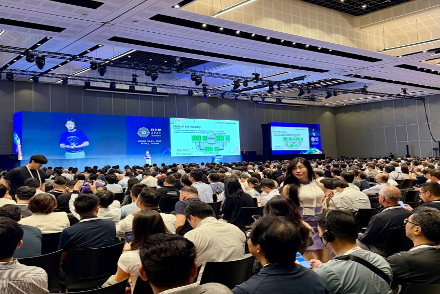
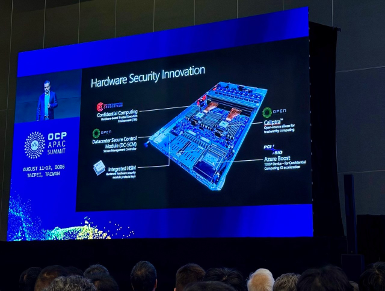
IOActive recently attended the 2026 OCP APAC Summit in Taipei. Below are our key takeaways from two days with the Open Compute community, along with a short recap video from the show floor at the end of this post.
Key Takeaways
The 2026 OCP APAC Summit (August 11–12) drew hyperscalers, semiconductor companies, device manufacturers, and infrastructure providers under the theme “Leading the Future of AI.”
AI security conversations extended beyond compute performance to the full stack: networking, cooling, storage, power, firmware, and the security controls underneath all of it.
Openness was a recurring theme, anchored by a dedicated SONiC Workshop on the open-source network operating system.
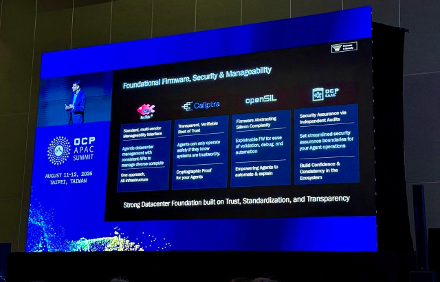
Multiple talks and vendor conversations pointed to growing interest in OCP S.A.F.E., the framework for independent security review of device firmware.
IOActive helped develop OCP S.A.F.E. from its early stages and continues to evaluate firmware security for device manufacturers today.
AI in the Agentic Era
AI was naturally at the center of this year’s summit, but the conversation went well past GPUs and raw compute performance.
The future of AI depends as much on trustworthy infrastructure as it does on faster accelerators and larger clusters. That means thinking about security across the whole stack, from applications and operating systems down to the firmware and hardware controlling the physical devices.
Open Data Centers and Open Networking
Openness was the other constant. The Open Compute Project’s philosophy of open hardware specifications, interoperable architectures, open firmware increasingly extends to networking, and the summit’s dedicated SONiC Workshop was a good example. SONiC, the open-source network operating system, brought together developers, users, maintainers, and vendors to compare notes on real-world deployments.
The direction of travel is toward data centers built from a diverse ecosystem of components rather than a single vertically integrated platform. That shift raises a practical question for operators: as devices and firmware arrive from a wider set of suppliers, how do you know they were built securely?
OCP S.A.F.E. and the Case for Independent Security Review
That question was the throughline of many of our conversations at the summit. Multiple technical talks and device-vendor discussions pointed to growing interest in OCP S.A.F.E., which lets vendors have their products evaluated by independent security reviewers against an established methodology.
For manufacturers, that’s more than a compliance checkbox. An independent review can surface vulnerabilities in firmware and other security-critical components before devices ship at scale, and it gives customers a concrete basis for confidence in what they’re deploying. As the supply chain behind any given rack grows more diverse, security assurance needs to travel with it.
IOActive has been involved in developing the OCP S.A.F.E. framework since its early stages, and we continue to work with device manufacturers on firmware and security assessments across the infrastructure being deployed today.
Taipei as a Meeting Point
Taipei was a fitting location for these conversations. Taiwan sits at the center of the global technology supply chain, home to a dense concentration of semiconductor companies, server manufacturers, ODMs, component suppliers, and firmware developers—much of the ecosystem responsible for the infrastructure data centers worldwide run on.
The summit itself made room for those conversations to happen: networking lounges, meeting areas, and coffee stations throughout the venue, lunch on-site, and reception drinks in the Expo Hall on the first evening. Live translation kept the technical sessions accessible to an international audience.
If you’re a device vendor preparing for OCP S.A.F.E. or looking to strengthen your firmware’s security, contact IOActive. Our team supports OCP S.A.F.E. assessments and independent firmware source-code security reviews.
Watch Our OCP APAC Summit Recap
Want to see the event from the show floor? We captured some of the technologies, conversations, and demonstrations from our time at the 2026 OCP APAC Summit in Taipei.
“Cybersecurity assessment providers should be compared by the depth and relevance of their testing, not simply by the number of assessments they offer.” – IOActive Security Team
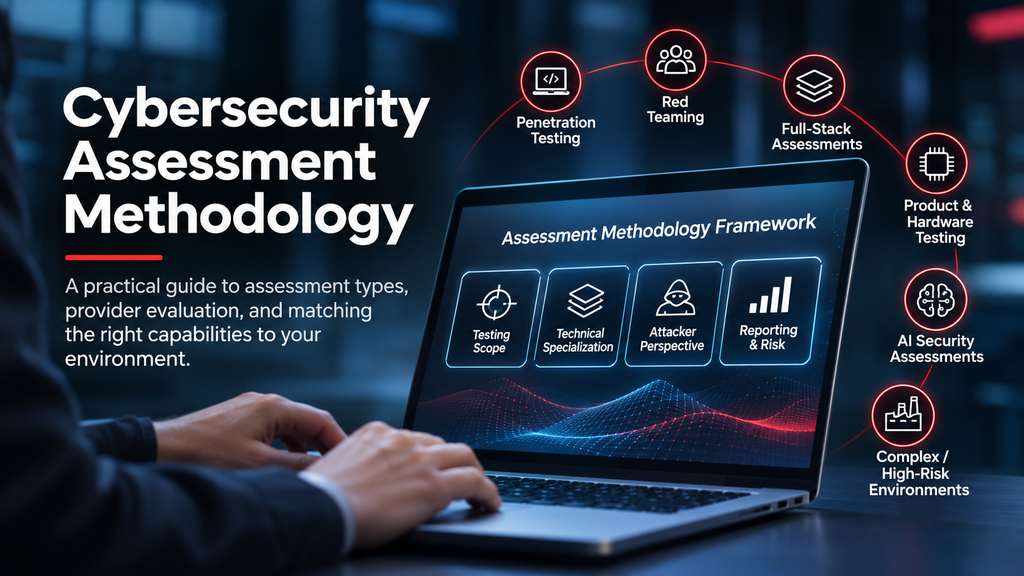
Not all security assessments are built the same, and neither are the providers that deliver them. For enterprise security teams evaluating external partners, it’s essential to examine each partners’ cybersecurity assessment methodology: what gets tested, how it is tested, and whether the approach reflects how real attackers actually operate. This piece covers the major assessment types available to enterprise organizations, the criteria that separate higher-capability providers from lower ones, and a structured framework for matching your environment to the right approach.
Types of Cybersecurity Assessments
Not every organization needs the same type of assessment. Understanding what each engagement involves, including what to look for in a provider’s approach to executing it, is the first step in evaluating whether a firm’s methodology fits your actual security needs.
Cybersecurity Assessment Types
Assessment Type
Primary Purpose
Best Fit For
Penetration Testing
Identify and exploit vulnerabilities within a defined scope
Compliance mandates, foundational control validation
Red Team Exercises
Simulate targeted adversaries pursuing real objectives
Organizations with mature controls and an active SOC
Full-Stack Assessments
Test the entire technology stack from silicon to cloud
Complex, multi-layer enterprise environments
AI Security Assessments
Target AI/ML-specific attack surfaces and infrastructure
Organizations integrating AI into critical systems
Product and Hardware Testing
Assess physical devices, firmware, and silicon
Device manufacturers, IoT and OT deployments
Code Review and Reverse Engineering
Surface vulnerabilities at source-code and binary levels
Software development lifecycle, acquired or legacy code
Collaborative red/blue testing for detection improvement
Teams ready to operationalize red team findings
The sections below define each assessment type and explain what to look for in a provider’s methodology when executing each one.
Penetration Testing
What it is: A time-boxed, authorized engagement in which ethical hackers identify and exploit vulnerabilities across a defined set of systems, applications, or networks.
What it does: Finds exploitable weaknesses, demonstrates real-world impact, and delivers remediation guidance tied to specific findings.
When to use: Most valuable for meeting compliance mandates (PCI DSS, HIPAA, SOC 2 Type II) or validating foundational security controls.
What to look for in a provider: Manual exploitation performed alongside automated scanning, not in place of it. Consultants capable of chaining multi-step attack sequences, not just cataloging isolated findings. Remediation guidance sequenced by exploitability and business impact, not solely by CVSS score.
Red Team Exercises
What it is: A covert engagement that simulates targeted adversaries pursuing specific objectives, using the same tactics, techniques, and procedures (TTPs) as real-world threat actors.
What it does: Generates realistic data on detection timelines and incident response effectiveness, testing people, processes, and technology together rather than in isolation.
When to use: Most valuable when foundational controls are already in place and an organization needs to know whether its security operations can detect and contain a sophisticated, motivated attacker.
What to look for in a provider: Defined engagement objectives tied to your organization’s actual crown jewels. Threat actor TTPs specific to your industry and threat landscape, not generic attack playbooks. Documented experience conducting covert operations against mature security teams.
Full-Stack Assessments
What it is: An engagement extending beyond application and network layers to examine the entire technology stack, from silicon, firmware, and embedded systems through software, cloud environments, and organizational processes.
What it does: Surfaces vulnerabilities that exist across layer boundaries and cannot be found when components are tested in isolation.
When to use: Most valuable for organizations whose risk environment spans hardware, software, and cloud infrastructure, or where a single compromise could cascade across multiple layers.
What to look for in a provider: Verifiable technical expertise at every layer of the stack. Dedicated physical labs for hardware and embedded device testing. A methodology that integrates silicon, firmware, application, and cloud assessment into a unified risk picture rather than a series of disconnected engagements.
AI Security Assessments
What it is: An engagement targeting the attack surfaces introduced by AI and machine learning systems, including adversarial inputs, prompt injection, model extraction, data poisoning, and compromised training pipelines.
What it does: Identifies vulnerabilities in AI/ML infrastructure that standard penetration testing frameworks do not address.
When to use: Most valuable for organizations integrating AI into critical systems, customer-facing products, or consequential decision-making workflows.
What to look for in a provider: Specific technical familiarity with ML architecture, LLM systems, and AI infrastructure, not general offensive security experience reapplied to an AI context. Testing that reaches the model layer, not only the surrounding application interface.
Product and Hardware Security Testing
What it is: An examination of the physical and logical security of connected devices, embedded systems, firmware, and silicon, including side-channel analysis, fault injection, reverse engineering of proprietary protocols, and cryptographic implementation review at the hardware level.
What it does: Identifies vulnerabilities below the software layer that application and network testing cannot detect.
When to use: Critical for device manufacturers, industrial equipment providers, and organizations deploying connected hardware at scale.
What to look for in a provider: A dedicated physical hardware lab. Documented experience with embedded system analysis and silicon-level techniques, including fault injection and side-channel attacks. A testing methodology covering hardware, firmware, and protocol layers together, rather than firmware in isolation.
Code Review and Reverse Engineering
What it is: A deep examination of software security at the source-code and binary levels, surfacing business logic flaws, implementation errors, and vulnerabilities in proprietary or legacy code that automated tools miss.
What it does: Provides visibility into software defects invisible to dynamic testing approaches.
When to use: Most valuable during software development lifecycles, before major product releases, or when evaluating acquired or third-party code.
What to look for in a provider: Reviewers with development backgrounds capable of identifying logic flaws alongside security vulnerabilities. Language and platform coverage relevant to your codebase. A methodology combining automated analysis with intensive manual review rather than relying on either alone.
Critical Infrastructure / OT Testing
What it is: Security assessment of industrial control systems (ICS), SCADA environments, and operational technology (OT) networks. These environments operate under constraints that standard IT security methodology cannot accommodate: proprietary protocols, extreme availability requirements, and physical safety implications.
What it does: Identifies vulnerabilities in OT/ICS environments without disrupting live operations.
When to use: Essential for organizations in energy, utilities, manufacturing, water systems, and other sectors where digital and physical systems converge.
What to look for in a provider: Sector-specific OT/ICS expertise, not IT security methodology adapted to an OT context. A testing approach designed for operational continuity constraints. Documented experience conducting assessments in live environments where testing itself carries operational risk. A 2024 CISA red team assessment of a U.S. critical infrastructure organization found simulated attackers went undetected for months, underscoring the gap between generic assessment methodology and the specialized expertise these environments require.
Purple Team Exercises
What it is: A collaborative engagement pairing red team offensive expertise with an organization’s own security team, focused on real-time detection rule tuning, playbook validation, and skills transfer between attacker and defender.
What it does: Improves detection and response capability directly, rather than documenting gaps for a team to address independently.
When to use: Most valuable for security teams that have completed initial red team engagements and want to operationalize findings in a collaborative format.
What to look for in a provider: Consultants capable of operating in both attacker and advisor roles simultaneously. A structured methodology for real-time feedback and control validation, not a loosely coordinated simulation.
Key Criteria for Evaluating Cybersecurity Assessment Methodology
The assessment type defines what gets tested. The methodology defines how, and this is where provider capability differences become most consequential. These six criteria help distinguish providers whose testing delivers genuine security insight from those whose engagements produce reports without materially improving security posture.
Assessment Scope and Technical Specialization
Most security firms assess network and application layers. Far fewer can credibly test hardware, silicon, embedded firmware, AI systems, or OT environments. A provider may list broad services without maintaining the specialized expertise to execute them.
Look for:
A dedicated physical lab for embedded device and hardware testing
Documented capability for silicon-level testing, including side-channel analysis and fault injection
AI security testing that reaches the model layer, not just the application interface
Sector-specific references for OT/ICS environments
Provider Scope Coverage by Capability Level
Scope Layer
Standard Provider
High-Capability Provider
Application and Network
Yes
Yes
Cloud Environments
Sometimes
Yes
Embedded / IoT Devices
Rarely
Yes
Hardware / Silicon
Rarely
Yes: dedicated physical lab required
AI/ML Systems
Rarely
Yes: with dedicated AI expertise
OT / ICS
Rarely
Yes: specialized sector knowledge required
The gap between standard and high-capability providers widens significantly below the application layer. For organizations whose risk environment includes hardware, AI, or OT systems, scope coverage and technical specialization are the threshold criteria, not price or brand recognition.
Testing Methodology: Attacker-Driven vs. Checklist-Driven
There is a meaningful difference between providers who work through a checklist of known vulnerability categories and providers who approach testing with the mindset of an actual adversary. The latter requires consultants who can chain vulnerabilities across layers, reason about attacker objectives, and adapt in real time.
Look for:
Manual exploitation is performed alongside automated tooling, not replaced by it
Demonstrated ability to chain multi-step vulnerabilities across components
Threat actor TTPs specific to your industry, not generic attack frameworks
Engagement objectives tied to your organization’s actual crown jewels
Vulnerability Research Capability
The highest-capability providers generate original vulnerability research rather than relying exclusively on public CVE databases and commercial tooling. Firms with active research programs bring a more current understanding of attack surfaces, including weaknesses not yet publicly disclosed.
Look for:
Published CVEs attributed directly to the provider’s research team
Peer-reviewed technical research or presentations at Black Hat, DEF CON, or IEEE S&P
Publicly documented discoveries in hardware, AI, automotive, industrial, or other specialized domains
A research function that feeds directly into assessment methodology
Reporting Quality and Risk Translation
A rigorous assessment methodology produces findings that drive decisions, not simply findings that document vulnerabilities. Enterprise security teams and executive stakeholders need reports that prioritize risk in business terms.
Look for:
Findings mapped to business impact, not only to technical severity scores
Remediation guidance that is specific, practical, and sequenced by risk priority
Findings contextualized to the organization’s actual environment, not offered generically
Metrics supporting ongoing measurement: detection timelines, mean-time-to-compromise, and control coverage gaps
Environment Complexity Fit
For organizations running conventional enterprise IT, environment fit is rarely the differentiating factor. For organizations in regulated industries, manufacturing, energy, defense, or sectors where physical and digital systems converge, it is often the deciding one.
Look for:
References from engagements in your sector
A stated methodology for testing within operational continuity constraints
Documented experience in environments where the testing itself introduces operational risk
All six criteria above feed directly into the selection framework below: assessment scope, testing methodology, technical specialization, vulnerability research capability, reporting quality, and environment complexity fit.
A Framework for Selecting the Right Cybersecurity Assessment Provider
Provider Selection Framework: Seven Steps to the Right Fit
Step
Question to Answer
What to Look For
1. Define what you’re protecting
What are your organization’s crown jewels, and where do they live?
Environments may span IT, OT, hardware, cloud, and AI
2. Identify the assessment type
What question does this engagement need to answer?
Compliance gap? Detection readiness? Hardware risk? AI exposure?
3. Evaluate scope coverage
Can the provider credibly assess every relevant layer?
Documented capability, not listed services
4. Assess testing methodology
Does the provider test with genuine attacker perspective?
Matching Provider Capability to Organizational Maturity
Organizational maturity also shapes which type of engagement makes sense. Security programs early in their development benefit most from penetration testing and code review. Programs with mature controls and functioning SOCs get more from red team exercises, purple team exercises, and adversarial simulation. Providers capable of operating across that full maturity range, and advising on which engagement fits the current stage, offer more strategic value than specialists limited to a single methodology.
When Standard IT Methodology Is Not Enough
For organizations whose environments extend to hardware, AI systems, embedded devices, or critical infrastructure, Steps 3, 5, and 7 carry the most weight. The provider pool narrows significantly once the risk environment extends beyond conventional IT. The right partner combines offensive testing expertise with active vulnerability research, physical lab capability, and documented experience in complex environments.
Evaluate a Provider’s Cybersecurity Assessment Methodology Before Signing a Statement of Work
Understanding the depth and rigor of a provider’s cybersecurity assessment methodology is a more reliable guide than reviewing their service catalog.
IOActive has spent over 25 years conducting assessments across the full technology stack, from silicon and embedded hardware to software, AI systems, and critical infrastructure, backed by a research team with a documented record of original vulnerability discovery. If your organization’s environment extends beyond conventional IT,contact IOActiveto discuss an assessment approach matched to your actual attack surface.
“The right cybersecurity provider should be evaluated on the depth of problems they can uncover, the environments they can test, and the expertise behind their findings.” – IOActive Security Team
When you evaluate a cybersecurity provider, the right partner should help you answer a specific security question with evidence you can act on. A long service list is not enough. The provider should also be able to test the systems, attack paths, and business risks that matter to your company.
This article focuses on providers that run independent security tests and attack-led work. That includes penetration testing, red teaming, product and hardware security testing, AI/ML security testing, and full-stack assessments. If you are choosing an MDR, SOC, or managed security provider, also review monitoring, response, and service levels. Those managed-service needs are outside this guide.
Start with the decision that the engagement must support. Then compare the method, team skill, proof, reporting, and ability to test beyond compliance.
The Five-Step Evaluation Path
Define the security question. State what decision the assessment must support.
Choose the assessment method. Match the method to the asset, threat, and desired outcome.
Match the provider to the engagement. Look for experience at the technology layer and risk level involved.
Test the quality of the findings. Confirm that the report explains evidence, impact, root cause, and priorities.
Validate research and independence. Look for current skills, clear briefings, and work beyond compliance.
Use the table below as a quick screen during the buying process. Good signs show a strong lead. Warning signs show what to resolve before you shortlist a provider.
Cybersecurity Provider Evaluation Checklist
Step
What to check
Question to ask
Good signs
Warning signs
1
Scope fit
What decision will the test support?
Clear assets, attack paths, limits, and goals
A generic scope with no clear outcome
2
Technical depth
Can the team work beyond tools?
Manual work, custom tests, and proven attack paths
A scan report presented as the full test
3
Engagement fit
Has the team handled these systems and threats?
Work on similar systems and risks
Generic case studies or one method for all clients
4
Finding quality
Can our teams check and rank the results?
Steps to repeat, impact, cause, and fix guidance
Long issue lists with little detail
5
Provider depth
Does the team research and explain clearly?
Relevant research, clear briefings, and stated limits
Broad claims backed only by logos or badges
Step 1: Define the Security Question Your Assessment Must Answer
“We need a penetration test” is not a clear need. It may mean a public app, a cloud system, a product before launch, or a path to a key asset.
Write the decision first. You may need to launch a product, fund a fix, test response, accept a risk, or meet a customer need.
Give each provider the same facts:
The assets and systems in scope.
The likely attackers or abuse cases.
The attack paths or trust boundaries that matter.
The testing limits, dependencies, and rules of the test.
The business decision must support the results.
A strong provider should restate your question in its scope. If the scope lists tasks but not the decisions they inform, ask for a rewrite.
If your decision is…
Your scope should clarify…
Launch a product
Which product layers, interfaces, and abuse cases could affect release risk
Reduce attack surface
Which assets, entry points, and chained attack paths need testing
Improve detection and response
Which realistic attacker actions must defenders detect and contain
Prioritize remediation
How results will be ranked by ease of attack, impact, and business cost
Support risk acceptance
Which residual risks remain after testing and what evidence supports acceptance
Step 2: Choose an Assessment Method That Fits the Goal
Once the question is clear, pick the method that can answer it. Do not ask every provider for the same output. Ask what each method does and what proof it should produce.
Assessment element
Use it for
What to look for
Threat modeling (method)
Finding likely attack paths before testing
Named assets, actors, entry points, trust boundaries, and goals
Manual review (method)
Finding design, code, setup, and logic flaws that tools may miss
Analyst notes, test steps, and custom test examples
Attack-path testing (method)
Showing how flaws can combine into real impact
A chained attack example with limits and key facts
Technical evidence (output)
Letting teams check that a finding is real
Steps to repeat, affected parts, logs, images, or code notes
Risk ranking (decision aid)
Helping leaders decide what to fix first
Business impact, ease of attack, links, and a clear work order
Retesting (follow-up)
Checking whether fixes reduce the risk
Clear close rules, retest scope, and open issue steps
The label matters less than the proof. A good plan explains why the method fits, what it will not cover, and how the result will guide the next choice.
Step 3: Match the Provider to the Engagement
A provider that fits one engagement may not fit another. Use the goal, likely attacker, system layer, and cost of failure to choose the right team.
Goal
Best-fit provider type
Skills to value
Evidence to review
Test an application or network
Penetration testing provider
Manual attacks, path tests, and real impact checks
Sample finding, test scope, and work on similar systems
Test detection and response
Red team or purple team provider
Threat-led exercises for prevention, detection, response, and recovery
Model, data, prompt, API, pipeline, system, and access-rule tests
AI test cases, threat model, and test plan
Find systemic risk
Full-stack assessment provider
Coverage across systems, people, process, supply chain, and business impact
Full-stack plan, team skills, and joint results
These provider types can overlap. A product review may include penetration testing, code review, hardware testing, and AI testing. Ask who will do each part and who will combine the results into one risk view.
Step 4: Test the Quality of the Findings and Delivery
A strong assessment helps only when your teams can understand, check, and rank the results. Before signing, request a sample report with sensitive data removed. Use these four questions to judge the provider’s work.
Can we verify what was tested and found?
The report should name the asset, test condition, behavior, and proof. A severity label is not enough. Ask if an engineer could repeat the issue from the report alone.
Do we understand the impact and root cause?
A useful finding links the weakness to a business result. It also explains the cause, such as a design choice, a missing control, an unsafe default, or a process gap. This helps stop repeat issues.
Do we know what to fix first?
The provider should separate urgent exposure from lower-priority hardening. Look for rankings based on ease of attack, affected assets, path position, business impact, and links. Ask how moderate issues combine into a serious path.
Can leaders and engineers use the result?
Executives need a short view of risk, impact, and choices. Engineers need enough detail to check and fix each issue. Ask who presents the results, whether work sessions are included, and how disputes about severity are handled.
Step 5: Validate Research, Independence, and Work Beyond Compliance
After reviewing the sample report, assess the provider itself. Research can show how a team studies new systems. It should relate to your setup and be clear, not hyped.
Look for:
Research related to your systems, threats, or industry.
Examples that show how the team found an issue.
Clear rules for disclosure and client data.
Direct answers about methods, limits, and staff.
Evidence that hard findings are reported clearly.
Certifications and compliance work can help. They should support, not replace, proof of deep skill. Compliance checks a stated rule. Security testing asks if an attacker can bypass it or reach something important.
Ask Four Questions Beyond Compliance
Use compliance testing as a base, then ask these four paired questions. Each one connects an audit check to the security outcome an enterprise buyer actually needs.
1. Did the control meet the stated rule, and can an attacker bypass it?
A control can satisfy a written requirement and still fail under attack. Ask the provider to test bypasses, abuse cases, and paths around the control, not only whether the control is present.
2. Was the approved setting present, and does it work under attack?
A configuration review confirms what was set. Security testing checks whether the setting holds when an attacker probes, misuses, or tries to evade it.
3. Was the component included in scope, and can it create a path to a critical asset?
Scope coverage does not show how a component connects to the rest of the environment. Ask the provider to assess trust boundaries, dependencies, and attack paths into high-value systems.
4. Did the test produce audit evidence, and did it reveal meaningful business impact?
Audit evidence can show that a test occurred. A security assessment should also explain what an attacker could do, which business processes could be affected, and what to fix first.
How IOActive Fits This Evaluation Framework
IOActive’s public service pages show examples across these provider types:
Penetration testing: Mobile apps, infrastructure, wireless, cloud, embedded devices, and web services.
These skills matter when you need more than a scan or compliance review. The same rules still apply: define the decision, confirm the method, review the proof, and check that your team can act on the result.
Choose a Provider That Can Answer Your Security Question
To evaluate a cybersecurity provider, start with the decision you need to make. Then compare methods, team skill, provider fit, proof, communication, research, and work beyond compliance. The right partner can test your real risk and turn the result into a clear next step.
Inside the IOActive Silicon Lab: Interpreting Images
By
Andrew Zonenberg
In the post “Reading CMOS layout,” we discussed understanding CMOS layout in order to reverse-engineer photographs of a circuit to a transistor-level schematic. This was all well and good, but I glossed over an important (and often overlooked) part of the process: using the photos to observe and understand the circuit’s actual geometry.
Optical Microscopy
Let’s start with brightfield optical microscope imagery. (Darkfield microscopy is rarely used for semiconductor work.) Although reading lower metal layers on modern deep-submicron processes does usually require electron microscopy, optical microscopes still have their place in the reverse engineer’s toolbox. They are much easier to set up and run quickly, have a wider field of view at low magnifications, need less sophisticated sample preparation, and provide real-time full-color imagery. An optical microscope can also see through glass insulators, allowing inspection of some underlying structures without needing to deprocess the device.
This can be both a blessing and a curse. If you can see underlying structures in upper-layer images, it can be much easier to align views of different layers. But it can also be much harder to tell what you’re actually looking at! Luckily, another effect comes to the rescue – depth of field.
Depth of field
When using an objective with 40x power or higher, a typical optical microscope has a useful focal plane of less than 1 µm. This means that it is critical to keep the sample stage extremely flat – a slope of only 100 nm per mm (0.005 degrees) can result in one side of a 10x10mm die being in razor-sharp focus while the other side is blurred beyond recognition.
In the image below (from a Micrel KSZ9021RN gigabit Ethernet PHY) the top layer is in sharp focus but all of the features below are blurred—the deeper the layer, the less easy it is to see.
We as reverse engineers can use this to our advantage. By sweeping the focus up or down, we can get a qualitative feel for which wires are above, below, or on the same layer as other wires. Although it can be useful in still photos, the effect is most intuitively understood when looking through the eyepiece and adjusting the focus knob by hand. Compare the previous image to this one, with the focal plane shifted to one of the lower metal layers.
I also find that it’s sometimes beneficial to image a multi-layer IC using a higher magnification than strictly necessary, in order to deliberately limit the depth of field and blur out other wiring layers. This can provide a cleaner, more easily understood image, even if the additional resolution isn’t necessary.
Color
Another important piece of information the optical microscope provides is color.The color of a feature under an optical microscope is typically dependent on three factors:
Material color
Orientation of the surface relative to incident light
Thickness of the glass/transparent material over it
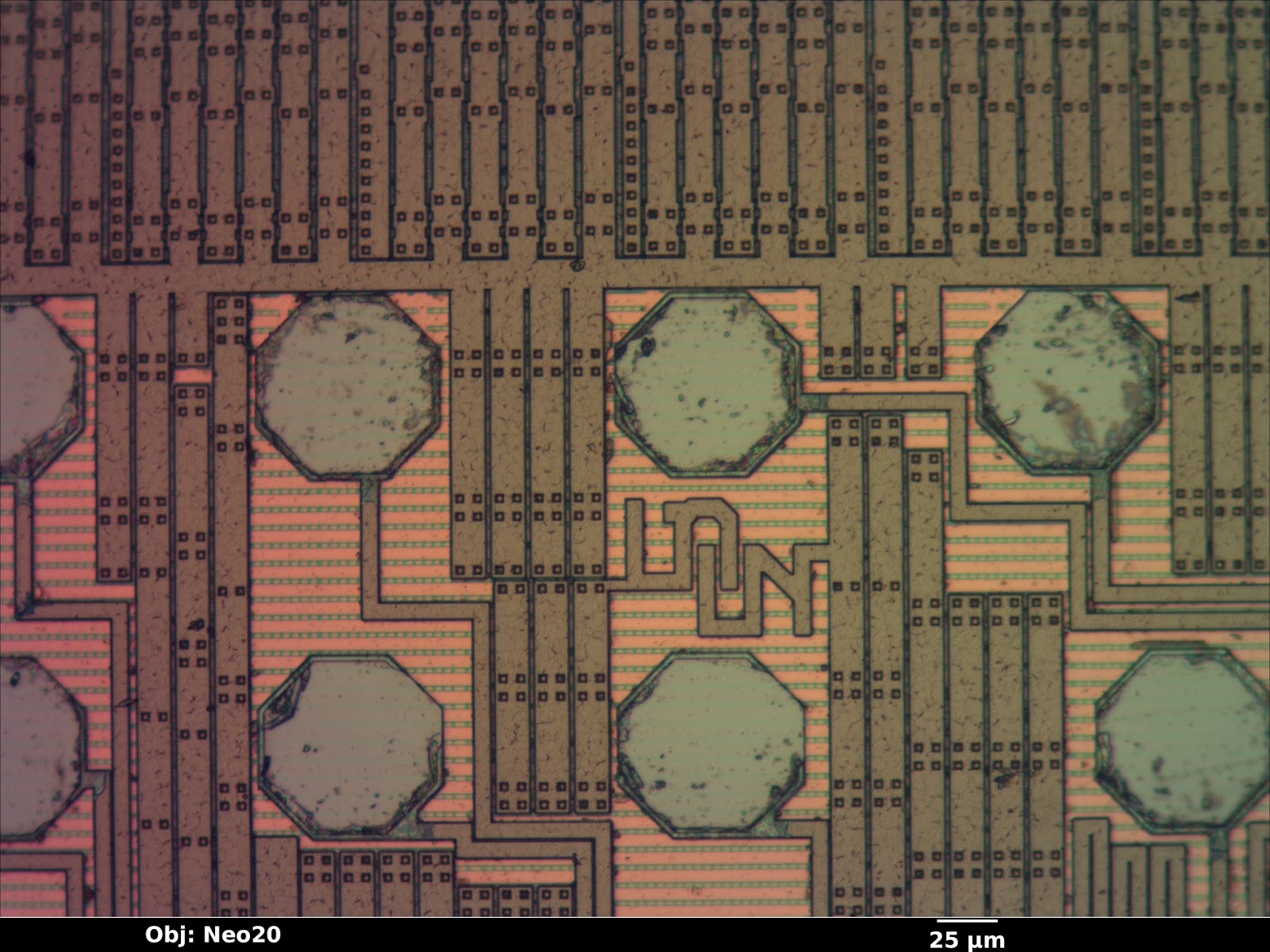
Material color is the easiest to understand. A flat, smooth surface of a substance with nothing on top will have the same color as the bulk material. The octagonal bond pads in the image below (a Xilinx XC3S50A FPGA), for example, are made of bare aluminum and show up as a smooth silvery color, just as one would expect. Unfortunately, most materials used in integrated circuits are either silvery (silicon, polysilicon, aluminum, tungsten) or clear (silicon dioxide or nitride). Copper is the lone exception.
Orientation is another factor to consider. If a feature is tilted relative to the incident light, it will be less brightly lit. The dark squares in the image below are vias in the upper metal layer which go down to the next layer; the “sag” in the top layer is not filled in this process so the resulting slopes show up as darker. This makes topography visible on an otherwise featureless surface.
The third property affecting observed color of a feature is the glass thickness above it. When light hits a reflective surface under a transparent, reflective surface, some of the beam bounces off the lower surface and some bounces off the top of the glass. The two beams interfere with each other, producing constructive and destructive interference at wavelengths equal to multiples of the glass thickness.
This is the same effect responsible for the colors seen in a film of oil floating on a puddle of water–the reflections from the oil’s surface and the oil-water interface interfere. Since the oil film is not exactly the same thickness across the entire puddle, the observed colors vary slightly. In the image above, the clear silicon nitride passivation is uniform in thickness, so the top layer wiring (aluminum, mostly for power distribution) shows up as a uniform tannish color. The next layer down has more glass over it and shows up as a slightly different pink color.
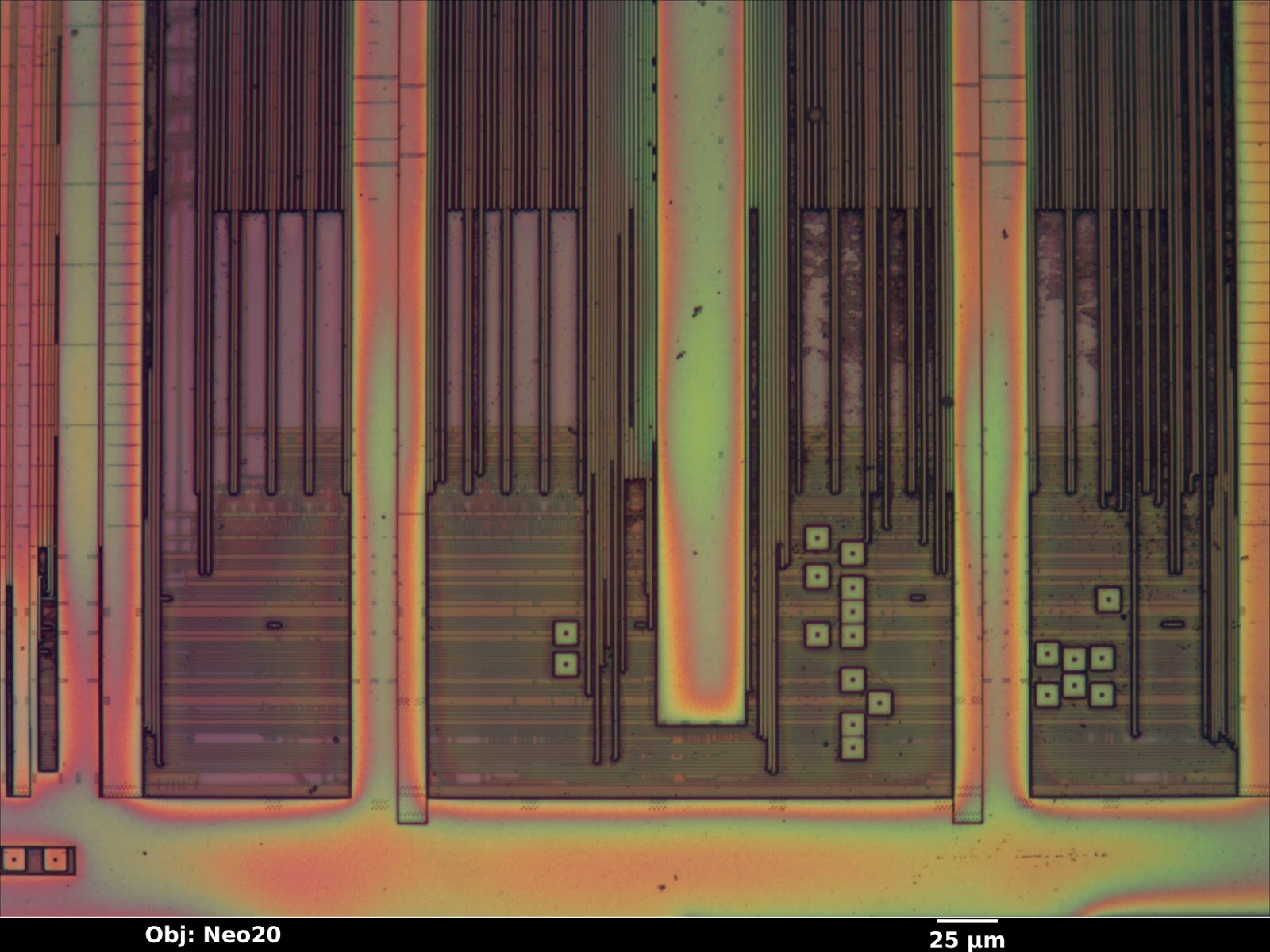
Compare that to the image below (an Altera EPM3064A CPLD). The thickness of the top passivation layer varies significantly across the die surface, resulting in rainbow-colored fringes.
Electron Microscopy
The scanning electron microscope is the preferred tool for imaging finer pitch features (below about 250 nm). Due to the smaller wavelength of electron beams as compared to visible light, this tool can obtain significantly higher resolutions.
The basic operating principle of a SEM is similar to an old-fashioned CRT display: electromagnets move a beam of electrons in a vacuum chamber in a raster-scan pattern over the sample. At each pixel, the beam interacts with the sample, producing several forms of radiation that the microscope can detect and use for imaging.
Electron microscopy in general has an extremely high depth of field, making it very useful for imaging 3D structures. The image below (copper bond wires on a Microchip PIC12F683) has about the same field of view as the optical images from the beginning of this article, but even from a tilted perspective the entire loop of wire is in sharp focus.
Secondary Electron Images
The most common general-purpose image detector for the SEM is the secondary electron detector. When a high-energy electron from the scanning beam grazes an atom in the sample, it sometimes dislodges an electron from the outer shell. Secondary electrons have very low energy, and will slow to a stop after traveling a fairly short distance. As a result, only those generated very near the surface of the sample will escape and be detected.
This makes secondary electron images very sensitive to topography. Outside edges, tilted surfaces, and small point features (dust and particulates) show up brighter than a flat surface because a high percentage of the secondary electrons are generated near exposed surfaces of the specimen. Inward-facing edges show up dimmer than a flat surface because a high percentage of the secondary electrons are absorbed in the material.
The general appearance of a secondary electron image is similar to a surface lit up with a floodlight. The eye position is that of the objective lens, and the “light source” appears to come from the position of the secondary electron detector.
In the image below (the polysilicon layer of a Microchip PIC12F683 before cleaning), the polysilicon word lines running horizontally across the memory array have bright edges, which shows that they are raised above the background. The diamond-shaped source/drain areas have dark “shadowed” edges, showing that they are lower than their surroundings (and thus many of the secondary electrons are being absorbed). The dust particles and loose tungsten via plugs scattered around the image show up very brightly because they have so much exposed surface area.
Compare the above SEM view to the optical image of the same area below. Note that the SEM image has much higher resolution, but the optical image reveals (through color changes) thickness variations in the glass layer that are not obvious in the SEM. This can be very helpful when trying to gauge progress or uniformity of an etch/polish operation.
In addition to the primary contrast mechanism discussed above, the efficiency of secondary electron emission is weakly dependent on the elemental composition of the material being observed. For example, at 20 kV the number of secondary electrons produced for a given beam current is about four times higher for tungsten than for silicon (see this paper). While this may lead to some visible contrast in a secondary electron image, if elemental information is desired, it would be preferable to use a less topography-sensitive imaging mode.
Backscattered Electron Images
Secondary electron imaging does not work well on flat specimens, such as a die that has been polished to remove upper metal layers or a cross section. Although it’s often possible to etch such a sample to produce topography for imaging in secondary electron mode, it’s usually easier to image the flat sample using backscatter mode.
When a high-energy beam electron directly impacts the nucleus of an atom in the sample, it will bounce back at high speed in the approximate direction it came from. The probability of such a “backscatter” event happening depends on the atomic number Z of the material being imaged. Since backscatters are very energetic, the surrounding material does not easily absorb them. As a result, the appearance of the resulting image is not significantly influenced by topography and contrast is primarily dependent on material (Z-contrast).
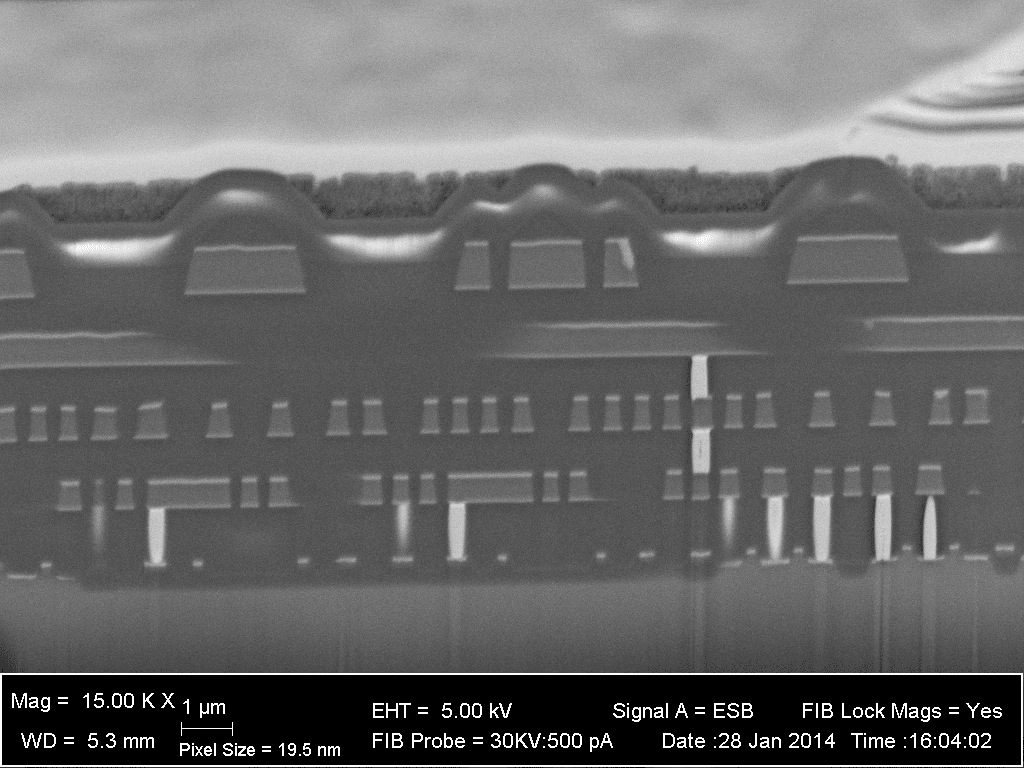
In the image below (cross section of a Xilinx XC2C32A CPLD), the silicon substrate (bottom, Z=14) shows up as a medium gray. The silicon dioxide insulator between the wires is darker due to the lower average atomic number (Z=8 for oxygen). The aluminum wires (Z=13) are about the same color as the silicon, but the titanium barrier layer (Z=22) above and below is significantly brighter. The tungsten vias (Z=74) are extremely bright white. Looking at the bottom right where the via plugs touch the silicon, a thin layer of cobalt (Z=27) silicide is visible.
Depending on the device you are analyzing, any or all of these three imaging techniques may be useful. Knowledge of the pros and cons of these techniques and the ability to interpret their results are key skills for the semiconductor reverse engineer.