INSIGHTS | November 5, 2026

Cybersecurity Trends 2027: Risks Reshaping Security

Cybersecurity Trends 2027: Risks Reshaping Security

Key Takeaways

  • AI will expand security exposure through speed, scale, data access, and automated action. Its use requires clear operating boundaries.
  • Connected technologies will extend enterprise exposure through IoT, IIoT, OT, edge systems, cellular modems, and supplier-managed access.
  • Critical infrastructure security will be measured through continuity, safety, recovery time, and the ability to maintain trusted operations.
  • Offensive security will test whether controls perform across realistic attack paths, detection events, response decisions, and recovery actions.
  • Supply chain risk will require evidence across software, hardware, firmware, data, cloud services, and specialist providers.

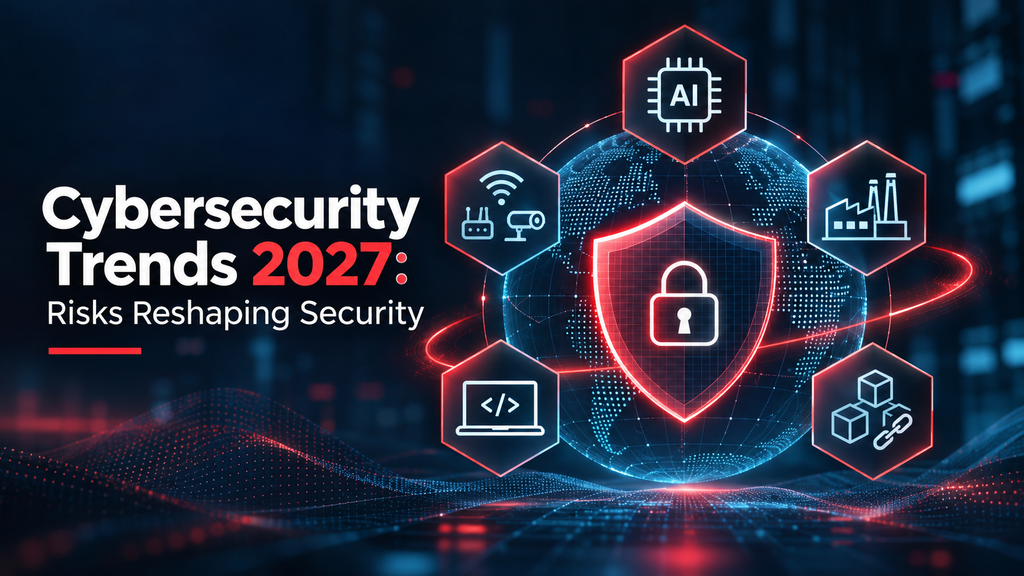
Five shifts will define cybersecurity trends 2027: bounded AI, connected technologies, critical infrastructure exposure, offensive validation, and supply chain risk. Recent CISA alerts put those shifts in operational terms. In July 2026, CISA warned that threat actors were targeting internet-exposed programmable logic controllers in water systems. In August, a related advisory described actors using AI-generated exploitation scripts against exposed PLCs.

These incidents show why 2027 planning must connect emerging technology to evidence about real-world exposure. A joint Five Eyes statement warns that frontier AI is changing cyber risk on a timeline measured in months, not years. The following sections examine the five shifts most likely to affect enterprise exposure and the planning questions security leaders should use for 2027.

TrendWhere exposure is movingPlanning changes for 2027Priority validation question
Bounded AIModels, agents, data, tool access, and deployment pipelinesDefine permitted actions, data boundaries, human review, and rollback pathsCan the system fail safely when inputs, permissions, or model behavior change?
Connected technologiesIoT, IIoT, OT, edge systems, cellular modems, and supplier-managed accessMaintain an accurate external exposure register and secure remote accessWhich assets are reachable, who can reach them, and what can they change?
Critical infrastructureOperational systems with safety, uptime, and public-service consequencesLink cyber risk to continuity plans, engineering constraints, and recovery timeWhat is the operational consequence of compromise, lost visibility, or lockout?
Offensive securityIdentity, cloud, endpoints, applications, physical access, and response processesTest realistic attack paths, detection, response, and recoveryCan defenders contain an intrusion before it reaches a critical business process?
Supply chain riskOpen-source software, firmware, silicon, cloud services, integrators, and dataDemand evidence across suppliers and lifecycle stagesWhich dependency could change the trust boundary without internal approval?

This is a categorized risk map, not a ranked list. Its purpose is to show where enterprise exposure is moving and which validation question belongs to each trend. The first priority is AI, where adoption speed can exceed assurance.

AI will remain central to the cybersecurity trends shaping 2027. The useful question is where AI can act, what it can access, how its output is verified, and how quickly a human or system can stop it.

The World Economic Forum’s Global Cybersecurity Outlook 2026 found that 87% of respondents viewed AI-related vulnerabilities as the fastest-growing cyber risk during 2025. The report also found that 64% of organizations had a process to assess AI tools before deployment. Those figures point to a control gap between adoption and assurance. In 2027, that gap is likely to matter more as organizations connect AI to sensitive data, business workflows, and automated actions.

For 2027, AI security should be governed as an engineering discipline. Security teams need threat models for model inputs, training data, retrieval sources, plugins, APIs, identities, and automated actions. They also need operational tests for degraded performance, malicious instructions, data leakage, and unsafe tool use.

AI security lens: the 2027 shift

  • Authority: By 2027, define which actions require human approval and which actions can run automatically.
  • Data: By 2027, map sensitive data into prompts, context windows, training sets, logs, and model outputs.
  • Recovery: By 2027, maintain a tested rollback path for model, prompt, policy, and integration changes.

By 2027, bounded AI should distinguish durable security controls from product hype. Teams that can define authority, data boundaries, and recovery paths will be better positioned to deploy AI without turning speed into unmanaged exposure. That shift creates a bridge to the next priority: connected technologies and the paths they create into enterprise operations.

Connected Technologies Will Turn Asset Visibility Into Resilience

The attack surface in 2027 will extend to systems that many enterprise security teams do not directly own. Cellular modems, engineering workstations, cloud control planes, embedded devices, smart facilities, and supplier-managed connections can provide entry points to high-consequence environments.

CISA’s Internet Exposure Reduction Guidance states that internet-accessible IT, IIoT, SCADA, ICS, and remote access technologies continue to grow. The guidance recommends identifying accessible systems, removing unnecessary exposure, securing necessary remote access, and reviewing exposure on a routine basis.

The broader lesson applies across industries. Asset inventories need ownership, reachability, software and firmware status, remote-access paths, and operational consequences. A vulnerability register without exposure context will struggle to rank the paths that matter most.

Connected technology lens: the 2027 shift

  • Reachability: By 2027, identify every internet-facing asset, remote-access method, and supplier-managed connection.
  • Change authority: By 2027, record who can alter configuration, credentials, logic, firmware, or network paths.
  • Consequence: By 2027, map each asset to safety, uptime, revenue, regulatory, and recovery requirements.

By 2027, exposure management will need to move from periodic discovery to a continuous view of how technology connects to operations. That means tracking reachability, change authority, and consequence as conditions change—not only when an inventory is refreshed.

Critical Infrastructure Risk Will Be Measured in Operational Consequence

Critical infrastructure operators carry security requirements that extend beyond data protection. A compromised system can affect safety, public services, production, environmental controls, or the ability to operate manually during recovery.

CISA’s July 2026 alert reported that threat actors targeting exposed PLCs had modified passwords, changed IP addresses, and caused loss of monitoring and control functionality. The alert also warned that exposed OT assets can create risks involving operational disruption and physical damage. That pattern is expected to remain relevant in 2027 as exposed OT assets, remote access, and internet-connected control systems continue to create paths into operational environments.

For 2027, security planning should connect technical controls to engineering constraints and recovery time. Leaders need to know which systems can be isolated, which processes can run manually, which backups are trusted, and which suppliers can restore affected equipment.

Critical infrastructure lens

  • Continuity: Identify the essential process that must continue during a cyber incident.
  • Safety: Map how loss of control, visibility, or configuration integrity could affect people and equipment.
  • Recovery: Test restoration procedures against actual dependencies, access requirements, and operating conditions.

This perspective gives critical infrastructure risk a measurable business context. It also creates the basis for offensive testing that reflects real operational pressure.

Offensive Security Will Test Control Performance

Security programs increasingly need evidence that controls work under pressure. A tool deployment, policy document, or completed assessment provides limited assurance when teams have not tested a realistic attack sequence.

For 2027, mature programs will connect threat intelligence to threat emulation. The shift is from periodic, point-in-time testing to scenario-based validation of identity compromise, cloud privilege escalation, lateral movement, data access, physical entry, and recovery decisions in environments that reflect the organization’s technology and operating model.

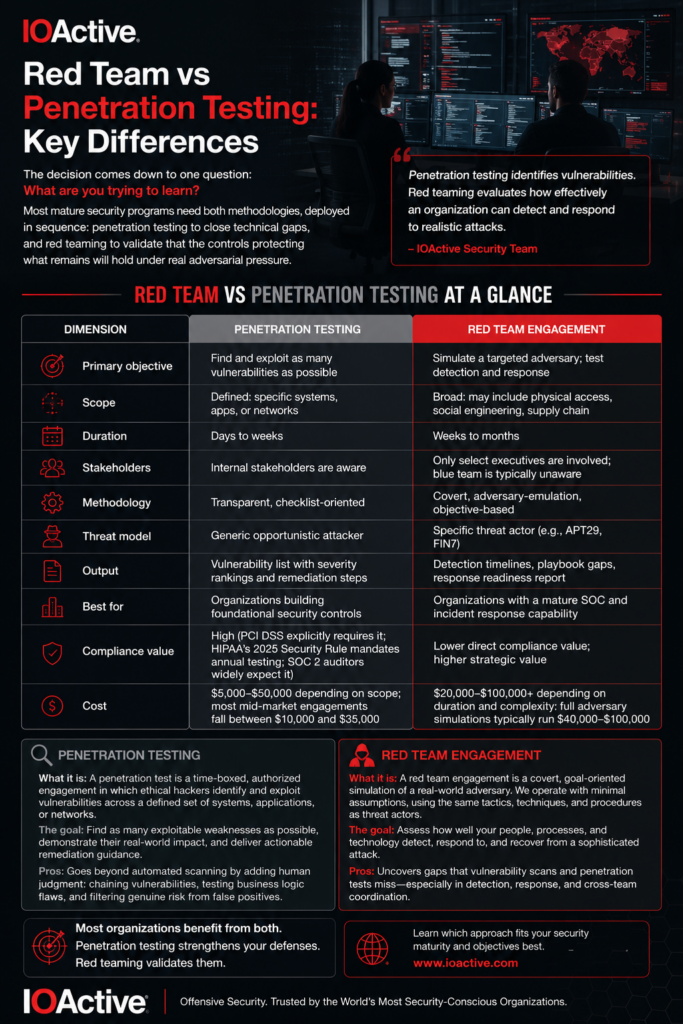
Red and purple team exercises can reveal detection gaps, response delays, authority problems, and process constraints. In 2027, those exercises will need to connect more directly to business-critical outcomes, while penetration testing continues to examine technical weaknesses across applications, infrastructure, cloud, mobile, and embedded systems.

Offensive security lens: the 2027 shift

  • Path: Can an attacker move from an exposed service to a critical business process?
  • Signal: Which attacker actions create useful telemetry, and how long does triage take?
  • Decision: Who can isolate systems, suspend access, or accept operational impact during an incident?

By 2027, security testing should function as a management instrument, producing evidence for investment, prioritization, and risk acceptance—not simply a list of technical findings.

Supply Chain Risk Will Reach Below the Application Layer

Supply chain risk will continue to expand across software, hardware, firmware, cloud services, data, and specialist providers. The World Economic Forum’s 2026 report identifies supply chain opacity and concentration as core forces shaping cyber resilience.

For 2027, third-party risk programs will need to examine how dependencies are built, updated, configured, and retired. That includes open-source packages, CI/CD runners, model repositories, semiconductor components, device firmware, managed service accounts, and the people who maintain them.

The practical test is traceability. Security leaders should know which dependencies support critical processes, which parties can change them, what evidence supports their security, and how the organization will operate if a dependency becomes unavailable or untrustworthy.

Supply chain risk lens: the 2027 shift

  • Provenance: Can the organization verify where software, firmware, data, and components originated?
  • Privilege: Which suppliers, integrators, and service accounts can change production systems?
  • Continuity: What is the tested fallback if a provider is compromised, unavailable, or subject to geopolitical disruption?

By 2027, supply chain programs will need to move beyond point-in-time reviews toward evidence of provenance, privilege, and continuity across the dependency lifecycle. The resulting program connects procurement, architecture, engineering, incident response, and executive risk decisions.

What Security Leaders Should Prepare for in 2027

A strong 2027 security strategy will be built around validation. Set a short list of high-consequence scenarios, then test the assumptions behind them. Confirm that teams can see the relevant activity, make decisions quickly, and recover without relying on undocumented expertise.

2027 readiness check

  • Evidence: Can leaders see proof that priority controls work under realistic conditions?
  • Exposure: Can teams identify reachable assets, trust paths, and high-consequence dependencies?
  • Consequence: Can the organization contain disruption and recover within its operational limits?

How IOActive Can Help Prepare for 2027

IOActive’s analysis of the Five Eyes cyber risk statement identifies practical actions for organizations looking to minimize risk in 2027: reduce attack surface, accelerate patching, address legacy systems, strengthen identity and access controls, and prepare for incidents.

A research-led security partner can extend that work across AI, software, hardware, connected technologies, and critical infrastructure. IOActive’s AI/ML Security Services assess AI systems across architecture, code, applications, devices, and infrastructure. Its Red Team and Purple Team Services examine realistic attack paths and defensive response. Its penetration testing practice applies attacker perspective across cloud, mobile, embedded, infrastructure, and web services.

Build 2027 priorities around evidence, exposure, and operational consequence. To discuss an independent assessment of emerging risk, contact IOActive’s security experts and turn cybersecurity trends 2027 into a testable security plan.


Sources

INSIGHTS | October 20, 2026

Cyber Risk Management Strategies for Enterprises

Cybersecurity war room.

“The most effective cyber risk management strategies prioritize business impact alongside technical risk.” – IOActive Security Team

The strongest cyber risk management strategies begin with a business question. Which failures could stop a critical business service, harm people, cut revenue, or damage trust? A list of flaws cannot answer that question. Leaders need to see how weaknesses combine, which services they threaten, and what action will cut the risk.

This framework focuses on five decisions:

  1. Link technical risk to business impact.
  2. Test real attack paths through offensive security assessments.
  3. Treat third parties and Operational Technology (OT) as business dependencies.
  4. Set risk rules for each AI use case.
  5. Make continuous validation part of governance.

Use this framework during annual planning, major technology changes, supplier reviews, and new AI approvals. It gives executives a shared way to rank risk. It provides technical teams with a testable set of assumptions and service owners with a clear role. The result is a shorter path from a security finding to a funded business decision. It also helps separate risks that need immediate action from risks that can be tracked.

Start With Business Impact, Not a Finding Count

The NIST Cybersecurity Framework (CSF) 2.0 organizes security work into six functions: Govern, Identify, Protect, Detect, Respond, and Recover. Together, these functions help a company set priorities, reduce risk, spot failures, respond to incidents, and restore key services. They become most useful when the organization applies them to the services it must keep running.

Start with the services the business must protect. A factory may depend on production uptime, safe machine control, maintenance access, and a safe stop. A bank may depend on payments, administrative access, market links, and customer login. The same flaw can demand a different response based on its place in that service chain.

Business Impact Risk Prioritization Matrix

Decision factorLowMediumHigh
Business impactLocal inconvenienceService degradationSafety, revenue, or regulated-service interruption
Attack pathRare conditions requiredSeveral prerequisitesDirect or demonstrated path
Control confidenceTested and reliablePartly validatedUnknown, bypassed, or contradicted by evidence
Dependency exposureIsolated assetShared serviceSingle point of failure
Time to consequenceWeeks or monthsDaysHours or less
Executive actionTrack and reviewFund targeted reductionEscalate, assign an owner, and set a deadline

Use the matrix to direct resources toward paths that could interrupt a critical business service. A demonstrated path to that service deserves faster action than an isolated flaw on a test system.

Test the Risk Model Through Offensive Security Assessments

A risk model contains assumptions. It assumes that a control will block an attack, a team will spot it, and a restore process will work under pressure. An offensive security assessment tests those assumptions. It checks whether an attacker can connect separate weaknesses into a path to a critical business service.

A flaw scan may find an exposed system, but it does not show what an attacker can do with that access. An offensive assessment goes further: Which account or network boundary does the access bypass? What can the attacker reach? Could the result affect the business?

This distinction also clarifies the roles of Red Team and Purple Team engagements. Red Team work simulates adversary behavior, while Purple Team work brings offensive and defensive teams together to test controls, improve detection, and close response gaps.

A well-scoped assessment should answer four questions:

  1. Can an intruder reach a critical business service? Map the route from first access to the service. Look for account escalation, weak network limits, admin rights, exposed admin tools, and third-party access.
  2. Which controls should stop or flag the path? Name each expected prevention and detection point. Then name its owner and the proof that it worked.
  3. How quickly would the company know? Compare alert and triage time with the time an attacker would need to cause harm. Look for blind spots and unclear response paths.
  4. What action would limit harm? Define the contain, restore, or safe-stop action that protects the service under attack conditions.

IOActive’s research covers embedded devices, industrial control systems, aviation systems, vehicles, hardware, and connected products. That research can expose gaps where software, hardware, physical access, and safety meet.

Treat Third Parties and Operational Technology (OT) as Business Dependencies

Third-party risk should not stop at a questionnaire or contract clause. Cloud platforms, managed service firms, software suppliers, industrial integrators, and logistics partners may hold access, support a critical business service, or affect restoration if the company cannot replace them quickly.

For each third-party dependency, document what the party can see, change, or stop. Then assess its access path, data exposure, restore role, single points of failure, and exit options. The 2025 Verizon Data Breach Investigations Report found that third parties were involved in 30% of the breaches analyzed. That was twice the prior year’s share.

Operational technology (OT) needs the same business lens, with extra attention to safety, uptime, physical processes, and change control. Review asset lists and network separation with operators and engineers, not only with IT staff. CISA links accurate OT asset knowledge with security, maintenance, and uptime. CISA and its partners also recommend limiting OT access to what each user needs.

Third-Party and OT Evidence Matrix

DependencyEvidence to requestDecision it should support
Cloud or SaaS providerRecovery evidence, access review, and logging coverageWhether the service can support a critical process
Managed service providerPrivilege map, access approvals, and logging testWhether provider access is limited and observable
Software supplierUpdate checks and vulnerability handlingWhether updates create unacceptable exposure
Industrial integratorOT attack-path review and remote-access controlsWhether maintenance access could affect safe operations
Logistics partnerAlternate-process test and dependency mapWhether the business can continue during supplier failure

Use the evidence to set a fix, name the risk owner, and test the restore plan where needed.

Govern AI Adoption by Use Case

AI is not a single risk category. A public chatbot, coding assistant, customer-facing model, and plant-support application have different users, data, permissions, failure modes, and business impact. Treating them as one program can hide the controls each use case needs.

NIST’s AI Risk Management Framework supports managing AI risks during development and use. Before approval, the owner should state the purpose, users, and data access. The owner should also define decision power, likely misuse, human checks, logs, and a rollback plan. IOActive’s AI security services describe support from concept through deployment. That lifecycle view helps teams test risk during buying, data preparation, model use, integrations, and live operations.

AI Use-Case Risk Gate

AI gateEvidence to requestApproval question
PurposeBusiness outcome and affected usersIs the use case necessary and bounded?
DataPermissions, retention, and sensitive contentCan the system access only needed data?
BehaviorAbuse cases, output tests, and failure modesWhat could it produce or recommend incorrectly?
AuthorityActions the system can recommend or initiateWhich actions require human approval?
ResilienceMonitoring, rollback, and incident playbookHow will the team stop or restore it?

Approved systems still need checks after launch. A change in the model, data, integration, user group, or authority can change the risk.

Make Continuous Validation Part of Cyber Risk Management Strategies

A risk plan loses value when its proof becomes old. Systems change. Third parties gain access. Cloud accounts grow. AI goes live. New research changes a threat model. A control that worked during a test may not protect the same critical business service after a design or process change.

Continuous checks do not mean scanning every system at all times. They mean checking the controls that protect critical business services. NIST CSF 2.0 treats security risk management as an ongoing practice. It includes continuous monitoring within the Detect function.

Continuous Validation Trigger Matrix

TriggerValidation actionOwner or participant
Major design changeUpdate attack paths and control assumptionsSecurity architecture and service owner
New third-party accessReview privileges, logs, and restore dependencyVendor owner and security
AI system enters productionTest abuse cases, permissions, logs, and rollbackAI owner, privacy, and security
OT process or firmware changeReview safety limits, network separation, and remote accessEngineering, operations, and security
Completed fixRetest the original attack path and remaining accessControl owner and assessor

For board and executive reports, track the share of critical business services with tested attack paths and overdue high-priority fixes. Also track time to detect and contain a tested path and the share of restore exercises that meet their goals.

Put Cyber Risk Management Strategies Into Practice

The most effective cyber risk management strategies connect technical evidence to business consequences. IOActive combines threat research, adversarial testing, and security advice to help organizations test the assumptions behind their plans.

Sources

INSIGHTS | October 6, 2026

Cyber Risk Management Strategies: Six Ways to Align Security With Business Priorities

Cybersecurity analyst reviewing business systems as part of a cyber risk management strategies.

Recent IOActive research on 2026 attack trends points to a recurring problem: attackers target systems that companies rely on the most, but watch the least, including operational technology (OT), firmware supply chains, and AI-enabled development. That raises a difficult question for security leaders: Which risks deserve investment first?

The answer is not always the vulnerability with the highest technical severity. A useful cyber risk management strategy links technical risk to business impact, tests whether attack paths are realistic, and directs funding toward the risks most likely to disrupt the business.

“The most effective cyber risk management strategies prioritize business impact alongside technical risk.” – IOActive Security Team

Six Pillars of Business-Aligned Cyber Risk Management Strategies

PillarsWhere to StartKey Areas CoveredQuestion to Consider
Link risk to business impactFocus on risks that could disrupt critical operationsCritical services, dependencies, recoveryWhich services and dependencies need protection first?
Test priorities through offensive securityTest whether realistic attack paths can achieve business objectivesPenetration testing, Red Team, threat researchHow well do controls detect and respond to realistic attacks?
Manage connected exposureEvaluate risks beyond the organization’s direct controlThird parties, supply chains, OTWhich dependencies could affect resilience?
Govern AI by impactMatch oversight to the impact of failure or misuseAI-generated code, automation, dataWhere are more controls required?
Turn findings into decisionsEstablish ownership, thresholds, and funding prioritiesGovernance, risk appetite, reportingWhat should be fixed, accepted, or escalated?
Keep testing securityConfirm that controls remain effective as conditions changeRetesting, Purple Team, detection, recoveryHow does the organization know risk is improving?

These six pillars move from prioritization to validation, giving leaders a repeatable way to decide what to test, fund, and revisit.

A cyber risk management strategy should begin with the business services that cannot tolerate long outages, like production, payments, clinical operations, customer access, or safety processes.

Why it is essential

A vulnerability’s priority depends on what it could affect. Business impact may include lost revenue, downtime, safety consequences, regulatory exposure, reputational harm, data-integrity problems, or recovery difficulty. A moderate weakness may deserve urgent attention if it sits between an attacker and a critical process.

The key question is not simply, “How severe is this vulnerability?” It is, “Could this weakness create a credible path to business failure?”

What to do next

For each critical service, identify the dependencies that would have to fail for the service to stop or operate unsafely. Then rank those dependencies according to access, consequence, recoverability, and the likelihood that an attacker could reach them.

One useful way to structure this conversation is the NIST Cybersecurity Framework 2.0. The framework gives security, technology, risk, and business leaders a shared language for identifying, governing, protecting, detecting, responding to, and recovering from cybersecurity risk.

Used this way, the framework helps turn isolated findings into priorities the business can understand and fund.

Test Priorities Through Offensive Security

Offensive security tests whether realistic attack paths could reach a defined business objective. It provides evidence that a risk register or compliance assessment cannot provide on its own.

Why it is essential

An attacker may need to combine several moderate weaknesses to reach a sensitive system. A penetration test can validate a defined application, network, or product. A Red Team exercise can test whether an attacker can reach a business goal across technical, physical, and human layers. A Purple Team exercise can then bring offensive and defensive teams together to evaluate detection, response, and control effectiveness.

What to do next

Start with the decision the assessment needs to support. Leaders may need to know whether a compromised vendor account could reach production, whether a stolen credential could access a critical application, or whether security operations would detect a multi-step attack.

Choose the assessment based on that question rather than a generic checklist. The result should show which weaknesses could be combined, which controls would interrupt the attack, and where further investment would reduce uncertainty or exposure.

Manage Connected Exposure Across Third Parties and OT

A business-aligned strategy must include systems and organizations outside the traditional security boundary. Vendors, cloud providers, software suppliers, remote-access channels, and operational technology may all support critical business services.

Why it is essential

A supplier compromise could interrupt operations, expose sensitive data, alter production, or delay recovery. Third-party risk should therefore reflect more than a vendor’s questionnaire score. It should account for access, dependency, concentration, recoverability, and business consequence.

OT creates an additional concern because a security incident may affect physical processes. In some environments, an integrity failure may be more serious than an outage if an attacker can manipulate commands, sensor data, or operating conditions.

What to do next

Map the suppliers and external connections that support each critical service. Identify which accounts, interfaces, software components, and remote-access paths could provide entry into the environment.

For OT, evaluate security decisions alongside safety, continuity, recovery, and the limits of specialized systems. The goal is to understand which dependencies could create a credible path from an external compromise to operational disruption.

Govern AI Adoption According to Business Impact

AI should not be governed as a single risk category. The right controls depend on what the system can access, influence, or automate.

An internal productivity assistant presents a different risk from an AI tool that generates live code, handles customer data, approves transactions, or influences operational decisions.

Why it is essential

The consequences of an AI failure depend on where the system sits in the business. An incorrect answer may be inconvenient in one workflow but costly, unsafe, or difficult to reverse in another.

If an incorrect or manipulated result could cause material harm, keep a person involved in approval and define when the system must stop. If the system can reach sensitive data, production systems, or consequential decisions, limit access, log use, and monitor the system. If its output can affect a release, customer, or operational process, test it before deployment and continue checking it in production.

What to do next

A practical AI risk review should ask:

  • What happens if the system produces an incorrect or manipulated result?
  • What data, systems, or decisions can the system influence?
  • What validation occurs before the output reaches production or a customer?

Use the answers to set the controls. Keep a person involved when an output could cause material harm, restrict and monitor access to sensitive data or production systems, and require testing before release and during use. Review the code, data, integrations, access paths, and workflows around the system, then retest them as the system changes.

Turn Risk Findings Into Investment Choices

A technical finding has limited value until someone decides what to do about it. Governance should give security and business leaders a consistent way to determine whether a risk requires remediation, mitigation, formal acceptance, or escalation.

Why it is essential

Without clear ownership and decision thresholds, unresolved exposure can remain in a risk register without receiving meaningful attention. Explicit decisions also help executives compare security investments with other business priorities.

The most useful recommendation explains what an investment changes. A Red Team exercise may reduce uncertainty about attack paths, while improved monitoring may shorten detection and containment. Those are different outcomes and should be evaluated accordingly.

What to do next

Assign each high-impact risk an owner, a defined consequence, a decision deadline, and a treatment plan. Document whether the organization will fix the weakness, reduce its likelihood, limit its impact, monitor it, accept it, or escalate it.

Give every accepted or mitigated risk a review date so the decision remains visible and accountable.

Keep Testing and Adjusting Cyber Risk Management Strategies

Cyber risk management strategies need regular review as the business, suppliers, technology, and threat landscape change. Organizations need evidence that remediation, detection, response, and recovery still work.

Why it is essential

A control that worked six months ago may no longer protect the same system, service, or attack path. Organizations need evidence that remediation worked and that detection, response, and recovery capabilities remain effective.

What to do next

Retest important attack paths after remediation. Review dependencies after major changes. Use Purple Team exercises to validate detection and response, and measure time to detect, contain, recover, and restore key services.

Threat research should also update the assumptions behind security decisions. The goal is not more testing for its own sake. It is a feedback loop:

Identify → Prioritize → Test → Improve → Validate → Reprioritize

This sequence helps organizations determine whether security investment is reducing business risk or simply generating more technical findings.

Invest in the Risks Most Likely to Disrupt the Business

Effective cyber risk management strategies help leaders identify the attack scenarios most likely to disrupt operations, assess whether current defenses would withstand them, and direct investment where it will reduce risk.

That requires more than vulnerability discovery. It requires business context, adversarial testing, governance, and continuous validation.

IOActive combines research, offensive testing, and advisory services to help organizations examine those questions across AI/ML, supply chains, OT/ICS, hardware, firmware, and enterprise environments. The result is a clearer basis for deciding what to fix now, what to monitor, and what risk the business can accept.

GLOBAL THREAT GROUP, INSIGHTS, RESEARCH | October 1, 2026

LLM-Assisted Vulnerability Research: Finding Real Bugs with Code-Reasoning Models

Introduction

Point a code-reasoning model at a codebase and it reads through it far faster than I can, then hands back a long list of things that look like bugs. Generating that list is the easy part now, but most of it is noise. Almost every candidate falls apart the first time I try to trigger it against a real build, and the handful that survive still have to be proven before they count as findings. Getting from that list to a proven bug is the slow, deliberate part of the job.

In this post I walk through the workflow that I use to close that gap, and two real bugs it has produced. Both are now fixed in Angular and rated HIGH severity:

  • CVE-2026-68945: a server-side render cache that could hand one visitor’s response to the next visitor, skipping the backend’s authorization check entirely.
  • CVE-2026-69151: a translation-file path that let lower-trust text compile into a live JavaScript event handler, turning a localization bundle into a script-injection vector.

These two are the CVEs I can name today; more from the same process are still working through coordinated disclosure.

Neither came from asking a model to “find bugs.” Both came from a disciplined loop: work out the rules a project’s code must never break, from its patch history and its own design, then keep the model’s attention on one small piece of code at a time, drive it through four focused audit passes, and believe nothing until I have proven it myself in a real runtime. The model does the reading and the guessing. I own the threat model, the runtime, and the final call.

That division of labor, not the automation, is what holds the whole thing together. The rest of this post builds it up, starting with why the obvious shortcut (just asking a model to find bugs) doesn’t work.

Why “Find All the Vulnerabilities” Fails

Ask a large language model (LLM) to “find security bugs in this repository” and it will answer at length, confidently – and almost none of it will be worth acting on.

What comes back is a list of plausible-looking weak points with no sense of which ones an attacker can reach, textbook bug patterns matched onto code that never runs, and not one claim that the model has tried to disprove. Separating the real from the decorative lands right back on you, now scaled up to the length of the model’s output.

A bare request gives the model no notion of reachability, no trust boundary, and no idea which bug classes a maintainer would actually accept. That means it falls back on the only thing it can do: it matches shapes that look like vulnerabilities and reports them with even confidence, whether they sit on a hot path or in dead code. The model writes clean, persuasive analysis, but nothing in the request forces it to be true.

Constrain the request to a single testable claim, anchored in the target’s own history, and the same model behaves differently:

Recent accepted vulnerabilities in this component involved validation/use mismatches. A patch introduced cumulative length validation in one path. Identify sibling paths that still validate entries independently while dispatching batches to a backend that consumes cumulative state. Demonstrate or refute this in the product runtime, with a negative control and a fixed-version comparison.

Now the model has a reachability target, a boundary that defines impact, and a claim that can be caught when it’s wrong. This still generates candidates, but each one arrives with the terms of its own refutation attached.

The difference between the two prompts is not the model or its size, but the question. And a good question starts from a threat model.

Threat Modeling: Rules the Code Must Never Break

Before I send any code to a model, I build a compact threat model from the project’s own security history: its advisories, its commits, its patch diffs. The point isn’t only to re-hunt old bugs. It’s to learn how the software expects its data to behave, so I can then look for places where that assumption quietly fails.

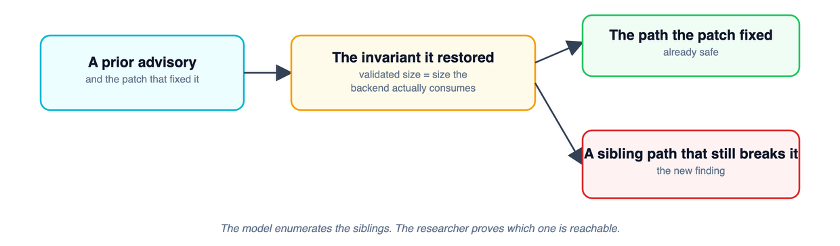
The output of that work is a short list of invariants. An invariant is a one-sentence rule the code assumes is always true and that a bug would break, for example, “the byte count validated at the perimeter must equal the amount the backend actually consumes.” That is the whole idea. An old validation-patch advisory becomes exactly that kind of rule. An advisory about a use-after-free (a bug where code keeps using an object after it’s been freed) becomes “no object may keep using itself after calling a callback that can destroy it.”

While an invariant is the rule the code must hold, once a bug shows that rule being broken, a variant is any other location where the same rule is broken in the same way.

Prior reported bugs make the hunt richer, because each one hands you an invariant the code already got wrong and a family of variants to chase, but they are not required. Where there are none, you derive the invariants from the code’s own contracts, a cache key that must stay unique or a trust boundary that must hold. This is where a model and an expert outrun what either does alone: the model maps the sinks and their connections across the whole surface far faster than a person could, while the researcher decides which invariants matter and where they break. The threat model is the method, and the pairing is what makes it powerful.

This is also why “find a use-after-free” is a useless prompt, while “determine whether this callback can free the parent object before the next line reads a member of it” is a good one. The first is a bug category, the second a specific claim a model and I can both test.

Nothing about this is specific to open-source. The method is the same whether the target is a public repository, a client’s proprietary codebase, or a closed black box, and what changes is only how much of the history is handed to you. Open-source projects give it away in public commits and advisories, which is why the examples in this post are open-source. On a closed target, you assemble the same ground truth yourself from decompiled interfaces, architecture documents, past vendor disclosures, and dynamic traces, and that is the slower, harder version of the identical work. A model can’t invent a threat model from nothing, and it works only from the evidence you give it.

Figure 1 – From a patch to its forgotten sibling.

Context Discipline: The Token Budget

Compressing history into an invariant is wasted effort if the model loses that invariant halfway through the job, which is exactly what happens when you ignore how its context works. A model doesn’t have your repository open the way an editor does. On every turn it sees one block of text – your prompt, the conversation so far, the code you pasted, the tool output that came back – and nothing else. That block is the context window, measured in tokens (roughly ¾ of a word each), and it is finite. Almost every failure I hit traces back to how that budget gets spent. The most relevant reasons for context failure are these three:

Lossy compaction. When a conversation nears the window limit, the tooling summarizes older turns to make room. Summaries keep the story (“found a validation gap”) and throw away the specifics upon which a finding depends: the exact line number, the build flag, the crash offset. After a couple of rounds of this, a session can sound completely confident while no longer holding a single piece of usable evidence. That’s the most dangerous failure mode, because nothing looks broken.

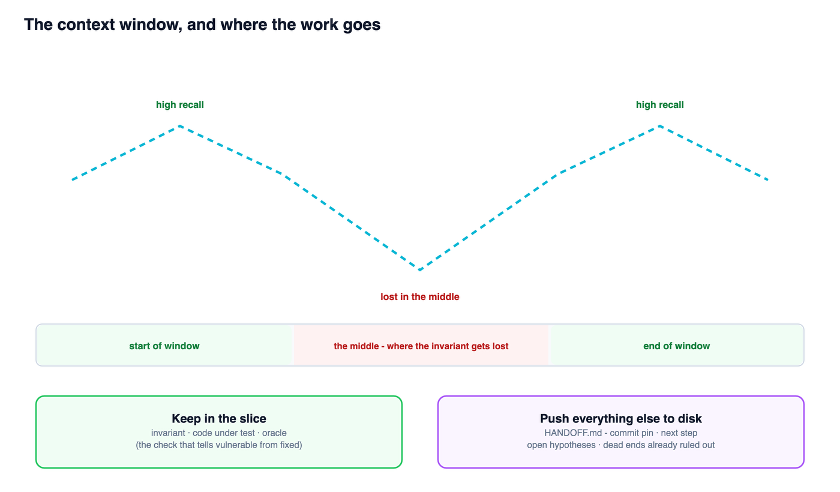
Degraded recall in the middle. A model recalls what sits at the start and end of a long context far better than what is buried in the middle. The effect has a name, “lost in the middle,” and it has outlasted several generations of far larger context windows. A 2025 context rot study found every one of eighteen frontier models still degrading as their input grew. That is the problem here, because the invariant, the one thing that has to hold from the first turn to the last, is exactly what sinks into that middle while the model keeps reasoning as if it still had it.

Cache invalidation. Reasoning over a large context is only affordable because the tooling caches the processed prefix. Churn the conversation and that cache goes cold, and every turn starts paying the full cost of reading everything again.

The fix is not a bigger window. That just moves the limit without solving the recall decay. The fix is to keep the working slice small enough that the invariant, the code under test, and the oracle (the check that separates a vulnerable build from a fixed one) all fit in the high-recall region at once. Everything else goes to disk.

Before I pause a session, I write a short HANDOFF.md at the repository root – the pinned commit, the current artifact, the live hypotheses, the dead ends already ruled out – so the next session resumes without re-deriving state. If that note runs longer than a page, the slice was too big and I split it.

Figure 2 – Keeping the slice in high-recall context.

The Four Audit Passes

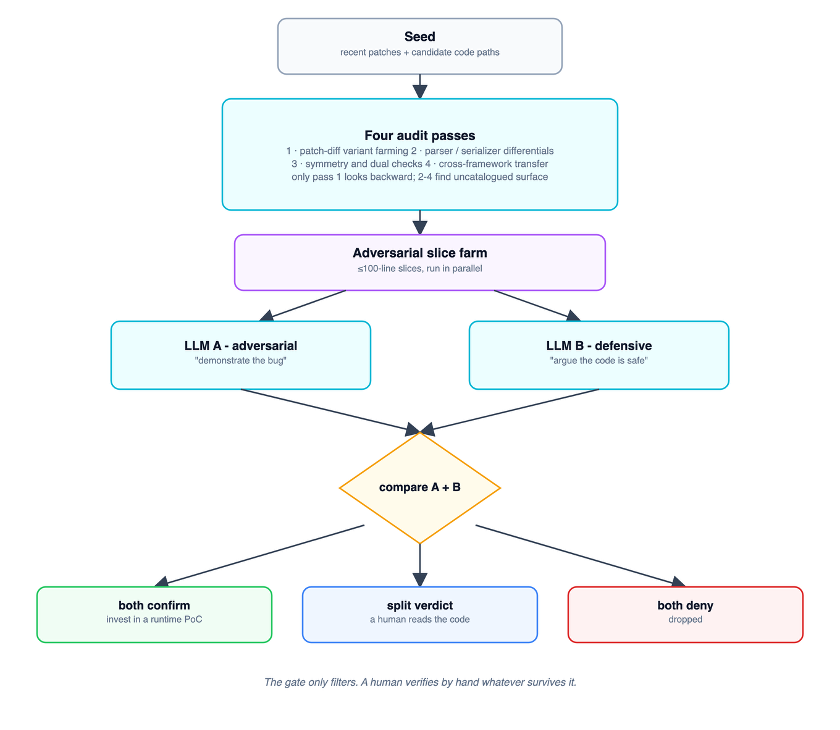
With a threat model in hand and a list of candidate code paths to check, I run the model through four audit passes. Each one has its own input and its own output.

  1. Patch-diff variant farming. A patch shows the exact line the maintainers changed, and the code around it shows the neighborhood they left alone. I ask the model to find sibling paths that still contain the old, pre-patch logic. This is my highest-yield pass by a wide margin.
  2. Parser and serializer differentials. When a system implements the same concept more than once – two URL parsers, two header processors, two cache-key generators – those implementations can disagree, and the disagreement is a bug. I list the pairs and ask for inputs where they produce different results, aiming at request smuggling, server-side request forgery (SSRF), or cache confusion.
  3. Symmetry and dual checks. For every input-validation check, I look for its output twin: the cache layer, serializer, or redirect handler that’s supposed to enforce the same rule on the way out. A missing twin is a strong candidate.
  4. Cross-framework transfer. Once a bug pattern works in one target, I test sibling frameworks for the same underlying assumption. If it replicates, that’s a class-level design flaw, not one project’s slip.

Only the first pass looks backward at patches. The other three go looking for attack surface nobody has catalogued yet.

Those passes hand back a list of candidate bugs. I cut each surviving candidate down to a slice of under a hundred lines and send it through a dual-model gate, where one session is prompted to prove the bug exploitable and another, handed the same slice with no prior context, is asked to prove it safe. This is not a vote, because two runs of the same model share the same blind spots. I treat it as a disagreement detector instead.

When both sessions call the bug real, it still owes me a runtime proof; when both call it safe, I drop it; and a split, which flags the non-obvious edge cases, is the most useful of the three. The gate only filters, though, and whatever comes out of it I verify by hand, reading the code and reproducing the behavior myself, because two models agreeing is not proof.

Figure 3 – Four audit passes into a dual-model gate.

What a Verified Finding Looks Like

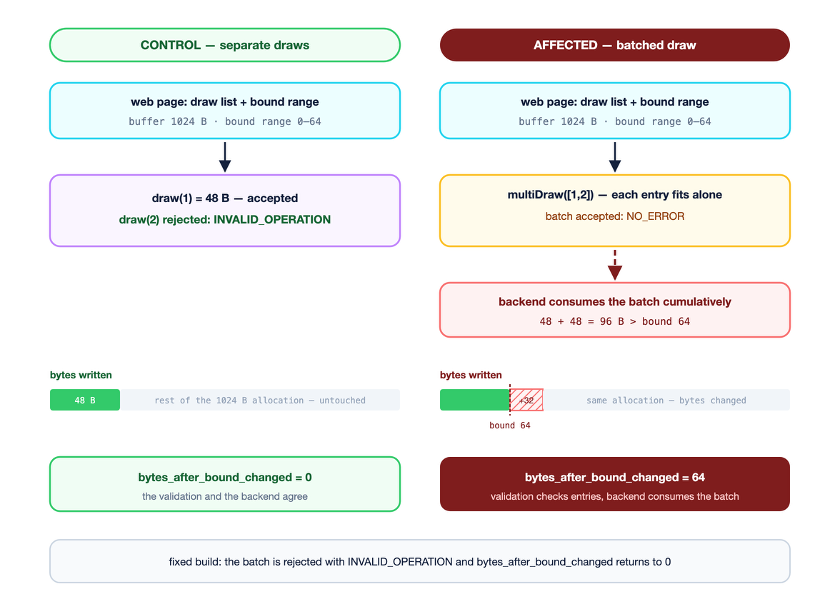
Before any of this touches a runtime, each candidate gets a spec card, four lines that fix exactly what is being claimed and what would prove it. Here’s one, from a sanitized browser-graphics example – a validation/use mismatch, where the check validates each draw command on its own but the backend runs the whole batch and walks the write cursor past the allowed buffer:

Invariant:  ValidateBatch must validate the cumulative byte count
            consumed by SubmitBatch, not the largest single entry.
Attacker:   A web page controls the draw list and the bound range.
Oracle:     The second draw must fail if draw1 + draw2 exceeds the
            bound range. A vulnerable build writes past the range;
            a fixed build returns an API error.
Stop:       Do not claim High unless the write crosses an allocation,
            ownership, process, origin, or authority boundary.

The oracle is the line that does the work, the exact condition that tells a vulnerable build from a fixed one. Here the oracle is checked across three runs, and the contrast between them is the proof:

separate_draw_control:    second_draw_error = INVALID_OPERATION
                          bytes_after_bound_changed = 0

batched_draw_vulnerable:  batch_error = NO_ERROR
                          bytes_after_bound_changed = 64

batched_draw_fixed:       batch_error = INVALID_OPERATION
                          bytes_after_bound_changed = 0

The first run is the negative control, where single checks reject the bad bounds. The second shows the bypass under batched execution, and the third confirms the fix. One log line would prove nothing, but the contrast across all three is what a triager can trust.

This example shows one more thing: because the writes stayed inside memory the calling page already owned, this was a constrained primitive (a real but limited capability), not full memory corruption. That distinction is the difference between a Medium and a High, and I’ll come back to it. The productive next question is never “can I make this proof-of-concept louder?” It’s “where else does this invariant fail?”

Figure 4 – A validation/use mismatch: control vs affected.

Two Real Findings in Angular

Here’s the method producing real, accepted bugs, both reported, confirmed, and patched upstream. One came from a forward-looking differential, the other from a patch variant.

CVE-2026-68945: two requests, one cache key

Advisory: GHSA-jhpw-976m-542j. Rated HIGH (CVSS v4.0) by the assigning authority.

The assumption, from history. Angular’s server-side rendering (SSR) builds the page on the server before sending it to the browser, and it caches the HTTP responses it fetches so the browser can reuse them during hydration instead of re-fetching. Any cache like that rests on one rule.

The invariant. Two HTTP requests that could receive security-distinct responses must never share a cache key.

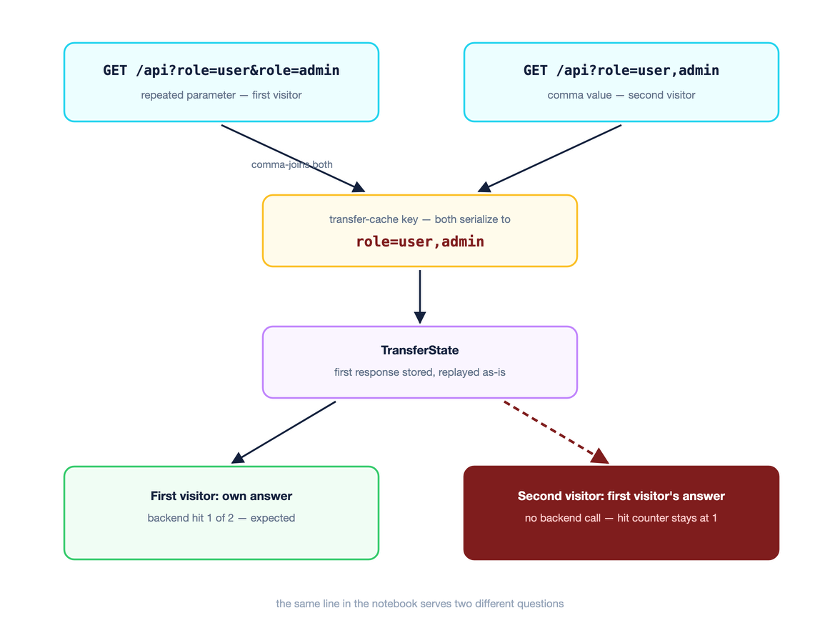
The hypothesis (Pass 2, serializer differential). If the code builds cache keys by turning request parameters into a string, is there more than one way to write “the same” string? There was. The key generator joined repeated parameters with commas, so two genuinely different requests collapsed onto one key:

GET /api?role=user&role=admin   →  key "role=user,admin"
GET /api?role=user,admin        →  key "role=user,admin"

Figure 5 – Two requests, one cache key (CVE-2026-68945).

The proof. The oracle was a backend hit-counter, and two distinct requests produced exactly one backend call. The second visitor was served the first visitor’s cached response straight from the transfer cache, never reaching the backend’s authorization check. Angular fixed the key serialization in 20.3.27, 21.2.19, and 22.0.2 (PR #68571).

CVE-2026-69151: a translation file that could inject a script

Advisory: GHSA-jj27-h5hq-8×99. Rated HIGH (CVSS v4.0) by the assigning authority.

The assumption, from history. Angular’s template compiler treats internationalization (i18n) files as lower-trust: translators are supposed to supply text, not code. That’s a trust boundary, and trust boundaries are exactly what threat modeling tells you to test.

The invariant. Lower-trust translation content must never compile into an event handler.

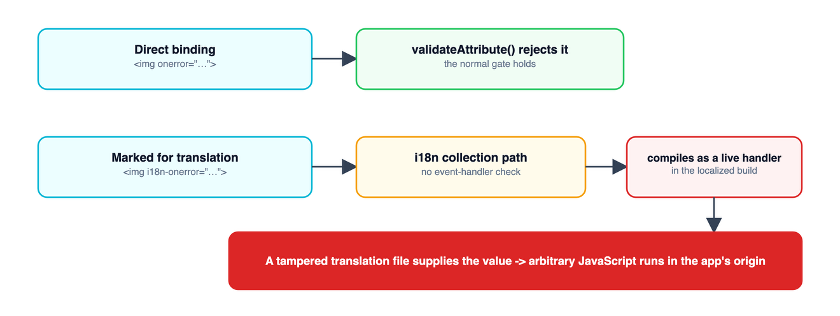
The hypothesis. An earlier fix had already closed one hole where translated content bypassed the normal attribute checks. So, what other attributes still slip through the same translation path? Event handlers did. The compiler accepted i18n-onerror and other i18n-on* attributes, which meant a tampered translation file could drop live JavaScript into a static event handler.

The proof. The demonstration is a compile-time differential rather than a memory trace. Bind onerror on an element directly and the compiler rejects it. Mark the same attribute i18n-onerror and it passes the i18n collection path and compiles into the localized build intact. A translation file supplying that attribute’s value then controls a live handler, which is exactly what the advisory documents, a lower-trust translation file replacing a benign onerror=”void 0″ with arbitrary JavaScript that runs in the application’s origin. Angular fixed it in 20.3.27, 21.2.19, and 22.0.1 (PRs #68821 and #69306).

Figure 6 – i18n bypass: onerror vs i18n-onerror (CVE-2026-69151).

The bug wasn’t a sanitization slip but a broken contract between the compiler and untrusted input, and that input is realistic: localization bundles routinely come from outside translators or a shared repository. As with the cache-key bug, the fix seeds the next cycle, because patching one attribute is an invitation to check every sibling attribute immediately.

Candidate Classification

The fastest way to sink a valid report is to overstate it, so I rate a finding by one thing only: the security boundary its runtime proof actually crosses.

That’s why the graphics example earlier was a Medium, not a High. The writes stayed inside memory the page already owned, so nothing crossed an allocation, process, origin, or authority boundary. Both Angular bugs cross a real one: CVE-2026-68945 serves a response across users, and CVE-2026-69151 runs script in the application’s origin. A scanner’s score is only an interpretation of it, but the breached boundary is a fact, so document the boundary and let the rating follow.

Conclusion

The cost of generating a hypothesis, writing a negative control, and checking a patch’s variants has collapsed. What’s scarce now is the discipline to throw the bad ones away quickly and prove the good ones are real.

In practice, that comes down to a few habits: threat-model before you prompt, so every question is anchored to one rule; never report a finding without a negative control and a fixed-version comparison; and run every candidate past a fresh, independent model session whose only job is to disprove it. That session is only a filter, though, and the final sign-off on any finding is always a person’s.

This doesn’t automatically favor defenders. The same tools are a download away for anyone, and patch-diff variant farming rewards whoever moves first after a commit ships. This means the takeaway for anyone shipping code is direct: run these passes on your own patches before you release, because someone outside will run them after you ship.

INSIGHTS | August 26, 2026

Signal Windows Desktop: contentProtection Bypass

Signal Desktop on Windows ships a screen-capture protection feature that prevents the application window from appearing in screenshots or screen recordings. In this post, we walk through how we identified the underlying Windows API powering that feature, why naïve attempts to disable it fail even from a privileged process, and how we ultimately bypassed the protection by executing code within Signal’s own process context using CreateRemoteThread.

In this post we cover two distinct phases of the research:

  • Static analysis — locating the contentProtection API chain through Signal’s open source code and Electron documentation.
  • Kernel internals — reverse engineering win32kfull!NtUserSetWindowDisplayAffinity to confirm the ownership check that enforces the protection and understand exactly why cross-process calls are rejected.

Background

During an internal discussion, a colleague mentioned noticing that Signal’s window did not appear during a screen-share session. This prompted us to investigate the mechanism behind it and, naturally, to ask whether that mechanism could be bypassed.

Signal Windows Desktop contentProtection Bypass Signal Windows Desktop contentProtection Bypass

Finding the API Behind contentProtection

Signal Desktop is an Electron application and its source code is publicly available on GitHub. A ripgrep search for contentProtection across the codebase quickly identified the relevant call site:

SHELL · RIPGREP · SIGNAL-DESKTOP SOURCE
C:\Users\tahai\code\Signal-Desktop>rg contentProtection
app\main.main.ts
566:  const contentProtection = ephemeralConfig.get('contentProtection');
571:    (contentProtection ?? isContentProtectionEnabledByDefault(OS, os.release()))
3022:  if (name !== 'contentProtection') {
3026:  const contentProtection = ephemeralConfig.get('contentProtection');
3029:    if (typeof contentProtection === 'boolean') {
3030:      window.setContentProtection(contentProtection);

ts\windows\preload.preload.ts
6:installEphemeralSetting('contentProtection');

ts\util\createIPCEvents.preload.ts
208:        ((await getEphemeralSetting('contentProtection')) ??
216:      await setEphemeralSetting('contentProtection', value);

The call at line 3030, window.setContentProtection(contentProtection), is the Electron API responsible for the behaviour. Checking the Electron documentation reveals how this maps to platform-specific system calls:

On Windows, setContentProtection(true) calls SetWindowDisplayAffinity with the flag WDA_EXCLUDEFROMCAPTURE. On Windows 10 version 2004 and later the window is excluded from capture entirely. On older versions the flag falls back to WDA_MONITOR behaviour, which renders the window as a black rectangle in any capture.

This setContentProtection path is a well-trodden one outside Signal, and community write-ups describing it match what we observed. On Windows the call resolves to SetWindowDisplayAffinity(WDA_EXCLUDEFROMCAPTURE) (and on macOS to CGWindowSetSharingType(kCGWindowSharingNone)), it requires Windows 10 build 19041 — the May 2020 Update — or newer for true exclusion rather than the black-rectangle WDA_MONITOR fallback, and the exclusion happens at the Desktop Window Manager (DWM) / kernel display layer rather than in the application. As a result the window is omitted from every user-mode capture pipeline that goes through Windows Graphics Capture (WGC) — Zoom, Teams, Meet, OBS, Game Bar, and ordinary PrintScreen and BitBlt captures alike. One documented caveat worth noting for defenders is that certain DXGI / direct-GPU capture paths can, on some GPU and driver combinations, still capture a window flagged this way — the exclusion is strong but not literally universal.

Windows SetWindowDisplayAffinity()

The API signature is straightforward — a window handle followed by a DWORD affinity value:

  • WDA_NONE (0x00000000) — no restrictions
  • WDA_MONITOR (0x00000001) — content displayed only on a monitor
  • WDA_EXCLUDEFROMCAPTURE (0x00000011) — content excluded from all capture

To disable the protection, we need to call this API with a valid top-level window handle for Signal and pass WDA_NONE. Obtaining the handle is straightforward: EnumWindows() paired with GetWindowTextW() and GetWindowThreadProcessId() lets us identify Signal’s window by cross-matching title text and process name.

Disabling the Protection — Three Approaches

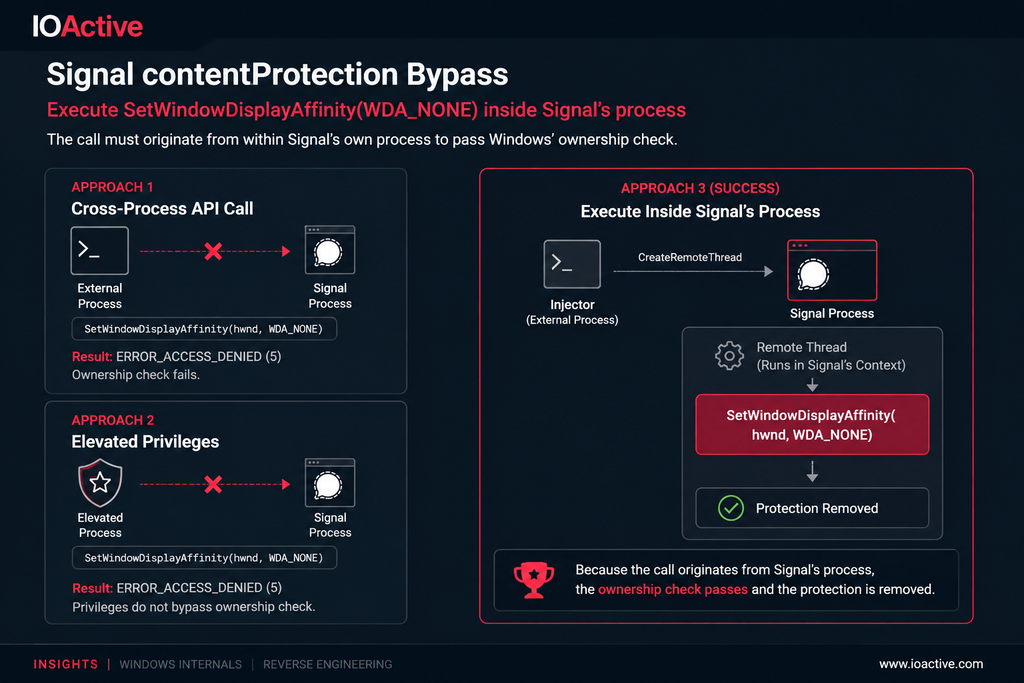
Approach 1 — Cross-Process API Call

With a valid handle in hand, the first attempt was direct: call SetWindowDisplayAffinity(hwnd, WDA_NONE) from a separate process. This returns immediately with ERROR_ACCESS_DENIED (5). Windows is enforcing an ownership check — a process cannot modify the display affinity of a window it does not own.

Approach 2 — Elevated Privileges

The same call was retried from a process running as Administrator. The result is identical: ERROR_ACCESS_DENIED. The check is not privilege-gated. Even a fully elevated process is rejected when calling SetWindowDisplayAffinity against a window it does not own.

Approach 3 — Remote Thread Injection (Successful)

The key constraint the previous two attempts revealed is that the call must originate from within Signal’s own process. We satisfied this using CreateRemoteThread to execute SetWindowDisplayAffinity(hwnd, WDA_NONE) inside Signal’s process context. Because the call is issued from Signal’s process, it passes the ownership check and the protection is silently removed. The proof of concept is available on GitHub.

SetWindowDisplayAffinity() — Kernel Internals

Having confirmed the ownership constraint empirically, we verified it through static analysis of the kernel implementation. The userland call chain is:

user32!SetWindowDisplayAffinity
  └─ win32u!NtUserSetWindowDisplayAffinity   [syscall boundary]

SetWindowDisplayAffinity in user32.dll is a thin wrapper around the NtUserSetWindowDisplayAffinity syscall exported by win32u.dll:

Locating the Implementation in the Kernel

In the kernel the syscall is handled across two modules. We confirmed this with the WinDbg x command:

WINDBG KD · MODULE SEARCH
1: kd> x win32*!*SetWindowDisplayAffinity*
fffff805`5d55ad40 win32k!stub_UserSetWindowDisplayAffinity
fffff805`5d51d320 win32k!_win32kstub_NtUserSetWindowDisplayAffinity
fffff805`5d4fe5ac win32k!NtUserSetWindowDisplayAffinity
fffff805`618bb180 win32kfull!NtUserSetWindowDisplayAffinity

Disassembling win32k!NtUserSetWindowDisplayAffinity shows it calls win32k!W32GetSessionState for a desktop-session sanity check, then dispatches through nt!KscpCfgDispatchUserCallTargetEsSmep — a first-layer check with no ownership logic. The ownership enforcement lives in win32kfull!NtUserSetWindowDisplayAffinity.

The Ownership Check

Working through the disassembly, the sequence is:

WINDBG KD · WIN32KFULL!NTUSERSETWINDOWDISPLAYAFFINITY — ANNOTATED
; Resolve the target window to its internal struct (via ValidateReceivingHwnd)
fffff805`618bb1ac  call  win32kfull!ValidateReceivingHwnd
fffff805`618bb1b3  mov   rdi, rax          ; rdi = window object

; Get the Win32 process object of the *current* (calling) process
fffff805`618bb1c2  call  nt!PsGetCurrentProcessWin32Process
fffff805`618bb1c7  mov   r8, rax            ; r8 = current process

; Compare: does the window's owning process match the calling process?
fffff805`618bb1db  mov   rax, [rdi+10h]     ; rax = window's thread info
fffff805`618bb1df  cmp   [rax+1D0h], r8    ; owning process == calling process?
fffff805`618bb1e6  jne   +0xe2              ; NO -> ACCESS_DENIED

; ACCESS_DENIED path
fffff805`618bb262  mov   ecx, 5             ; ERROR_ACCESS_DENIED
fffff805`618bb267  jmp   win32kfull!UserSetLastError

The check is explicit: PsGetCurrentProcessWin32Process returns the Win32 process object for the calling thread, and that value is compared against the process stored at offset 0x1D0 of the window’s owning thread structure. If they differ, the call is rejected. Administrator privilege does not factor into this path — the check is purely about process identity, which is why elevated callers receive the same ERROR_ACCESS_DENIED as unprivileged ones.

CreateRemoteThread satisfies this check because it causes the API call to execute on a thread within Signal’s own process, making PsGetCurrentProcessWin32Process return Signal’s process object — an exact match.

Going Below the API — Kernel-Level Enforcement

The ownership check above lives in the syscall handler for SetWindowDisplayAffinity, but that syscall is only the documented front door. The exclusion state it sets is ultimately applied deeper in the graphics stack, inside DWM. Independent kernel-mode research reinforces this: a proof-of-concept driver (DWMShield) skips the public API entirely and calls the undocumented internal routine win32kfull!GreProtectSpriteContent directly, passing a target HWND and the same 0x11 (WDA_EXCLUDEFROMCAPTURE) flag. It works from kernel mode by exposing a device and symbolic link, taking the target window handle over an IOCTL from a non-elevated client, and invoking GreProtectSpriteContent on its behalf — after which DWM applies the same capture-exclusion state that the official path would have produced.

That work is the mirror image of ours. Where CreateRemoteThread bypasses the kernel ownership check by making the call originate from inside the target process, the driver bypasses it from the other side — by dropping below the user-mode API to the routine that actually enforces the flag, where the per-process identity comparison never runs. It carries the usual kernel-research friction: because GreProtectSpriteContent is not exported, its address must be resolved manually and shifts on every reboot under KASLR, and the driver depends on an internal signature that Windows updates can change. But the takeaway is the same one the ownership check hints at: the capture-exclusion decision is made by DWM in kernel space, and it can be reached — by moving code into the owning process, as we did, or by reaching the enforcing routine directly, as the driver does.

Conclusion

EnumWindows is a powerful Win32 API: it allows any process, regardless of privilege, to enumerate top-level windows within the current desktop session and receive a handle to each. Those handles do not, by themselves, grant meaningful access — what can be done with a handle is gated separately by each target API’s own access controls. In the case of SetWindowDisplayAffinity, the gate is a kernel-level ownership check that correctly rejects cross-process calls from any caller, including administrators.

However, the check is bounded by process identity rather than a broader integrity or trust model. CreateRemoteThread — a documented, widely-available Windows API — provides a straightforward way to move code execution into the target process and thereby satisfy that identity check. The result is a silent, runtime removal of screen-capture protection with no indication to the user.

This finding illustrates a recurring theme in Windows security: individual API-level checks are often well-implemented, but the combination of legitimate APIs can produce outcomes the checks were not designed to prevent. Defence-in-depth controls like screen-capture protection are most effective when the device is uncompromised. Once an attacker has local code execution they are in a position to erode multiple such controls through in-process execution. Signal’s protection is a solid user-mode control. What these two paths show is only that, like any capture-exclusion built on the same DWM mechanism, it rests on the integrity of the endpoint rather than on a boundary the local attacker cannot cross.

References

INSIGHTS | August 18, 2026

The Five Eyes AI Shift in Cyber Risk Statement: What Industry Leaders Need to Know Now

Key Takeaways

  • On 22 June 2026, the leaders of the Five Eyes cyber security agencies issued a joint statement, The AI Shift in Cyber Risk: Why Leaders Must Act Now, warning that frontier AI is transforming cyber risk on a timeline measured in months, not years.
  • The statement is signed by the heads of the National Cyber Security Centre (NCSC, UK), Cybersecurity and Infrastructure Security Agency (CISA, US), National Security Agency (NSA, US), Australian Signals Directorate (ASD, Australia), Communications Security Establishment (CSE, Canada), and Government Communications Security Bureau (GCSB, New Zealand) — an unusually unified articulation of urgency from the Five Eyes partnership.
  • Cyber risk is explicitly reframed as a core business risk and board-level responsibility, not a technical issue to be delegated downward.
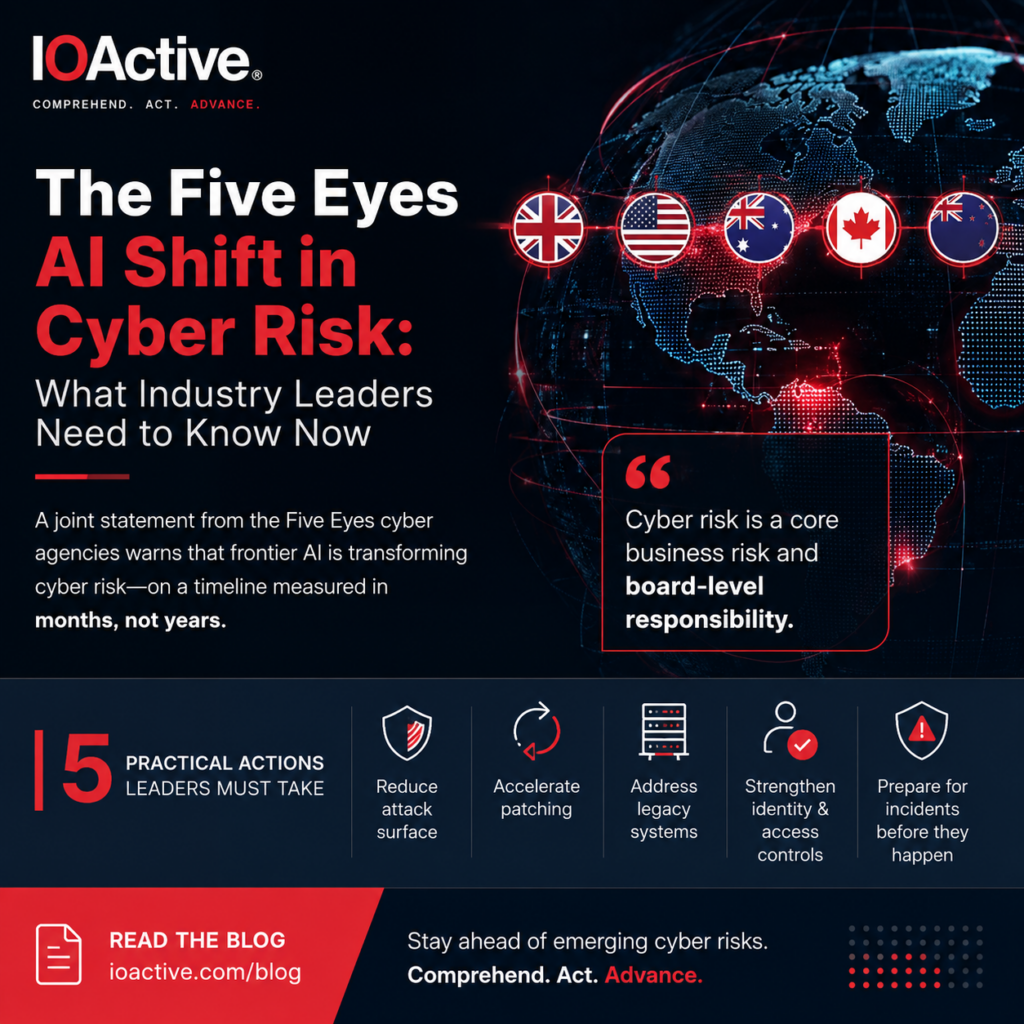
  • Five practical actions are prescribed: reduce attack surface, accelerate patching, address legacy systems, strengthen identity and access controls, and prepare for incidents before they happen.
  • The statement lands days after the NCSC’s own CEO disclosed that 75% of attacks on UK critical infrastructure over the past year are linked to hostile states, and weeks after NCSC guidance warning of an incoming “vulnerability patch wave” driven by AI-accelerated exploitation.
  • Organisations that treat this as a compliance afterthought will be out of step with where their regulators, and their adversaries, are already heading.

A Statement for a Narrowing Window

Joint statements from the Five Eyes cyber agencies are not issued lightly, and this one is notable for its tone as much as its content. Published on 22 June 2026, The AI Shift in Cyber Risk [1] is signed jointly by Stephanie Crowe (ASD), Rajiv Gupta (CSE), Catriona Robinson (GCSB), Richard Horne (NCSC), David Imbordino (NSA), and Nick Andersen (CISA). The framing is unambiguous: frontier AI models are expected to exceed current industry expectations, and the timeline for that shift is not years, it is months.

This is not an isolated warning. Five days before the statement was published, NCSC CEO Dr Richard Horne told the Royal United Services Institute’s Annual Security Lecture that the NCSC had managed more than 200 cyber incidents affecting the UK’s critical national infrastructure in the year to May 2026, with around 75% believed linked to hostile state actors including Russia, China, and Iran [2]. Horne went further, arguing that cyber security should no longer be framed as a risk to be tolerated within appetite, but as an ongoing contest with capable adversaries. He also pointed to an NCSC assessment that by 2028, AI-enabled capabilities will likely be used to exploit known vulnerabilities in legacy technology at scale across UK critical infrastructure.

That assessment builds directly on guidance the NCSC published in May 2026, warning organisations to prepare for a “vulnerability patch wave”: a forced correction in which AI-accelerated exploitation surfaces decades of accumulated technical debt across commercial, open source, and proprietary software simultaneously [3]. The Five Eyes statement should be read as the international consolidation of that warning, not a standalone development.

What Does the Statement Set Out?

The statement is short and deliberately free of new technical detail. Its purpose is to compress urgency into a small number of leadership-level actions, structured around four overarching asks and five practical steps [1].

Leaders are urged to:

  • Understand and assess risk, readiness, and accountability. Boards need a clear, current picture of organisational exposure, not a static risk register reviewed annually.
  • Prioritise foundational cyber security practices and controls. Sophistication in tooling does not substitute for getting the fundamentals right.
  • Empower cyber leaders with authority and resources. Cyber leadership requires the mandate to act, not just the responsibility to report.
  • Stay actively engaged as threats and guidance evolve. Static governance models cannot keep pace with a threat landscape that is itself accelerating.

Two structural points distinguish this statement from prior Five Eyes guidance. First, it reframes AI not solely as an adversary capability but as a defensive obligation: organisations are explicitly told to use AI deliberately to strengthen defence, not merely to improve efficiency. Second, it sets an expectation that breaches are not preventable in absolute terms; preparedness is reframed as the capability to contain incidents quickly before they escalate into operational and financial crises [1].

Who is Affected by the Statement?

Boards and Executive Leadership

The statement is addressed primarily upward, not downward. It states plainly that cyber resilience is not an IT issue, it is central to operational continuity and market trust, and that it is not enough to have controls; leaders must be confident those controls will perform during a real incident [1]. This places direct accountability on boards and executives to verify resilience, not simply to fund it.

CISOs and Security Leadership

For security leaders, the statement is a mandate to escalate. The call to empower cyber leaders with authority and resources [1] gives CISOs a clear external reference point when seeking budget, headcount, or the organisational authority to challenge unsafe trade-offs that have previously been accepted in the name of operational convenience.

Operators of Critical National Infrastructure

For CNI operators, the statement reinforces direction already set domestically. The NCSC’s own intervention five days prior, disclosing that three-quarters of attacks on UK CNI are state-linked [2], makes clear that the threat described in the Five Eyes statement is not a future scenario for this sector. It is the current operating environment.

Vendors and Technology Providers

The statement explicitly calls on leaders across industry, including vendors, to act now [1]. Combined with the NCSC’s separate warning that a wave of vulnerability disclosures is approaching across commercial, open source, and proprietary software [3], vendors should expect both faster exploitation of existing flaws and intensifying customer expectations around patch velocity and secure-by-design practice.

What are the Key Challenges Organisations Will Face?

Compressed Exploitation Timelines

The central technical claim underpinning the statement is that AI is shrinking the window between vulnerability discovery and exploitation [1]. Patch cadences and change-management processes built around weeks or months of lead time were not designed for this. Organisations with manual patching processes, particularly across operational technology environments with long update cycles, face a widening gap between the speed of the threat and the speed of their own response.

Your Adversary Already Has an AI Upgrade

Even if your organization hasn’t touched AI, your attackers have. The patch window that once gave defenders breathing room is effectively gone — Mandiant’s time-to-exploit tracking shows exploits now landing on or before the day a CVE goes public. Exploitation itself has become a commodity: working proof-of-concept exploits can be generated in about 15 minutes, and autonomous vulnerability discovery campaigns can be run for roughly $50. This isn’t theoretical. Recovered logs from a June incident (via OALABS) showed a single operator driving over 1,000 AI-agent sessions across 14+ companies, with the models flagging a policy violation only about 10 times — because every request was simply framed as “authorized red-team” work. Social engineering has scaled right alongside it: Arup lost $25.6 million in 2024 after a video call where every “colleague” on the line was a deepfake, and the economics of that kind of attack have only gotten cheaper since. None of this requires exotic new attack vectors. It’s the same attack surface organizations have always had, now facing an adversary that doesn’t sleep, doesn’t hesitate, and operates at machine speed.

Legacy and Unsupported Systems

The statement is blunt that unsupported systems are not just technical debt, they are strategic liabilities [1]. This sits uncomfortably with sectors where legacy estate is structural rather than incidental, where replacement cycles are measured in years and safety-critical considerations constrain how quickly systems can be patched or retired.

Governance Gaps Between Boards and Technical Teams

Repeated emphasis on board-level accountability assumes a level of cyber literacy that many boards do not yet have. The gap between technical risk and the language boards use to govern it remains one of the most persistent obstacles to the kind of confident assurance the statement demands.

AI as a Dual-Use Capability

The statement’s insistence that organisations use AI deliberately to strengthen defence, not just improve efficiency [1], is a meaningfully higher bar than most organisations’ current AI security posture. Many security teams have adopted AI tooling for productivity gains. Far fewer have built the detection, monitoring, and response capability the statement envisages, while simultaneously managing the new attack surface that frontier AI systems themselves introduce.

Shipping Faster Means Shipping More Attack Surface

AI coding assistants have undeniably accelerated software delivery — but speed and security are moving in opposite directions. Veracode’s testing across more than 100 models found that roughly 45% of AI-generated code carries a security weakness. What’s more concerning is the trendline: functional correctness has raced past 95%, while the security rate has stayed flat at around 55% for two years running. Newer, smarter models are writing code that works — not code that’s safe. The practical impact is that attack surface is now growing at delivery speed, with code merging faster than any human review process was designed to handle, whether that code was sanctioned by the organization or introduced through shadow AI use, often with no clear provenance to trace it back. At the same time, client appetite for security testing is rising faster than budgets are — creating a widening gap between how much validation organizations want and how much they’re actually resourcing. Closing that appetite-budget gap is, in many ways, the central challenge facing security teams right now.

Zero-Day Proliferation

The statement warns directly that as AI systems evolve, new and previously unknown vulnerabilities will emerge, including zero-day vulnerabilities [1]. Defence-in-depth, rather than reliance on any single control or technology, is positioned as the only credible response to a vulnerability landscape that is itself becoming less predictable.

How IOActive Can Help

IOActive’s work across offensive security, operational technology and industrial control system (OT/ICS) assessment, and critical infrastructure advisory positions us to support organisations translating this statement’s leadership-level mandate into operationally credible defence. Testing, not assumption, is how organisations find out whether their controls will actually perform under pressure, which is precisely the bar the statement sets.

Red Team and Purple Team Services

The statement’s call to verify that controls will perform during a real incident, not merely exist on paper [1], is best answered through adversarial testing rather than compliance review. IOActive’s Red Team operations emulate the tactics of the threat actors most likely to target a given organisation’s sector and assets, while our Purple Team engagements translate offensive findings directly into measurable improvements in detection and response.

Full Stack Security Assessments

Reducing attack surface and accelerating patching, two of the statement’s five practical actions [1], both depend on first knowing where exposure actually sits. Our full stack assessments examine internet-facing systems, cloud environments, and on-premises infrastructure together, identifying the specific systems an attacker would prioritise rather than producing a generic vulnerability count.

Supply Chain Integrity

The statement’s call for action extends explicitly to vendors [1]. IOActive’s Supply Chain Integrity service assesses the security posture of technology providers and critical third parties, reviewing firmware, embedded systems, and procurement processes for inherited risk before it becomes either a compliance finding or an incident vector.

Preparedness and Resilience Testing

The statement’s framing of preparedness as a capability to be trusted, not assumed, aligns directly with our tabletop exercise and crisis simulation work. We help organisations stress-test detection, escalation, and recovery processes ahead of a real incident, building the operational muscle memory boards are now being asked to assure.

Threat Modeling and Advisory

Understanding and assessing risk, readiness, and accountability, the statement’s first call to action [1], requires a structured, evidence-based view of organisational exposure. Our threat modelling and advisory engagements give CISOs and boards a shared, prioritised picture of risk that can be acted on with confidence rather than debated indefinitely.

The statement is explicit that delay carries growing and avoidable risk [1]. We recommend the following immediate actions.

  1. Brief your board now on the statement’s core claim, that cyber risk assumptions can become outdated in months, and translate that into business, financial, and reputational terms.
  2. Map your patch and change-management cycle against the compressed exploitation timelines the statement describes, identifying where current processes cannot keep pace.
  3. Inventory legacy and unsupported systems with explicit reference to their exposure on external attack surfaces, not just their internal criticality.
  4. Review identity and access controls across critical systems, with particular attention to permissions that have accumulated without recent review.
  5. Test your incident response plan through a structured exercise that assumes a breach has already occurred, rather than one that tests whether it can be prevented.
  6. Evaluate how AI is currently used across your security function, distinguishing tools adopted for efficiency from capability genuinely built to strengthen detection and response.

Conclusion

The Five Eyes statement is short by design, but its brevity should not be mistaken for limited weight. Six of the world’s most authoritative cyber security agencies have chosen to speak with one voice, in plain language, to say that the basis on which most organisations currently assess cyber risk is already out of date.

The statement does not introduce new technical obligations. It does something arguably more consequential: it removes the option of treating AI-accelerated cyber risk as a future planning consideration. Combined with the NCSC’s own recent disclosures on the scale of state-linked attacks against UK critical infrastructure and the coming vulnerability patch wave, the message to leaders is consistent and increasingly difficult to defer.

Organisations that wait for a forcing event, whether a breach, a regulatory deadline, or a sector-specific mandate, will be acting from a position of weakness. Those that act now, testing their assumptions rather than reviewing them, will be the ones still standing when the window the statement describes finally closes.

If you would like to discuss how your organisation’s current posture measures up against the expectations set out in this statement, or how IOActive can support your cyber resilience programme, we welcome the conversation.

References

[1] Australian Signals Directorate, Communications Security Establishment, Government Communications Security Bureau, National Cyber Security Centre (UK), National Security Agency, Cybersecurity and Infrastructure Security Agency. The AI Shift in Cyber Risk: Why Leaders Must Act Now. 22 June 2026. https://www.ncsc.gov.uk/news/the-ai-shift-in-cyber-risk-why-leaders-must-act-now

[2] National Cyber Security Centre. NCSC CEO: Hostile States Linked to Three-Quarters of Cyber Attacks Affecting UK’s Critical Systems. 17 June 2026. https://www.ncsc.gov.uk/news/ncsc-ceo-hostile-states-linked-to-three-quarters-of-cyber-attacks

[3] National Cyber Security Centre. Preparing for a ‘Vulnerability Patch Wave’. 1 May 2026. https://www.ncsc.gov.uk/blogs/prepare-for-vulnerability-patch-wave

INSIGHTS | August 13, 2026

Red Team vs Penetration Testing: Key Differences

Red Team vs Penetration Testing: Key Differences breakdown graphic

“Penetration testing identifies vulnerabilities. Red teaming evaluates how effectively an organization can detect and respond to realistic attacks.” IOActive Security Team

The decision between red team vs penetration testing comes down to one question: What are you trying to learn? Most mature security programs need both methodologies, deployed in sequence: penetration testing to close technical gaps, and red teaming to validate that the controls protecting what remains will hold under real adversarial pressure.

This article breaks down the differences between red team vs penetration testing so your organization can choose the right approach.

Red Team vs Penetration Testing at a Glance

DimensionPenetration TestingRed Team Engagement
Primary objectiveFind and exploit as many vulnerabilities as possibleSimulate a targeted adversary; test detection and response
ScopeDefined: specific systems, apps, or networksBroad: may include physical access, social engineering, supply chain
DurationDays to weeksWeeks to months
StakeholdersInternal stakeholders are awareOnly select executives are involved; blue team is typically unaware
MethodologyTransparent, checklist-orientedCovert, adversary-emulation, objective-based
Threat modelGeneric opportunistic attackerSpecific threat actor (e.g., APT29, FIN7)
OutputVulnerability list with severity rankings and remediation stepsDetection timelines, playbook gaps, response readiness report
Best forOrganizations building foundational security controlsOrganizations with a mature SOC and incident response capability
Compliance valueHigh (PCI DSS explicitly requires it; the proposed HIPAA Security Rule update would mandate annual testing if finalized; SOC 2 auditors widely expect it)Lower direct compliance value; higher strategic value
Cost$5,000–$50,000 depending on scope; most mid-market engagements fall between $10,000 and $35,000$20,000–$100,000+ depending on duration and complexity; full adversary simulations typically run $40,000–$100,000

Penetration Testing

What it is: A penetration test is a time-boxed, authorized engagement in which ethical hackers identify and exploit vulnerabilities across a defined set of systems, applications, or networks.

The goal: Find as many exploitable weaknesses as possible, demonstrate their real-world impact, and deliver actionable remediation guidance.

Pros: Penetration testing goes beyond automated vulnerability scanning by adding human judgment: chaining vulnerabilities, testing business logic flaws, and filtering genuine risk from noise. Findings are immediately actionable.

Cons: Internal teams are typically aware the test is underway, which limits the value for measuring detection and response.

Choose a pentest when:

  • A compliance mandate requires it (PCI DSS, HIPAA, SOC 2 Type II)
  • You have deployed new infrastructure, applications, or cloud environments
  • You are validating remediation from a prior assessment
  • You are establishing your organization’s first formal testing program

Red Team Testing

What it is: A red team engagement is a full-scope adversarial simulation in which expert ethical hackers pursue specific objectives, such as accessing sensitive data or compromising executive accounts. Red team engagements use the same tactics, techniques, and procedures (TTPs) as real-world threat actors.

The goal: Determine whether your organization’s people, processes, and technology can detect, contain, and respond to a sophisticated attacker pursuing a specific objective, before a real adversary tests those same capabilities.

Pros: The engagement runs covertly, often without notifying the organization’s own security staff. This generates realistic data on detection timelines and incident response effectiveness.

Cons: Red team engagements are not optimized for cataloging technical vulnerabilities at scale. If foundational controls are weak, the red team will often achieve its objectives before meaningful detection data can be collected. In those cases, a penetration test would have surfaced the same findings faster and at lower cost.

Choose a red team engagement when:

  • Your SOC monitors alerts but has never been validated against a sophisticated intrusion
  • You need to test people and processes, not just technical controls
  • You want to measure detection and response against a specific, realistic threat scenario
  • Your security program has matured beyond foundational vulnerability management

Choose Based on Security Maturity

The most reliable decision factor is security maturity, which determines which question you are ready to answer. Organizations that have not yet closed known vulnerabilities will get more value from a pentest than from a red team engagement.

Organizations early in their security journey should run penetration tests first. If a red team can compromise your environment in hours without triggering a single alert, those findings could have been reached more efficiently with a pentest. Closing known vulnerabilities first allows a red team engagement to surface detection and response gaps that actually matter.

Security Maturity and Testing

Maturity StageIndicatorsRecommended Approach
FoundationalNo formal pentest history; basic patchingPenetration testing
DevelopingRegular pentests; security tooling in placePentesting + targeted red team scenarios
EstablishedFunctioning SOC, SIEM, incident response planBoth methodologies on a defined cadence
AdvancedMature threat intelligence; purple teaming capabilityRed team + purple team for continuous validation

Most organizations overestimate their maturity. If you have not run a penetration test within the past 12 months, or if your SOC has never responded to a simulated intrusion, a red team engagement will tell you less than a rigorous pentest will.

How the Two Methodologies Work Together

Penetration testing and red teaming are not competitors: they serve different stages of a security program. The typical progression is to run a pentest, remediate vulnerabilities, and build detection and response capabilities. From there, a red team engagement tests whether the SOC would detect a sophisticated attacker exploiting what remains.

Red team findings routinely drive improvements to SIEM detection rules, incident response playbooks, and security awareness training. It’s also recommended to use purple team exercises, which pair red team attackers with the organization’s blue team in a collaborative format to accelerate control tuning in real time.

Work With IOActive for Red Team Engagements and Penetration Testing

With over 25 years of offensive security research and engagements across some of the world’s most complex environments, IOActive has the experience to determine the right methodology for your risk profile and execute it with precision. IOActive’s penetration testing practice goes beyond off-the-shelf tooling, applying an attacker’s perspective and human judgment to chain vulnerabilities, expose business logic flaws, and deliver findings with clear remediation priority. Our red and purple team engagements run multi-vector, goal-based adversary simulations across technical, physical, and human attack surfaces, testing prevention, detection, response, and recovery under realistic conditions.

INSIGHTS | November 2, 2025

Cybersecurity Assessment Methodology

Enterprise security team reviewing a cybersecurity assessment methodology framework across testing scope, technical specialization, and reporting quality

“Cybersecurity assessment providers should be compared by the depth and relevance of their testing, not simply by the number of assessments they offer.” – IOActive Security Team

Not all security assessments are built the same, and neither are the providers that deliver them. For enterprise security teams evaluating external partners, it’s essential to examine each partners’ cybersecurity assessment methodology: what gets tested, how it is tested, and whether the approach reflects how real attackers actually operate. This piece covers the major assessment types available to enterprise organizations, the criteria that separate higher-capability providers from lower ones, and a structured framework for matching your environment to the right approach.

Types of Cybersecurity Assessments

Not every organization needs the same type of assessment. Understanding what each engagement involves, including what to look for in a provider’s approach to executing it, is the first step in evaluating whether a firm’s methodology fits your actual security needs.

Cybersecurity Assessment Types

Assessment TypePrimary PurposeBest Fit For
Penetration TestingIdentify and exploit vulnerabilities within a defined scopeCompliance mandates, foundational control validation
Red Team ExercisesSimulate targeted adversaries pursuing real objectivesOrganizations with mature controls and an active SOC
Full-Stack AssessmentsTest the entire technology stack from silicon to cloudComplex, multi-layer enterprise environments
AI Security AssessmentsTarget AI/ML-specific attack surfaces and infrastructureOrganizations integrating AI into critical systems
Product and Hardware TestingAssess physical devices, firmware, and siliconDevice manufacturers, IoT and OT deployments
Code Review and Reverse EngineeringSurface vulnerabilities at source-code and binary levelsSoftware development lifecycle, acquired or legacy code
Critical Infrastructure / OT TestingAssess ICS/SCADA and OT environments safelyEnergy, utilities, manufacturing, industrial sectors
Purple Team ExercisesCollaborative red/blue testing for detection improvementTeams ready to operationalize red team findings

The sections below define each assessment type and explain what to look for in a provider’s methodology when executing each one.

Penetration Testing

What it is: A time-boxed, authorized engagement in which ethical hackers identify and exploit vulnerabilities across a defined set of systems, applications, or networks.

What it does: Finds exploitable weaknesses, demonstrates real-world impact, and delivers remediation guidance tied to specific findings.

When to use: Most valuable for meeting compliance mandates (PCI DSS, HIPAA, SOC 2 Type II) or validating foundational security controls.

What to look for in a provider: Manual exploitation performed alongside automated scanning, not in place of it. Consultants capable of chaining multi-step attack sequences, not just cataloging isolated findings. Remediation guidance sequenced by exploitability and business impact, not solely by CVSS score.

Red Team Exercises

What it is: A covert engagement that simulates targeted adversaries pursuing specific objectives, using the same tactics, techniques, and procedures (TTPs) as real-world threat actors.

What it does: Generates realistic data on detection timelines and incident response effectiveness, testing people, processes, and technology together rather than in isolation.

When to use: Most valuable when foundational controls are already in place and an organization needs to know whether its security operations can detect and contain a sophisticated, motivated attacker.

What to look for in a provider: Defined engagement objectives tied to your organization’s actual crown jewels. Threat actor TTPs specific to your industry and threat landscape, not generic attack playbooks. Documented experience conducting covert operations against mature security teams.

Full-Stack Assessments

What it is: An engagement extending beyond application and network layers to examine the entire technology stack, from silicon, firmware, and embedded systems through software, cloud environments, and organizational processes.

What it does: Surfaces vulnerabilities that exist across layer boundaries and cannot be found when components are tested in isolation.

When to use: Most valuable for organizations whose risk environment spans hardware, software, and cloud infrastructure, or where a single compromise could cascade across multiple layers.

What to look for in a provider: Verifiable technical expertise at every layer of the stack. Dedicated physical labs for hardware and embedded device testing. A methodology that integrates silicon, firmware, application, and cloud assessment into a unified risk picture rather than a series of disconnected engagements.

AI Security Assessments

What it is: An engagement targeting the attack surfaces introduced by AI and machine learning systems, including adversarial inputs, prompt injection, model extraction, data poisoning, and compromised training pipelines.

What it does: Identifies vulnerabilities in AI/ML infrastructure that standard penetration testing frameworks do not address.

When to use: Most valuable for organizations integrating AI into critical systems, customer-facing products, or consequential decision-making workflows.

What to look for in a provider: Specific technical familiarity with ML architecture, LLM systems, and AI infrastructure, not general offensive security experience reapplied to an AI context. Testing that reaches the model layer, not only the surrounding application interface.

Product and Hardware Security Testing

What it is: An examination of the physical and logical security of connected devices, embedded systems, firmware, and silicon, including side-channel analysis, fault injection, reverse engineering of proprietary protocols, and cryptographic implementation review at the hardware level.

What it does: Identifies vulnerabilities below the software layer that application and network testing cannot detect.

When to use: Critical for device manufacturers, industrial equipment providers, and organizations deploying connected hardware at scale.

What to look for in a provider: A dedicated physical hardware lab. Documented experience with embedded system analysis and silicon-level techniques, including fault injection and side-channel attacks. A testing methodology covering hardware, firmware, and protocol layers together, rather than firmware in isolation.

Code Review and Reverse Engineering

What it is: A deep examination of software security at the source-code and binary levels, surfacing business logic flaws, implementation errors, and vulnerabilities in proprietary or legacy code that automated tools miss.

What it does: Provides visibility into software defects invisible to dynamic testing approaches.

When to use: Most valuable during software development lifecycles, before major product releases, or when evaluating acquired or third-party code.

What to look for in a provider: Reviewers with development backgrounds capable of identifying logic flaws alongside security vulnerabilities. Language and platform coverage relevant to your codebase. A methodology combining automated analysis with intensive manual review rather than relying on either alone.

Critical Infrastructure / OT Testing

What it is: Security assessment of industrial control systems (ICS), SCADA environments, and operational technology (OT) networks. These environments operate under constraints that standard IT security methodology cannot accommodate: proprietary protocols, extreme availability requirements, and physical safety implications.

What it does: Identifies vulnerabilities in OT/ICS environments without disrupting live operations.

When to use: Essential for organizations in energy, utilities, manufacturing, water systems, and other sectors where digital and physical systems converge.

What to look for in a provider: Sector-specific OT/ICS expertise, not IT security methodology adapted to an OT context. A testing approach designed for operational continuity constraints. Documented experience conducting assessments in live environments where testing itself carries operational risk. A 2024 CISA red team assessment of a U.S. critical infrastructure organization found simulated attackers went undetected for months, underscoring the gap between generic assessment methodology and the specialized expertise these environments require.

Purple Team Exercises

What it is: A collaborative engagement pairing red team offensive expertise with an organization’s own security team, focused on real-time detection rule tuning, playbook validation, and skills transfer between attacker and defender.

What it does: Improves detection and response capability directly, rather than documenting gaps for a team to address independently.

When to use: Most valuable for security teams that have completed initial red team engagements and want to operationalize findings in a collaborative format.

What to look for in a provider: Consultants capable of operating in both attacker and advisor roles simultaneously. A structured methodology for real-time feedback and control validation, not a loosely coordinated simulation.

Key Criteria for Evaluating Cybersecurity Assessment Methodology

The assessment type defines what gets tested. The methodology defines how, and this is where provider capability differences become most consequential. These six criteria help distinguish providers whose testing delivers genuine security insight from those whose engagements produce reports without materially improving security posture.

Assessment Scope and Technical Specialization

Most security firms assess network and application layers. Far fewer can credibly test hardware, silicon, embedded firmware, AI systems, or OT environments. A provider may list broad services without maintaining the specialized expertise to execute them.

Look for:

  • A dedicated physical lab for embedded device and hardware testing
  • Documented capability for silicon-level testing, including side-channel analysis and fault injection
  • AI security testing that reaches the model layer, not just the application interface
  • Sector-specific references for OT/ICS environments

Provider Scope Coverage by Capability Level

Scope LayerStandard ProviderHigh-Capability Provider
Application and NetworkYesYes
Cloud EnvironmentsSometimesYes
Embedded / IoT DevicesRarelyYes
Hardware / SiliconRarelyYes: dedicated physical lab required
AI/ML SystemsRarelyYes: with dedicated AI expertise
OT / ICSRarelyYes: specialized sector knowledge required

The gap between standard and high-capability providers widens significantly below the application layer. For organizations whose risk environment includes hardware, AI, or OT systems, scope coverage and technical specialization are the threshold criteria, not price or brand recognition.

Testing Methodology: Attacker-Driven vs. Checklist-Driven

There is a meaningful difference between providers who work through a checklist of known vulnerability categories and providers who approach testing with the mindset of an actual adversary. The latter requires consultants who can chain vulnerabilities across layers, reason about attacker objectives, and adapt in real time.

Look for:

  • Manual exploitation is performed alongside automated tooling, not replaced by it
  • Demonstrated ability to chain multi-step vulnerabilities across components
  • Threat actor TTPs specific to your industry, not generic attack frameworks
  • Engagement objectives tied to your organization’s actual crown jewels

Vulnerability Research Capability

The highest-capability providers generate original vulnerability research rather than relying exclusively on public CVE databases and commercial tooling. Firms with active research programs bring a more current understanding of attack surfaces, including weaknesses not yet publicly disclosed.

Look for:

  • Published CVEs attributed directly to the provider’s research team
  • Peer-reviewed technical research or presentations at Black Hat, DEF CON, or IEEE S&P
  • Publicly documented discoveries in hardware, AI, automotive, industrial, or other specialized domains
  • A research function that feeds directly into assessment methodology

Reporting Quality and Risk Translation

A rigorous assessment methodology produces findings that drive decisions, not simply findings that document vulnerabilities. Enterprise security teams and executive stakeholders need reports that prioritize risk in business terms.

Look for:

  • Findings mapped to business impact, not only to technical severity scores
  • Remediation guidance that is specific, practical, and sequenced by risk priority
  • Findings contextualized to the organization’s actual environment, not offered generically
  • Metrics supporting ongoing measurement: detection timelines, mean-time-to-compromise, and control coverage gaps

Environment Complexity Fit

For organizations running conventional enterprise IT, environment fit is rarely the differentiating factor. For organizations in regulated industries, manufacturing, energy, defense, or sectors where physical and digital systems converge, it is often the deciding one.

Look for:

  • References from engagements in your sector
  • A stated methodology for testing within operational continuity constraints
  • Documented experience in environments where the testing itself introduces operational risk

All six criteria above feed directly into the selection framework below: assessment scope, testing methodology, technical specialization, vulnerability research capability, reporting quality, and environment complexity fit.

A Framework for Selecting the Right Cybersecurity Assessment Provider

Provider Selection Framework: Seven Steps to the Right Fit

StepQuestion to AnswerWhat to Look For
1. Define what you’re protectingWhat are your organization’s crown jewels, and where do they live?Environments may span IT, OT, hardware, cloud, and AI
2. Identify the assessment typeWhat question does this engagement need to answer?Compliance gap? Detection readiness? Hardware risk? AI exposure?
3. Evaluate scope coverageCan the provider credibly assess every relevant layer?Documented capability, not listed services
4. Assess testing methodologyDoes the provider test with genuine attacker perspective?Manual exploitation, TTPs, multi-vector attack chains
5. Check vulnerability research credentialsDoes the provider generate original research?Published CVEs, conference presentations, specialized domain expertise
6. Review reporting examplesDoes the report drive decisions, not just list findings?Business-impact framing, prioritized remediation, and executive readability
7. Evaluate environment complexity fitHas the provider operated in environments like yours?Sector-specific references, OT/hardware/AI-specific experience

Matching Provider Capability to Organizational Maturity

Organizational maturity also shapes which type of engagement makes sense. Security programs early in their development benefit most from penetration testing and code review. Programs with mature controls and functioning SOCs get more from red team exercises, purple team exercises, and adversarial simulation. Providers capable of operating across that full maturity range, and advising on which engagement fits the current stage, offer more strategic value than specialists limited to a single methodology.

When Standard IT Methodology Is Not Enough

For organizations whose environments extend to hardware, AI systems, embedded devices, or critical infrastructure, Steps 3, 5, and 7 carry the most weight. The provider pool narrows significantly once the risk environment extends beyond conventional IT. The right partner combines offensive testing expertise with active vulnerability research, physical lab capability, and documented experience in complex environments.

Evaluate a Provider’s Cybersecurity Assessment Methodology Before Signing a Statement of Work

Understanding the depth and rigor of a provider’s cybersecurity assessment methodology is a more reliable guide than reviewing their service catalog.

IOActive has spent over 25 years conducting assessments across the full technology stack, from silicon and embedded hardware to software, AI systems, and critical infrastructure, backed by a research team with a documented record of original vulnerability discovery. If your organization’s environment extends beyond conventional IT, contact IOActive to discuss an assessment approach matched to your actual attack surface.

INSIGHTS | September 29, 2025

AI Red Teaming Techniques for Enterprise AI Security

An enterprise security team reviewing AI red teaming techniques in a modern office environment.

Every major security breakthrough begins the same way: attackers find a new surface before defenders think to look there. It happened with networks, web applications, and the cloud. Now, as organizations embed artificial intelligence into their most critical operations, it is happening with AI systems as well, and conventional security testing was never designed to address it. That gap is exactly what AI red teaming techniques were built to close.

“AI red teaming reveals how attackers interact with AI systems in practice, exposing risks that traditional security testing often misses.” – IOActive Security Team

AI Red Teaming Techniques

Prompt Injection

What it is

A class of attacks where adversaries insert malicious instructions into AI input channels to override system behavior, hijack outputs, or trigger unauthorized actions.

How it works

Direct attacks manipulate user-facing prompts to override system instructions. Indirect attacks embed malicious commands inside content the AI trusts: retrieved documents, browsed webpages, or received emails. This allows attackers to compromise a system without ever interacting with it directly. Red teams use tools such as Garak and PromptBench to generate and score injection payloads across both vectors systematically. A structured engagement first maps every external input source the model trusts, then tests each path with escalating payload complexity to identify where instructions can be overridden.

Expected outcomes and benefits

Testing exposes which input paths, data sources, and integration points carry the highest risk of compromise. Organizations gain a clear map of where instruction override is possible and under what conditions.

Limitations

Injected instructions are difficult to detect because they can closely mimic legitimate input. Full coverage requires testing both direct and indirect vectors, and indirect paths multiply as AI systems access more external data sources.

Best for

Organizations deploying LLMs with access to external data, retrieval-augmented generation pipelines, agentic workflows, or enterprise integrations such as email, document management, and third-party APIs.

Prompt injection is the defining vulnerability class of the AI era. In direct attacks, adversaries manipulate user input to override system instructions. In indirect attacks, malicious instructions are embedded inside content the AI trusts: retrieved documents, browsed webpages, or received emails.

The risk scales with access. AI agents connected to enterprise platforms move 16 times more data than human users, turning a single compromised agent into an organization-wide exposure event, according to Obsidian Security. Indirect attacks now account for over 55% of observed prompt injection incidents, with 20 to 30% higher success rates than direct attacks due to stealth delivery through trusted content. OWASP ranks prompt injection as the number one vulnerability in its 2025 Top 10 for LLM Applications, with 73% of audited production systems showing exposure.

Jailbreak Testing

What it is

Systematic attempts to bypass the safety mechanisms, content filters, and alignment controls built into AI models, exposing gaps between intended behavior and actual behavior under adversarial pressure.

How it works

Red teams probe model guardrails using roleplay scenarios, multi-turn escalation sequences, adversarial rephrasing, cross-language attacks, and varied stylistic prompts designed to shift model behavior beyond its trained constraints.

Tools such as PyRIT (Microsoft’s Python Risk Identification Toolkit for red teamers) automate payload generation and track bypass rates across test runs, distinguishing a structured red team evaluation from ad hoc user experimentation. A formal engagement establishes a behavioral baseline, tests attack categories systematically, and maps each bypass to the specific guardrail or alignment control that failed.

Expected outcomes and benefits

Testing identifies which safety controls hold under pressure and which fail, along with the specific attack patterns most likely to succeed against a given deployment. Organizations can prioritize remediation based on realistic risk, not theoretical exposure.

Limitations

Success rates vary by model version and configuration. Not all bypasses carry equivalent risk, and some remediation options depend on controls that model providers, not operators, must implement.

Best for

Organizations deploying customer-facing LLMs, models with access to sensitive or regulated data, or AI systems where harmful outputs carry legal, reputational, or operational consequences.

Jailbreaks target safety mechanisms, bypassing the content filters and alignment controls built into a model. Roleplay-based attacks achieve 89.6% success rates against large language models. Multi-turn sequences, where an attacker escalates gradually across a conversation, reach 97% success within five exchanges. AI red teams probe these boundaries systematically across diverse attack styles, languages, and escalation strategies.

AI Agent Abuse and Privilege Escalation

What it is

Testing that targets autonomous AI agents’ susceptibility to goal hijacking, tool misuse, and unauthorized privilege escalation across the APIs, databases, and multi-agent environments they operate in.

How it works

Red teams attempt to redirect agent objectives, abuse tool access, and escalate privileges across agent architectures. In multi-agent environments, testers evaluate whether a single injected instruction can propagate across co-running agents in a cascading compromise.

Engagements begin by mapping the agent’s full tool inventory, permission scope, and trust relationships before testing whether crafted inputs can redirect agent behavior toward attacker-controlled objectives. MITRE ATLAS and custom agentic attack playbooks structure the engagement by threat actor objective rather than by system component.

Expected outcomes and benefits

Testing uncovers exploitable flaws in agent tool-execution logic, quantifies cascading risk in multi-agent pipelines, and validates whether permission boundaries hold under adversarial conditions.

Limitations

Scope grows significantly in complex multi-agent deployments. Comprehensive coverage requires deep access to agent architecture, tool configurations, and the external systems agents are authorized to reach.

Best for

Organizations running agentic AI workflows connected to enterprise systems, databases, or APIs, particularly where agents can take autonomous action such as sending emails, executing transactions, or modifying records.

Agentic AI introduces risks with no parallel in traditional testing. Agents plan, take action, and use tools: sending emails, querying databases, calling APIs, and chaining multi-step operations autonomously.

40% of AI agent frameworks contain exploitable prompt injection flaws in their tool-execution logic. Autonomous agents that call external APIs carry up to 2.5 times higher risk exposure than standalone models. In multi-agent environments, a single injected instruction can propagate to 48% of co-running agents in a cascading compromise. Red teams test for goal hijacking, tool misuse, and privilege escalation across these architectures.

Training Data Attacks and RAG Poisoning

What it is

Attacks that manipulate the data an AI system retrieves or learns from, corrupting its outputs and steering its behavior without touching the model itself.

How it works

Adversaries introduce crafted documents into retrieval pipelines or training datasets. Even a small number of poisoned entries can skew AI responses at scale. An adversary who controls what the AI retrieves effectively controls what it recommends and what actions it takes.

Red teams inject crafted documents into the retrieval corpus and query the system iteratively to measure how reliably poisoned content influences model outputs. Testing also covers chunk-level embedding manipulation and retrieval ranking abuse to determine how little adversarial content is required to achieve meaningful response distortion.

Expected outcomes and benefits

Testing reveals vulnerabilities in data ingestion pipelines, exposes how content control translates to output manipulation, and identifies supply chain risk in AI systems that rely on external or user-contributed data.

Limitations

Poisoning effects can be subtle and difficult to detect without targeted testing. Comprehensive assessment requires visibility into retrieval pipelines, document ingestion processes, and embedding logic, which may require close coordination with internal data and engineering teams.

Best for

Organizations using RAG architectures, enterprise knowledge bases, or AI systems trained on internal or third-party data, particularly where retrieved content directly shapes model output or user-facing recommendations.

Retrieval-Augmented Generation systems, which ground model responses in dynamically retrieved content, are vulnerable to data pipeline manipulation. Research published in Information (2026) shows that just five carefully crafted documents can manipulate AI responses 90% of the time through RAG poisoning. As IOActive has documented in its analysis of downstream AI attacks, an adversary who controls what an AI retrieves can control what it says and what it does.

Model Manipulation and Multimodal Attacks

What it is

Attacks targeting model confidentiality and cross-modal vulnerabilities, including efforts to reconstruct proprietary model behavior or embed malicious instructions inside image and audio inputs.

How it works

Model extraction attacks use crafted query sequences to map and replicate model behavior, enabling intellectual property theft or the creation of a shadow model for further exploitation. Multimodal attacks embed adversarial instructions inside images or audio accompanying benign requests, triggering unauthorized actions across input channels.

Extraction testing uses systematic query strategies to probe model decision boundaries and reconstruct behavior patterns without direct model access. Multimodal testing employs tools such as Burp Suite AI extensions and adversarial image generation frameworks to embed instructions inside image or audio payloads, then validates whether the target system processes them as executable commands.

Expected outcomes and benefits

Testing identifies intellectual property exposure, reveals how non-text inputs expand the attack surface, and validates whether input sanitization holds across all supported modalities.

Limitations

Model extraction requires significant query volume to produce a useful reconstruction. Multimodal testing scope depends on which input types the deployment supports, and organizations with restricted API access may face constraints on extraction simulations.

Best for

Organizations with proprietary or fine-tuned models, multimodal AI deployments, or any system that accepts user-submitted images, audio, or document files as part of its core workflow.

Model extraction attacks use crafted queries to reconstruct proprietary model behavior, enabling intellectual property theft or the development of a shadow model for further attacks. As AI systems expand to process images and audio alongside text, adversaries can embed malicious instructions inside images that accompany benign content, triggering unauthorized actions across input channels, according to OWASP’s LLM01:2025 guidance.

The techniques above represent the current front lines of AI adversarial testing. The urgency to apply them is driven by a threat environment that is moving faster than most organizations have adapted.

Why These Threats Are Escalating

The most consequential shift in the AI threat landscape is the rise of autonomous, tool-using agents operating across enterprise environments. A critical vulnerability in Microsoft 365 Copilot (CVE-2025-32711), rated CVSS 9.3, demonstrated how AI command injection in a widely deployed enterprise agent could enable large-scale data theft, as reported by Trend Micro. Controlled security experiments recorded credential theft or system manipulation outcomes in 70% of agent-based prompt injection trials.

OWASP’s December 2025 Top 10 for Agentic Applications and MITRE ATLAS’s October 2025 update, adding 14 new AI-focused techniques, reflect how quickly this space is evolving. The EU AI Act requires adversarial testing for high-risk AI systems ahead of its August 2026 compliance deadline, adding regulatory weight to what was already a security imperative.

The regulatory deadlines and real-world incidents above are not edge cases. They are the baseline risk environment organizations are now operating in, and the financial case for action reflects that reality.

The Business Case for AI Red Teaming

The business case for investing in AI red teaming is grounded in real incidents. 77% of businesses have reported an AI-related security incident. 35% of those incidents were caused by simple prompts, with some resulting in losses exceeding $100,000 per event, according to Adversa AI’s 2025 Security Report via Vectra AI. Organizations that run mature AI red teaming programs report 60% fewer AI-related security incidents than those without.

AI Red Teaming By The Numbers

Organizations are responding by increasingly investing in AI red teaming services. The market was valued at $2.26 billion in 2026 and is projected to reach $6.17 billion by 2030, growing at a 28.5% compound annual growth rate, according to Research and Markets. Demand for AI red teaming is forecasted to surge 35% by 2028, with qualified practitioners already in short supply, according to Practical DevSecOps.

The organizations best positioned to capture that advantage are those that can move beyond generic assessments and apply AI red teaming techniques grounded in real adversary behavior.

The IOActive Approach

IOActive brings decades of adversary simulation expertise to the full spectrum of AI red teaming techniques. The offensive instincts that break into financial institutions and critical infrastructure apply directly to AI systems that reason, decide, and act. IOActive connects proven red team methodology to the emerging AI attack taxonomy, testing how real adversaries would engage with an organization’s models, agents, and data pipelines.

A full engagement covers threat modeling scoped to the organization’s specific AI architecture, prompt injection testing across direct and indirect paths, jailbreak and safety bypass evaluation, agent workflow abuse testing, RAG and training data integrity assessment, privilege escalation validation, and multimodal attack surface review.

The output is a realistic picture of exploitable risk, produced under controlled conditions, with time to remediate before a real adversary finds the same vulnerabilities in production.

The vulnerabilities in your AI systems exist whether or not you have tested for them.

IOActive helps organizations find and fix exploitable risks in large language models, AI agents, and generative systems before adversaries do.

INSIGHTS | September 1, 2025

Offensive Security Best Practices for Modern Enterprises

Security professional reviewing server infrastructure in a data center as part of offensive security best practices.)

Annual assessments are not enough. A strong security program tests its defenses against realistic attack scenarios throughout the year. Can an attacker reach a critical service? Will the security team see the activity? Can the organization contain it before the business feels the impact?

The answers depend on people, processes, and technology working together. These offensive security best practices help security leaders build an ongoing, threat-informed capability.

Offensive Security Best Practices at a Glance

Best practiceWhat it doesWhat to doBusiness value
Threat-informed objectivesPrioritizes relevant threats, assets, and risksSelect two test objectives: one high-value asset path and one critical service pathBetter use of security resources
Adversary emulationRecreates realistic attacker behavior and objectivesMap one chained attack path and define evidence for each stepMore accurate risk insight
Red and Purple Team exercisesChallenges defenses, then improves them collaborativelyRun an independent Red Team exercise, then retest the highest-risk gap with the Blue TeamMeasurable defensive learning
Continuous validationRetests controls after change, remediation, and new threatsDefine retest triggers and compare the original result with the new resultOngoing assurance
Full-stack coverageEvaluates people, processes, technology, and dependenciesMap one business-critical service and test an attack across at least two layersFewer blind spots
Enterprise risk integrationConnects findings to business priorities and decisionsAssign an owner, a treatment decision, and a 90-day remediation pathBetter governance and investment

Use the table to plan the work. The sections below show how to implement each practice and choose reporting measures.

Set Threat-Informed Objectives

Effective testing starts with the threats and assets that matter most. Before choosing an assessment, identify critical services and sensitive data. Also identify privileged identities and operational systems, and map the dependencies that support them.

Mandiant’s 2025 data shows why this prioritization matters. Exploits were the most common initial infection vector in its investigations, accounting for 33%. Stolen credentials accounted for another 16%. Prioritize the attack paths most likely to affect the business.

Create a risk register using four fields: business service, high-value asset, likely threat scenario, and security question. Rank each scenario by business impact, then assess its exposure and the ability to detect and contain it. Turn the highest-ranked scenarios into test objectives.

What to do

  • Choose two objectives: test one path to a high-value asset and one path that could disrupt a critical business service.
  • Write the security question: for example, “Can an attacker with a compromised identity reach the payment environment without triggering a response?”

These objectives set a clear destination and make the result easier to measure. Next, model how an attacker might reach it.

Use Adversary Emulation to Test Real Attack Paths

Adversary emulation recreates realistic attacker behavior and objectives. Moving well beyond isolated weaknesses, it tests whether an attacker can join techniques, move through the environment, and reach a clear target.

A scenario may include initial access and privilege escalation. It may include lateral movement and persistence. It may end with access to a high-value asset. A Red Team approach uses threat intelligence to shape the scenario. It also uses attacker tactics, techniques, and procedures to model a real attack chain.

Turn each step into a control-validation action. Record the failed control and the evidence available, then record the owner, remediation action, and retest date. This keeps the exercise focused on reducing risk and assigning follow-up work.

Mandiant reported a global median dwell time of 11 days in its 2025 report. When an outside party found the intrusion, the median was 26 days. Use these figures as context for your own baseline. For each exercise, record whether the path was completed, along with detection coverage, time to detect, time to contain, business impact, and internal discovery time.

Emulation should show which improvement can reduce risk next.

What to do

  • Build one attack chain: map the path from the selected entry point to the target asset, including the control expected to stop each step.
  • Define the evidence in advance: agree on the alerts, logs, response actions, and timing measures that will determine whether each control worked.

With the path defined, pair independent attack pressure with collaborative defensive improvement.

Combine Red Team and Purple Team Exercises

Red Team exercises provide an independent challenge. Skilled operators try to bypass controls and follow realistic attack paths. They work toward a defined objective. Threat-emulation services include Red Team, Purple Team, physical security and breach assessment, and social engineering.

Purple Team work turns that challenge into measurable defensive improvement. The offensive and defensive teams examine alerts together. They tune detection logic, refine response playbooks, and rerun the highest-risk failed step. Red Team shows what an attacker may accomplish. Purple Team tests whether defenders can detect and stop it.

Start with the highest-risk failed step, and focus the first retest on the control that matters most. Have the Blue Team confirm the expected alert, then run the response action. Repeat the step until the result is measurable. Track time to detect, time to contain, technique coverage, and recurring false positives.

No single improvement percentage applies across Red Team and Purple Team exercises. Compare the baseline with the retest result to show whether the organization became faster, more visible, or more resilient.

What to do

  • Run two exercises: use an independent Red Team scenario to test the attack path, then use a Purple Team session to validate the highest-risk detection and response gaps.
  • Retest the failed step: after tuning the alert, repeat the technique and confirm that the response works under realistic conditions.

The resulting evidence feeds the next practice: continuous validation.

Use Security Validation to Continuously Test Controls

Controls can lose effectiveness after configuration changes, new technology, security incidents, or shifts in attacker behavior. Security validation provides a repeatable way to check priority controls over time.

Build validation into risk, change, and remediation workflows. A practical cycle is: test the control, identify gaps, remediate them, retest, and report progress.

Define a retest trigger for each priority control. Verizon’s 2026 Data Breach Investigations Report found that software vulnerabilities began 31% of breaches and ransomware appeared in 48% of breaches. The report also found that 15% of breaches involved attack techniques bolstered by generative AI. These findings support validation whenever the environment or threat picture changes.

What to do

  • Set five triggers: retest after a material configuration change, a new exposed service, a high-severity vulnerability, a relevant threat-intelligence update, or completed remediation.
  • Report one outcome: record whether the original failure was reproduced, contained, or resolved, and attach the evidence.

Continuous Validation Triggers and KPIs

Validation triggerMinimum responseKPI to report
Material configuration changeRerun the affected attack stepDetection coverage before and after the change
New exposed serviceTest access, authentication, and monitoringUnauthorized paths found
High-severity vulnerabilityValidate exploitability and containmentExploit success and time to contain
Relevant threat-intelligence updateAdd or revise an emulation scenarioTechniques covered
Completed remediationRetest the original failure and record evidenceFailure reproduced: yes or no

When a failed control crosses a system boundary, extend the test across the full stack and verify the handoff.

Test the Full Stack

Attack paths cross security teams and technology layers. A weakness in identity management may expose an application. An application compromise may then provide access to cloud infrastructure, operational technology, or sensitive data.

A mature program tests people and processes as well as technology. The scope may include applications, APIs, cloud environments, endpoints, connected devices, AI systems, supply chains, hardware, and firmware. Shape the assessment around business risk and the dependencies that could change the outcome.

Full Stack Security Assessments cover physical security, hardware, embedded systems, and silicon-level systems. They also cover software, people, processes, and supply-chain security. This cross-layer view helps teams understand one attack path from entry point to business impact.

AI adoption adds another cross-layer dependency that can span several teams. Include identity, cloud, data, and AI workflows in the same risk conversation. Keep those workflows connected to the broader security program.

Measure the layers that matter to the selected service. Useful KPIs include social-engineering success and reporting rates. Track privileged paths, authorization bypasses, cross-zone paths, asset-to-asset paths, and untested dependencies.

What to do

  • Start with one service: map every dependency that supports a business-critical service, from people and facilities to applications and data.
  • Cross two layers: select one attack scenario that moves across at least two layers, such as identity to cloud or physical access to a workstation.

This produces a practical full-stack test and gives business leaders evidence they can use.

Connect Findings to Enterprise Risk Management

Offensive security creates value when each significant finding answers four questions. What could an attacker do? Which business service is affected? Which control failed? What should the organization address first?

The financial stakes make this translation important. IBM’s 2025 Cost of a Data Breach Report put the average global breach cost at $4.44 million and the mean time to identify and contain a breach at 241 days. Connect each finding to exposure, disruption, response performance, and the cost of reducing the risk.

NIST’s 2026 Cybersecurity Framework 2.0 quick-start guide links cybersecurity risk, enterprise risk, and workforce decisions. Give each priority finding a business owner, risk scenario, treatment decision, target date, and success measure.

Useful measures include priority attack paths validated and detection and containment performance. Track recurring control failures and the time between remediation and retesting. Map those measures to decisions about ownership, funding, staffing, architecture, and accepted risk.

What to do

  • Assign a decision owner: give each priority finding one accountable business owner and a technical lead.
  • Build a 90-day roadmap: put the highest-impact attack paths first, define retest dates, and report progress in the same forum used for enterprise risk decisions.

Enterprise Risk Decision Matrix

Security evidenceKPI to reportEnterprise decision
A priority attack path succeedsPercentage of priority paths completedFund remediation or formally accept the risk
Detection is missing or delayedMedian time to detectPrioritize monitoring, logging, or staffing
A control fails after remediationRepeat-failure rateRevisit the control design or implementation
Retesting is repeatedly delayedDays overdueEscalate ownership and delivery risk
A business service has several exposed layersNumber of exposed layersSequence a full-stack improvement plan

The real result is a better question: “Which risk decision should this evidence change?”

Make Offensive Security an Ongoing Capability

An ongoing capability links four activities: threat intelligence shapes the scenario, testing produces evidence, an owner handles remediation, and retesting confirms the result.

IOActive offers Red Team and Purple Team exercises, physical security and breach assessments, and social engineering. Its services also include full-stack assessments, penetration testing, code review, reverse engineering, secure development, advisory services, security training, and OCP SAFE assessments.

Select the service combination that matches the attack path. One engagement can expose the path, while follow-on testing and advisory support can help teams sustain the fix.

What to do

  • Schedule the retest first: define the evidence required to close the finding before the initial engagement begins.
  • Review the cycle quarterly: refresh threat scenarios, check overdue remediation, and select the next business-critical attack path.

Talk to IOActive About Offensive Security Best Practices

A mature offensive security program turns realistic attack testing into clear decisions. Test a business-critical attack path, measure how quickly defenses detect and contain it, fix the highest-risk gap, and retest.

If you need help connecting these activities across your technology stack, talk to IOActive. The team can help you apply these practices to a clear business risk.

Sources

  1. Google Threat Intelligence, “M-Trends 2025: Data, Insights, and Recommendations From the Frontlines,” https://cloud.google.com/blog/topics/threat-intelligence/m-trends-2025
  2. IOActive, “Red Team & Purple Team Services,” https://www.ioactive.com/service/red-team-and-purple-team-services/
  3. Verizon, “2026 Data Breach Investigations Report,” https://www.verizon.com/business/resources/reports/dbir/
  4. IOActive, “Full Stack Security Assessments,” https://www.ioactive.com/service/full-stack-security-assessments-2/
  5. IBM, “2025 Cost of a Data Breach Report: Navigating the AI rush without sidelining security,” https://www.ibm.com/think/x-force/2025-cost-of-a-data-breach-navigating-ai
  6. National Institute of Standards and Technology, “NIST Cybersecurity Framework 2.0: Cybersecurity, Enterprise Risk Management, and Workforce Management Quick-Start Guide,” https://csrc.nist.gov/pubs/sp/1308/final