INSIGHTS | November 5, 2026

Cybersecurity Trends 2027: Risks Reshaping Security

Cybersecurity Trends 2027: Risks Reshaping Security

Key Takeaways

  • AI will expand security exposure through speed, scale, data access, and automated action. Its use requires clear operating boundaries.
  • Connected technologies will extend enterprise exposure through IoT, IIoT, OT, edge systems, cellular modems, and supplier-managed access.
  • Critical infrastructure security will be measured through continuity, safety, recovery time, and the ability to maintain trusted operations.
  • Offensive security will test whether controls perform across realistic attack paths, detection events, response decisions, and recovery actions.
  • Supply chain risk will require evidence across software, hardware, firmware, data, cloud services, and specialist providers.

Five shifts will define cybersecurity trends 2027: bounded AI, connected technologies, critical infrastructure exposure, offensive validation, and supply chain risk. Recent CISA alerts put those shifts in operational terms. In July 2026, CISA warned that threat actors were targeting internet-exposed programmable logic controllers in water systems. In August, a related advisory described actors using AI-generated exploitation scripts against exposed PLCs.

These incidents show why 2027 planning must connect emerging technology to evidence about real-world exposure. A joint Five Eyes statement warns that frontier AI is changing cyber risk on a timeline measured in months, not years. The following sections examine the five shifts most likely to affect enterprise exposure and the planning questions security leaders should use for 2027.

TrendWhere exposure is movingPlanning changes for 2027Priority validation question
Bounded AIModels, agents, data, tool access, and deployment pipelinesDefine permitted actions, data boundaries, human review, and rollback pathsCan the system fail safely when inputs, permissions, or model behavior change?
Connected technologiesIoT, IIoT, OT, edge systems, cellular modems, and supplier-managed accessMaintain an accurate external exposure register and secure remote accessWhich assets are reachable, who can reach them, and what can they change?
Critical infrastructureOperational systems with safety, uptime, and public-service consequencesLink cyber risk to continuity plans, engineering constraints, and recovery timeWhat is the operational consequence of compromise, lost visibility, or lockout?
Offensive securityIdentity, cloud, endpoints, applications, physical access, and response processesTest realistic attack paths, detection, response, and recoveryCan defenders contain an intrusion before it reaches a critical business process?
Supply chain riskOpen-source software, firmware, silicon, cloud services, integrators, and dataDemand evidence across suppliers and lifecycle stagesWhich dependency could change the trust boundary without internal approval?

This is a categorized risk map, not a ranked list. Its purpose is to show where enterprise exposure is moving and which validation question belongs to each trend. The first priority is AI, where adoption speed can exceed assurance.

AI will remain central to the cybersecurity trends shaping 2027. The useful question is where AI can act, what it can access, how its output is verified, and how quickly a human or system can stop it.

The World Economic Forum’s Global Cybersecurity Outlook 2026 found that 87% of respondents viewed AI-related vulnerabilities as the fastest-growing cyber risk during 2025. The report also found that 64% of organizations had a process to assess AI tools before deployment. Those figures point to a control gap between adoption and assurance. In 2027, that gap is likely to matter more as organizations connect AI to sensitive data, business workflows, and automated actions.

For 2027, AI security should be governed as an engineering discipline. Security teams need threat models for model inputs, training data, retrieval sources, plugins, APIs, identities, and automated actions. They also need operational tests for degraded performance, malicious instructions, data leakage, and unsafe tool use.

AI security lens: the 2027 shift

  • Authority: By 2027, define which actions require human approval and which actions can run automatically.
  • Data: By 2027, map sensitive data into prompts, context windows, training sets, logs, and model outputs.
  • Recovery: By 2027, maintain a tested rollback path for model, prompt, policy, and integration changes.

By 2027, bounded AI should distinguish durable security controls from product hype. Teams that can define authority, data boundaries, and recovery paths will be better positioned to deploy AI without turning speed into unmanaged exposure. That shift creates a bridge to the next priority: connected technologies and the paths they create into enterprise operations.

Connected Technologies Will Turn Asset Visibility Into Resilience

The attack surface in 2027 will extend to systems that many enterprise security teams do not directly own. Cellular modems, engineering workstations, cloud control planes, embedded devices, smart facilities, and supplier-managed connections can provide entry points to high-consequence environments.

CISA’s Internet Exposure Reduction Guidance states that internet-accessible IT, IIoT, SCADA, ICS, and remote access technologies continue to grow. The guidance recommends identifying accessible systems, removing unnecessary exposure, securing necessary remote access, and reviewing exposure on a routine basis.

The broader lesson applies across industries. Asset inventories need ownership, reachability, software and firmware status, remote-access paths, and operational consequences. A vulnerability register without exposure context will struggle to rank the paths that matter most.

Connected technology lens: the 2027 shift

  • Reachability: By 2027, identify every internet-facing asset, remote-access method, and supplier-managed connection.
  • Change authority: By 2027, record who can alter configuration, credentials, logic, firmware, or network paths.
  • Consequence: By 2027, map each asset to safety, uptime, revenue, regulatory, and recovery requirements.

By 2027, exposure management will need to move from periodic discovery to a continuous view of how technology connects to operations. That means tracking reachability, change authority, and consequence as conditions change—not only when an inventory is refreshed.

Critical Infrastructure Risk Will Be Measured in Operational Consequence

Critical infrastructure operators carry security requirements that extend beyond data protection. A compromised system can affect safety, public services, production, environmental controls, or the ability to operate manually during recovery.

CISA’s July 2026 alert reported that threat actors targeting exposed PLCs had modified passwords, changed IP addresses, and caused loss of monitoring and control functionality. The alert also warned that exposed OT assets can create risks involving operational disruption and physical damage. That pattern is expected to remain relevant in 2027 as exposed OT assets, remote access, and internet-connected control systems continue to create paths into operational environments.

For 2027, security planning should connect technical controls to engineering constraints and recovery time. Leaders need to know which systems can be isolated, which processes can run manually, which backups are trusted, and which suppliers can restore affected equipment.

Critical infrastructure lens

  • Continuity: Identify the essential process that must continue during a cyber incident.
  • Safety: Map how loss of control, visibility, or configuration integrity could affect people and equipment.
  • Recovery: Test restoration procedures against actual dependencies, access requirements, and operating conditions.

This perspective gives critical infrastructure risk a measurable business context. It also creates the basis for offensive testing that reflects real operational pressure.

Offensive Security Will Test Control Performance

Security programs increasingly need evidence that controls work under pressure. A tool deployment, policy document, or completed assessment provides limited assurance when teams have not tested a realistic attack sequence.

For 2027, mature programs will connect threat intelligence to threat emulation. The shift is from periodic, point-in-time testing to scenario-based validation of identity compromise, cloud privilege escalation, lateral movement, data access, physical entry, and recovery decisions in environments that reflect the organization’s technology and operating model.

Red and purple team exercises can reveal detection gaps, response delays, authority problems, and process constraints. In 2027, those exercises will need to connect more directly to business-critical outcomes, while penetration testing continues to examine technical weaknesses across applications, infrastructure, cloud, mobile, and embedded systems.

Offensive security lens: the 2027 shift

  • Path: Can an attacker move from an exposed service to a critical business process?
  • Signal: Which attacker actions create useful telemetry, and how long does triage take?
  • Decision: Who can isolate systems, suspend access, or accept operational impact during an incident?

By 2027, security testing should function as a management instrument, producing evidence for investment, prioritization, and risk acceptance—not simply a list of technical findings.

Supply Chain Risk Will Reach Below the Application Layer

Supply chain risk will continue to expand across software, hardware, firmware, cloud services, data, and specialist providers. The World Economic Forum’s 2026 report identifies supply chain opacity and concentration as core forces shaping cyber resilience.

For 2027, third-party risk programs will need to examine how dependencies are built, updated, configured, and retired. That includes open-source packages, CI/CD runners, model repositories, semiconductor components, device firmware, managed service accounts, and the people who maintain them.

The practical test is traceability. Security leaders should know which dependencies support critical processes, which parties can change them, what evidence supports their security, and how the organization will operate if a dependency becomes unavailable or untrustworthy.

Supply chain risk lens: the 2027 shift

  • Provenance: Can the organization verify where software, firmware, data, and components originated?
  • Privilege: Which suppliers, integrators, and service accounts can change production systems?
  • Continuity: What is the tested fallback if a provider is compromised, unavailable, or subject to geopolitical disruption?

By 2027, supply chain programs will need to move beyond point-in-time reviews toward evidence of provenance, privilege, and continuity across the dependency lifecycle. The resulting program connects procurement, architecture, engineering, incident response, and executive risk decisions.

What Security Leaders Should Prepare for in 2027

A strong 2027 security strategy will be built around validation. Set a short list of high-consequence scenarios, then test the assumptions behind them. Confirm that teams can see the relevant activity, make decisions quickly, and recover without relying on undocumented expertise.

2027 readiness check

  • Evidence: Can leaders see proof that priority controls work under realistic conditions?
  • Exposure: Can teams identify reachable assets, trust paths, and high-consequence dependencies?
  • Consequence: Can the organization contain disruption and recover within its operational limits?

How IOActive Can Help Prepare for 2027

IOActive’s analysis of the Five Eyes cyber risk statement identifies practical actions for organizations looking to minimize risk in 2027: reduce attack surface, accelerate patching, address legacy systems, strengthen identity and access controls, and prepare for incidents.

A research-led security partner can extend that work across AI, software, hardware, connected technologies, and critical infrastructure. IOActive’s AI/ML Security Services assess AI systems across architecture, code, applications, devices, and infrastructure. Its Red Team and Purple Team Services examine realistic attack paths and defensive response. Its penetration testing practice applies attacker perspective across cloud, mobile, embedded, infrastructure, and web services.

Build 2027 priorities around evidence, exposure, and operational consequence. To discuss an independent assessment of emerging risk, contact IOActive’s security experts and turn cybersecurity trends 2027 into a testable security plan.


Sources

INSIGHTS | October 20, 2026

Cyber Risk Management Strategies for Enterprises

Cybersecurity war room.

“The most effective cyber risk management strategies prioritize business impact alongside technical risk.” – IOActive Security Team

The strongest cyber risk management strategies begin with a business question. Which failures could stop a critical business service, harm people, cut revenue, or damage trust? A list of flaws cannot answer that question. Leaders need to see how weaknesses combine, which services they threaten, and what action will cut the risk.

This framework focuses on five decisions:

  1. Link technical risk to business impact.
  2. Test real attack paths through offensive security assessments.
  3. Treat third parties and Operational Technology (OT) as business dependencies.
  4. Set risk rules for each AI use case.
  5. Make continuous validation part of governance.

Use this framework during annual planning, major technology changes, supplier reviews, and new AI approvals. It gives executives a shared way to rank risk. It provides technical teams with a testable set of assumptions and service owners with a clear role. The result is a shorter path from a security finding to a funded business decision. It also helps separate risks that need immediate action from risks that can be tracked.

Start With Business Impact, Not a Finding Count

The NIST Cybersecurity Framework (CSF) 2.0 organizes security work into six functions: Govern, Identify, Protect, Detect, Respond, and Recover. Together, these functions help a company set priorities, reduce risk, spot failures, respond to incidents, and restore key services. They become most useful when the organization applies them to the services it must keep running.

Start with the services the business must protect. A factory may depend on production uptime, safe machine control, maintenance access, and a safe stop. A bank may depend on payments, administrative access, market links, and customer login. The same flaw can demand a different response based on its place in that service chain.

Business Impact Risk Prioritization Matrix

Decision factorLowMediumHigh
Business impactLocal inconvenienceService degradationSafety, revenue, or regulated-service interruption
Attack pathRare conditions requiredSeveral prerequisitesDirect or demonstrated path
Control confidenceTested and reliablePartly validatedUnknown, bypassed, or contradicted by evidence
Dependency exposureIsolated assetShared serviceSingle point of failure
Time to consequenceWeeks or monthsDaysHours or less
Executive actionTrack and reviewFund targeted reductionEscalate, assign an owner, and set a deadline

Use the matrix to direct resources toward paths that could interrupt a critical business service. A demonstrated path to that service deserves faster action than an isolated flaw on a test system.

Test the Risk Model Through Offensive Security Assessments

A risk model contains assumptions. It assumes that a control will block an attack, a team will spot it, and a restore process will work under pressure. An offensive security assessment tests those assumptions. It checks whether an attacker can connect separate weaknesses into a path to a critical business service.

A flaw scan may find an exposed system, but it does not show what an attacker can do with that access. An offensive assessment goes further: Which account or network boundary does the access bypass? What can the attacker reach? Could the result affect the business?

This distinction also clarifies the roles of Red Team and Purple Team engagements. Red Team work simulates adversary behavior, while Purple Team work brings offensive and defensive teams together to test controls, improve detection, and close response gaps.

A well-scoped assessment should answer four questions:

  1. Can an intruder reach a critical business service? Map the route from first access to the service. Look for account escalation, weak network limits, admin rights, exposed admin tools, and third-party access.
  2. Which controls should stop or flag the path? Name each expected prevention and detection point. Then name its owner and the proof that it worked.
  3. How quickly would the company know? Compare alert and triage time with the time an attacker would need to cause harm. Look for blind spots and unclear response paths.
  4. What action would limit harm? Define the contain, restore, or safe-stop action that protects the service under attack conditions.

IOActive’s research covers embedded devices, industrial control systems, aviation systems, vehicles, hardware, and connected products. That research can expose gaps where software, hardware, physical access, and safety meet.

Treat Third Parties and Operational Technology (OT) as Business Dependencies

Third-party risk should not stop at a questionnaire or contract clause. Cloud platforms, managed service firms, software suppliers, industrial integrators, and logistics partners may hold access, support a critical business service, or affect restoration if the company cannot replace them quickly.

For each third-party dependency, document what the party can see, change, or stop. Then assess its access path, data exposure, restore role, single points of failure, and exit options. The 2025 Verizon Data Breach Investigations Report found that third parties were involved in 30% of the breaches analyzed. That was twice the prior year’s share.

Operational technology (OT) needs the same business lens, with extra attention to safety, uptime, physical processes, and change control. Review asset lists and network separation with operators and engineers, not only with IT staff. CISA links accurate OT asset knowledge with security, maintenance, and uptime. CISA and its partners also recommend limiting OT access to what each user needs.

Third-Party and OT Evidence Matrix

DependencyEvidence to requestDecision it should support
Cloud or SaaS providerRecovery evidence, access review, and logging coverageWhether the service can support a critical process
Managed service providerPrivilege map, access approvals, and logging testWhether provider access is limited and observable
Software supplierUpdate checks and vulnerability handlingWhether updates create unacceptable exposure
Industrial integratorOT attack-path review and remote-access controlsWhether maintenance access could affect safe operations
Logistics partnerAlternate-process test and dependency mapWhether the business can continue during supplier failure

Use the evidence to set a fix, name the risk owner, and test the restore plan where needed.

Govern AI Adoption by Use Case

AI is not a single risk category. A public chatbot, coding assistant, customer-facing model, and plant-support application have different users, data, permissions, failure modes, and business impact. Treating them as one program can hide the controls each use case needs.

NIST’s AI Risk Management Framework supports managing AI risks during development and use. Before approval, the owner should state the purpose, users, and data access. The owner should also define decision power, likely misuse, human checks, logs, and a rollback plan. IOActive’s AI security services describe support from concept through deployment. That lifecycle view helps teams test risk during buying, data preparation, model use, integrations, and live operations.

AI Use-Case Risk Gate

AI gateEvidence to requestApproval question
PurposeBusiness outcome and affected usersIs the use case necessary and bounded?
DataPermissions, retention, and sensitive contentCan the system access only needed data?
BehaviorAbuse cases, output tests, and failure modesWhat could it produce or recommend incorrectly?
AuthorityActions the system can recommend or initiateWhich actions require human approval?
ResilienceMonitoring, rollback, and incident playbookHow will the team stop or restore it?

Approved systems still need checks after launch. A change in the model, data, integration, user group, or authority can change the risk.

Make Continuous Validation Part of Cyber Risk Management Strategies

A risk plan loses value when its proof becomes old. Systems change. Third parties gain access. Cloud accounts grow. AI goes live. New research changes a threat model. A control that worked during a test may not protect the same critical business service after a design or process change.

Continuous checks do not mean scanning every system at all times. They mean checking the controls that protect critical business services. NIST CSF 2.0 treats security risk management as an ongoing practice. It includes continuous monitoring within the Detect function.

Continuous Validation Trigger Matrix

TriggerValidation actionOwner or participant
Major design changeUpdate attack paths and control assumptionsSecurity architecture and service owner
New third-party accessReview privileges, logs, and restore dependencyVendor owner and security
AI system enters productionTest abuse cases, permissions, logs, and rollbackAI owner, privacy, and security
OT process or firmware changeReview safety limits, network separation, and remote accessEngineering, operations, and security
Completed fixRetest the original attack path and remaining accessControl owner and assessor

For board and executive reports, track the share of critical business services with tested attack paths and overdue high-priority fixes. Also track time to detect and contain a tested path and the share of restore exercises that meet their goals.

Put Cyber Risk Management Strategies Into Practice

The most effective cyber risk management strategies connect technical evidence to business consequences. IOActive combines threat research, adversarial testing, and security advice to help organizations test the assumptions behind their plans.

Sources

INSIGHTS | October 6, 2026

Cyber Risk Management Strategies: Six Ways to Align Security With Business Priorities

Cybersecurity analyst reviewing business systems as part of a cyber risk management strategies.

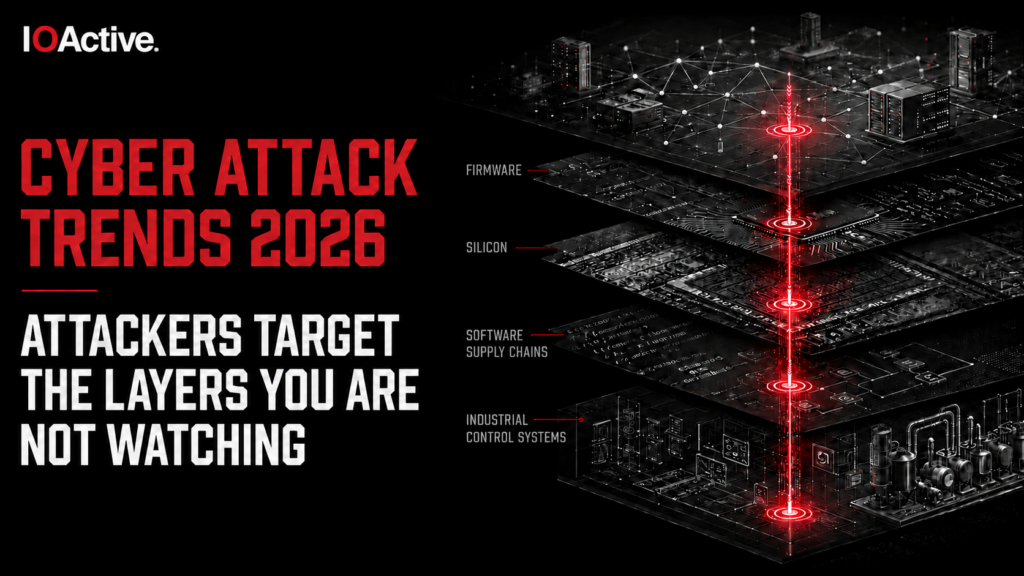
Recent IOActive research on 2026 attack trends points to a recurring problem: attackers target systems that companies rely on the most, but watch the least, including operational technology (OT), firmware supply chains, and AI-enabled development. That raises a difficult question for security leaders: Which risks deserve investment first?

The answer is not always the vulnerability with the highest technical severity. A useful cyber risk management strategy links technical risk to business impact, tests whether attack paths are realistic, and directs funding toward the risks most likely to disrupt the business.

“The most effective cyber risk management strategies prioritize business impact alongside technical risk.” – IOActive Security Team

Six Pillars of Business-Aligned Cyber Risk Management Strategies

PillarsWhere to StartKey Areas CoveredQuestion to Consider
Link risk to business impactFocus on risks that could disrupt critical operationsCritical services, dependencies, recoveryWhich services and dependencies need protection first?
Test priorities through offensive securityTest whether realistic attack paths can achieve business objectivesPenetration testing, Red Team, threat researchHow well do controls detect and respond to realistic attacks?
Manage connected exposureEvaluate risks beyond the organization’s direct controlThird parties, supply chains, OTWhich dependencies could affect resilience?
Govern AI by impactMatch oversight to the impact of failure or misuseAI-generated code, automation, dataWhere are more controls required?
Turn findings into decisionsEstablish ownership, thresholds, and funding prioritiesGovernance, risk appetite, reportingWhat should be fixed, accepted, or escalated?
Keep testing securityConfirm that controls remain effective as conditions changeRetesting, Purple Team, detection, recoveryHow does the organization know risk is improving?

These six pillars move from prioritization to validation, giving leaders a repeatable way to decide what to test, fund, and revisit.

A cyber risk management strategy should begin with the business services that cannot tolerate long outages, like production, payments, clinical operations, customer access, or safety processes.

Why it is essential

A vulnerability’s priority depends on what it could affect. Business impact may include lost revenue, downtime, safety consequences, regulatory exposure, reputational harm, data-integrity problems, or recovery difficulty. A moderate weakness may deserve urgent attention if it sits between an attacker and a critical process.

The key question is not simply, “How severe is this vulnerability?” It is, “Could this weakness create a credible path to business failure?”

What to do next

For each critical service, identify the dependencies that would have to fail for the service to stop or operate unsafely. Then rank those dependencies according to access, consequence, recoverability, and the likelihood that an attacker could reach them.

One useful way to structure this conversation is the NIST Cybersecurity Framework 2.0. The framework gives security, technology, risk, and business leaders a shared language for identifying, governing, protecting, detecting, responding to, and recovering from cybersecurity risk.

Used this way, the framework helps turn isolated findings into priorities the business can understand and fund.

Test Priorities Through Offensive Security

Offensive security tests whether realistic attack paths could reach a defined business objective. It provides evidence that a risk register or compliance assessment cannot provide on its own.

Why it is essential

An attacker may need to combine several moderate weaknesses to reach a sensitive system. A penetration test can validate a defined application, network, or product. A Red Team exercise can test whether an attacker can reach a business goal across technical, physical, and human layers. A Purple Team exercise can then bring offensive and defensive teams together to evaluate detection, response, and control effectiveness.

What to do next

Start with the decision the assessment needs to support. Leaders may need to know whether a compromised vendor account could reach production, whether a stolen credential could access a critical application, or whether security operations would detect a multi-step attack.

Choose the assessment based on that question rather than a generic checklist. The result should show which weaknesses could be combined, which controls would interrupt the attack, and where further investment would reduce uncertainty or exposure.

Manage Connected Exposure Across Third Parties and OT

A business-aligned strategy must include systems and organizations outside the traditional security boundary. Vendors, cloud providers, software suppliers, remote-access channels, and operational technology may all support critical business services.

Why it is essential

A supplier compromise could interrupt operations, expose sensitive data, alter production, or delay recovery. Third-party risk should therefore reflect more than a vendor’s questionnaire score. It should account for access, dependency, concentration, recoverability, and business consequence.

OT creates an additional concern because a security incident may affect physical processes. In some environments, an integrity failure may be more serious than an outage if an attacker can manipulate commands, sensor data, or operating conditions.

What to do next

Map the suppliers and external connections that support each critical service. Identify which accounts, interfaces, software components, and remote-access paths could provide entry into the environment.

For OT, evaluate security decisions alongside safety, continuity, recovery, and the limits of specialized systems. The goal is to understand which dependencies could create a credible path from an external compromise to operational disruption.

Govern AI Adoption According to Business Impact

AI should not be governed as a single risk category. The right controls depend on what the system can access, influence, or automate.

An internal productivity assistant presents a different risk from an AI tool that generates live code, handles customer data, approves transactions, or influences operational decisions.

Why it is essential

The consequences of an AI failure depend on where the system sits in the business. An incorrect answer may be inconvenient in one workflow but costly, unsafe, or difficult to reverse in another.

If an incorrect or manipulated result could cause material harm, keep a person involved in approval and define when the system must stop. If the system can reach sensitive data, production systems, or consequential decisions, limit access, log use, and monitor the system. If its output can affect a release, customer, or operational process, test it before deployment and continue checking it in production.

What to do next

A practical AI risk review should ask:

  • What happens if the system produces an incorrect or manipulated result?
  • What data, systems, or decisions can the system influence?
  • What validation occurs before the output reaches production or a customer?

Use the answers to set the controls. Keep a person involved when an output could cause material harm, restrict and monitor access to sensitive data or production systems, and require testing before release and during use. Review the code, data, integrations, access paths, and workflows around the system, then retest them as the system changes.

Turn Risk Findings Into Investment Choices

A technical finding has limited value until someone decides what to do about it. Governance should give security and business leaders a consistent way to determine whether a risk requires remediation, mitigation, formal acceptance, or escalation.

Why it is essential

Without clear ownership and decision thresholds, unresolved exposure can remain in a risk register without receiving meaningful attention. Explicit decisions also help executives compare security investments with other business priorities.

The most useful recommendation explains what an investment changes. A Red Team exercise may reduce uncertainty about attack paths, while improved monitoring may shorten detection and containment. Those are different outcomes and should be evaluated accordingly.

What to do next

Assign each high-impact risk an owner, a defined consequence, a decision deadline, and a treatment plan. Document whether the organization will fix the weakness, reduce its likelihood, limit its impact, monitor it, accept it, or escalate it.

Give every accepted or mitigated risk a review date so the decision remains visible and accountable.

Keep Testing and Adjusting Cyber Risk Management Strategies

Cyber risk management strategies need regular review as the business, suppliers, technology, and threat landscape change. Organizations need evidence that remediation, detection, response, and recovery still work.

Why it is essential

A control that worked six months ago may no longer protect the same system, service, or attack path. Organizations need evidence that remediation worked and that detection, response, and recovery capabilities remain effective.

What to do next

Retest important attack paths after remediation. Review dependencies after major changes. Use Purple Team exercises to validate detection and response, and measure time to detect, contain, recover, and restore key services.

Threat research should also update the assumptions behind security decisions. The goal is not more testing for its own sake. It is a feedback loop:

Identify → Prioritize → Test → Improve → Validate → Reprioritize

This sequence helps organizations determine whether security investment is reducing business risk or simply generating more technical findings.

Invest in the Risks Most Likely to Disrupt the Business

Effective cyber risk management strategies help leaders identify the attack scenarios most likely to disrupt operations, assess whether current defenses would withstand them, and direct investment where it will reduce risk.

That requires more than vulnerability discovery. It requires business context, adversarial testing, governance, and continuous validation.

IOActive combines research, offensive testing, and advisory services to help organizations examine those questions across AI/ML, supply chains, OT/ICS, hardware, firmware, and enterprise environments. The result is a clearer basis for deciding what to fix now, what to monitor, and what risk the business can accept.

GLOBAL THREAT GROUP, INSIGHTS, RESEARCH | October 1, 2026

LLM-Assisted Vulnerability Research: Finding Real Bugs with Code-Reasoning Models

Introduction

Point a code-reasoning model at a codebase and it reads through it far faster than I can, then hands back a long list of things that look like bugs. Generating that list is the easy part now, but most of it is noise. Almost every candidate falls apart the first time I try to trigger it against a real build, and the handful that survive still have to be proven before they count as findings. Getting from that list to a proven bug is the slow, deliberate part of the job.

In this post I walk through the workflow that I use to close that gap, and two real bugs it has produced. Both are now fixed in Angular and rated HIGH severity:

  • CVE-2026-68945: a server-side render cache that could hand one visitor’s response to the next visitor, skipping the backend’s authorization check entirely.
  • CVE-2026-69151: a translation-file path that let lower-trust text compile into a live JavaScript event handler, turning a localization bundle into a script-injection vector.

These two are the CVEs I can name today; more from the same process are still working through coordinated disclosure.

Neither came from asking a model to “find bugs.” Both came from a disciplined loop: work out the rules a project’s code must never break, from its patch history and its own design, then keep the model’s attention on one small piece of code at a time, drive it through four focused audit passes, and believe nothing until I have proven it myself in a real runtime. The model does the reading and the guessing. I own the threat model, the runtime, and the final call.

That division of labor, not the automation, is what holds the whole thing together. The rest of this post builds it up, starting with why the obvious shortcut (just asking a model to find bugs) doesn’t work.

Why “Find All the Vulnerabilities” Fails

Ask a large language model (LLM) to “find security bugs in this repository” and it will answer at length, confidently – and almost none of it will be worth acting on.

What comes back is a list of plausible-looking weak points with no sense of which ones an attacker can reach, textbook bug patterns matched onto code that never runs, and not one claim that the model has tried to disprove. Separating the real from the decorative lands right back on you, now scaled up to the length of the model’s output.

A bare request gives the model no notion of reachability, no trust boundary, and no idea which bug classes a maintainer would actually accept. That means it falls back on the only thing it can do: it matches shapes that look like vulnerabilities and reports them with even confidence, whether they sit on a hot path or in dead code. The model writes clean, persuasive analysis, but nothing in the request forces it to be true.

Constrain the request to a single testable claim, anchored in the target’s own history, and the same model behaves differently:

Recent accepted vulnerabilities in this component involved validation/use mismatches. A patch introduced cumulative length validation in one path. Identify sibling paths that still validate entries independently while dispatching batches to a backend that consumes cumulative state. Demonstrate or refute this in the product runtime, with a negative control and a fixed-version comparison.

Now the model has a reachability target, a boundary that defines impact, and a claim that can be caught when it’s wrong. This still generates candidates, but each one arrives with the terms of its own refutation attached.

The difference between the two prompts is not the model or its size, but the question. And a good question starts from a threat model.

Threat Modeling: Rules the Code Must Never Break

Before I send any code to a model, I build a compact threat model from the project’s own security history: its advisories, its commits, its patch diffs. The point isn’t only to re-hunt old bugs. It’s to learn how the software expects its data to behave, so I can then look for places where that assumption quietly fails.

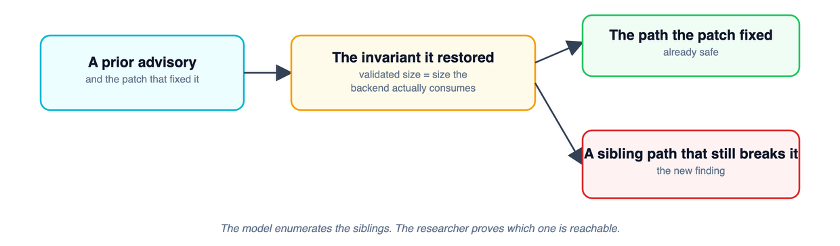
The output of that work is a short list of invariants. An invariant is a one-sentence rule the code assumes is always true and that a bug would break, for example, “the byte count validated at the perimeter must equal the amount the backend actually consumes.” That is the whole idea. An old validation-patch advisory becomes exactly that kind of rule. An advisory about a use-after-free (a bug where code keeps using an object after it’s been freed) becomes “no object may keep using itself after calling a callback that can destroy it.”

While an invariant is the rule the code must hold, once a bug shows that rule being broken, a variant is any other location where the same rule is broken in the same way.

Prior reported bugs make the hunt richer, because each one hands you an invariant the code already got wrong and a family of variants to chase, but they are not required. Where there are none, you derive the invariants from the code’s own contracts, a cache key that must stay unique or a trust boundary that must hold. This is where a model and an expert outrun what either does alone: the model maps the sinks and their connections across the whole surface far faster than a person could, while the researcher decides which invariants matter and where they break. The threat model is the method, and the pairing is what makes it powerful.

This is also why “find a use-after-free” is a useless prompt, while “determine whether this callback can free the parent object before the next line reads a member of it” is a good one. The first is a bug category, the second a specific claim a model and I can both test.

Nothing about this is specific to open-source. The method is the same whether the target is a public repository, a client’s proprietary codebase, or a closed black box, and what changes is only how much of the history is handed to you. Open-source projects give it away in public commits and advisories, which is why the examples in this post are open-source. On a closed target, you assemble the same ground truth yourself from decompiled interfaces, architecture documents, past vendor disclosures, and dynamic traces, and that is the slower, harder version of the identical work. A model can’t invent a threat model from nothing, and it works only from the evidence you give it.

Figure 1 – From a patch to its forgotten sibling.

Context Discipline: The Token Budget

Compressing history into an invariant is wasted effort if the model loses that invariant halfway through the job, which is exactly what happens when you ignore how its context works. A model doesn’t have your repository open the way an editor does. On every turn it sees one block of text – your prompt, the conversation so far, the code you pasted, the tool output that came back – and nothing else. That block is the context window, measured in tokens (roughly ¾ of a word each), and it is finite. Almost every failure I hit traces back to how that budget gets spent. The most relevant reasons for context failure are these three:

Lossy compaction. When a conversation nears the window limit, the tooling summarizes older turns to make room. Summaries keep the story (“found a validation gap”) and throw away the specifics upon which a finding depends: the exact line number, the build flag, the crash offset. After a couple of rounds of this, a session can sound completely confident while no longer holding a single piece of usable evidence. That’s the most dangerous failure mode, because nothing looks broken.

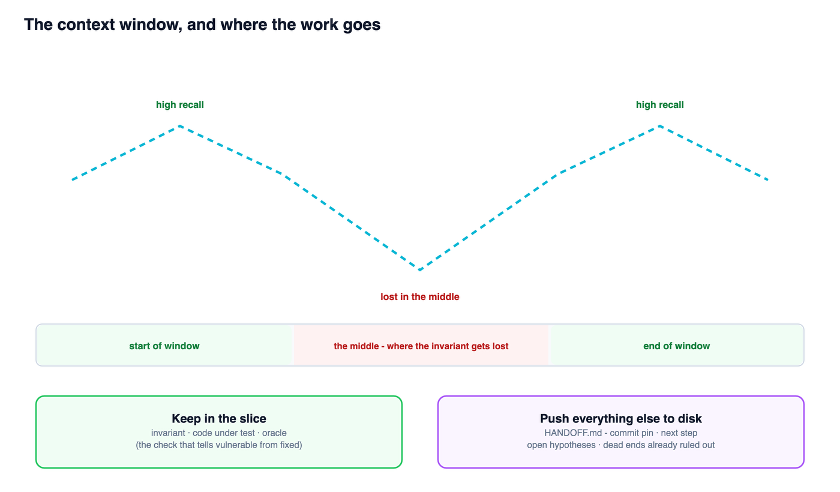
Degraded recall in the middle. A model recalls what sits at the start and end of a long context far better than what is buried in the middle. The effect has a name, “lost in the middle,” and it has outlasted several generations of far larger context windows. A 2025 context rot study found every one of eighteen frontier models still degrading as their input grew. That is the problem here, because the invariant, the one thing that has to hold from the first turn to the last, is exactly what sinks into that middle while the model keeps reasoning as if it still had it.

Cache invalidation. Reasoning over a large context is only affordable because the tooling caches the processed prefix. Churn the conversation and that cache goes cold, and every turn starts paying the full cost of reading everything again.

The fix is not a bigger window. That just moves the limit without solving the recall decay. The fix is to keep the working slice small enough that the invariant, the code under test, and the oracle (the check that separates a vulnerable build from a fixed one) all fit in the high-recall region at once. Everything else goes to disk.

Before I pause a session, I write a short HANDOFF.md at the repository root – the pinned commit, the current artifact, the live hypotheses, the dead ends already ruled out – so the next session resumes without re-deriving state. If that note runs longer than a page, the slice was too big and I split it.

Figure 2 – Keeping the slice in high-recall context.

The Four Audit Passes

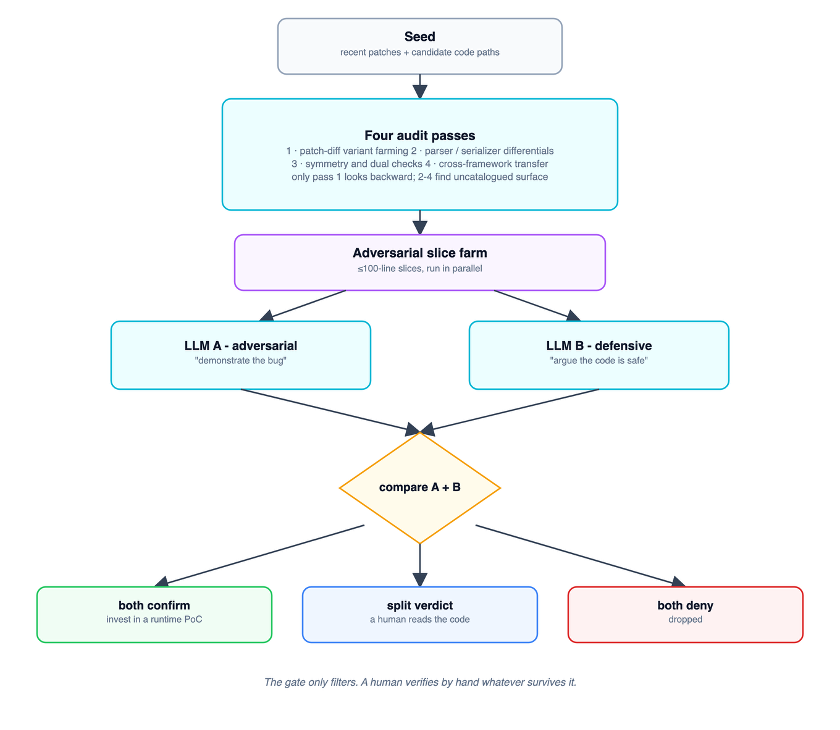
With a threat model in hand and a list of candidate code paths to check, I run the model through four audit passes. Each one has its own input and its own output.

  1. Patch-diff variant farming. A patch shows the exact line the maintainers changed, and the code around it shows the neighborhood they left alone. I ask the model to find sibling paths that still contain the old, pre-patch logic. This is my highest-yield pass by a wide margin.
  2. Parser and serializer differentials. When a system implements the same concept more than once – two URL parsers, two header processors, two cache-key generators – those implementations can disagree, and the disagreement is a bug. I list the pairs and ask for inputs where they produce different results, aiming at request smuggling, server-side request forgery (SSRF), or cache confusion.
  3. Symmetry and dual checks. For every input-validation check, I look for its output twin: the cache layer, serializer, or redirect handler that’s supposed to enforce the same rule on the way out. A missing twin is a strong candidate.
  4. Cross-framework transfer. Once a bug pattern works in one target, I test sibling frameworks for the same underlying assumption. If it replicates, that’s a class-level design flaw, not one project’s slip.

Only the first pass looks backward at patches. The other three go looking for attack surface nobody has catalogued yet.

Those passes hand back a list of candidate bugs. I cut each surviving candidate down to a slice of under a hundred lines and send it through a dual-model gate, where one session is prompted to prove the bug exploitable and another, handed the same slice with no prior context, is asked to prove it safe. This is not a vote, because two runs of the same model share the same blind spots. I treat it as a disagreement detector instead.

When both sessions call the bug real, it still owes me a runtime proof; when both call it safe, I drop it; and a split, which flags the non-obvious edge cases, is the most useful of the three. The gate only filters, though, and whatever comes out of it I verify by hand, reading the code and reproducing the behavior myself, because two models agreeing is not proof.

Figure 3 – Four audit passes into a dual-model gate.

What a Verified Finding Looks Like

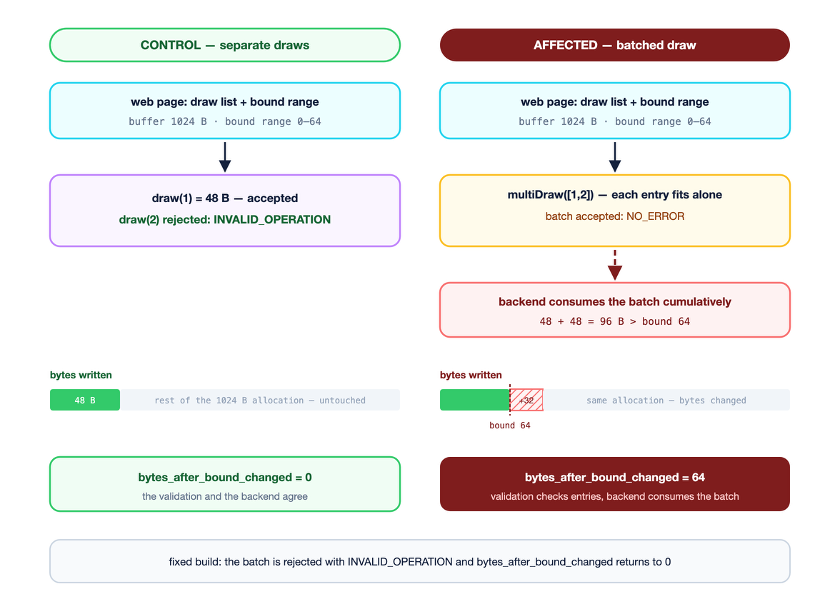
Before any of this touches a runtime, each candidate gets a spec card, four lines that fix exactly what is being claimed and what would prove it. Here’s one, from a sanitized browser-graphics example – a validation/use mismatch, where the check validates each draw command on its own but the backend runs the whole batch and walks the write cursor past the allowed buffer:

Invariant:  ValidateBatch must validate the cumulative byte count
            consumed by SubmitBatch, not the largest single entry.
Attacker:   A web page controls the draw list and the bound range.
Oracle:     The second draw must fail if draw1 + draw2 exceeds the
            bound range. A vulnerable build writes past the range;
            a fixed build returns an API error.
Stop:       Do not claim High unless the write crosses an allocation,
            ownership, process, origin, or authority boundary.

The oracle is the line that does the work, the exact condition that tells a vulnerable build from a fixed one. Here the oracle is checked across three runs, and the contrast between them is the proof:

separate_draw_control:    second_draw_error = INVALID_OPERATION
                          bytes_after_bound_changed = 0

batched_draw_vulnerable:  batch_error = NO_ERROR
                          bytes_after_bound_changed = 64

batched_draw_fixed:       batch_error = INVALID_OPERATION
                          bytes_after_bound_changed = 0

The first run is the negative control, where single checks reject the bad bounds. The second shows the bypass under batched execution, and the third confirms the fix. One log line would prove nothing, but the contrast across all three is what a triager can trust.

This example shows one more thing: because the writes stayed inside memory the calling page already owned, this was a constrained primitive (a real but limited capability), not full memory corruption. That distinction is the difference between a Medium and a High, and I’ll come back to it. The productive next question is never “can I make this proof-of-concept louder?” It’s “where else does this invariant fail?”

Figure 4 – A validation/use mismatch: control vs affected.

Two Real Findings in Angular

Here’s the method producing real, accepted bugs, both reported, confirmed, and patched upstream. One came from a forward-looking differential, the other from a patch variant.

CVE-2026-68945: two requests, one cache key

Advisory: GHSA-jhpw-976m-542j. Rated HIGH (CVSS v4.0) by the assigning authority.

The assumption, from history. Angular’s server-side rendering (SSR) builds the page on the server before sending it to the browser, and it caches the HTTP responses it fetches so the browser can reuse them during hydration instead of re-fetching. Any cache like that rests on one rule.

The invariant. Two HTTP requests that could receive security-distinct responses must never share a cache key.

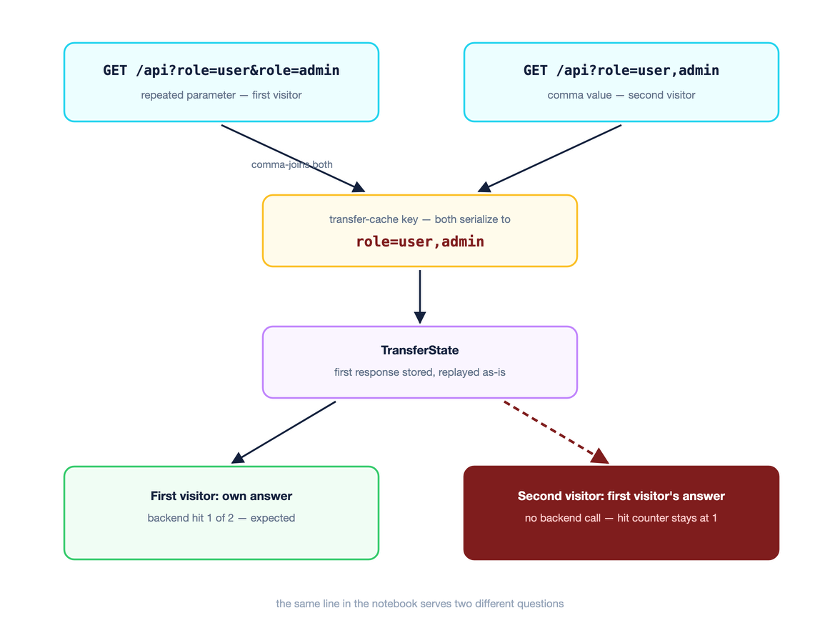
The hypothesis (Pass 2, serializer differential). If the code builds cache keys by turning request parameters into a string, is there more than one way to write “the same” string? There was. The key generator joined repeated parameters with commas, so two genuinely different requests collapsed onto one key:

GET /api?role=user&role=admin   →  key "role=user,admin"
GET /api?role=user,admin        →  key "role=user,admin"

Figure 5 – Two requests, one cache key (CVE-2026-68945).

The proof. The oracle was a backend hit-counter, and two distinct requests produced exactly one backend call. The second visitor was served the first visitor’s cached response straight from the transfer cache, never reaching the backend’s authorization check. Angular fixed the key serialization in 20.3.27, 21.2.19, and 22.0.2 (PR #68571).

CVE-2026-69151: a translation file that could inject a script

Advisory: GHSA-jj27-h5hq-8×99. Rated HIGH (CVSS v4.0) by the assigning authority.

The assumption, from history. Angular’s template compiler treats internationalization (i18n) files as lower-trust: translators are supposed to supply text, not code. That’s a trust boundary, and trust boundaries are exactly what threat modeling tells you to test.

The invariant. Lower-trust translation content must never compile into an event handler.

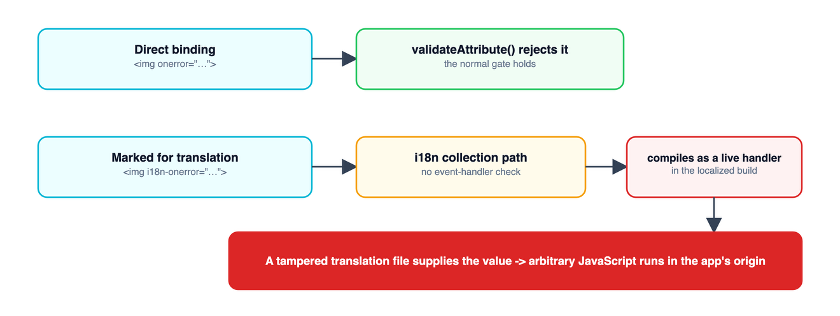
The hypothesis. An earlier fix had already closed one hole where translated content bypassed the normal attribute checks. So, what other attributes still slip through the same translation path? Event handlers did. The compiler accepted i18n-onerror and other i18n-on* attributes, which meant a tampered translation file could drop live JavaScript into a static event handler.

The proof. The demonstration is a compile-time differential rather than a memory trace. Bind onerror on an element directly and the compiler rejects it. Mark the same attribute i18n-onerror and it passes the i18n collection path and compiles into the localized build intact. A translation file supplying that attribute’s value then controls a live handler, which is exactly what the advisory documents, a lower-trust translation file replacing a benign onerror=”void 0″ with arbitrary JavaScript that runs in the application’s origin. Angular fixed it in 20.3.27, 21.2.19, and 22.0.1 (PRs #68821 and #69306).

Figure 6 – i18n bypass: onerror vs i18n-onerror (CVE-2026-69151).

The bug wasn’t a sanitization slip but a broken contract between the compiler and untrusted input, and that input is realistic: localization bundles routinely come from outside translators or a shared repository. As with the cache-key bug, the fix seeds the next cycle, because patching one attribute is an invitation to check every sibling attribute immediately.

Candidate Classification

The fastest way to sink a valid report is to overstate it, so I rate a finding by one thing only: the security boundary its runtime proof actually crosses.

That’s why the graphics example earlier was a Medium, not a High. The writes stayed inside memory the page already owned, so nothing crossed an allocation, process, origin, or authority boundary. Both Angular bugs cross a real one: CVE-2026-68945 serves a response across users, and CVE-2026-69151 runs script in the application’s origin. A scanner’s score is only an interpretation of it, but the breached boundary is a fact, so document the boundary and let the rating follow.

Conclusion

The cost of generating a hypothesis, writing a negative control, and checking a patch’s variants has collapsed. What’s scarce now is the discipline to throw the bad ones away quickly and prove the good ones are real.

In practice, that comes down to a few habits: threat-model before you prompt, so every question is anchored to one rule; never report a finding without a negative control and a fixed-version comparison; and run every candidate past a fresh, independent model session whose only job is to disprove it. That session is only a filter, though, and the final sign-off on any finding is always a person’s.

This doesn’t automatically favor defenders. The same tools are a download away for anyone, and patch-diff variant farming rewards whoever moves first after a commit ships. This means the takeaway for anyone shipping code is direct: run these passes on your own patches before you release, because someone outside will run them after you ship.

INSIGHTS | September 22, 2026

IT Risk Management Strategies: Key Metrics & Trends

Cyberattacks and data breaches have ranked as the number one global business concern for three consecutive years, according to Aon’s 2025 Global Risk Management Survey. The organizations still managing risk reactively are paying a measurable price. Hyperproof’s 2026 IT Risk and Compliance Benchmark Report found that 50% of those organizations suffered a breach in 2025. Among organizations with integrated, automated programs, the breach rate dropped to 27%.

That 23-point gap reflects a strategic difference in program design: how often risk is assessed, how findings connect to business decisions, and whether testing reflects real-world attack conditions.

This piece identifies key IT risk management strategies that separate mature programs from vulnerable ones, anchored in benchmarks from Verizon, Forrester, IBM, and Hyperproof:

  • Shift from periodic to continuous risk assessment
  • Align security testing to where attackers are actually moving
  • Extend technical validation into third-party and supply chain environments
  • Treat AI red teaming as a separate discipline from traditional red teaming
  • Quantify risk in business terms to improve security investment decisions

IT Risk Management Strategies

StrategyWhat It CatchesWhen to PrioritizeSign of Maturity
1. Shift to continuous risk assessmentBlind spots between assessment cyclesBoard lacks risk visibility; breach rate exceeds benchmarksNIST CSF 2.0 Govern in place; findings escalate to leadership on a defined cadence
2. Align testing to attacker trajectoriesAssessments that miss active threat vectorsEdge devices, ransomware, or third-party vectors are outside current scopeTTPs modeled on current threat actor behavior, not generic categories
3. Extend technical validation into third-party environmentsVendor programs limited to questionnaires and attestationsThird-party access is broad, or a vendor breach occurred in the past 24 monthsCritical suppliers tested under realistic attack conditions
4. Treat AI red teaming as a separate disciplineAI deployments assessed only against traditional controlsLLMs, ML models, AI APIs, or AI-integrated hardware are in productionPrompt injection, data poisoning, and adversarial inputs tested separately from IT infrastructure
5. Quantify risk in business termsSecurity findings that never reach prioritization or budget decisionsSecurity investment lacks ROI framing; findings stay technicalFAIR-based financial exposure tied to findings; risk reported in dollar terms

5 IT Risk Management Strategies That Separate High-Maturity Programs from Vulnerable Ones

“Effective IT risk management strategies prioritize the risks most likely to disrupt critical business operations, not simply the risks that are easiest to identify.” —IOActive

Strategy 1: Shift from Periodic to Continuous Risk Assessment

The biggest differentiator between high-maturity and low-maturity programs is not which framework they use. It is how often they assess.

Treating risk assessment as a periodic compliance exercise creates blind spots between cycles. The 23-point breach rate differential between reactive and integrated programs reflects this directly. Forrester’s State of Enterprise Risk Management 2025 adds another dimension: organizations without board-level ERM visibility were 20% more likely to suffer six or more critical risk events in a given year.

For most enterprise security programs, “continuous” does not mean auditing everything at once. It means layering assessment activities across defined cadences:

  • Ongoing: Automated monitoring of critical assets, threat intelligence feeds, and anomaly detection across production environments
  • Quarterly: Risk register review, third-party posture updates, and findings-to-remediation tracking against defined SLAs
  • Annually (minimum): Full penetration test of the environment, including edge devices and third-party access points
  • Change-triggered: Targeted assessment after any significant infrastructure change, acquisition, new vendor integration, or disclosed supplier breach

Two frameworks structure this cadence in practice. NIST CSF 2.0’s Govern function formalizes how risk oversight connects to organizational decision-making, not just technical operations. The FAIR (Factor Analysis of Information Risk) methodology translates those findings into probabilistic financial exposure that boards can act on. If current assessments cannot convert a technical finding into a quantified business risk, the reporting structure, not just the testing methodology, needs to change. IOActive’s penetration testing and advisory engagements are designed to generate findings at that level of specificity.

Reactive vs. Integrated Risk Programs: How Maturity Drives Breach Outcomes

Program CharacteristicReactive ProgramIntegrated Program
Assessment frequencyAnnual or periodicContinuous, change-triggered
Risk reportingSiloed, technicalTied to business outcomes
Board visibilityLimited or absentFormal ERM governance
Breach rate (2025)50%27%
Framework alignmentAd hocNIST CSF 2.0, FAIR, or equivalent

The table above makes the gap concrete: the difference between a 50% and a 27% breach rate is not a technology gap. It is a program design gap. Every row represents a decision a security leader can change without replacing existing tooling. To close that gap, start with three diagnostics:

  • Audit your assessment cadence. If the last full assessment was more than 12 months ago and was not triggered by an infrastructure change, your program is operating reactively regardless of which framework it claims to follow.
  • Test your reporting chain. Pull the most recent security finding delivered to leadership. If it was framed in technical terms without a financial exposure estimate, the board cannot act on it — and the Forrester data suggests that this gap is directly linked to higher rates of critical risk events.
  • Check framework alignment. NIST CSF 2.0 and FAIR are not aspirational targets. They are the operational baseline of integrated programs. If neither is in use, the program lacks a structured escalation path from findings to resource allocation.

Strategy 2: Align Security Testing to Where Attackers Are Moving

According to the Verizon 2025 DBIR, three vectors account for the most significant attacker movement in 2025: edge devices (exploitation up nearly eightfold), ransomware (up 37% year-over-year in breach data), and third-party environments (now involved in nearly 30% of all breaches, double the prior year). These are not random fluctuations. They reflect a deliberate shift toward the parts of enterprise environments that are hardest to monitor and least likely to be included in standard assessment scopes.

Organizations that limit testing to familiar, well-controlled internal environments are building a risk picture that excludes exactly the vectors attackers are actively exploiting. Effective IT risk management strategies account for where threats are moving: assessments must be built on current threat intelligence and on documented tactics, techniques, and procedures (TTPs) from active threat actors, rather than generic attack categories.

Active Threat Vectors Every IT Risk Management Strategy Must Account For (2025)

Threat Vector2025 TrendAssessment Implication
Ransomware37% YoY in breach dataTest detection and containment, not just prevention
Edge device exploitationNearly 8x growthExpand scope beyond the traditional network perimeter
Third-party involvementDoubled; ~30% of all breachesInclude supplier environments in testing scope
Phishing/social engineeringConsistent top initial access vectorTest employee response under realistic conditions

Strategy 3: Extend Technical Validation Into Third-Party and Supply Chain Environments

Third-party risk has moved from a compliance checkbox to a primary breach vector. Ethixbase360 reported that nearly 30% of all data breaches in 2025 involved third-party vendors or suppliers, double the rate from 2024. When a breach originates from a third-party environment, average remediation costs reach $4.8 million.

Exposure increases as the attack surface expands. SaaS integrations, AI APIs, cloud-managed services, and hardware supply chains create entry points outside an organization’s direct control. Attackers increasingly target upstream suppliers as indirect entry routes into better-defended downstream targets, a vector that questionnaires and attestations alone do not address.

For security leaders ready to move beyond attestation-based programs, four steps define where to start:

  • Classify vendors by access level. Identify which third parties have privileged access to your network, data, or production systems. Those with the highest access represent the highest residual risk if their environments are unvalidated.
  • Audit your current validation method per vendor. For each critical supplier, determine whether your current risk assessment is based on a questionnaire, a certification review, or actual technical testing. Questionnaire-only programs cannot detect active vulnerabilities or misconfigurations in a vendor’s environment.
  • Prioritize vendors who have changed or expanded access in the past 12 months. New SaaS integrations, API connections, and cloud-managed service agreements are the most common sources of unvalidated exposure in enterprise supply chains.
  • Schedule technical testing of your highest-risk suppliers. This means penetration testing of vendor-facing access points and, where applicable, hardware and firmware assessment for vendors operating in your physical or OT environment.

Technical validation of critical supplier environments, tested under realistic attack conditions, is where the real picture emerges. IOActive’s Supply Chain Integrity services take an attacker’s-mindset approach across every technology layer, including hardware, firmware, and silicon-level components.

Strategy 4: Treat AI Red Teaming as a Separate Discipline from Traditional Red Teaming

AI is both a security tool and a security risk vector, and those two realities require separate responses. IOActive’s AI Security Services address the risk side: testing the AI implementations that enterprise clients are deploying for vulnerabilities that traditional security assessments were not built to find. The distinction is not a matter of degree; it is a difference in target, methodology, threat framework, and deliverable.

AI Red Teaming vs. Traditional Red Teaming: Two Disciplines, Two Different Attack Surfaces

DimensionTraditional Red TeamAI Red Team
Primary targetNetworks, endpoints, applications, physical controlsML models, LLMs, training pipelines, AI APIs
Key attack typesLateral movement, privilege escalation, social engineeringPrompt injection, model extraction, data poisoning, adversarial inputs
Threat frameworkMITRE ATT&CK (Enterprise, Mobile, ICS)MITRE ATLAS, OWASP LLM Top 10
ScopeIT perimeter, cloud infrastructure, physical accessInference endpoints, training data, AI-integrated hardware, CI/CD pipelines
Deliverable focusControl gaps, detection capability, IR readinessModel robustness, data integrity, AI compliance posture
On-prem applicabilityYesPartial (AI-integrated hardware and embedded systems)

The Adversa AI 2025 report found that 35% of real-world AI security incidents resulted from simple prompt attacks, with no specialized tooling required: only manipulated inputs causing unintended behavior or data leakage. That finding aligns with IOActive’s own research, which evaluated 27 leading AI models using 730 real-world programming prompts across 27 languages and 219 vulnerability categories. Organizations testing AI implementations only against traditional security controls are not testing against the attacks that are actually succeeding in the field.

For security leaders building an AI red teaming capability or evaluating whether one is needed, four steps define where to start:

  • Inventory every AI deployment in production. Include LLMs, ML models, AI-integrated APIs, and any hardware with embedded AI components. Systems that have not been formally cataloged cannot be scoped into a testing program.
  • Determine how each has been tested to date. If AI systems have only been assessed under a traditional penetration testing scope, prompt injection, data poisoning, and adversarial input attacks have not been evaluated. That gap is where 35% of real-world AI incidents originate.
  • Prioritize by exposure. Public-facing AI interfaces and AI systems with access to sensitive data or internal decision-making pipelines carry the highest risk and should be tested first under MITRE ATLAS and OWASP LLM Top 10 frameworks.
  • Engage an AI red team, not a traditional one. The methodologies, tooling, and threat frameworks are different enough that assigning AI security testing to a conventional red team produces incomplete findings. The attack surface requires a purpose-built discipline.

Strategy 5: Quantify Risk in Business Terms to Improve Security Investment Decisions

Investment without measurement does not close the breach rate gap. Hyperproof found that 58% of GRC professionals anticipated increased risk and compliance spending in 2026, and that trajectory is expected to continue. The organizations extracting the most value from that spend are those directing it toward real-world validation with measurable business-risk outputs.

The FAIR methodology converts technical findings, such as a misconfigured edge device or an unpatched vendor API, into probabilistic estimates of financial exposure. NIST CSF 2.0’s Govern function formalizes the escalation path, providing a structure for how those estimates reach board-level decision-makers and translate into resource allocation. The result is a feedback loop: assessments generate findings, findings translate into financial exposure, and financial exposure directs investment where actual risk is highest.

Find Out Where Your IT Risk Management Strategies Actually Stand

Before directing more investment toward security tools or programs, three questions can identify where current gaps are largest:

  1. Can your team articulate, with data, how a sophisticated threat actor would move through your environment today? If the most recent assessment was conducted more than 12 months ago or did not include edge devices and third-party access points, the answer is likely no.
  2. Have your AI implementations been tested against prompt injection, data poisoning, and adversarial inputs? Testing AI only against traditional security controls leaves the most common AI-specific attack vectors unaddressed.
  3. Does your third-party risk program include technical validation of critical supplier environments, or only attestations and questionnaires? Given that 30% of 2025 breaches involved third parties, questionnaire-only programs leave a primary breach vector unvalidated.

If those questions cannot be answered with confidence, they are the gaps worth closing first. IOActive’s research-driven assessments connect offensive security findings to the business risk decisions that CISOs, CIOs, and boards need to build mature IT risk management strategies.

Sources

  1. Aon 2025 Global Risk Management Survey
  2. Forrester Business Risk Survey, 2025
  3. Forrester: The State of Enterprise Risk Management, 2025
  4. Hyperproof 2026 IT Risk and Compliance Benchmark Report
  5. Verizon 2025 Data Breach Investigations Report (DBIR)
  6. IBM/Ponemon Cost of a Data Breach 2025 (via CompTIA State of Cybersecurity 2025)
  7. Ethixbase360: Top 10 Third-Party Cyber Breaches of 2025
  8. FortifyData: Third-Party Data Breaches in 2025
  9. Adversa AI 2025 Report
  10. Grand View Research: Risk Management Market Report
  11. IOActive Resources: AI Model Research (730 prompts, 27 languages, 219 vulnerability categories)
  12. NIST Cybersecurity Framework (CSF) 2.0
INSIGHTS | August 20, 2026

Key Takeaways from the 2026 OCP APAC Summit

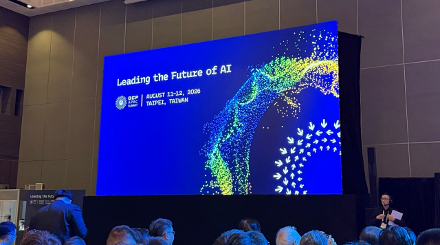
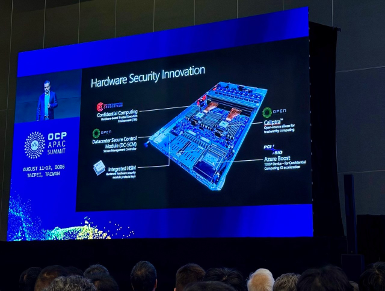
IOActive recently attended the 2026 OCP APAC Summit in Taipei. Below are our key takeaways from two days with the Open Compute community, along with a short recap video from the show floor at the end of this post.

Key Takeaways

  • The 2026 OCP APAC Summit (August 11–12) drew hyperscalers, semiconductor companies, device manufacturers, and infrastructure providers under the theme “Leading the Future of AI.”
  • AI security conversations extended beyond compute performance to the full stack: networking, cooling, storage, power, firmware, and the security controls underneath all of it.
  • Openness was a recurring theme, anchored by a dedicated SONiC Workshop on the open-source network operating system.
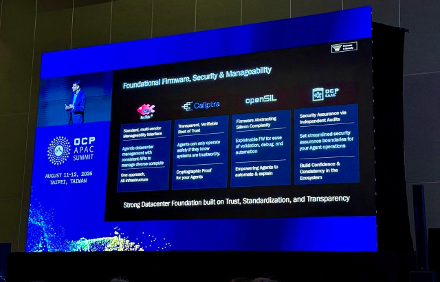
  • Multiple talks and vendor conversations pointed to growing interest in OCP S.A.F.E., the framework for independent security review of device firmware.
  • IOActive helped develop OCP S.A.F.E. from its early stages and continues to evaluate firmware security for device manufacturers today.

AI in the Agentic Era

AI was naturally at the center of this year’s summit, but the conversation went well past GPUs and raw compute performance.

The future of AI depends as much on trustworthy infrastructure as it does on faster accelerators and larger clusters. That means thinking about security across the whole stack, from applications and operating systems down to the firmware and hardware controlling the physical devices.

Open Data Centers and Open Networking

Openness was the other constant. The Open Compute Project’s philosophy of open hardware specifications, interoperable architectures, open firmware increasingly extends to networking, and the summit’s dedicated SONiC Workshop was a good example. SONiC, the open-source network operating system, brought together developers, users, maintainers, and vendors to compare notes on real-world deployments.

The direction of travel is toward data centers built from a diverse ecosystem of components rather than a single vertically integrated platform. That shift raises a practical question for operators: as devices and firmware arrive from a wider set of suppliers, how do you know they were built securely?

OCP S.A.F.E. and the Case for Independent Security Review

That question was the throughline of many of our conversations at the summit. Multiple technical talks and device-vendor discussions pointed to growing interest in OCP S.A.F.E., which lets vendors have their products evaluated by independent security reviewers against an established methodology.

For manufacturers, that’s more than a compliance checkbox. An independent review can surface vulnerabilities in firmware and other security-critical components before devices ship at scale, and it gives customers a concrete basis for confidence in what they’re deploying. As the supply chain behind any given rack grows more diverse, security assurance needs to travel with it.

IOActive has been involved in developing the OCP S.A.F.E. framework since its early stages, and we continue to work with device manufacturers on firmware and security assessments across the infrastructure being deployed today.

Taipei as a Meeting Point

Taipei was a fitting location for these conversations. Taiwan sits at the center of the global technology supply chain, home to a dense concentration of semiconductor companies, server manufacturers, ODMs, component suppliers, and firmware developers—much of the ecosystem responsible for the infrastructure data centers worldwide run on.

The summit itself made room for those conversations to happen: networking lounges, meeting areas, and coffee stations throughout the venue, lunch on-site, and reception drinks in the Expo Hall on the first evening. Live translation kept the technical sessions accessible to an international audience.

If you’re a device vendor preparing for OCP S.A.F.E. or looking to strengthen your firmware’s security, contact IOActive. Our team supports OCP S.A.F.E. assessments and independent firmware source-code security reviews.

Watch Our OCP APAC Summit Recap

Want to see the event from the show floor? We captured some of the technologies, conversations, and demonstrations from our time at the 2026 OCP APAC Summit in Taipei.

AI & MACHINE LEARING, INSIGHTS | August 6, 2026

Security Challenges in AI Adoption: 2026

Security professional using a laptop to review AI code

As enterprise AI adoption accelerates in 2026, organizations are discovering that deploying AI responsibly requires a fundamentally different security approach. AI is now embedded in development pipelines, customer-facing applications, operational workflows, and automated decision-making systems. Each deployment extends the attack surface in ways that existing security controls were not built to detect or contain.

This article breaks down the most significant security challenges in AI adoption for Global 1000 enterprises, supported by current research and IOActive’s adversarial testing experience. Attackers are exploiting the risks documented here right now, and every one of them can be measured and tested.  For security leaders building the internal case for AI security investment, the benchmarks and risk categories below provide the data to start that conversation.

Security Challenges in AI Adoption in 2026

Enterprise AI Security Challenges at a Glance

Security ChallengePrimary Attack VectorDocumented Exposure RateDetectable by Traditional Tools?Assessment Method
AI-Generated Code VulnerabilitiesInsecure code deployed without security review31.6% of AI-generated code samples are fully exploitable²PartialAdversarial code review and automated scanning
Prompt InjectionDirect or indirect input manipulationPresent in 73%+ of tested LLM deployments¹RarelyAdversarial red-teaming
Data Leakage via AI ToolsEmployee input, RAG over-disclosure, memorized training data50% of organizations expect a breach via AI tools in 12 months³RarelyPipeline security review
Shadow AI IncidentsUnauthorized AI tool adoption outside approved channels49% of organizations expect incidents in 12 months³NoInventory and governance review
Training Data PoisoningUpstream supply chain contaminationGrowing; no established baselineVery difficultData provenance audit
Third-Party Model RiskPre-trained models, external inference APIs97% of organizations had a supply chain breach in 2025⁴NoArchitecture review
Agentic AI MisusePrompt engineering, agent manipulation40% of enterprise apps will include AI agents by end of 2026⁵Very difficultThreat modeling
AI Governance GapsFragmented ownership, absent or ad hoc policy70% of organizations lack optimized AI governance³N/AProgram efficacy assessment

AI Application Security: Where Traditional Controls Fall Short

AI-enabled applications introduce attack surfaces that standard penetration testing was not designed to probe. When a model sits between user input and backend systems, the authorization boundary shifts in ways that static analysis and WAF rules cannot capture. Traditional security testing verifies that code executes as intended. AI security testing must verify that a model behaves as intended across adversarial inputs it was never built to anticipate.

How Tool-Calling Chains Expand the Attack Surface

Tool-calling features are pathways that allow AI models to take actions in connected systems, such as accessing files, querying databases, or triggering API calls. These are among the most exploitable surfaces in deployed AI stacks. A successful attack against a tool-calling chain does not require shell access; it requires a crafted input that persuades the model to act against its operator’s intent.

What the Research has Found in 2026

IOActive’s 2026 research quantifies how broadly this problem affects AI in production. In an evaluation of 27 leading AI models using 730 real-world programming prompts across 27 programming languages and 219 vulnerability categories, average security performance across all models was just 59%.² Nearly one-third of AI-generated code samples (31.6%) were fully exploitable, and no model achieved 100% secure output.² Even the best-performing configuration produced 90 vulnerabilities.² Infrastructure and DevOps code, including Dockerfiles, Terraform configurations, and CI/CD pipelines, exceeded 70 to 97% vulnerability rates.²

The practical takeaway is direct: organizations using AI in software development must treat AI-generated code as untrusted input requiring mandatory security review before deployment, particularly for authentication, cryptography, and infrastructure.

Traditional Application Security vs. AI Application Security

DimensionTraditional Application SecurityAI Application Security
Primary attack surfaceCode logic, APIs, and user inputsPrompts, model behavior, tool-calling chains
Testing approachStatic and dynamic analysisAdversarial red-teaming, behavioral evaluation
Attack success predictionDeterministicProbabilistic
Authorization bypass methodCredential theft, injectionPrompt manipulation, context override
Data leakage pathDatabase exfiltrationModel output, RAG retrieval over-disclosure
Governing frameworkOWASP Top 10OWASP LLM Top 10, MITRE ATLAS

Prompt Injection: The Most Prevalent and Exploitable AI Vulnerability

Prompt injection holds the top position in OWASP’s LLM Top 10 (ranked LLM01:2025) for a measurable reason. It appears in over 73% of tested LLM deployments¹ and carries attack success rates of 50 to 84% against unprotected systems, depending on configuration.⁶ In 2025, researchers documented over 461,640 prompt injection submissions in a single dataset, confirming that this attack class is being weaponized at scale.⁷

Why Prompt Injection Is a Structural Problem

Prompt injection is the AI equivalent of social engineering the system itself. An attacker submits instructions disguised as normal input, and the model follows them instead of its original instructions. Because large language models process operator instructions and user input through the same channel, this vulnerability is structural, not a configuration error that can be patched away.

Direct and Indirect Injection: How Attacks Are Delivered

The two dominant variants are direct injection, arriving through the user interface, and indirect injection, embedded in content that the model retrieves as context, including documents, emails, and database records. IOActive’s AI application assessments test both variants, as well as chained injection across multi-step workflows and persistent injection that survives into model memory or session history. Every finding is delivered with prompts and replay harnesses so engineering teams can reproduce, regression-test, and track remediation.

“The greatest AI security risks rarely originate in the model itself; they emerge from how AI systems interact with data, applications, and business processes.”

Prompt Injection Types, Delivery Methods, and Risk Levels

Injection TypeDelivery MethodPotential ImpactExecution Difficulty
Direct injectionUser input via chat interfaceSystem prompt override, sensitive data disclosureLow
Indirect injectionRAG context, documents, email contentExfiltration, unauthorized API callsMedium
Chained injectionMulti-step agent workflowFull pipeline compromiseHigh
Persistent injectionModel memory or session historyRecurring unauthorized behaviorHigh

Data Leakage, Shadow AI, and Training Data Integrity

AI systems process, memorize, and sometimes reproduce sensitive data in ways that fall entirely outside traditional data loss prevention models. The risk operates at two distinct levels: what the model was trained on, and what it is exposed to at inference time.

Training-Level Risk: What Models Memorize

At the training level, models can memorize specific records from their training data, including personally identifiable information, internal documents, and proprietary source code. IOActive’s adversarial evaluation methodology includes membership inference testing, which determines whether specific data has been memorized by a model rather than inferred from general training patterns. In enterprise fine-tuned models, sensitive training data can surface in model outputs under targeted prompting conditions, and no application-layer control will catch it after deployment.

Inference-Level Risk: What Employees Share

At the inference level, 50% of organizations expect data loss caused by AI tools within the next 12 months.³ Employees entering customer records, regulated data, or internal strategy documents into third-party AI applications create a leakage path that exists entirely outside security visibility and DLP enforcement. Shadow AI compounds this exposure: 49% of organizations expect incidents from unauthorized AI tool adoption within the same timeframe.³ These tools process real business data while remaining invisible to security monitoring and data classification controls.

AI Data Leakage Pathways and Mitigation Approaches

Leakage PathwaySourceDetectable by Standard DLP?Mitigation
Training data memorizationFine-tuned enterprise modelsNoMembership inference testing
Inference-time user inputEmployee-entered promptsPartialPolicy enforcement, input filtering
RAG retrieval over-sharingVector database query resultsNoAccess scoping, retrieval audit
Model output over-disclosureAI assistant or chatbot responsesRarelyOutput filtering, red-teaming
Shadow AI tool adoptionUnauthorized external applicationsNoInventory, governance, monitoring

Third-Party Model Risk and AI Supply Chain Exposure

Most enterprise AI deployments don’t start from scratch. They rely on pre-trained foundation models, open-source frameworks, third-party datasets, and external inference APIs. Each dependency introduces a trust assumption that few organizations have formally assessed.

Why AI Supply Chain Risk Is Broader Than Traditional Software Risk

OWASP’s LLM03:2025 Supply Chain classification identifies AI supply chain vulnerabilities across training data, models, and deployment platforms. The scope is broader than traditional software supply chain risk: a model’s behavior is directly shaped by its training provenance. A foundation model built on manipulated or low-quality data carries those defects into production, and application-layer security controls cannot correct them after deployment.

The Scale of Current Exposure

The broader supply chain risk baseline is severe. In 2025, 97% of organizations experienced at least one supply chain breach, a 20% increase from 2024.⁴ Software engineering teams account for nearly 50% of enterprise AI use,⁸ meaning AI-generated code is entering software supply chains at a volume that manual review alone cannot keep pace with.

How IOActive Assesses Third-Party Model Risk

IOActive’s third-party model risk assessments cover model signing and artifact lineage, access privileges around model weights, and deployment integrity testing. Threat modeling is aligned to MITRE ATLAS, the adversarial threat landscape framework built specifically for AI systems, so findings connect directly to real-world attack patterns rather than abstract risk categories.

Third-Party AI Risk Areas and Assessment Methods

Risk AreaKey Assessment QuestionsAssessment Method
Foundation model provenanceWho trained it? On what data?Architecture review
Model integrityIs the model signed? Has it been modified in transit?Integrity and custody testing
Inference API exposureWhat data transits external inference endpoints?Penetration testing
Open-source dependenciesAre framework vulnerabilities patched and tracked?Dependency and code audit
Training data provenanceIs training data labeled, validated, and auditable?Data pipeline security review
Artifact lineageCan high-influence training samples be identified?Pipeline assurance review

Agentic AI: When Autonomous Systems Inherit Your Risk Surface

Agentic AI refers to AI systems that take actions independently, without waiting for human approval at each step. They can browse the web, send emails, execute code, call APIs, and trigger workflows autonomously. Gartner predicts that 40% of enterprise applications will incorporate these task-specific AI agents by the end of 2026, up from fewer than 5% in 2025.⁵ Deloitte’s 2026 State of AI report anticipates that 75% of companies will use agentic AI to some degree by 2028.⁹

The Permission Problem: Why Agentic Systems Are Inherently High-Risk

To operate effectively, agents require broad cross-environment permissions, including access to files, APIs, email systems, payment workflows, and production databases. Many AI tools connecting to external systems currently operate in a trust-by-default mode, creating significant vulnerabilities.¹⁰ When an agent is manipulated through prompt injection, the blast radius extends to every system that agent can reach. In multi-agent systems, a compromised upstream agent can propagate malicious instructions to downstream agents before any human checkpoint has the opportunity to intervene.

What Agentic AI Attacks Look Like in Practice

Attack scenarios are concrete. Indirect prompt injection embedded in a retrieved document can cause an agent to forward sensitive files, execute unauthorized API calls, or authorize transactions, all without user interaction. Identity and access management risks expand dramatically in these environments: agent credentials and permissions require the same rigor as for human users, yet most organizations have not yet built that infrastructure.

IOActive’s threat modeling for agentic systems traces attacker paths across SDKs, agents, plugins, and the surrounding supply chain. Exposures are mapped to ATLAS-style TTPs, the AI-specific adversarial technique catalog, so that detections and guardrails emerge as engineering tasks with clear owners rather than policy abstractions without enforcement.

Agentic AI Attack Scenarios and Business Impact

Attack ScenarioEntry PointAgent ActionBusiness ImpactRecommended Assessment
Prompt injection via retrieved documentRAG or email contextForwards sensitive files externallyData exfiltrationAI Application Security Assessment; Prompt Injection Testing
Chained agent manipulationCompromised upstream agentPropagates malicious task downstreamCascading unauthorized system accessAgentic AI Threat Modeling; Red Team Exercise
RAG-based indirect injectionVector database retrievalExecutes unauthorized API callsUnauthorized transactions or data modificationsAI Pipeline Security Assessment; RAG Architecture Review
Excessive permissions abuseMisconfigured agent identityDeletes or modifies production dataData loss, operational disruptionAgentic AI Architecture Review; Identity and Access Management Review
Multi-agent trust exploitationInter-agent communication channelEscalates privileges across systemsLateral movement, IP theftFull-Scope Red Team Exercise; Agentic AI Threat Modeling

AI Governance: The Structural Security Challenge Behind Every AI Adoption Decision

Most AI security failures share a common root cause: governance structures that haven’t kept pace with deployment speed. Proofpoint’s 2025 State of AI Security research found that 70% of organizations lack optimized AI governance, and 39% operate with no AI-specific governance at all.³ These organizations are deploying AI while simultaneously expecting data loss events and shadow AI incidents within the next 12 months.

The Ownership Fragmentation Problem

Ownership fragmentation compounds the problem. CIOs control 29% of AI security decisions, while CISOs rank fourth at 14.5%.³ That distribution reflects an AI adoption curve that outran the security function entirely. Effective AI governance requires unified ownership, board-level risk visibility, and continuous monitoring. Those capabilities don’t emerge naturally from a model where each function applies different controls to different risk definitions.

Building the Internal Case for AI Security Investment

For security leaders working to build internal momentum around AI risk, the business case is now straightforward: nearly one-third (31%) of organizations are redirecting their largest security investment toward AI supply chain security over the next 12 months.³ Organizations deploying AI ahead of a governance framework are also accumulating compliance exposure as AI-specific audit requirements mature across financial services, critical infrastructure, and government sectors, including CREST-aligned assessments and Cyber Essentials mandates increasingly applied to vendor supply chains.

Establishing Your Baseline

Reaching a governed state requires knowing where you stand today. An independent AI security assessment establishes the baseline across model behavior, pipeline integrity, application security, and governance maturity so that improvements can be sequenced, budgeted, and measured.

AI Governance Maturity Levels

Governance Maturity LevelDescriptionEst. % of OrganizationsPrimary Risk
NoneNo AI-specific governance in place3%³Uncontrolled and unmeasured AI deployment
Ad hocInformal practices, no documentation16%³Inconsistent controls, high shadow AI exposure
DefinedDocumented framework, limited enforcement20%³Framework exists; enforcement gaps create exposure
ManagedMeasured effectiveness and reporting31%³Controls in place but not continuously optimized
OptimizedBoard visibility, automated monitoring, incident-driven updates30%³Closest to secure; still requires adversarial validation

Frequently Asked Questions

What is the most commonly exploited AI security vulnerability in enterprise environments?

Prompt injection holds the top position in OWASP’s LLM Top 10 and appears in over 73% of tested LLM deployments.¹ Its success rate against unprotected systems ranges from 50 to 84%, making it the first vulnerability class to address in any structured AI security assessment.⁶

How does AI security testing differ from standard penetration testing?

Standard penetration testing validates code execution paths, authentication controls, and API security. AI security testing additionally requires adversarial evaluation of model behavior, prompt injection testing across direct and indirect attack vectors, membership inference analysis (which confirms whether sensitive data was memorized by the model rather than inferred), training data poisoning assessment, and model extraction simulation. IOActive’s AI security assessments cover the full stack, from model and pipeline through application and infrastructure, with findings delivered as reproducible, engineering-ready remediation tasks.

What governance steps should organizations prioritize before expanding AI deployment?

Establish an AI system inventory, assign unified ownership of AI security decisions to the CISO function, and define data handling policies for AI tools before expanding deployment. Treat AI-generated code as untrusted input requiring mandatory security review, particularly for authentication, cryptography, and infrastructure configurations. An independent assessment of existing deployments is the fastest path to identifying where governance gaps create measurable exposure and where emerging compliance requirements may impose near-term deadlines.

What makes agentic AI uniquely risky compared to traditional AI deployments?

Traditional AI deployments produce outputs that a human reviews before acting. Agentic systems take actions autonomously across multiple systems at machine speed. When a manipulated agent can send emails, authorize payments, delete files, and call APIs without a human approval step, the blast radius of a single successful injection attack is orders of magnitude larger than in a passive AI deployment.

Conclusion

The security challenges in AI adoption in 2026 are measurable, documented, and addressable with the right adversarial methodology. Prompt injection succeeds against 50 to 84% of unprotected systems. Nearly one-third of AI-generated code is fully exploitable by default. Seventy percent of organizations lack the governance structures needed to detect or contain AI-related incidents. Those are the current baselines, not the inevitable outcomes. Organizations that instrument their models, secure their pipelines, enforce governance, and apply adversarial testing as a standard part of AI delivery are the ones that move through enterprise AI adoption with the least exposure and the clearest audit trail.

With more than 25 years of independent security research, physical testing labs across three continents, and a track record of identifying emerging threats before they reach headline status, IOActive brings the depth that enterprise AI security demands.

Sources

1.) Obsidian Security. “Prompt Injection Attacks: The Most Common AI Exploit in 2025.” obsidiansecurity.com/blog/prompt-injection

2.) IOActive. “The Security Gap in AI-Generated Code.” April 2026. ioactive.com/the-security-gap-in-ai-generated-code/

3.) Proofpoint. “The State of AI Security 2025.” proofpoint.com/us/resources/threat-reports/state-ai-security-2025

4.) Atlas Systems. “Third-Party Risk Management Statistics.” atlassystems.com/blog/third-party-risk-management-statistics

5.) Gartner. “Gartner Predicts 40 Percent of Enterprise Apps Will Feature Task-Specific AI Agents by 2026.” August 2025.

6.) Vectra AI. “Prompt Injection: Types, Real-World CVEs, and Enterprise Defenses.” vectra.ai/topics/prompt-injection

7.) Securance. “Prompt Injection: The OWASP #1 AI Threat in 2026.” securance.com/blog/prompt-injection-the-owasp-1-ai-threat-in-2026

8.) Zscaler ThreatLabz. “AI Security Report 2026.” zscaler.com/resources/industry-reports/threatlabz-ai-security-report-2026.pdf

9.) Deloitte. “State of AI 2026.” deloitte.com/content/dam/assets-zone3/us/en/docs/services/consulting/2026/state-of-ai-2026.pdf

10.) Recorded Future. “Emerging Enterprise Security Risks of AI.” recordedfuture.com/research/emerging-enterprise-security-risks-of-ai

INSIGHTS | August 4, 2026

Cyber Attack Trends 2026: What Security Teams Face

Cyber Attack Trends 2026 at the Silicon Level; Firmware, Silicon, Software Supply Chains, Industrial Control Systems.

“The most significant cyber attacks of 2026 will target the systems organizations depend on most, not the systems they monitor most closely.”

Most cybersecurity forecasts treat ransomware, AI-enabled attacks, and supply chain risks as parallel threats of equal weight; a framing that produces the wrong priorities for security teams protecting complex organizations. The cyber attack trends in 2026 share a specific characteristic: they exploit environments organizations depend on most but monitor least, from industrial control systems running legacy protocols to firmware supply chains lacking integrity verification. This article evaluates which attack patterns represent confirmed, active risk across key threat categories.

ThreatKey Risk IndicatorLevel of ConcernRecommended Assessment
Ransomware

Targeting OT and critical infrastructure
$74B global damage projected¹EscalatingRed team, OT security assessments
Software Supply Chain Attacks

Build pipelines, open-source dependencies
$80.6B cost projection by 2026²UnderestimatedSecure development lifecycle (SDL)
OT/ICS Threats

PLCs, RTUs, engineering workstations
3,300+ industrial orgs impacted³UnderdetectedOT/ICS security assessment
AI-Enabled Attacks

Dev pipelines, social engineering
31.6% of AI code fully exploitable⁴Mixed: some confirmed, some speculativeSecure code review, SDL
Critical Infrastructure Cyberattacks

Energy, water, transport, defense
$4.82M average breach cost⁵UnderreportedFull-stack ICS/OT assessment

Ransomware: From File Encryption to Operational Disruption

Ransomware groups have moved beyond encrypting files and demanding payment. The operational model has shifted toward the targeted disruption of systems that organizations cannot quickly stop or replace.

Ransomware incidents reached 6,500 in 2025, up from under 1,400 in 2020, a more than 360% increase over five years.⁶ Global damage costs are projected to reach $74 billion in 2026, a 30% increase from $57 billion in 2025.¹ For organizations in critical sectors, the average breach cost stands at $4.82 million per incident, excluding production loss and regulatory response.

Ransomware CharacteristicTraditional Model (Pre-2022)2026 ModelRecommended Assessment
Primary objectiveFile encryption, ransom demandOperational disruption plus ransomOT incident response planning
Target selectionOpportunistic, volume-basedSector-targeted, timing-awareThreat modeling
OT environment knowledgeLowActive, documented reconnaissanceOT security assessment
Recovery timelineHours to days (IT)Days to weeks (OT)OT business continuity review
Payment pressure leverThreat of data exposureExtended process downtimeRed team exercise

How Threat Groups Are Targeting OT Environments

The threat model has changed in a specific way. Groups with OT knowledge now time attacks around operational windows: peak demand periods for energy utilities, scheduled maintenance cycles at manufacturers, pre-harvest windows in agricultural processing. Dragos tracked 3,300 industrial organizations affected by ransomware in 2025.³ These are not random hits. They reflect adversaries who understand operational context well enough to maximize financial leverage.

What Separates Fast Recovery From Extended Downtime

Organizations recovering fastest from ransomware incidents are those that have run realistic OT continuity exercises against adversary scenarios. Applying untested IT recovery playbooks to industrial environments results in extended downtime because the two environments fail differently and recover on different timelines.

Software Supply Chain Attacks: The Dominant Third-Party Risk Vector

The SolarWinds compromise in 2020 demonstrated that trusted software update mechanisms could deliver malware to thousands of organizations simultaneously. The XZ Utils backdoor in 2024 showed that state-sponsored actors were willing to invest years in maintaining access to open-source projects before activating a payload. Neither incident was an outlier. Both represent a confirmed shift in how sophisticated threat actors approach access at scale.

Supply Chain Attack TypeNotable CaseDetection DifficultyDownstream ScopeRecommended Assessment
Software build tool compromiseSolarWinds (2020)High18,000+ organizationsSecure development lifecycle (SDL) review
Open-source package backdoorXZ Utils (2024)HighMillions of Linux systemsSoftware composition analysis
Firmware implantVendor hardware (multiple)Very highFull device lifecycleFirmware security assessment
AI model poisoningEmerging (2025–2026)Very highDevelopment pipelinesAI supply chain review
Hardware and silicon-level attackAMD Sinkclose (2024)⁷Extremely highEndpoint device fleetsSilicon security assessment

Third-Party Risk Is Growing Faster Than Programs Can Track

Third-party involvement in security breaches rose from 15% to 30% in 2025.² Supply chain attack costs are projected to exceed $80.6 billion by 2026.² The attack surface is not shrinking: organizations now average over 1,000 third-party vendors, and the majority lack visibility into the security posture of their software dependencies beyond first-tier vendors.

One Compromise Can Expose Every Downstream Organization

The risk is systemic, not incidental. A single compromise of a widely used build tool, package manager, or firmware update process exposes every downstream organization that relies on it. Your environment’s security now depends in part on the security of every component that touches your build pipeline, whether or not you have audited it.

OT/ICS Threats: Adversaries Mapping Physical Processes

The 2026 Dragos OT Cybersecurity Year in Review documents a specific evolution in how adversaries approach industrial environments. They are no longer staging for future disruption. They are actively mapping control loops to understand how to manipulate physical processes with precision.³

OT Threat GroupPrimary Target SectorDocumented 2025 ActivityICS Kill Chain StageRecommended Assessment
VOLTZITEElectric, oil and gasGateway compromise, configuration extractionStage 2OT network security assessment
KAMACITEEnergy, water, heating (EU, US)Four-month ICS reconnaissance campaignStage 1ICS threat hunting
ELECTRUMUkrainian, Polish infrastructureDestructive wiper deployment (PathWiper)³Stage 2OT incident response planning
SYLVANITEUS utilities, SAP environmentsZero-day exploitation (CVE-2025-31324)Stage 1Vulnerability assessment
BAUXITEIsraeli critical infrastructureDual wiper variants deployedStage 2Full-stack ICS/OT assessment

Active OT Threat Groups

Three new OT threat groups emerged in 2025. Established groups expanded operations globally. Dragos now tracks 26 OT threat groups.³ KAMACITE conducted four months of sustained reconnaissance against US internet-exposed ICS assets, targeting specific device types in sequence. VOLTZITE compromised Sierra Wireless Airlink gateways across electric and oil-and-gas sectors, then pivoted to engineering workstations to extract configuration and alarm data. ELECTRUM deployed coordinated destructive wiper malware against eight Ukrainian ISPs and, in December 2025, Polish CHP facilities.³

Why Most Organizations Cannot See the Threat

The visibility problem is structural. Only 30% of OT networks have the monitoring capability to detect these threats before operational impact. 56% of organizations cannot see below the IT/OT boundary. 88% struggle with detection and response in OT environments.³

The Integrity Blind Spot Adversaries Exploit

IOActive’s research into OT security architecture has identified a persistent strategic blind spot. The standard AIC reordering (Availability-Integrity-Confidentiality) used in many OT environments prioritizes availability, which is precisely where the most capable adversaries operate. Stuxnet manipulated centrifuge speeds while feeding false readings to operators for months. Triton/TRISIS targeted Safety Instrumented Systems to remove the safeguard layer before causing process failure. Industroyer sent commands directly to substation equipment using native industrial protocols. All three targeted integrity, not availability, because integrity failures often go undetected, whereas availability failures trigger an immediate response.⁸

AI-Enabled Attacks: Separating Confirmed Risk From Speculation

AI’s role in offensive security requires more precision than most threat briefings provide. The meaningful 2026 risk is not the speculative scenario of fully autonomous AI attackers. It is the measurable deterioration in code security caused by AI-assisted development tools, and the accelerated pace at which phishing and social engineering campaigns now operate.

AI Attack VectorOperational MaturityDocumented Risk IndicatorDefender PriorityRecommended Assessment
AI-generated insecure code in productionHigh31.6% of samples fully exploitable⁴CriticalSecure code review, SDL
AI-accelerated phishing and spear-phishingHighVolume and personalization increase confirmedHighSocial engineering assessment
Deepfake-based social engineering and fraudMedium-HighActive in financial and executive targetingHighRed team exercise
AI-assisted vulnerability discovery by threat actorsMediumBeing used by advanced groupsMediumThreat modeling
Autonomous AI attack agentsLowDemonstration cases only; no confirmed deployment at scaleMonitor onlyNo immediate action required

AI-Generated Code Is Already a Security Liability

IOActive’s April 2026 whitepaper evaluated 27 leading AI models and AI-powered coding tools using 730 real-world programming prompts across 27 languages and 219 vulnerability categories. Security outcomes were measured against 72 automated vulnerability detectors, producing nearly 20,000 analyzed code samples. The results were direct: average security performance across all models was 59%, and 31.6% of AI-generated code samples were fully exploitable.⁴

No model achieved 100% secure output. Infrastructure and DevOps code (Dockerfiles, Terraform, CI/CD pipelines) produced the worst results, with vulnerability rates between 70% and 97%. Authentication, rate limiting, and cryptography consistently failed across nearly all models.⁴ According to IOActive’s research, GitHub Copilot is now generating nearly half of developers’ code.⁴ Organizations deploying AI coding tools without mandatory security review before production deployment are introducing exploitable risk at scale as a present, documented condition.

Where AI Is Accelerating Offensive Capabilities

The WEF Global Cybersecurity Outlook 2026 found that 87% of respondents identified AI-related vulnerabilities as the fastest-growing cyber risk over 2025.⁹ AI is accelerating phishing volume, enabling more convincing social engineering, and lowering the technical barrier for credential-based attacks.

Critical Infrastructure: The Widening Gap Between Visibility and Exposure

64% of organizations now account for geopolitically motivated cyberattacks against critical infrastructure in their 2026 risk strategies.⁹ 91% of the world’s largest organizations have changed their cybersecurity strategies due to geopolitical volatility.⁹ Awareness has grown. Technical detection coverage has not kept pace with it.

Critical Infrastructure SectorPrimary 2026 Threat VectorCurrent Avg. VisibilityRecommended Assessment
Energy (grid and generation)OT compromise, wiper malwareLow (30% avg. OT visibility³)Full-stack ICS/OT assessment
Water and wastewaterICS manipulation, ransomwareVery lowOT network segmentation review
TelecommunicationsSupply chain implants, espionageMediumHardware and firmware audit
TransportationEmbedded system attacks, GPS manipulationLowEmbedded systems assessment
Defense industrial baseHardware supply chain, insider accessVariableSilicon-level security review

Active Campaigns Against Energy Infrastructure

The December 2025 coordinated attack on Polish CHP facilities and renewable energy management systems, attributed by Dragos to Russian state-linked actors consistent with ELECTRUM, confirmed that energy infrastructure in NATO-aligned countries is an active target.³ The same month, a new destructive wiper variant from ELECTRUM confirmed an active malware development pipeline. These are not isolated incidents: they reflect sustained, organized campaigns with documented capability to disrupt physical processes.

Where Conventional Monitoring Falls Short

IOActive’s critical infrastructure research spans SATCOM terminal vulnerabilities across aviation, maritime, and military systems; avionics security in DAL-A certified systems; and industrial control assessments across energy, chemical, and defense sectors. That body of work consistently surfaces the same pattern: the most consequential vulnerabilities reside in layers below where most monitoring tools operate. Software-layer monitoring does not detect the reconnaissance and lateral movement techniques being used by the most capable OT threat groups.

For organizations in these sectors, sophisticated adversaries have both the motive and the documented capability to access environments through the layers that receive the least security scrutiny. The more urgent question is whether that access is already established.

Which of these five threat categories should security teams prioritize first?

OT/ICS threats and software supply chain attacks warrant the highest priority for organizations that have not assessed them recently, because both operate below the visibility threshold of most existing monitoring tools. Ransomware remains the highest-volume threat. AI-enabled attacks require immediate attention in development pipelines. Specifically, autonomous-AI attack scenarios do not warrant the same urgency as the confirmed, active attack patterns documented above.

How should security teams distinguish real business risk from vendor-amplified hype?

Apply two tests. First: Does the threat have documented, confirmed use in real environments, not proof-of-concept demonstrations? Second: Does it target environments your organization depends on but under-monitors? Threats that pass both tests warrant defense investment. Threats that fail the first should be tracked, but should not displace attention from attack patterns already operating at scale.

IOActive’s assessments are grounded in research spanning hardware, firmware, embedded systems, industrial control systems, and live adversarial engagements across industries. Most threat intelligence derives from network-layer telemetry. IOActive’s research includes silicon-level attack techniques, OT protocol analysis, and hardware supply chain evaluation, which is where the most consequential vulnerabilities in 2026 are concentrated. Learn more about IOActive’s Full-Stack Security Assessment approach.

Attackers Target the Layers You Are Not Watching

The cyberattack trends in 2026 share one thing in common: they target the layers that most organizations aren’t watching. IOActive’s research spans silicon, firmware, OT, and live adversarial engagements, giving security teams a complete picture of where real exposure exists and what to do about it.

Sources

1. Cybersecurity Ventures, via SLCyber (2026). The True Cost of a Ransomware Attack in 2026. https://slcyber.io/blog/the-true-cost-of-a-ransomware-attack-in-2026/

2. Vectra AI / Think Ahead Tech (2025–2026). Supply chain attack cost and third-party breach data. https://www.vectra.ai/topics/supply-chain-attack; https://think-ahead.tech/en/blog/software-supplychain-security

3. Dragos. 2026 OT Cybersecurity Year in Review. https://www.dragos.com/ot-cybersecurity-year-in-review

4. IOActive. The Security Gap in AI-Generated Code (April 2026). https://www.ioactive.com/the-security-gap-in-ai-generated-code/

5. IBM. Cost of a Data Breach Report 2025, via StationX. https://app.stationx.net/articles/ransomware-statistics

6. Industrial Cyber. Hacktivists and Cybercriminals Expand Attacks on ICS, OT, and AI Systems Across Critical Infrastructure. https://industrialcyber.co/reports/hacktivists-and-cybercriminals-expand-attacks-on-ics-ot-and-ai-systems-across-critical-infrastructure/

7. IOActive. Tales from the Call Gate: AMD Sinkclose Vulnerability (2024). https://ioactive.com/tales-from-the-call-gate-an-smm-supervisor-vulnerability/

8. IOActive. Rethinking the CIA Triad in Operational Technology Environments (2026). https://www.ioactive.com/rethinking-the-cia-triad-in-operational-technology-environments/

9. World Economic Forum. Global Cybersecurity Outlook 2026 (January 2026). https://reports.weforum.org/docs/WEF_Global_Cybersecurity_Outlook_2026.pdf

INSIGHTS | November 2, 2025

Cybersecurity Assessment Methodology

Enterprise security team reviewing a cybersecurity assessment methodology framework across testing scope, technical specialization, and reporting quality

“Cybersecurity assessment providers should be compared by the depth and relevance of their testing, not simply by the number of assessments they offer.” – IOActive Security Team

Not all security assessments are built the same, and neither are the providers that deliver them. For enterprise security teams evaluating external partners, it’s essential to examine each partners’ cybersecurity assessment methodology: what gets tested, how it is tested, and whether the approach reflects how real attackers actually operate. This piece covers the major assessment types available to enterprise organizations, the criteria that separate higher-capability providers from lower ones, and a structured framework for matching your environment to the right approach.

Types of Cybersecurity Assessments

Not every organization needs the same type of assessment. Understanding what each engagement involves, including what to look for in a provider’s approach to executing it, is the first step in evaluating whether a firm’s methodology fits your actual security needs.

Cybersecurity Assessment Types

Assessment TypePrimary PurposeBest Fit For
Penetration TestingIdentify and exploit vulnerabilities within a defined scopeCompliance mandates, foundational control validation
Red Team ExercisesSimulate targeted adversaries pursuing real objectivesOrganizations with mature controls and an active SOC
Full-Stack AssessmentsTest the entire technology stack from silicon to cloudComplex, multi-layer enterprise environments
AI Security AssessmentsTarget AI/ML-specific attack surfaces and infrastructureOrganizations integrating AI into critical systems
Product and Hardware TestingAssess physical devices, firmware, and siliconDevice manufacturers, IoT and OT deployments
Code Review and Reverse EngineeringSurface vulnerabilities at source-code and binary levelsSoftware development lifecycle, acquired or legacy code
Critical Infrastructure / OT TestingAssess ICS/SCADA and OT environments safelyEnergy, utilities, manufacturing, industrial sectors
Purple Team ExercisesCollaborative red/blue testing for detection improvementTeams ready to operationalize red team findings

The sections below define each assessment type and explain what to look for in a provider’s methodology when executing each one.

Penetration Testing

What it is: A time-boxed, authorized engagement in which ethical hackers identify and exploit vulnerabilities across a defined set of systems, applications, or networks.

What it does: Finds exploitable weaknesses, demonstrates real-world impact, and delivers remediation guidance tied to specific findings.

When to use: Most valuable for meeting compliance mandates (PCI DSS, HIPAA, SOC 2 Type II) or validating foundational security controls.

What to look for in a provider: Manual exploitation performed alongside automated scanning, not in place of it. Consultants capable of chaining multi-step attack sequences, not just cataloging isolated findings. Remediation guidance sequenced by exploitability and business impact, not solely by CVSS score.

Red Team Exercises

What it is: A covert engagement that simulates targeted adversaries pursuing specific objectives, using the same tactics, techniques, and procedures (TTPs) as real-world threat actors.

What it does: Generates realistic data on detection timelines and incident response effectiveness, testing people, processes, and technology together rather than in isolation.

When to use: Most valuable when foundational controls are already in place and an organization needs to know whether its security operations can detect and contain a sophisticated, motivated attacker.

What to look for in a provider: Defined engagement objectives tied to your organization’s actual crown jewels. Threat actor TTPs specific to your industry and threat landscape, not generic attack playbooks. Documented experience conducting covert operations against mature security teams.

Full-Stack Assessments

What it is: An engagement extending beyond application and network layers to examine the entire technology stack, from silicon, firmware, and embedded systems through software, cloud environments, and organizational processes.

What it does: Surfaces vulnerabilities that exist across layer boundaries and cannot be found when components are tested in isolation.

When to use: Most valuable for organizations whose risk environment spans hardware, software, and cloud infrastructure, or where a single compromise could cascade across multiple layers.

What to look for in a provider: Verifiable technical expertise at every layer of the stack. Dedicated physical labs for hardware and embedded device testing. A methodology that integrates silicon, firmware, application, and cloud assessment into a unified risk picture rather than a series of disconnected engagements.

AI Security Assessments

What it is: An engagement targeting the attack surfaces introduced by AI and machine learning systems, including adversarial inputs, prompt injection, model extraction, data poisoning, and compromised training pipelines.

What it does: Identifies vulnerabilities in AI/ML infrastructure that standard penetration testing frameworks do not address.

When to use: Most valuable for organizations integrating AI into critical systems, customer-facing products, or consequential decision-making workflows.

What to look for in a provider: Specific technical familiarity with ML architecture, LLM systems, and AI infrastructure, not general offensive security experience reapplied to an AI context. Testing that reaches the model layer, not only the surrounding application interface.

Product and Hardware Security Testing

What it is: An examination of the physical and logical security of connected devices, embedded systems, firmware, and silicon, including side-channel analysis, fault injection, reverse engineering of proprietary protocols, and cryptographic implementation review at the hardware level.

What it does: Identifies vulnerabilities below the software layer that application and network testing cannot detect.

When to use: Critical for device manufacturers, industrial equipment providers, and organizations deploying connected hardware at scale.

What to look for in a provider: A dedicated physical hardware lab. Documented experience with embedded system analysis and silicon-level techniques, including fault injection and side-channel attacks. A testing methodology covering hardware, firmware, and protocol layers together, rather than firmware in isolation.

Code Review and Reverse Engineering

What it is: A deep examination of software security at the source-code and binary levels, surfacing business logic flaws, implementation errors, and vulnerabilities in proprietary or legacy code that automated tools miss.

What it does: Provides visibility into software defects invisible to dynamic testing approaches.

When to use: Most valuable during software development lifecycles, before major product releases, or when evaluating acquired or third-party code.

What to look for in a provider: Reviewers with development backgrounds capable of identifying logic flaws alongside security vulnerabilities. Language and platform coverage relevant to your codebase. A methodology combining automated analysis with intensive manual review rather than relying on either alone.

Critical Infrastructure / OT Testing

What it is: Security assessment of industrial control systems (ICS), SCADA environments, and operational technology (OT) networks. These environments operate under constraints that standard IT security methodology cannot accommodate: proprietary protocols, extreme availability requirements, and physical safety implications.

What it does: Identifies vulnerabilities in OT/ICS environments without disrupting live operations.

When to use: Essential for organizations in energy, utilities, manufacturing, water systems, and other sectors where digital and physical systems converge.

What to look for in a provider: Sector-specific OT/ICS expertise, not IT security methodology adapted to an OT context. A testing approach designed for operational continuity constraints. Documented experience conducting assessments in live environments where testing itself carries operational risk. A 2024 CISA red team assessment of a U.S. critical infrastructure organization found simulated attackers went undetected for months, underscoring the gap between generic assessment methodology and the specialized expertise these environments require.

Purple Team Exercises

What it is: A collaborative engagement pairing red team offensive expertise with an organization’s own security team, focused on real-time detection rule tuning, playbook validation, and skills transfer between attacker and defender.

What it does: Improves detection and response capability directly, rather than documenting gaps for a team to address independently.

When to use: Most valuable for security teams that have completed initial red team engagements and want to operationalize findings in a collaborative format.

What to look for in a provider: Consultants capable of operating in both attacker and advisor roles simultaneously. A structured methodology for real-time feedback and control validation, not a loosely coordinated simulation.

Key Criteria for Evaluating Cybersecurity Assessment Methodology

The assessment type defines what gets tested. The methodology defines how, and this is where provider capability differences become most consequential. These six criteria help distinguish providers whose testing delivers genuine security insight from those whose engagements produce reports without materially improving security posture.

Assessment Scope and Technical Specialization

Most security firms assess network and application layers. Far fewer can credibly test hardware, silicon, embedded firmware, AI systems, or OT environments. A provider may list broad services without maintaining the specialized expertise to execute them.

Look for:

  • A dedicated physical lab for embedded device and hardware testing
  • Documented capability for silicon-level testing, including side-channel analysis and fault injection
  • AI security testing that reaches the model layer, not just the application interface
  • Sector-specific references for OT/ICS environments

Provider Scope Coverage by Capability Level

Scope LayerStandard ProviderHigh-Capability Provider
Application and NetworkYesYes
Cloud EnvironmentsSometimesYes
Embedded / IoT DevicesRarelyYes
Hardware / SiliconRarelyYes: dedicated physical lab required
AI/ML SystemsRarelyYes: with dedicated AI expertise
OT / ICSRarelyYes: specialized sector knowledge required

The gap between standard and high-capability providers widens significantly below the application layer. For organizations whose risk environment includes hardware, AI, or OT systems, scope coverage and technical specialization are the threshold criteria, not price or brand recognition.

Testing Methodology: Attacker-Driven vs. Checklist-Driven

There is a meaningful difference between providers who work through a checklist of known vulnerability categories and providers who approach testing with the mindset of an actual adversary. The latter requires consultants who can chain vulnerabilities across layers, reason about attacker objectives, and adapt in real time.

Look for:

  • Manual exploitation is performed alongside automated tooling, not replaced by it
  • Demonstrated ability to chain multi-step vulnerabilities across components
  • Threat actor TTPs specific to your industry, not generic attack frameworks
  • Engagement objectives tied to your organization’s actual crown jewels

Vulnerability Research Capability

The highest-capability providers generate original vulnerability research rather than relying exclusively on public CVE databases and commercial tooling. Firms with active research programs bring a more current understanding of attack surfaces, including weaknesses not yet publicly disclosed.

Look for:

  • Published CVEs attributed directly to the provider’s research team
  • Peer-reviewed technical research or presentations at Black Hat, DEF CON, or IEEE S&P
  • Publicly documented discoveries in hardware, AI, automotive, industrial, or other specialized domains
  • A research function that feeds directly into assessment methodology

Reporting Quality and Risk Translation

A rigorous assessment methodology produces findings that drive decisions, not simply findings that document vulnerabilities. Enterprise security teams and executive stakeholders need reports that prioritize risk in business terms.

Look for:

  • Findings mapped to business impact, not only to technical severity scores
  • Remediation guidance that is specific, practical, and sequenced by risk priority
  • Findings contextualized to the organization’s actual environment, not offered generically
  • Metrics supporting ongoing measurement: detection timelines, mean-time-to-compromise, and control coverage gaps

Environment Complexity Fit

For organizations running conventional enterprise IT, environment fit is rarely the differentiating factor. For organizations in regulated industries, manufacturing, energy, defense, or sectors where physical and digital systems converge, it is often the deciding one.

Look for:

  • References from engagements in your sector
  • A stated methodology for testing within operational continuity constraints
  • Documented experience in environments where the testing itself introduces operational risk

All six criteria above feed directly into the selection framework below: assessment scope, testing methodology, technical specialization, vulnerability research capability, reporting quality, and environment complexity fit.

A Framework for Selecting the Right Cybersecurity Assessment Provider

Provider Selection Framework: Seven Steps to the Right Fit

StepQuestion to AnswerWhat to Look For
1. Define what you’re protectingWhat are your organization’s crown jewels, and where do they live?Environments may span IT, OT, hardware, cloud, and AI
2. Identify the assessment typeWhat question does this engagement need to answer?Compliance gap? Detection readiness? Hardware risk? AI exposure?
3. Evaluate scope coverageCan the provider credibly assess every relevant layer?Documented capability, not listed services
4. Assess testing methodologyDoes the provider test with genuine attacker perspective?Manual exploitation, TTPs, multi-vector attack chains
5. Check vulnerability research credentialsDoes the provider generate original research?Published CVEs, conference presentations, specialized domain expertise
6. Review reporting examplesDoes the report drive decisions, not just list findings?Business-impact framing, prioritized remediation, and executive readability
7. Evaluate environment complexity fitHas the provider operated in environments like yours?Sector-specific references, OT/hardware/AI-specific experience

Matching Provider Capability to Organizational Maturity

Organizational maturity also shapes which type of engagement makes sense. Security programs early in their development benefit most from penetration testing and code review. Programs with mature controls and functioning SOCs get more from red team exercises, purple team exercises, and adversarial simulation. Providers capable of operating across that full maturity range, and advising on which engagement fits the current stage, offer more strategic value than specialists limited to a single methodology.

When Standard IT Methodology Is Not Enough

For organizations whose environments extend to hardware, AI systems, embedded devices, or critical infrastructure, Steps 3, 5, and 7 carry the most weight. The provider pool narrows significantly once the risk environment extends beyond conventional IT. The right partner combines offensive testing expertise with active vulnerability research, physical lab capability, and documented experience in complex environments.

Evaluate a Provider’s Cybersecurity Assessment Methodology Before Signing a Statement of Work

Understanding the depth and rigor of a provider’s cybersecurity assessment methodology is a more reliable guide than reviewing their service catalog.

IOActive has spent over 25 years conducting assessments across the full technology stack, from silicon and embedded hardware to software, AI systems, and critical infrastructure, backed by a research team with a documented record of original vulnerability discovery. If your organization’s environment extends beyond conventional IT, contact IOActive to discuss an assessment approach matched to your actual attack surface.

INSIGHTS | October 27, 2025

How to Evaluate a Cybersecurity Provider

Security leaders reviewing an assessment dashboard to evaluate a cybersecurity provider’s skills and test coverage.)

“The right cybersecurity provider should be evaluated on the depth of problems they can uncover, the environments they can test, and the expertise behind their findings.” – IOActive Security Team

When you evaluate a cybersecurity provider, the right partner should help you answer a specific security question with evidence you can act on. A long service list is not enough. The provider should also be able to test the systems, attack paths, and business risks that matter to your company.

This article focuses on providers that run independent security tests and attack-led work. That includes penetration testing, red teaming, product and hardware security testing, AI/ML security testing, and full-stack assessments. If you are choosing an MDR, SOC, or managed security provider, also review monitoring, response, and service levels. Those managed-service needs are outside this guide.

Start with the decision that the engagement must support. Then compare the method, team skill, proof, reporting, and ability to test beyond compliance.

The Five-Step Evaluation Path

  1. Define the security question. State what decision the assessment must support.
  2. Choose the assessment method. Match the method to the asset, threat, and desired outcome.
  3. Match the provider to the engagement. Look for experience at the technology layer and risk level involved.
  4. Test the quality of the findings. Confirm that the report explains evidence, impact, root cause, and priorities.
  5. Validate research and independence. Look for current skills, clear briefings, and work beyond compliance.

Use the table below as a quick screen during the buying process. Good signs show a strong lead. Warning signs show what to resolve before you shortlist a provider.

Cybersecurity Provider Evaluation Checklist

StepWhat to checkQuestion to askGood signsWarning signs
1Scope fitWhat decision will the test support?Clear assets, attack paths, limits, and goalsA generic scope with no clear outcome
2Technical depthCan the team work beyond tools?Manual work, custom tests, and proven attack pathsA scan report presented as the full test
3Engagement fitHas the team handled these systems and threats?Work on similar systems and risksGeneric case studies or one method for all clients
4Finding qualityCan our teams check and rank the results?Steps to repeat, impact, cause, and fix guidanceLong issue lists with little detail
5Provider depthDoes the team research and explain clearly?Relevant research, clear briefings, and stated limitsBroad claims backed only by logos or badges

Step 1: Define the Security Question Your Assessment Must Answer

“We need a penetration test” is not a clear need. It may mean a public app, a cloud system, a product before launch, or a path to a key asset.

Write the decision first. You may need to launch a product, fund a fix, test response, accept a risk, or meet a customer need.

Give each provider the same facts:

  • The assets and systems in scope.
  • The likely attackers or abuse cases.
  • The attack paths or trust boundaries that matter.
  • The testing limits, dependencies, and rules of the test.
  • The business decision must support the results.

A strong provider should restate your question in its scope. If the scope lists tasks but not the decisions they inform, ask for a rewrite.

If your decision is…Your scope should clarify…
Launch a productWhich product layers, interfaces, and abuse cases could affect release risk
Reduce attack surfaceWhich assets, entry points, and chained attack paths need testing
Improve detection and responseWhich realistic attacker actions must defenders detect and contain
Prioritize remediationHow results will be ranked by ease of attack, impact, and business cost
Support risk acceptanceWhich residual risks remain after testing and what evidence supports acceptance

Step 2: Choose an Assessment Method That Fits the Goal

Once the question is clear, pick the method that can answer it. Do not ask every provider for the same output. Ask what each method does and what proof it should produce.

Assessment elementUse it forWhat to look for
Threat modeling (method)Finding likely attack paths before testingNamed assets, actors, entry points, trust boundaries, and goals
Manual review (method)Finding design, code, setup, and logic flaws that tools may missAnalyst notes, test steps, and custom test examples
Attack-path testing (method)Showing how flaws can combine into real impactA chained attack example with limits and key facts
Technical evidence (output)Letting teams check that a finding is realSteps to repeat, affected parts, logs, images, or code notes
Risk ranking (decision aid)Helping leaders decide what to fix firstBusiness impact, ease of attack, links, and a clear work order
Retesting (follow-up)Checking whether fixes reduce the riskClear close rules, retest scope, and open issue steps

The label matters less than the proof. A good plan explains why the method fits, what it will not cover, and how the result will guide the next choice.

Step 3: Match the Provider to the Engagement

A provider that fits one engagement may not fit another. Use the goal, likely attacker, system layer, and cost of failure to choose the right team.

GoalBest-fit provider typeSkills to valueEvidence to review
Test an application or networkPenetration testing providerManual attacks, path tests, and real impact checksSample finding, test scope, and work on similar systems
Test detection and responseRed team or purple team providerThreat-led exercises for prevention, detection, response, and recoveryTest rules, goals, and report sample
Review a product before launchProduct security providerDesign review, code checks, interface tests, misuse cases, and fix guidanceProduct method and related past work
Test hardware or firmwareEmbedded, hardware, or silicon security providerFirmware analysis, protocol tests, reverse engineering, lab work, and low-layer testsLab skills and examples with similar parts
Test an AI systemAI/ML security providerModel, data, prompt, API, pipeline, system, and access-rule testsAI test cases, threat model, and test plan
Find systemic riskFull-stack assessment providerCoverage across systems, people, process, supply chain, and business impactFull-stack plan, team skills, and joint results

These provider types can overlap. A product review may include penetration testing, code review, hardware testing, and AI testing. Ask who will do each part and who will combine the results into one risk view.

Step 4: Test the Quality of the Findings and Delivery

A strong assessment helps only when your teams can understand, check, and rank the results. Before signing, request a sample report with sensitive data removed. Use these four questions to judge the provider’s work.

Can we verify what was tested and found?

The report should name the asset, test condition, behavior, and proof. A severity label is not enough. Ask if an engineer could repeat the issue from the report alone.

Do we understand the impact and root cause?

A useful finding links the weakness to a business result. It also explains the cause, such as a design choice, a missing control, an unsafe default, or a process gap. This helps stop repeat issues.

Do we know what to fix first?

The provider should separate urgent exposure from lower-priority hardening. Look for rankings based on ease of attack, affected assets, path position, business impact, and links. Ask how moderate issues combine into a serious path.

Can leaders and engineers use the result?

Executives need a short view of risk, impact, and choices. Engineers need enough detail to check and fix each issue. Ask who presents the results, whether work sessions are included, and how disputes about severity are handled.

Step 5: Validate Research, Independence, and Work Beyond Compliance

After reviewing the sample report, assess the provider itself. Research can show how a team studies new systems. It should relate to your setup and be clear, not hyped.

Look for:

  • Research related to your systems, threats, or industry.
  • Examples that show how the team found an issue.
  • Clear rules for disclosure and client data.
  • Direct answers about methods, limits, and staff.
  • Evidence that hard findings are reported clearly.

Certifications and compliance work can help. They should support, not replace, proof of deep skill. Compliance checks a stated rule. Security testing asks if an attacker can bypass it or reach something important.

Ask Four Questions Beyond Compliance

Use compliance testing as a base, then ask these four paired questions. Each one connects an audit check to the security outcome an enterprise buyer actually needs.

1. Did the control meet the stated rule, and can an attacker bypass it?

A control can satisfy a written requirement and still fail under attack. Ask the provider to test bypasses, abuse cases, and paths around the control, not only whether the control is present.

2. Was the approved setting present, and does it work under attack?

A configuration review confirms what was set. Security testing checks whether the setting holds when an attacker probes, misuses, or tries to evade it.

3. Was the component included in scope, and can it create a path to a critical asset?

Scope coverage does not show how a component connects to the rest of the environment. Ask the provider to assess trust boundaries, dependencies, and attack paths into high-value systems.

4. Did the test produce audit evidence, and did it reveal meaningful business impact?

Audit evidence can show that a test occurred. A security assessment should also explain what an attacker could do, which business processes could be affected, and what to fix first.

How IOActive Fits This Evaluation Framework

IOActive’s public service pages show examples across these provider types:

These skills matter when you need more than a scan or compliance review. The same rules still apply: define the decision, confirm the method, review the proof, and check that your team can act on the result.

Choose a Provider That Can Answer Your Security Question

To evaluate a cybersecurity provider, start with the decision you need to make. Then compare methods, team skill, provider fit, proof, communication, research, and work beyond compliance. The right partner can test your real risk and turn the result into a clear next step.