INSIGHTS | August 13, 2026

Red Team vs Penetration Testing: Key Differences

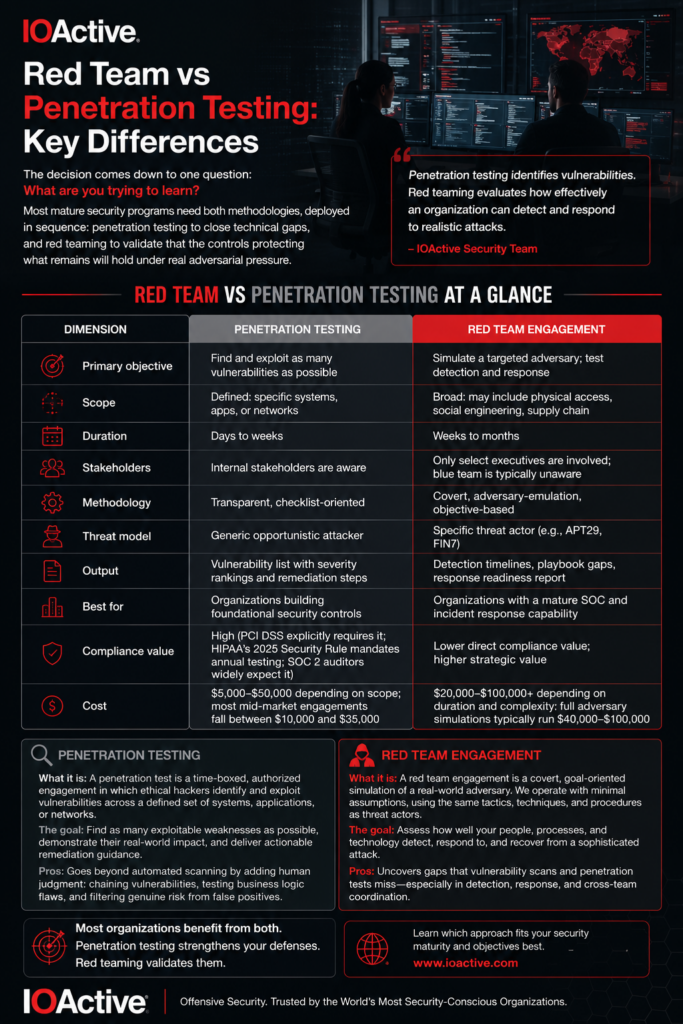
Red Team vs Penetration Testing: Key Differences breakdown graphic

“Penetration testing identifies vulnerabilities. Red teaming evaluates how effectively an organization can detect and respond to realistic attacks.” IOActive Security Team

The decision between red team vs penetration testing comes down to one question: What are you trying to learn? Most mature security programs need both methodologies, deployed in sequence: penetration testing to close technical gaps, and red teaming to validate that the controls protecting what remains will hold under real adversarial pressure.

This article breaks down the differences between red team vs penetration testing so your organization can choose the right approach.

Red Team vs Penetration Testing at a Glance

DimensionPenetration TestingRed Team Engagement
Primary objectiveFind and exploit as many vulnerabilities as possibleSimulate a targeted adversary; test detection and response
ScopeDefined: specific systems, apps, or networksBroad: may include physical access, social engineering, supply chain
DurationDays to weeksWeeks to months
StakeholdersInternal stakeholders are awareOnly select executives are involved; blue team is typically unaware
MethodologyTransparent, checklist-orientedCovert, adversary-emulation, objective-based
Threat modelGeneric opportunistic attackerSpecific threat actor (e.g., APT29, FIN7)
OutputVulnerability list with severity rankings and remediation stepsDetection timelines, playbook gaps, response readiness report
Best forOrganizations building foundational security controlsOrganizations with a mature SOC and incident response capability
Compliance valueHigh (PCI DSS explicitly requires it; the proposed HIPAA Security Rule update would mandate annual testing if finalized; SOC 2 auditors widely expect it)Lower direct compliance value; higher strategic value
Cost$5,000–$50,000 depending on scope; most mid-market engagements fall between $10,000 and $35,000$20,000–$100,000+ depending on duration and complexity; full adversary simulations typically run $40,000–$100,000

Penetration Testing

What it is: A penetration test is a time-boxed, authorized engagement in which ethical hackers identify and exploit vulnerabilities across a defined set of systems, applications, or networks.

The goal: Find as many exploitable weaknesses as possible, demonstrate their real-world impact, and deliver actionable remediation guidance.

Pros: Penetration testing goes beyond automated vulnerability scanning by adding human judgment: chaining vulnerabilities, testing business logic flaws, and filtering genuine risk from noise. Findings are immediately actionable.

Cons: Internal teams are typically aware the test is underway, which limits the value for measuring detection and response.

Choose a pentest when:

  • A compliance mandate requires it (PCI DSS, HIPAA, SOC 2 Type II)
  • You have deployed new infrastructure, applications, or cloud environments
  • You are validating remediation from a prior assessment
  • You are establishing your organization’s first formal testing program

Red Team Testing

What it is: A red team engagement is a full-scope adversarial simulation in which expert ethical hackers pursue specific objectives, such as accessing sensitive data or compromising executive accounts. Red team engagements use the same tactics, techniques, and procedures (TTPs) as real-world threat actors.

The goal: Determine whether your organization’s people, processes, and technology can detect, contain, and respond to a sophisticated attacker pursuing a specific objective, before a real adversary tests those same capabilities.

Pros: The engagement runs covertly, often without notifying the organization’s own security staff. This generates realistic data on detection timelines and incident response effectiveness.

Cons: Red team engagements are not optimized for cataloging technical vulnerabilities at scale. If foundational controls are weak, the red team will often achieve its objectives before meaningful detection data can be collected. In those cases, a penetration test would have surfaced the same findings faster and at lower cost.

Choose a red team engagement when:

  • Your SOC monitors alerts but has never been validated against a sophisticated intrusion
  • You need to test people and processes, not just technical controls
  • You want to measure detection and response against a specific, realistic threat scenario
  • Your security program has matured beyond foundational vulnerability management

Choose Based on Security Maturity

The most reliable decision factor is security maturity, which determines which question you are ready to answer. Organizations that have not yet closed known vulnerabilities will get more value from a pentest than from a red team engagement.

Organizations early in their security journey should run penetration tests first. If a red team can compromise your environment in hours without triggering a single alert, those findings could have been reached more efficiently with a pentest. Closing known vulnerabilities first allows a red team engagement to surface detection and response gaps that actually matter.

Security Maturity and Testing

Maturity StageIndicatorsRecommended Approach
FoundationalNo formal pentest history; basic patchingPenetration testing
DevelopingRegular pentests; security tooling in placePentesting + targeted red team scenarios
EstablishedFunctioning SOC, SIEM, incident response planBoth methodologies on a defined cadence
AdvancedMature threat intelligence; purple teaming capabilityRed team + purple team for continuous validation

Most organizations overestimate their maturity. If you have not run a penetration test within the past 12 months, or if your SOC has never responded to a simulated intrusion, a red team engagement will tell you less than a rigorous pentest will.

How the Two Methodologies Work Together

Penetration testing and red teaming are not competitors: they serve different stages of a security program. The typical progression is to run a pentest, remediate vulnerabilities, and build detection and response capabilities. From there, a red team engagement tests whether the SOC would detect a sophisticated attacker exploiting what remains.

Red team findings routinely drive improvements to SIEM detection rules, incident response playbooks, and security awareness training. It’s also recommended to use purple team exercises, which pair red team attackers with the organization’s blue team in a collaborative format to accelerate control tuning in real time.

Work With IOActive for Red Team Engagements and Penetration Testing

With over 25 years of offensive security research and engagements across some of the world’s most complex environments, IOActive has the experience to determine the right methodology for your risk profile and execute it with precision. IOActive’s penetration testing practice goes beyond off-the-shelf tooling, applying an attacker’s perspective and human judgment to chain vulnerabilities, expose business logic flaws, and deliver findings with clear remediation priority. Our red and purple team engagements run multi-vector, goal-based adversary simulations across technical, physical, and human attack surfaces, testing prevention, detection, response, and recovery under realistic conditions.

INSIGHTS | August 10, 2026

When the Advisory Arrives First: Minnesota’s Water Utilities and the Limits of Warning

Key Takeaways

  • More than 30 Minnesota community water systems were targeted across July 26 and 27, 2026 in what Minnesota IT Services (MNIT) has characterized as a coordinated cyberattack. Automated control functions were affected at several utilities, and the City of Braham briefly took its water treatment plant offline [4][6][9].
  • No attribution has been made. Officials have not named a threat actor, identified an exploited vulnerability, confirmed which products were affected, or established whether data was taken [4][7].
  • The incidents followed four days after the July 22 update to joint advisory AA26-097A, which widened observed Iranian-affiliated targeting of internet-facing programmable logic controllers (PLCs) from Rockwell Automation equipment to include Schneider Electric and Siemens devices [1][3].
  • The City of Plymouth reported that impact was confined to equipment reached over cellular links. Remote assets — water towers, lift stations, pump stations — frequently sit outside the boundary of formal risk and vulnerability assessments [4][10].
  • The consequence class here is loss or manipulation of view and control, not data loss. Operators in the UK and Europe carry equivalent exposure, under a regulatory regime that is tightening as the UK Cyber Security and Resilience Bill progresses through Parliament [16].

Why This Incident Matters Now

A joint advisory told critical infrastructure operators, in specific terms, that state-linked actors were reaching internet-facing PLCs at water and wastewater utilities and manipulating what those controllers do. Four days later, more than 30 water systems in a single US state reported disrupted automated controls over a 48-hour period.

Whether the two events are connected has not been established publicly, and this analysis does not assume they are. The more useful question for security leaders is what the sequence reveals about the distance between a warning being issued and a warning being actioned. Advisory AA26-097A has been in circulation since April 7, 2026 [1]. Its July update did not describe a novel technique. It broadened the list of affected manufacturers and added detection guidance. For any operator running an internet-reachable controller from one of the named vendors, the required response was already documented, already free, and already several months old.

The Minnesota incidents are therefore worth examining less as a novel threat and more as a measurement of how much of the sector is positioned to act on advisories at the speed at which they are now being issued.

What Actually Happened in Minnesota

MNIT confirmed that more than 30 community water systems were targeted on July 26 and 27, 2026, and activated a statewide cybersecurity incident response [4][6][8]. The agency is coordinating with CISA, the Environmental Protection Agency (EPA), the FBI, state agencies and affected utilities [5][6]. The FBI has confirmed it is in contact with victims [6].

Four cities disclosed incidents publicly: Braham, Maple Plain, Plymouth and South St. Paul [4][9][10][11][12]. The reported pattern is consistent across them. Automated control functions were affected; contingency procedures were activated; in most cases water and wastewater operations continued. Braham took its treatment plant offline after detecting the incident and asked residents to limit water use, later reporting that the attackers had shut down operating controls, taking the well and treatment plant with them [4][9]. Maple Plain declared a local state of emergency to support its response [5][12]. South St. Paul reported that manual intervention by public works staff maintained normal operations despite the loss of some automated controls [4][11]. Plymouth attributed communications problems at two water towers and multiple lift stations to the incident, and stated that the impact was limited to equipment connected via cellular communications [4][10].

The affected cities have consistently informed residents that drinking water remains safe. MNIT stated on July 28 that it was aware of no active requests for residents to alter their water use [5].

Several material facts remain unpublished. MNIT has not released a full list of affected systems. No exploited vulnerability, affected product line or exfiltration finding has been made public. No actor has been named. Iranian-affiliated groups such as CyberAv3ngers and Handala fit the profile of the activity, and several outlets have noted the resemblance, but investigators have stressed that formal attribution has not been made [4][7]. Analysts should treat the attribution question as open.

What Changed in Advisory AA26-097A on July 22

Advisory AA26-097A was first published on April 7, 2026 by the FBI, CISA, the NSA, the EPA, the Department of Energy and US Cyber Command’s Cyber National Mission Force. It documented Iranian-affiliated advanced persistent threat (APT) actors exploiting internet-connected operational technology (OT) devices across the Government Services and Facilities, Water and Wastewater Systems, and Energy sectors, with confirmed disruption at victim organizations since at least March 2026 [1][2].

The July 22 update made three substantive changes [1][2][3].

Manufacturer Scope Widened

Observed targeting now extends beyond Rockwell Automation and Allen-Bradley controllers to Schneider Electric and Siemens PLCs, and potentially other branded devices. Specific models are named in the advisory, including Rockwell CompactLogix and Micro850, Schneider Modicon M340, and the Siemens S7-1200 series [3].

Detection Guidance for Reusable Code Modules

The update adds guidance on identifying malicious modifications to reusable logic — Add-On Instructions within Rockwell programs, for example — including validating project files and comparing running logic against a known-good baseline [3].

A Refreshed Indicator Set and a New Co-Authoring Agency

The update publishes a refreshed set of indicators of compromise, and the Department of the Treasury is added as a co-authoring agency [1][17].

The access method described in the advisory is the part that should concern operators most, because it is not a vulnerability in the conventional sense. Actors reach internet-exposed controllers from leased overseas hosting infrastructure and connect using the manufacturers’ own engineering software — Studio 5000 Logix Designer, EcoStruxure Control Expert, TIA Portal — the same tooling legitimate engineers use [1][3]. Connections made this way are difficult to separate from authorized administrative activity. From there, the advisory documents modification of control logic, disabling of alarm and shutdown functions, and alteration of data presented on operator displays [3].

Water and Wastewater Systems is named explicitly among the targeted sectors, and internet-exposed PLCs remain the primary access point [3].

Who Is Affected by Internet-Exposed OT?

US Water and Wastewater Operators

The sector’s risk profile varies enormously by resource level. Large municipal utilities often run segmented networks, dedicated security staff and formal asset lifecycle management. Most community water systems are small municipal utilities or rural cooperatives, some serving only a few hundred customers, without dedicated cybersecurity personnel or continuous monitoring [14]. A technique that a well-resourced utility would contain quickly can cause prolonged operational impact in a small system. The EPA leads federal water sector cybersecurity efforts but has no explicit statutory authority to mandate cybersecurity measures, relying on voluntary engagement and technical assistance [15].

UK and European Operators

Drinking water is an in-scope sector under the UK’s NIS Regulations 2018, and the UK Cyber Security and Resilience (Network and Information Systems) Bill would expand obligations, incident reporting requirements and regulatory powers across those sectors [16]. The Bill received its second reading in the House of Lords on July 14, 2026 [16]. The technical exposure is not materially different: the same vendors, the same engineering tooling, and the same practice of reaching remote assets over public networks.

Critical National Infrastructure (CNI) Operators in Other Sectors

Energy and government facilities are named alongside water in AA26-097A. Any organization running the named controller families in an internet-reachable configuration is within the described targeting scope, regardless of sector [1][3].

System Integrators and OT Suppliers

Where control system architecture is delivered by an integrator, the connectivity decisions — including secondary and backup communication paths — are frequently made outside the asset owner’s direct visibility. Under the Cyber Security and Resilience Bill, suppliers to regulated entities face obligations of their own [16].

What Are the Practical Challenges for Operators?

Remote Assets Are the Architecture’s Blind Spot

Plymouth’s disclosure that impact was limited to cellular-connected equipment is the most operationally instructive detail released so far. Water towers, lift stations and pump stations commonly report back to supervisory control and data acquisition (SCADA) systems over cellular modems, and these secondary or alternative communication links are routinely omitted from risk and vulnerability assessments [4]. This is not a new failure mode. In the 2020 attacks on Israeli water facilities, actors linked to the Iranian government used vulnerable cellular routers as the point of entry [4]. An assessment scoped to the plant boundary will not find a modem on a tower six miles away.

The Relevant Consequence Is Not Data Loss

In MITRE ATT&CK for industrial control systems (ICS) terms, the consequences at stake are denial or loss of view, denial or loss of control, and manipulation of view or control [4]. A physical process can continue running while operators lose the ability to see or influence it. Manipulation is the more dangerous case, because the process may be in a state that differs from what the screens report — precisely the scenario AA26-097A describes when it documents altered operator display data [1][3]. Detection strategies built around data exfiltration will not register any of this.

Advisory Volume Exceeds Absorption Capacity

Four days is a short interval between an advisory update and a sector-wide incident, but the underlying advisory was nearly four months old. The constraint is not awareness. It is the engineering time to inventory controllers, establish logic baselines, remove internet exposure and rehearse manual operation — work that competes with statutory obligations for water quality, capital works and day-to-day service delivery.

Attribution Absorbs Attention That Belongs Elsewhere

Whether the Minnesota incidents prove to be Iranian-affiliated changes very little about the required response. The controls that reduce exposure to this activity are the same controls regardless of who is behind it, and waiting for attribution before acting concedes time to the adversary.

How IOActive Can Help

IOActive’s work in critical infrastructure spans the technical and strategic worlds of OT and ICS security, from the semiconductor inside a controller to the governance program around it. Our team has operated in ICS environments since building the first proof-of-concept worm against the smart grid in 2009 [20], and has helped define standards and best practices including NIST 800-53 and 800-37. The two gaps this incident exposes are assessment problems before they are tooling problems: assessment scope that stops at the plant boundary and misses remote, cellular-connected assets, and the absence of an authoritative baseline against which controller logic can be validated. The services below address each directly.

Full Stack Security Assessments

Most providers scan at the network or application layer only. Our Full Stack Security Assessments examine the entire environment, drilling down to the facility and silicon level and up through the personnel, process, and supply-chain layers around it. For a water or wastewater operator, that means scoping to the whole estate rather than the plant boundary — the towers, lift stations and pump stations that report back over cellular modems, the OT/IT boundary, and the third-party managed links that are frequently the only route in. Drawing on our hardware research background, it also extends to the firmware and silicon of PLC and human-machine interface (HMI) devices themselves through penetration testing, reverse engineering, side-channel analysis, and fault injection. It is the same class of work behind our research Compromising Industrial Facilities from 40 Miles Away, which showed how a memory-corruption flaw in widely deployed industrial wireless automation devices could be exploited remotely to disable field sensor nodes — exactly the kind of remotely reachable field connectivity that Plymouth’s disclosure points to [18].

Red Team and Purple Team Services

Manipulation of view and control is the consequence class that matters here, and it is precisely what adversarial testing exists to surface. Our Red Team engagements emulate the tradecraft AA26-097A describes, including the “living off the land” use of vendors’ own engineering software in place of exploits, while our Purple Team work translates those findings into measurable improvements in whether your operators and analysts would actually detect unauthorized logic changes in time to act. It is the tabletop in step 6 below, run against the live environment rather than a whiteboard. IOActive research has repeatedly shown how attackers can blind the humans in the loop: our study SCADA and Mobile Security in the IoT Era found that more than 20% of the vulnerabilities identified across dozens of ICS mobile applications could let an attacker misinform operators or influence the industrial process directly [19].

Supply Chain Integrity

Where control system architecture is delivered by an integrator, connectivity decisions — including secondary and backup communication paths — are frequently made outside the asset owner’s visibility, and AA26-097A documents the vendors’ own configuration software being used as the access channel. Our Supply Chain Integrity service assesses the security posture of technology providers and critical third parties, reviewing firmware, embedded systems, remote-access arrangements, and procurement processes for inherited risk before it becomes an incident vector. Under the UK Cyber Security and Resilience Bill, suppliers to regulated entities will carry obligations of their own [16].

Secure Development Lifecycle

The advisory urges device manufacturers to adopt secure-by-default design rather than leaving operators to compensate for exposed controllers [1]. For the vendors and OEMs in the PLC, remote terminal unit (RTU) and HMI supply chain, our Secure Development Lifecycle work embeds security review into design and engineering — from threat modeling through code review and pre-release testing — so that the next generation of devices does not ship with the internet-reachable defaults this campaign depends on.

Advisory Services

Removing internet exposure is an architectural program, not a one-time patch, and there is no CVE here to wait for. Our Advisory Services — spanning programmatic security review, security program development and management, and Virtual CISO support — help water sector leaders and boards turn an advisory into a prioritized remediation plan, close the gap between a warning being issued and a warning being actioned, and prepare for the reporting obligations that arrive with an incident: Cyber Incident Reporting for Critical Infrastructure Act (CIRCIA) timelines in the US, and current and forthcoming NIS duties in the UK [15][16].

  1. Establish whether any controller is reachable from the internet. This means verification against the live estate, not a review of the network diagram. Include devices reached over cellular, satellite, radio and any third-party managed link, in line with the joint NCSC-UK, CISA and FBI secure connectivity principles for OT [13].
  2. Extend assessment scope to every remote asset. Towers, lift stations, pump stations and any site with an independent communications path. Where an integrator built the connectivity, request the full inventory of links in writing.
  3. Capture an offline logic and configuration baseline for every controller. This is both a detection capability and a recovery capability. Without it, comparing running logic to known-good logic — the core of the advisory’s new detection guidance — is not possible.
  4. Apply the AA26-097A mitigations directly. Remove direct internet exposure, change default credentials on PLCs and HMIs, enforce multi-factor authentication on all remote OT access, and enable controller key switches or run/program mode protections where the platform supports them [1][3].
  5. Ingest the refreshed indicators and hunt for engineering software activity. Look specifically for vendor engineering tooling running on hosts that are not designated engineering workstations, and for connections to controllers from unexpected sources [1].
  6. Rehearse the manipulation scenario, not the outage scenario. Run a tabletop in which operator displays report normal conditions while the process deviates. The exercise should establish how staff would detect the discrepancy, what independent instrumentation exists, and how manual operation would be initiated and sustained.
  7. Verify that incident reporting obligations are understood before they are triggered. For US utilities, CIRCIA reporting timelines; for UK operators, current and forthcoming NIS obligations under the UK Cyber Security and Resilience Bill [15][16].

Conclusion

The Minnesota utilities appear to have avoided serious consequences largely because staff reverted to manual operation and contingency plans held. That is a real result, and it reflects institutional competence that deserves acknowledgment. It is also a thin margin, and it depended on operators noticing that something was wrong.

The uncomfortable element of this incident is not that it happened without warning. It is that the warning was issued, updated, distributed through federal channels and sector information sharing and analysis centers (ISACs), and reported in the trade press — and the interval between that warning and disrupted controls in more than 30 communities was four days. Advisories are only a control if the organization receiving them has the capacity to act. For much of the water sector, on both sides of the Atlantic, that capacity is the constraint that needs addressing, and it will not be resolved by another advisory.

If you would like to discuss how your organization’s controller exposure and remote-asset connectivity measure up against the activity described here, or how IOActive can support your OT/ICS resilience program, we welcome the conversation.

References

[1] CISA, FBI, NSA, EPA, DOE, CNMF and US Department of the Treasury. Iranian-Affiliated Cyber Actors Exploit Programmable Logic Controllers Across US Critical Infrastructure (AA26-097A), published April 7, 2026, updated July 22, 2026. https://www.cisa.gov/news-events/cybersecurity-advisories/aa26-097a

[2] Internet Crime Complaint Center (IC3). Advisory AA26-097A (PDF), July 22, 2026. https://www.ic3.gov/CSA/2026/260722.pdf

[3] WaterISAC. (TLP:CLEAR) CISA Updates Iranian-Affiliated PLC Targeting Advisory (AA26-097A), July 2026. https://www.waterisac.org/tlpclear-cisa-updates-iranian-affiliated-plc-targeting-advisory-aa26-097a

[4] E. Kovacs. Dozens of Minnesota Water Utilities Targeted in Coordinated OT Attacks, SecurityWeek, July 29, 2026. https://www.securityweek.com/dozens-of-minnesota-water-utilities-targeted-in-coordinated-ot-attacks/

[5] Coordinated Cyberattack Targets 30+ Minnesota Water Systems as One Plant Goes Offline, The Hacker News, July 2026. https://thehackernews.com/2026/07/coordinated-cyberattack-targets-30.html

[6] Authorities investigating a coordinated cyberattack against Minnesota water systems, Cybersecurity Dive, July 28, 2026. https://www.cybersecuritydive.com/news/authorities-investigating-a-coordinated-cyberattack-against-minnesota-water/826427/

[7] Coordinated cyberattack disrupts water utilities in 30+ Minnesota communities, StateScoop, July 28, 2026. https://statescoop.com/coordinated-cyberattack-disrupts-water-utilities-in-30-minnesota-communities/

[8] Hackers target over 30 Minnesota water utilities in coordinated OT attack, BleepingComputer, July 29, 2026. https://www.bleepingcomputer.com/news/security/hackers-target-over-30-minnesota-water-utilities-in-coordinated-ot-attack/

[9] City of Braham. Cyber security incident statements, July 2026. https://brahammn.gov/

[10] City of Plymouth. News release, July 2026. https://www.plymouthmn.gov/Home/Components/News/News/8977/542

[11] City of South St. Paul. News release, July 2026. https://www.southstpaulmn.gov/m/newsflash/Home/Detail/900

[12] City of Maple Plain. Press Release: Cyber Security Incident, July 2026. https://www.mapleplainmn.gov/administration/page/press-release-cyber-security-incident

[13] NCSC-UK, CISA, FBI and international partners. Secure Connectivity Principles for Operational Technology, January 2026. https://www.cisa.gov/news-events/news/cisa-uk-ncsc-fbi-unveil-principles-combat-cyber-risks-ot

[14] Testimony before the US Senate Committee on Environment and Public Works. The Cybersecurity State of the Water Sector, February 4, 2026. https://www.epw.senate.gov/public/_cache/files/5/3/53d93dfe-ed8c-4e48-b705-0b16cb92c90a/FA38A32EE48D7F3D4B0C069FDC08A69E6327376EB85838A03310B2E91C8582C1.02-04-2026-dr.-simonton-testimony.pdf

[15] Nossaman LLP. Water Utilities: Congress Temporarily Extends Cyber Laws, EPA Releases New Guidance, November 2025. https://www.nossaman.com/newsroom-insights-water-utilities-congress-temporarily-extends-cyber-laws-epa-releases-new-guidance

[16] House of Lords Library. Cyber Security and Resilience (Network and Information Systems) Bill: HL Bill 32 of 2026–27, June 2026. https://lordslibrary.parliament.uk/research-briefings/lln-2026-0032/

[17] ComplianceHub. CISA Updates AA26-097A: Iranian-Affiliated PLC Targeting Widens to Schneider and Siemens, July 2026. https://compliancehub.wiki/cisa-aa26-097a-update-iranian-plc-targeting-critical-infrastructure-july-2026/

[18] IOActive. Compromising Industrial Facilities from 40 Miles Away (white paper). https://www.ioactive.com/wp-content/uploads/2018/05/IOActive_Compromising_Industrial_Facilities_from_40_Miles_Away.pdf

[19] IOActive (A. Bolshev, I. Yushkevich). SCADA and Mobile Security in the IoT Era. https://www.ioactive.com/scada-and-mobile-security-in-iot-era/

[20] M. Davis, IOActive. Advanced Metering Infrastructure (Smart Grid) Device Security, Black Hat USA 2009. https://blackhat.com/presentations/bh-usa-09/MDAVIS/BHUSA09-Davis-AMI-SLIDES.pdf

AI & MACHINE LEARING, INSIGHTS | August 6, 2026

Security Challenges in AI Adoption: 2026

Security professional using a laptop to review AI code

As enterprise AI adoption accelerates in 2026, organizations are discovering that deploying AI responsibly requires a fundamentally different security approach. AI is now embedded in development pipelines, customer-facing applications, operational workflows, and automated decision-making systems. Each deployment extends the attack surface in ways that existing security controls were not built to detect or contain.

This article breaks down the most significant security challenges in AI adoption for Global 1000 enterprises, supported by current research and IOActive’s adversarial testing experience. Attackers are exploiting the risks documented here right now, and every one of them can be measured and tested.  For security leaders building the internal case for AI security investment, the benchmarks and risk categories below provide the data to start that conversation.

Security Challenges in AI Adoption in 2026

Enterprise AI Security Challenges at a Glance

Security ChallengePrimary Attack VectorDocumented Exposure RateDetectable by Traditional Tools?Assessment Method
AI-Generated Code VulnerabilitiesInsecure code deployed without security review31.6% of AI-generated code samples are fully exploitable²PartialAdversarial code review and automated scanning
Prompt InjectionDirect or indirect input manipulationPresent in 73%+ of tested LLM deployments¹RarelyAdversarial red-teaming
Data Leakage via AI ToolsEmployee input, RAG over-disclosure, memorized training data50% of organizations expect a breach via AI tools in 12 months³RarelyPipeline security review
Shadow AI IncidentsUnauthorized AI tool adoption outside approved channels49% of organizations expect incidents in 12 months³NoInventory and governance review
Training Data PoisoningUpstream supply chain contaminationGrowing; no established baselineVery difficultData provenance audit
Third-Party Model RiskPre-trained models, external inference APIs97% of organizations had a supply chain breach in 2025NoArchitecture review
Agentic AI MisusePrompt engineering, agent manipulation40% of enterprise apps will include AI agents by end of 2026Very difficultThreat modeling
AI Governance GapsFragmented ownership, absent or ad hoc policy70% of organizations lack optimized AI governance³N/AProgram efficacy assessment

AI Application Security: Where Traditional Controls Fall Short

AI-enabled applications introduce attack surfaces that standard penetration testing was not designed to probe. When a model sits between user input and backend systems, the authorization boundary shifts in ways that static analysis and WAF rules cannot capture. Traditional security testing verifies that code executes as intended. AI security testing must verify that a model behaves as intended across adversarial inputs it was never built to anticipate.

How Tool-Calling Chains Expand the Attack Surface

Tool-calling features are pathways that allow AI models to take actions in connected systems, such as accessing files, querying databases, or triggering API calls. These are among the most exploitable surfaces in deployed AI stacks. A successful attack against a tool-calling chain does not require shell access; it requires a crafted input that persuades the model to act against its operator’s intent.

What the Research has Found in 2026

IOActive’s 2026 research quantifies how broadly this problem affects AI in production. In an evaluation of 27 leading AI models using 730 real-world programming prompts across 27 programming languages and 219 vulnerability categories, average security performance across all models was just 59%.² Nearly one-third of AI-generated code samples (31.6%) were fully exploitable, and no model achieved 100% secure output.² Even the best-performing configuration produced 90 vulnerabilities.² Infrastructure and DevOps code, including Dockerfiles, Terraform configurations, and CI/CD pipelines, exceeded 70 to 97% vulnerability rates.²

The practical takeaway is direct: organizations using AI in software development must treat AI-generated code as untrusted input requiring mandatory security review before deployment, particularly for authentication, cryptography, and infrastructure.

Traditional Application Security vs. AI Application Security

DimensionTraditional Application SecurityAI Application Security
Primary attack surfaceCode logic, APIs, and user inputsPrompts, model behavior, tool-calling chains
Testing approachStatic and dynamic analysisAdversarial red-teaming, behavioral evaluation
Attack success predictionDeterministicProbabilistic
Authorization bypass methodCredential theft, injectionPrompt manipulation, context override
Data leakage pathDatabase exfiltrationModel output, RAG retrieval over-disclosure
Governing frameworkOWASP Top 10OWASP LLM Top 10, MITRE ATLAS

Prompt Injection: The Most Prevalent and Exploitable AI Vulnerability

Prompt injection holds the top position in OWASP’s LLM Top 10 (ranked LLM01:2025) for a measurable reason. It appears in over 73% of tested LLM deployments¹ and carries attack success rates of 50 to 84% against unprotected systems, depending on configuration.⁶ In 2025, researchers documented over 461,640 prompt injection submissions in a single dataset, confirming that this attack class is being weaponized at scale.

Why Prompt Injection Is a Structural Problem

Prompt injection is the AI equivalent of social engineering the system itself. An attacker submits instructions disguised as normal input, and the model follows them instead of its original instructions. Because large language models process operator instructions and user input through the same channel, this vulnerability is structural, not a configuration error that can be patched away.

Direct and Indirect Injection: How Attacks Are Delivered

The two dominant variants are direct injection, arriving through the user interface, and indirect injection, embedded in content that the model retrieves as context, including documents, emails, and database records. IOActive’s AI application assessments test both variants, as well as chained injection across multi-step workflows and persistent injection that survives into model memory or session history. Every finding is delivered with prompts and replay harnesses so engineering teams can reproduce, regression-test, and track remediation.

“The greatest AI security risks rarely originate in the model itself; they emerge from how AI systems interact with data, applications, and business processes.”

Prompt Injection Types, Delivery Methods, and Risk Levels

Injection TypeDelivery MethodPotential ImpactExecution Difficulty
Direct injectionUser input via chat interfaceSystem prompt override, sensitive data disclosureLow
Indirect injectionRAG context, documents, email contentExfiltration, unauthorized API callsMedium
Chained injectionMulti-step agent workflowFull pipeline compromiseHigh
Persistent injectionModel memory or session historyRecurring unauthorized behaviorHigh

Data Leakage, Shadow AI, and Training Data Integrity

AI systems process, memorize, and sometimes reproduce sensitive data in ways that fall entirely outside traditional data loss prevention models. The risk operates at two distinct levels: what the model was trained on, and what it is exposed to at inference time.

Training-Level Risk: What Models Memorize

At the training level, models can memorize specific records from their training data, including personally identifiable information, internal documents, and proprietary source code. IOActive’s adversarial evaluation methodology includes membership inference testing, which determines whether specific data has been memorized by a model rather than inferred from general training patterns. In enterprise fine-tuned models, sensitive training data can surface in model outputs under targeted prompting conditions, and no application-layer control will catch it after deployment.

Inference-Level Risk: What Employees Share

At the inference level, 50% of organizations expect data loss caused by AI tools within the next 12 months.³ Employees entering customer records, regulated data, or internal strategy documents into third-party AI applications create a leakage path that exists entirely outside security visibility and DLP enforcement. Shadow AI compounds this exposure: 49% of organizations expect incidents from unauthorized AI tool adoption within the same timeframe.³ These tools process real business data while remaining invisible to security monitoring and data classification controls.

AI Data Leakage Pathways and Mitigation Approaches

Leakage PathwaySourceDetectable by Standard DLP?Mitigation
Training data memorizationFine-tuned enterprise modelsNoMembership inference testing
Inference-time user inputEmployee-entered promptsPartialPolicy enforcement, input filtering
RAG retrieval over-sharingVector database query resultsNoAccess scoping, retrieval audit
Model output over-disclosureAI assistant or chatbot responsesRarelyOutput filtering, red-teaming
Shadow AI tool adoptionUnauthorized external applicationsNoInventory, governance, monitoring

Third-Party Model Risk and AI Supply Chain Exposure

Most enterprise AI deployments don’t start from scratch. They rely on pre-trained foundation models, open-source frameworks, third-party datasets, and external inference APIs. Each dependency introduces a trust assumption that few organizations have formally assessed.

Why AI Supply Chain Risk Is Broader Than Traditional Software Risk

OWASP’s LLM03:2025 Supply Chain classification identifies AI supply chain vulnerabilities across training data, models, and deployment platforms. The scope is broader than traditional software supply chain risk: a model’s behavior is directly shaped by its training provenance. A foundation model built on manipulated or low-quality data carries those defects into production, and application-layer security controls cannot correct them after deployment.

The Scale of Current Exposure

The broader supply chain risk baseline is severe. In 2025, 97% of organizations experienced at least one supply chain breach, a 20% increase from 2024. Software engineering teams account for nearly 50% of enterprise AI use, meaning AI-generated code is entering software supply chains at a volume that manual review alone cannot keep pace with.

How IOActive Assesses Third-Party Model Risk

IOActive’s third-party model risk assessments cover model signing and artifact lineage, access privileges around model weights, and deployment integrity testing. Threat modeling is aligned to MITRE ATLAS, the adversarial threat landscape framework built specifically for AI systems, so findings connect directly to real-world attack patterns rather than abstract risk categories.

Third-Party AI Risk Areas and Assessment Methods

Risk AreaKey Assessment QuestionsAssessment Method
Foundation model provenanceWho trained it? On what data?Architecture review
Model integrityIs the model signed? Has it been modified in transit?Integrity and custody testing
Inference API exposureWhat data transits external inference endpoints?Penetration testing
Open-source dependenciesAre framework vulnerabilities patched and tracked?Dependency and code audit
Training data provenanceIs training data labeled, validated, and auditable?Data pipeline security review
Artifact lineageCan high-influence training samples be identified?Pipeline assurance review

Agentic AI: When Autonomous Systems Inherit Your Risk Surface

Agentic AI refers to AI systems that take actions independently, without waiting for human approval at each step. They can browse the web, send emails, execute code, call APIs, and trigger workflows autonomously. Gartner predicts that 40% of enterprise applications will incorporate these task-specific AI agents by the end of 2026, up from fewer than 5% in 2025. Deloitte’s 2026 State of AI report anticipates that 75% of companies will use agentic AI to some degree by 2028.

The Permission Problem: Why Agentic Systems Are Inherently High-Risk

To operate effectively, agents require broad cross-environment permissions, including access to files, APIs, email systems, payment workflows, and production databases. Many AI tools connecting to external systems currently operate in a trust-by-default mode, creating significant vulnerabilities.¹⁰ When an agent is manipulated through prompt injection, the blast radius extends to every system that agent can reach. In multi-agent systems, a compromised upstream agent can propagate malicious instructions to downstream agents before any human checkpoint has the opportunity to intervene.

What Agentic AI Attacks Look Like in Practice

Attack scenarios are concrete. Indirect prompt injection embedded in a retrieved document can cause an agent to forward sensitive files, execute unauthorized API calls, or authorize transactions, all without user interaction. Identity and access management risks expand dramatically in these environments: agent credentials and permissions require the same rigor as for human users, yet most organizations have not yet built that infrastructure.

IOActive’s threat modeling for agentic systems traces attacker paths across SDKs, agents, plugins, and the surrounding supply chain. Exposures are mapped to ATLAS-style TTPs, the AI-specific adversarial technique catalog, so that detections and guardrails emerge as engineering tasks with clear owners rather than policy abstractions without enforcement.

Agentic AI Attack Scenarios and Business Impact

Attack ScenarioEntry PointAgent ActionBusiness ImpactRecommended Assessment
Prompt injection via retrieved documentRAG or email contextForwards sensitive files externallyData exfiltrationAI Application Security Assessment; Prompt Injection Testing
Chained agent manipulationCompromised upstream agentPropagates malicious task downstreamCascading unauthorized system accessAgentic AI Threat Modeling; Red Team Exercise
RAG-based indirect injectionVector database retrievalExecutes unauthorized API callsUnauthorized transactions or data modificationsAI Pipeline Security Assessment; RAG Architecture Review
Excessive permissions abuseMisconfigured agent identityDeletes or modifies production dataData loss, operational disruptionAgentic AI Architecture Review; Identity and Access Management Review
Multi-agent trust exploitationInter-agent communication channelEscalates privileges across systemsLateral movement, IP theftFull-Scope Red Team Exercise; Agentic AI Threat Modeling

AI Governance: The Structural Security Challenge Behind Every AI Adoption Decision

Most AI security failures share a common root cause: governance structures that haven’t kept pace with deployment speed. Proofpoint’s 2025 State of AI Security research found that 70% of organizations lack optimized AI governance, and 39% operate with no AI-specific governance at all.³ These organizations are deploying AI while simultaneously expecting data loss events and shadow AI incidents within the next 12 months.

The Ownership Fragmentation Problem

Ownership fragmentation compounds the problem. CIOs control 29% of AI security decisions, while CISOs rank fourth at 14.5%.³ That distribution reflects an AI adoption curve that outran the security function entirely. Effective AI governance requires unified ownership, board-level risk visibility, and continuous monitoring. Those capabilities don’t emerge naturally from a model where each function applies different controls to different risk definitions.

Building the Internal Case for AI Security Investment

For security leaders working to build internal momentum around AI risk, the business case is now straightforward: nearly one-third (31%) of organizations are redirecting their largest security investment toward AI supply chain security over the next 12 months.³ Organizations deploying AI ahead of a governance framework are also accumulating compliance exposure as AI-specific audit requirements mature across financial services, critical infrastructure, and government sectors, including CREST-aligned assessments and Cyber Essentials mandates increasingly applied to vendor supply chains.

Establishing Your Baseline

Reaching a governed state requires knowing where you stand today. An independent AI security assessment establishes the baseline across model behavior, pipeline integrity, application security, and governance maturity so that improvements can be sequenced, budgeted, and measured.

AI Governance Maturity Levels

Governance Maturity LevelDescriptionEst. % of OrganizationsPrimary Risk
NoneNo AI-specific governance in place3%³Uncontrolled and unmeasured AI deployment
Ad hocInformal practices, no documentation16%³Inconsistent controls, high shadow AI exposure
DefinedDocumented framework, limited enforcement20%³Framework exists; enforcement gaps create exposure
ManagedMeasured effectiveness and reporting31%³Controls in place but not continuously optimized
OptimizedBoard visibility, automated monitoring, incident-driven updates30%³Closest to secure; still requires adversarial validation

Frequently Asked Questions

What is the most commonly exploited AI security vulnerability in enterprise environments?

Prompt injection holds the top position in OWASP’s LLM Top 10 and appears in over 73% of tested LLM deployments.¹ Its success rate against unprotected systems ranges from 50 to 84%, making it the first vulnerability class to address in any structured AI security assessment.

How does AI security testing differ from standard penetration testing?

Standard penetration testing validates code execution paths, authentication controls, and API security. AI security testing additionally requires adversarial evaluation of model behavior, prompt injection testing across direct and indirect attack vectors, membership inference analysis (which confirms whether sensitive data was memorized by the model rather than inferred), training data poisoning assessment, and model extraction simulation. IOActive’s AI security assessments cover the full stack, from model and pipeline through application and infrastructure, with findings delivered as reproducible, engineering-ready remediation tasks.

What governance steps should organizations prioritize before expanding AI deployment?

Establish an AI system inventory, assign unified ownership of AI security decisions to the CISO function, and define data handling policies for AI tools before expanding deployment. Treat AI-generated code as untrusted input requiring mandatory security review, particularly for authentication, cryptography, and infrastructure configurations. An independent assessment of existing deployments is the fastest path to identifying where governance gaps create measurable exposure and where emerging compliance requirements may impose near-term deadlines.

What makes agentic AI uniquely risky compared to traditional AI deployments?

Traditional AI deployments produce outputs that a human reviews before acting. Agentic systems take actions autonomously across multiple systems at machine speed. When a manipulated agent can send emails, authorize payments, delete files, and call APIs without a human approval step, the blast radius of a single successful injection attack is orders of magnitude larger than in a passive AI deployment.

Conclusion

The security challenges in AI adoption in 2026 are measurable, documented, and addressable with the right adversarial methodology. Prompt injection succeeds against 50 to 84% of unprotected systems. Nearly one-third of AI-generated code is fully exploitable by default. Seventy percent of organizations lack the governance structures needed to detect or contain AI-related incidents. Those are the current baselines, not the inevitable outcomes. Organizations that instrument their models, secure their pipelines, enforce governance, and apply adversarial testing as a standard part of AI delivery are the ones that move through enterprise AI adoption with the least exposure and the clearest audit trail.

With more than 25 years of independent security research, physical testing labs across three continents, and a track record of identifying emerging threats before they reach headline status, IOActive brings the depth that enterprise AI security demands.

Sources

1.) Obsidian Security. “Prompt Injection Attacks: The Most Common AI Exploit in 2025.” obsidiansecurity.com/blog/prompt-injection

2.) IOActive. “The Security Gap in AI-Generated Code.” April 2026. ioactive.com/the-security-gap-in-ai-generated-code/

3.) Proofpoint. “The State of AI Security 2025.” proofpoint.com/us/resources/threat-reports/state-ai-security-2025

4.) Atlas Systems. “Third-Party Risk Management Statistics.” atlassystems.com/blog/third-party-risk-management-statistics

5.) Gartner. “Gartner Predicts 40 Percent of Enterprise Apps Will Feature Task-Specific AI Agents by 2026.” August 2025.

6.) Vectra AI. “Prompt Injection: Types, Real-World CVEs, and Enterprise Defenses.” vectra.ai/topics/prompt-injection

7.) Securance. “Prompt Injection: The OWASP #1 AI Threat in 2026.” securance.com/blog/prompt-injection-the-owasp-1-ai-threat-in-2026

8.) Zscaler ThreatLabz. “AI Security Report 2026.” zscaler.com/resources/industry-reports/threatlabz-ai-security-report-2026.pdf

9.) Deloitte. “State of AI 2026.” deloitte.com/content/dam/assets-zone3/us/en/docs/services/consulting/2026/state-of-ai-2026.pdf

10.) Recorded Future. “Emerging Enterprise Security Risks of AI.” recordedfuture.com/research/emerging-enterprise-security-risks-of-ai

INSIGHTS | August 4, 2026

Cyber Attack Trends 2026: What Security Teams Face

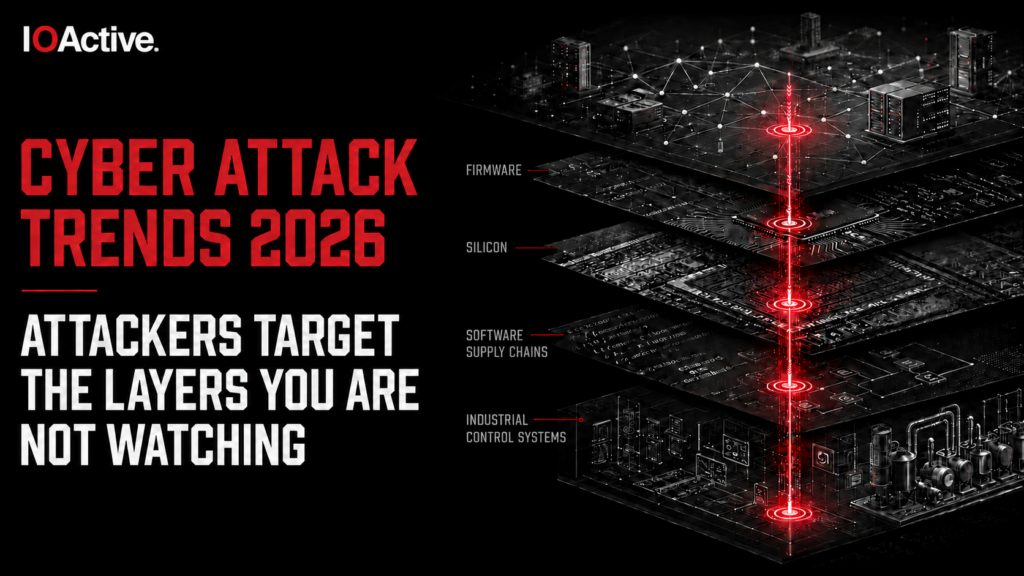
Cyber Attack Trends 2026 at the Silicon Level; Firmware, Silicon, Software Supply Chains, Industrial Control Systems.

“The most significant cyber attacks of 2026 will target the systems organizations depend on most, not the systems they monitor most closely.”

Most cybersecurity forecasts treat ransomware, AI-enabled attacks, and supply chain risks as parallel threats of equal weight; a framing that produces the wrong priorities for security teams protecting complex organizations. The cyber attack trends in 2026 share a specific characteristic: they exploit environments organizations depend on most but monitor least, from industrial control systems running legacy protocols to firmware supply chains lacking integrity verification. This article evaluates which attack patterns represent confirmed, active risk across key threat categories.

ThreatKey Risk IndicatorLevel of ConcernRecommended Assessment
Ransomware

Targeting OT and critical infrastructure
$74B global damage projected¹EscalatingRed team, OT security assessments
Software Supply Chain Attacks

Build pipelines, open-source dependencies
$80.6B cost projection by 2026²UnderestimatedSecure development lifecycle (SDL)
OT/ICS Threats

PLCs, RTUs, engineering workstations
3,300+ industrial orgs impacted³UnderdetectedOT/ICS security assessment
AI-Enabled Attacks

Dev pipelines, social engineering
31.6% of AI code fully exploitableMixed: some confirmed, some speculativeSecure code review, SDL
Critical Infrastructure Cyberattacks

Energy, water, transport, defense
$4.82M average breach costUnderreportedFull-stack ICS/OT assessment

Ransomware: From File Encryption to Operational Disruption

Ransomware groups have moved beyond encrypting files and demanding payment. The operational model has shifted toward the targeted disruption of systems that organizations cannot quickly stop or replace.

Ransomware incidents reached 6,500 in 2025, up from under 1,400 in 2020, a more than 360% increase over five years. Global damage costs are projected to reach $74 billion in 2026, a 30% increase from $57 billion in 2025.¹ For organizations in critical sectors, the average breach cost stands at $4.82 million per incident, excluding production loss and regulatory response.

Ransomware CharacteristicTraditional Model (Pre-2022)2026 ModelRecommended Assessment
Primary objectiveFile encryption, ransom demandOperational disruption plus ransomOT incident response planning
Target selectionOpportunistic, volume-basedSector-targeted, timing-awareThreat modeling
OT environment knowledgeLowActive, documented reconnaissanceOT security assessment
Recovery timelineHours to days (IT)Days to weeks (OT)OT business continuity review
Payment pressure leverThreat of data exposureExtended process downtimeRed team exercise

How Threat Groups Are Targeting OT Environments

The threat model has changed in a specific way. Groups with OT knowledge now time attacks around operational windows: peak demand periods for energy utilities, scheduled maintenance cycles at manufacturers, pre-harvest windows in agricultural processing. Dragos tracked 3,300 industrial organizations affected by ransomware in 2025.³ These are not random hits. They reflect adversaries who understand operational context well enough to maximize financial leverage.

What Separates Fast Recovery From Extended Downtime

Organizations recovering fastest from ransomware incidents are those that have run realistic OT continuity exercises against adversary scenarios. Applying untested IT recovery playbooks to industrial environments results in extended downtime because the two environments fail differently and recover on different timelines.

Software Supply Chain Attacks: The Dominant Third-Party Risk Vector

The SolarWinds compromise in 2020 demonstrated that trusted software update mechanisms could deliver malware to thousands of organizations simultaneously. The XZ Utils backdoor in 2024 showed that state-sponsored actors were willing to invest years in maintaining access to open-source projects before activating a payload. Neither incident was an outlier. Both represent a confirmed shift in how sophisticated threat actors approach access at scale.

Supply Chain Attack TypeNotable CaseDetection DifficultyDownstream ScopeRecommended Assessment
Software build tool compromiseSolarWinds (2020)High18,000+ organizationsSecure development lifecycle (SDL) review
Open-source package backdoorXZ Utils (2024)HighMillions of Linux systemsSoftware composition analysis
Firmware implantVendor hardware (multiple)Very highFull device lifecycleFirmware security assessment
AI model poisoningEmerging (2025–2026)Very highDevelopment pipelinesAI supply chain review
Hardware and silicon-level attackAMD Sinkclose (2024)⁷Extremely highEndpoint device fleetsSilicon security assessment

Third-Party Risk Is Growing Faster Than Programs Can Track

Third-party involvement in security breaches rose from 15% to 30% in 2025.² Supply chain attack costs are projected to exceed $80.6 billion by 2026.² The attack surface is not shrinking: organizations now average over 1,000 third-party vendors, and the majority lack visibility into the security posture of their software dependencies beyond first-tier vendors.

One Compromise Can Expose Every Downstream Organization

The risk is systemic, not incidental. A single compromise of a widely used build tool, package manager, or firmware update process exposes every downstream organization that relies on it. Your environment’s security now depends in part on the security of every component that touches your build pipeline, whether or not you have audited it.

OT/ICS Threats: Adversaries Mapping Physical Processes

The 2026 Dragos OT Cybersecurity Year in Review documents a specific evolution in how adversaries approach industrial environments. They are no longer staging for future disruption. They are actively mapping control loops to understand how to manipulate physical processes with precision.³

OT Threat GroupPrimary Target SectorDocumented 2025 ActivityICS Kill Chain StageRecommended Assessment
VOLTZITEElectric, oil and gasGateway compromise, configuration extractionStage 2OT network security assessment
KAMACITEEnergy, water, heating (EU, US)Four-month ICS reconnaissance campaignStage 1ICS threat hunting
ELECTRUMUkrainian, Polish infrastructureDestructive wiper deployment (PathWiper)³Stage 2OT incident response planning
SYLVANITEUS utilities, SAP environmentsZero-day exploitation (CVE-2025-31324)Stage 1Vulnerability assessment
BAUXITEIsraeli critical infrastructureDual wiper variants deployedStage 2Full-stack ICS/OT assessment

Active OT Threat Groups

Three new OT threat groups emerged in 2025. Established groups expanded operations globally. Dragos now tracks 26 OT threat groups.³ KAMACITE conducted four months of sustained reconnaissance against US internet-exposed ICS assets, targeting specific device types in sequence. VOLTZITE compromised Sierra Wireless Airlink gateways across electric and oil-and-gas sectors, then pivoted to engineering workstations to extract configuration and alarm data. ELECTRUM deployed coordinated destructive wiper malware against eight Ukrainian ISPs and, in December 2025, Polish CHP facilities.³

Why Most Organizations Cannot See the Threat

The visibility problem is structural. Only 30% of OT networks have the monitoring capability to detect these threats before operational impact. 56% of organizations cannot see below the IT/OT boundary. 88% struggle with detection and response in OT environments.³

The Integrity Blind Spot Adversaries Exploit

IOActive’s research into OT security architecture has identified a persistent strategic blind spot. The standard AIC reordering (Availability-Integrity-Confidentiality) used in many OT environments prioritizes availability, which is precisely where the most capable adversaries operate. Stuxnet manipulated centrifuge speeds while feeding false readings to operators for months. Triton/TRISIS targeted Safety Instrumented Systems to remove the safeguard layer before causing process failure. Industroyer sent commands directly to substation equipment using native industrial protocols. All three targeted integrity, not availability, because integrity failures often go undetected, whereas availability failures trigger an immediate response.

AI-Enabled Attacks: Separating Confirmed Risk From Speculation

AI’s role in offensive security requires more precision than most threat briefings provide. The meaningful 2026 risk is not the speculative scenario of fully autonomous AI attackers. It is the measurable deterioration in code security caused by AI-assisted development tools, and the accelerated pace at which phishing and social engineering campaigns now operate.

AI Attack VectorOperational MaturityDocumented Risk IndicatorDefender PriorityRecommended Assessment
AI-generated insecure code in productionHigh31.6% of samples fully exploitableCriticalSecure code review, SDL
AI-accelerated phishing and spear-phishingHighVolume and personalization increase confirmedHighSocial engineering assessment
Deepfake-based social engineering and fraudMedium-HighActive in financial and executive targetingHighRed team exercise
AI-assisted vulnerability discovery by threat actorsMediumBeing used by advanced groupsMediumThreat modeling
Autonomous AI attack agentsLowDemonstration cases only; no confirmed deployment at scaleMonitor onlyNo immediate action required

AI-Generated Code Is Already a Security Liability

IOActive’s April 2026 whitepaper evaluated 27 leading AI models and AI-powered coding tools using 730 real-world programming prompts across 27 languages and 219 vulnerability categories. Security outcomes were measured against 72 automated vulnerability detectors, producing nearly 20,000 analyzed code samples. The results were direct: average security performance across all models was 59%, and 31.6% of AI-generated code samples were fully exploitable.

No model achieved 100% secure output. Infrastructure and DevOps code (Dockerfiles, Terraform, CI/CD pipelines) produced the worst results, with vulnerability rates between 70% and 97%. Authentication, rate limiting, and cryptography consistently failed across nearly all models. According to IOActive’s research, GitHub Copilot is now generating nearly half of developers’ code. Organizations deploying AI coding tools without mandatory security review before production deployment are introducing exploitable risk at scale as a present, documented condition.

Where AI Is Accelerating Offensive Capabilities

The WEF Global Cybersecurity Outlook 2026 found that 87% of respondents identified AI-related vulnerabilities as the fastest-growing cyber risk over 2025. AI is accelerating phishing volume, enabling more convincing social engineering, and lowering the technical barrier for credential-based attacks.

Critical Infrastructure: The Widening Gap Between Visibility and Exposure

64% of organizations now account for geopolitically motivated cyberattacks against critical infrastructure in their 2026 risk strategies. 91% of the world’s largest organizations have changed their cybersecurity strategies due to geopolitical volatility. Awareness has grown. Technical detection coverage has not kept pace with it.

Critical Infrastructure SectorPrimary 2026 Threat VectorCurrent Avg. VisibilityRecommended Assessment
Energy (grid and generation)OT compromise, wiper malwareLow (30% avg. OT visibility³)Full-stack ICS/OT assessment
Water and wastewaterICS manipulation, ransomwareVery lowOT network segmentation review
TelecommunicationsSupply chain implants, espionageMediumHardware and firmware audit
TransportationEmbedded system attacks, GPS manipulationLowEmbedded systems assessment
Defense industrial baseHardware supply chain, insider accessVariableSilicon-level security review

Active Campaigns Against Energy Infrastructure

The December 2025 coordinated attack on Polish CHP facilities and renewable energy management systems, attributed by Dragos to Russian state-linked actors consistent with ELECTRUM, confirmed that energy infrastructure in NATO-aligned countries is an active target.³ The same month, a new destructive wiper variant from ELECTRUM confirmed an active malware development pipeline. These are not isolated incidents: they reflect sustained, organized campaigns with documented capability to disrupt physical processes.

Where Conventional Monitoring Falls Short

IOActive’s critical infrastructure research spans SATCOM terminal vulnerabilities across aviation, maritime, and military systems; avionics security in DAL-A certified systems; and industrial control assessments across energy, chemical, and defense sectors. That body of work consistently surfaces the same pattern: the most consequential vulnerabilities reside in layers below where most monitoring tools operate. Software-layer monitoring does not detect the reconnaissance and lateral movement techniques being used by the most capable OT threat groups.

For organizations in these sectors, sophisticated adversaries have both the motive and the documented capability to access environments through the layers that receive the least security scrutiny. The more urgent question is whether that access is already established.

Which of these five threat categories should security teams prioritize first?

OT/ICS threats and software supply chain attacks warrant the highest priority for organizations that have not assessed them recently, because both operate below the visibility threshold of most existing monitoring tools. Ransomware remains the highest-volume threat. AI-enabled attacks require immediate attention in development pipelines. Specifically, autonomous-AI attack scenarios do not warrant the same urgency as the confirmed, active attack patterns documented above.

How should security teams distinguish real business risk from vendor-amplified hype?

Apply two tests. First: Does the threat have documented, confirmed use in real environments, not proof-of-concept demonstrations? Second: Does it target environments your organization depends on but under-monitors? Threats that pass both tests warrant defense investment. Threats that fail the first should be tracked, but should not displace attention from attack patterns already operating at scale.

IOActive’s assessments are grounded in research spanning hardware, firmware, embedded systems, industrial control systems, and live adversarial engagements across industries. Most threat intelligence derives from network-layer telemetry. IOActive’s research includes silicon-level attack techniques, OT protocol analysis, and hardware supply chain evaluation, which is where the most consequential vulnerabilities in 2026 are concentrated. Learn more about IOActive’s Full-Stack Security Assessment approach.

Attackers Target the Layers You Are Not Watching

The cyberattack trends in 2026 share one thing in common: they target the layers that most organizations aren’t watching. IOActive’s research spans silicon, firmware, OT, and live adversarial engagements, giving security teams a complete picture of where real exposure exists and what to do about it.

Sources

1. Cybersecurity Ventures, via SLCyber (2026). The True Cost of a Ransomware Attack in 2026. https://slcyber.io/blog/the-true-cost-of-a-ransomware-attack-in-2026/

2. Vectra AI / Think Ahead Tech (2025–2026). Supply chain attack cost and third-party breach data. https://www.vectra.ai/topics/supply-chain-attack; https://think-ahead.tech/en/blog/software-supplychain-security

3. Dragos. 2026 OT Cybersecurity Year in Review. https://www.dragos.com/ot-cybersecurity-year-in-review

4. IOActive. The Security Gap in AI-Generated Code (April 2026). https://www.ioactive.com/the-security-gap-in-ai-generated-code/

5. IBM. Cost of a Data Breach Report 2025, via StationX. https://app.stationx.net/articles/ransomware-statistics

6. Industrial Cyber. Hacktivists and Cybercriminals Expand Attacks on ICS, OT, and AI Systems Across Critical Infrastructure. https://industrialcyber.co/reports/hacktivists-and-cybercriminals-expand-attacks-on-ics-ot-and-ai-systems-across-critical-infrastructure/

7. IOActive. Tales from the Call Gate: AMD Sinkclose Vulnerability (2024). https://ioactive.com/tales-from-the-call-gate-an-smm-supervisor-vulnerability/

8. IOActive. Rethinking the CIA Triad in Operational Technology Environments (2026). https://www.ioactive.com/rethinking-the-cia-triad-in-operational-technology-environments/

9. World Economic Forum. Global Cybersecurity Outlook 2026 (January 2026). https://reports.weforum.org/docs/WEF_Global_Cybersecurity_Outlook_2026.pdf

INSIGHTS | July 27, 2026

Iranian-Affiliated Actors Expand PLC Targeting to Siemens and Schneider Electric: What CISA’s Updated Advisory Means for CNI

Key Takeaways

  • On 22 July 2026, CISA, the FBI, NSA, and five other US agencies updated joint advisory AA26-097A, expanding the scope of an ongoing Iranian-affiliated campaign against internet-exposed PLCs from Rockwell Automation to now include Schneider Electric and Siemens devices [1].
  • The update adds a new exfiltration technique (MITRE ATT&CK T1041): actors are using vendors’ own legitimate engineering software to steal PLC project files from victim environments [1].
  • At one confirmed US victim, actors modified ladder logic to disable safety shutdown and alarm functions, allowing unsafe conditions to develop without alerting operators [1].
  • Government Services, Water and Wastewater Systems (WWS), and Energy sector organisations are named as directly affected; the multi-vendor scope means the realistic exposure is broader.
  • New IOCs and mitigation guidance are available, but the core weakness enabling this campaign — internet-exposed OT, often reachable via cellular modems — has been publicly known since at least April 2026 [1][4].

Why This Update Matters Now

Advisory AA26-097A is not a new warning — it was first published on 7 April 2026, when the authoring agencies (FBI, CISA, NSA, EPA, DOE, and US Cyber Command’s Cyber National Mission Force) disclosed active exploitation of internet-exposed Rockwell Automation/Allen-Bradley PLCs by an Iranian-affiliated group [1]. That group has been previously tracked under the CyberAv3ngers alias, tied to Iran’s IRGC Cyber Electronic Command, and is the same actor set implicated in the 2023 Unitronics PLC compromises across US water utilities [5].

The 22 July 2026 update adds new guidance on detecting malicious changes in reusable code modules exploited within Rockwell Automation PLC programs, and expands scope to include observed targeting of Schneider Electric, Siemens, and potentially other branded PLCs [1]. The Department of the Treasury also joined as a co-authoring agency, an addition worth noting given the financial-sector implications of Treasury’s involvement.

For CISOs overseeing critical national infrastructure, the update signals two things: the campaign has not been contained by the original advisory’s mitigations, and the actors’ targeting logic is protocol- and port-based rather than vendor-specific — meaning any internet-exposed PLC, regardless of manufacturer, is realistically in scope.

What Actually Changed in the Update

The July revision is substantive rather than cosmetic. Three additions stand out.

Expanded Manufacturer and Device Scope

The advisory now names specific targeted models: Rockwell’s CompactLogix and Micro850, Schneider Electric’s BMX P34/Modicon M340, and Siemens’ S7-1200 series. Inbound malicious traffic has been observed on ports associated with each vendor’s protocols — 44818 and 2222 for Rockwell, 102 for Siemens, and 502 for Modbus — alongside port 22 targeting on connected cellular modems [1].

A New Exfiltration Technique

For the first time, the advisory documents actors using the vendors’ own configuration software — Rockwell’s Studio 5000 Logix Designer, Schneider Electric’s EcoStruxure Control Expert, and Siemens’ TIA Portal — on leased, third-party infrastructure to pull device project files out of victim environments (MITRE ATT&CK T1041). This is a “living off the land” pattern: no exploit is required, because the tools used are the same ones legitimate engineers and integrators use daily [1].

Confirmed Safety-Logic Tampering

In one documented case, actors downloaded a malicious project file that preserved the PLC’s downstream ladder logic function but overrode the instruction sets responsible for maintaining safe operating parameters — disabling shutdown and alarm logic so operators would not be notified when the system entered an unsafe state. This is the detail that should reframe the conversation for CNI leaders: this is not credential theft or data exposure, it is a direct line to physical-process manipulation [1]. IOActive research has repeatedly shown how attackers can blind the humans in the loop: our study SCADA and Mobile Security in the IoT Era found that more than 20% of the vulnerabilities identified across dozens of ICS mobile applications could let an attacker misinform operators or influence the industrial process directly [7].

Who Is Affected by This Update?

Water and Wastewater Systems Operators

WWS remains a named sector, consistent with the actor group’s history since the 2023 Unitronics campaign [5]. Many WWS facilities rely on cellular-connected PLCs for remote pump stations and field sites — precisely the exposure pattern flagged in this advisory.

Energy Sector Asset Owners

Named alongside WWS, energy sector organisations running any of the three named vendors’ controllers should treat this as a direct exposure notice, not general awareness content.

Government Services and Facilities, Including Municipalities

Smaller municipal operators frequently lack the OT security maturity of larger CNI operators, and their PLC deployments may be exposed without an internal team fully aware of the risk.

Integrators and Managed Service Providers

The advisory specifically calls out that service providers may be maintaining internet connectivity to OT systems for remote monitoring purposes without being aware of active threat targeting — placing a burden on operators to proactively brief their vendors and MSPs [1].

Security Leaders in Adjacent Sectors

Rockwell, Schneider Electric, and Siemens PLCs are used far beyond the three named sectors — in manufacturing, transportation, and building automation. CISOs outside WWS, Energy, and Government Services should not assume this advisory doesn’t apply to them.

Open Questions and Risk Context

Independent research adds useful context the advisory itself doesn’t fully quantify. Censys identified 5,219 internet-exposed hosts globally responding to EtherNet/IP on port 44818 and self-identifying as Rockwell Automation/Allen-Bradley devices when the original advisory was published in April [3] — and a large share of that exposure traced back to cellular carrier networks rather than fixed corporate connections, indicating field-deployed devices such as pump stations and substations reachable through cellular modems as their sole path to the internet. Comparable exposure figures for Schneider Electric and Siemens devices under this expanded campaign have not yet been independently published at the time of writing; organisations should treat any current third-party exposure estimate for those vendors with appropriate caution.

It’s also worth flagging what the advisory explicitly does not claim: this is not a new vulnerability disclosure. The authoring agencies state that this activity reflects opportunistic targeting of exposed devices, not a vendor-specific flaw — device manufacturers are urged to adopt secure-by-default design, but no new CVE is attached to this update [1]. Organisations should not wait on a vendor patch; the primary mitigation is architectural (removing internet exposure), not a fix to be deployed.

Finally, attribution to a specific Iranian-affiliated group beyond the general IRGC-CEC/CyberAv3ngers lineage has not been formally re-confirmed in the July update — the advisory refers to “an Iranian-affiliated APT group” without reasserting the CyberAv3ngers name directly in the new content [1]. CISOs briefing boards should be precise about what is confirmed versus inferred from the group’s historical TTP overlap.

How IOActive Can Help

IOActive’s work in critical infrastructure spans the technical and strategic worlds of OT and ICS security, from the semiconductor inside a controller to the governance programme around it. Our team has operated in ICS environments since building the first proof-of-concept worm against the smart grid in 2009 [8], and has helped define standards and best practices including NIST 800-53 and 800-37. The services below map directly to the exposure pattern AA26-097A describes — internet-reachable PLCs, legitimate engineering tools turned against their owners, and safety logic that can be altered without detection.

Full Stack Security Assessments

Most providers scan at the network or application layer only. Our Full Stack assessments examine the entire environment, drilling down to the facility and silicon level and up through the personnel, process, and supply-chain layers around it. For the exposure this advisory describes, that means identifying internet-facing Rockwell, Schneider Electric, and Siemens controllers, testing the OT/IT boundary and the cellular-modem paths that so often provide the only route in, and — drawing on our hardware research background — examining the firmware and silicon of PLC and HMI devices themselves through penetration testing, reverse engineering, side-channel analysis, and fault injection. It is the same class of work behind our research Compromising Industrial Facilities from 40 Miles Away, which showed how a memory-corruption flaw in widely deployed industrial wireless automation devices could be exploited remotely to disable field sensor nodes — exactly the kind of remotely reachable field connectivity the advisory flags at cellular-connected pump stations and substations [6].

Red Team and Purple Team Services

The advisory’s most alarming detail — actors modifying ladder logic to disable safety shutdown and alarm functions without alerting operators — is exactly the scenario adversarial testing exists to surface. Our Red Team engagements emulate the tradecraft of the Iranian-affiliated actors described here, including the “living off the land” use of vendors’ own engineering software in place of exploits, while our Purple Team work translates those findings into measurable improvements in whether your monitoring would actually detect project-file tampering and unauthorised logic changes in time to act.

Supply Chain Integrity

AA26-097A places a specific burden on integrators and managed service providers maintaining remote connectivity to OT systems, and documents the vendors’ own configuration software — Studio 5000 Logix Designer, EcoStruxure Control Expert, and TIA Portal — being used as an exfiltration channel. Our Supply Chain Integrity service assesses the security posture of technology providers and critical third parties, reviewing firmware, embedded systems, remote-access arrangements, and procurement processes for inherited risk before it becomes an incident vector.

Secure Development Lifecycle

The advisory urges device manufacturers to adopt secure-by-default design rather than leaving operators to compensate for exposed controllers. For the vendors and OEMs in the PLC and HMI supply chain, our Secure Development Lifecycle work embeds security review into design and engineering — from threat modelling through code review and pre-release testing — so that the next generation of devices does not ship with the internet-reachable defaults this campaign depends on.

Advisory Services

Removing internet exposure is an architectural programme, not a one-time patch, and the advisory is explicit that there is no CVE to wait for. Our Advisory Services — spanning programmatic security review, security program development and management, and Virtual CISO support — help CISOs and boards turn this advisory into a prioritised remediation plan, brief leadership with precision about what is confirmed versus inferred regarding attribution, and build the incident readiness to respond if targeting is found in their environment.

  1. Inventory PLC exposure immediately. Identify all internet-facing Rockwell, Schneider Electric, and Siemens devices, prioritising the specifically named models (CompactLogix, Micro850, BMX P34/Modicon M340, S7-1200 series).
  2. Query logs against the July 2026 IOCs. Cross-reference the newly published STIX indicators against traffic logs for ports 44818, 2222, 102, and 502, and port 22 on connected cellular modems.
  3. Remove direct internet exposure. Route all remote access through a secure gateway or jump host; do not rely on the device’s built-in access controls alone.
  4. Validate project file integrity. Compare running logic against known-good baselines using vendor integrity tools, with particular attention to Add-On Instructions (AOIs) and safety/alarm logic.
  5. Brief integrators and MSPs directly. Confirm that any third party with remote access to your OT environment is aware of this advisory and has reviewed their own access paths.
  6. Set controllers to RUN mode where physically possible, switching to program mode only for authorised maintenance windows.

Conclusion

The expansion of AA26-097A from a single-vendor warning to a multi-vendor advisory in just over three months is a signal in itself: this is an active, adapting campaign, not a contained incident. For CNI security leaders, the technical specifics matter less than the underlying pattern — internet-exposed OT, reached through legitimate engineering tools, is producing real operational and financial consequences. The organisations that treat this as a one-time patching exercise will likely see a third update to this advisory before the underlying exposure problem is solved.

If you would like to discuss how your organisation’s PLC and control-system exposure measures up against the activity described in this advisory, or how IOActive can support your OT/ICS resilience programme, we welcome the conversation.

References

[1] CISA, FBI, NSA, EPA, DOE, CNMF, Department of the Treasury. Iranian-Affiliated Cyber Actors Exploit Programmable Logic Controllers Across US Critical Infrastructure (AA26-097A), updated 22 July 2026. https://www.ic3.gov/CSA/2026/260722.pdf

[2] WaterISAC. CISA Updates Iranian-Affiliated PLC Targeting Advisory (AA26-097A), 22 July 2026. https://www.waterisac.org/tlpclear-cisa-updates-iranian-affiliated-plc-targeting-advisory-aa26-097a

[3] Censys. Iranian-Affiliated APT Targeting of Rockwell/Allen-Bradley PLCs, April 2026. https://censys.com/blog/iranian-affiliated-apt-targeting-rockwell-allen-bradley-plcs/

[4] Cybersecurity Dive. Nearly 4K industrial control devices vulnerable to Iran-linked hacking campaign, 10 April 2026. https://www.cybersecuritydive.com/news/critical-infrastucture-plcs-iran-hacking-censys/817209/

[5] CISA. IRGC-Affiliated Cyber Actors Exploit PLCs in Multiple Sectors, Including US Water and Wastewater Systems Facilities (AA23-335A). https://www.cisa.gov/news-events/cybersecurity-advisories/aa23-335a

[6] IOActive. Compromising Industrial Facilities from 40 Miles Away (white paper). https://www.ioactive.com/wp-content/uploads/2018/05/IOActive_Compromising_Industrial_Facilities_from_40_Miles_Away.pdf

[7] IOActive (A. Bolshev, I. Yushkevich). SCADA and Mobile Security in the IoT Era. https://www.ioactive.com/scada-and-mobile-security-in-iot-era/

[8] M. Davis, IOActive. Advanced Metering Infrastructure (Smart Grid) Device Security, Black Hat USA 2009. https://blackhat.com/presentations/bh-usa-09/MDAVIS/BHUSA09-Davis-AMI-SLIDES.pdf

INSIGHTS | July 21, 2026

Lessons from the Polish Energy Sector Incident

Key takeaways

  • 30+ facilities were breached the same way: internet-facing FortiGate VPN portals with no MFA, using accounts stored locally on the device rather than a central identity provider.
  • Credential reuse across sites turned one compromised account into a fleet-wide problem; a leaked FortiGate config at one target was functionally a leaked password list.
  • A destructive function inside one wiper shows signs of LLM generation — and got the logic backwards, making the wiper slower than a naive full overwrite.
  • Canary-file detection stopped the wiper twice at the CHP plant, without needing a signature for the malware family, forcing the attacker to burn around 50 minutes recompiling and retrying.

On the morning of 29 December 2025, coordinated attacks hit at least 30 wind and solar farms across Poland, alongside a combined heat and power plant supplying heat to nearly half a million people. Temperatures were dropping, snowstorms were moving across the country, and New Year’s Eve was days away. The timing of it all certainly was not a mistake. CERT Polska has published a thorough technical account of what happened, and if you want the full attack chain, malware analysis, and indicators of compromise, that is the place to start. [1] This blog post will not retell the attack but rather highlight some important lessons: how straightforward the initial access actually was, an observation about how one of the malware samples was likely built, and detection engineering that worked.

Ease of Access

CERT Polska’s attribution points to an activity cluster tracked under several names by different organisations, most notably Static Tundra, with a documented history stretching back over a decade and a consistent focus on the energy sector. [1] This is not a smash-and-grab criminal operation but likely a state-backed Russian threat actor. It is patient, well-resourced, and has a track record of getting into industrial environments and staying there.

So how exactly did they breach the perimeter? At every one of the 30 renewable energy facilities, a FortiGate device sat at the network perimeter, doing double duty as VPN and firewall. The VPN portal was reachable from the internet, which is normal enough, plenty of legitimate remote access setups work this way. What was not normal is that authentication relied on accounts statically defined inside the device’s own configuration file, with no multi-factor authentication sitting in front of them.

“Statically defined” can sound abstract, so it’s worth being precise about what it means in practice. These are local user accounts, username and password, stored directly on the FortiGate itself rather than authenticated against a central identity provider. The attacker did not need to pivot through some other compromised system to get them. They needed valid credentials for one of those accounts, and the login page was sitting on the open internet waiting for them.

Where the credentials came from differs slightly by target, which is itself informative. CERT Polska notes that credential reuse across facilities was common industry practice at the renewable energy sites, meaning a single compromised account could plausibly unlock all 30. Some of the devices had also been vulnerable to remote code execution issues at various points in their history, which is one obvious route to harvesting credentials in the first place. [1] At the manufacturing company hit on the same day, the picture is more damning still: the FortiGate’s configuration had been stolen at some point in the past and posted publicly on a forum used by criminal communities. [1] Older FortiGate firmware has a history of storing local account secrets in a weakly protected format, so a leaked configuration file is functionally equivalent to a leaked password list. CVE-2022-40684, a well-documented authentication bypass affecting FortiOS, is the kind of vulnerability that produces exactly this scenario, though CERT Polska’s report does not confirm which specific CVE was involved at this target. [2]

Once inside, the attacker had admin-level privileges on the FortiGate, which they used to obtain or fabricate VPN accounts with access spanning all internal subnets, segmentation or no segmentation. From there, the rest of the network offered remarkably little resistance. Hitachi RTU560 controllers running the substations had a built-in account literally named “Default”. [1] Mikronika RTUs, built on Linux, accepted default SSH credentials straight to a root shell. Moxa NPort serial device servers had their web interfaces wide open with factory credentials still in place. None of this required any skill beyond knowing where to look, and a simple web search for default credentials.

Consider that this is a group capable enough to have been linked to power grid attacks and malware deployments against critical infrastructure for the better part of ten years. They got into 30 separate facilities, simultaneously, using a login page with no second factor and a password that, in some cases, was sitting in a forum post. Sophistication in this incident lived in the planning, the coordination across targets, and the choice of timing. No zero-days necessary.

The fix here is not overtly complex and should lie well within the skill bounds of any team tasked with protecting these types of assets. Centralised authentication through RADIUS or LDAP rather than accounts baked into each device, mandatory MFA on any internet-facing OT ingress point, and credentials scoped to least privilege rather than blanket subnet access. ISA/IEC 62443-3-3 covers most of this directly under its identification and authentication requirements. [3] It’s not groundbreaking advice.

LLM in the Loop

Buried in CERT Polska’s malware analysis section is a detail that, as far as I can tell, hasn’t shown up in a formally attributed nation-state incident report targeting OT environments before. The attack against the manufacturing company used a PowerShell-based wiper the report names LazyWiper, which overwrites files with pseudorandom byte sequences to render them unrecoverable. Inside it, a C# function (invoked from the PowerShell script) responsible for overwriting file contents stood out from the rest of the script: different coding style, inconsistent indentation, and comments that, in CERT Polska’s words, “would likely not be written by a human developer”. [1] Their conclusion is that the function was probably generated using an LLM.

There’s a slightly comic footnote to this: The function exists because the technique of overwriting selected byte ranges rather than the whole file is, in theory, faster than a full overwrite. Whoever or whatever wrote it got the logic backwards: the way the file operations were actually implemented made it significantly slower than just overwriting everything would have been. [1] So the AI-assisted component of a nation-state wiper attack appears to have made the wiper worse at its job, not better. It’s somewhat comforting to know that even the bad guys struggle with agentic coding.

CERT Polska is appropriately cautious here, and I’ll take my lead from them. This is inferred from the code characteristics and not something confirmed as fact. If true, this pattern is indicative of the broader trend of attackers leveraging LLMs. You no longer need a malware developer on staff, the bar to entry for creating malware has been significantly lowered. (Even if the LLM inverts the logic).

The Detection That Held

At the CHP plant, the same actor had been inside the network for months before the destructive phase. Reconnaissance activity going back to March 2025, credential theft via LSASS memory dumps, a full Active Directory database extraction in July, all quietly building toward something. [1] When the wiper, a native Windows binary CERT Polska calls DynoWiper, was finally distributed across the domain via a Group Policy Object on 29 December, it began executing on more than 100 machines.

Somewhat fortunately, it didn’t get to finish. The organisation’s EDR deployment used a canary file mechanism, essentially planted files that trigger an alert the moment their contents start changing, and the wiper’s overwrite activity tripped it. Execution was halted before the damage spread further. [1]

The attacker didn’t give up. They recompiled a modified version of DynoWiper within roughly 50 minutes and tried again. CERT Polska’s table of analysed samples shows two compile timestamps around 50 minutes apart on the same day, which is about as close as you get to watching an attacker’s reaction time in real time. [1] That attempt was blocked too.

There’s more here than “a defence worked”. First, it’s a clean demonstration that detecting wiper behaviour doesn’t require predicting the specific malware family or having a signature for it in advance. Canary files work because they detect the behaviour, indiscriminate overwriting, rather than the binary. Second, GPO-based distribution, while a convenient and quiet way to push malware across a domain, leaves a trail in event logs that’s detectable if anyone is looking for it, which CERT Polska’s forensic timeline confirms they were able to reconstruct after the fact in considerable detail. Third, the roughly-50-minute recompile-and-retry tells you something about operational tempo: a good detection control doesn’t just block one attempt, it forces the attacker to burn time and resources reacting in the moment, which is exactly the kind of friction a defender wants to introduce.

Lessons Learned

Default credentials in OT environments are not a theoretical finding from a penetration test report. They were the literal mechanism that let a state-sponsored group into 30 separate facilities at once. Credential reuse across sites turns a single compromise into a fleet-wide one, which is a particularly bad trade when the alternative, centralised identity management, is neither new nor exotic technology. And detection engineering, specifically behaviour-based controls like canary files that don’t depend on knowing what the potentially LLM generated malware looks like in advance, demonstrably worked against a capable, patient, and reactive adversary under live conditions.

The CERT Polska report has the full attack chain, the IoCs, the YARA rules, and the MITRE ATT&CK mappings for both enterprise and ICS environments, and it’s worth reading in full if any of this is relevant to your own environment. [1] If any of this overlaps with the kind of thing you’d rather see firsthand, my colleague Colin Cassidy is giving a talk called ACME Windpharm at hack::soho in London, walking through lessons learned from a real windfarm security assessment. Catch it in person or live on our YouTube channel.

References

[1] CERT Polska. Energy Sector Incident Report – 29 December. 2025. https://cert.pl/uploads/docs/CERT_Polska_Energy_Sector_Incident_Report_2025.pdf

[2] Cybersecurity and Infrastructure Security Agency. CVE-2022-40684. National Vulnerability Database. https://nvd.nist.gov/vuln/detail/CVE-2022-40684

[3] ISA/IEC 62443-3-3. System Security Requirements and Security Levels. Research Triangle Park: ISA. https://www.isa.org/standards-and-publications/isa-standards/isa-iec-62443-series-of-standards

INSIGHTS | June 12, 2026

The UK Energy Sector Cyber Security Strategy: What Industry Leaders Need to Know Now

Key Takeaways:

  • The UK Government published their Energy Sector Cyber Security Strategy on 28 May 2026, setting out a four-year roadmap to 2030
  • Jointly authored by DESNZ, Ofgem, NCSC and NESO, the strategy signals an unprecedented level of coordinated regulatory intent
  • Clean Power 2030 ambitions are expanding the attack surface at pace, introducing new vulnerabilities alongside new technologies
  • Regulatory scope is widening well beyond current NIS-regulated operators, with Cyber Essentials proposed as a baseline for all Ofgem licensees
  • Supply chain security, OT resilience, and board-level accountability sit at the heart of the strategy’s expectations
  • Organisations that move ahead of compliance deadlines will be better positioned for both security resilience and commercial credibility

A Strategy for a Critical Moment

Energy infrastructure has always been a target. What has changed is the scale, the sophistication, and the geopolitical intent behind those who are seeking to compromise it.

Published on 28 May 2026, the UK Government’s Energy Sector Cyber Security Strategy[1] arrives at a moment of acute tension. A national drive toward Clean Power 2030 is accelerating the transformation and digitalisation of the energy system faster than many organisations can embed the security controls needed to protect it. Adversaries have taken notice.

The NCSC has reported a stark increase in threats to Critical National Infrastructure. In January 2026, CERT Polska attributed a cyberattack on Polish renewable energy infrastructure directly to Russian actors, an incident that caused physical damage to industrial equipment alongside IT disruption.[4, 5] A month earlier, in December 2025, threat actors targeted distributed energy resources in a separate Polish incident designed to destabilise grid operations.[4] In 2024, the NCSC and international partners issued a joint advisory on China state-sponsored actors observed compromising US energy, transport, and water systems, assessed as pre-positioning for future disruptive or destructive attacks.[2, 3]

The message for UK energy sector leaders is unambiguous. This threat is real, escalating, and targeting precisely the kinds of assets the sector is now deploying at pace.

What Does the Energy Sector Cyber Security Strategy Set Out?

Developed jointly by the Department for Energy Security and Net Zero (DESNZ), Ofgem, the National Cyber Security Centre (NCSC), and the National Energy System Operator (NESO), (collectively referred to as the ‘Quad partners’) the strategy is built around five strategic outcomes to be delivered between now and 2030.[1]

  • Understanding Threat, Vulnerability, and Risk.  Building a whole-system picture of the energy sector, including supply chain interdependencies, critical failure points, and areas of risk concentration.
  • Prevention Through Enhanced Resilience.  Accelerating cyber maturity across operators, expanding regulatory scope beyond current NIS-regulated entities, and embedding security by design in new infrastructure.
  • Preparedness, Response, and Recovery.  Developing detection capabilities, testing cross-sector response plans, and building access to advanced adversary simulation schemes.
  • Monitoring, Regulation, and Enforcement.  Strengthening oversight through the forthcoming Cyber Security and Resilience Bill (CSRB), introduced to Parliament in November 2025,[6] and leveraging Ofgem licensing powers more actively.
  • Fostering Partnership, Culture, and Skills.  Addressing structural skills shortages, expanding security clearance access, and embedding a risk-driven security culture from the boardroom downward.

Two shifts stand out above others. The first is the explicit intention to expand regulatory reach, with the strategy proposing Cyber Essentials as a baseline requirement for all Ofgem licensees, not merely those currently in scope of the NIS regulations.[1, 7] The second sees supply chain security elevated from a good-practice consideration to a formal, time-bound regulatory objective, with critical supplier designation expected by 2030.

Who is Affected by the Energy Sector Cyber Security Strategy?

Energy Operators and Utilities

For NIS-regulated Operators of Essential Services, the clock is already running. Accelerated maturity targets for the most critical systems are due by 2027 for downstream gas and electricity, and 2028 for oil and upstream gas.[1] Critically, the Quad partners are explicit that operators should move ahead of ministerial deadlines wherever operationally feasible. Boards and executives are called out directly, with cyber risk expected to be governed with the same rigour as safety and physical resilience.

Smaller Operators and New Market Entrants

The strategy’s most commercially significant expansion is its reach toward organisations historically outside formal regulatory scope. Distributed energy resources, battery storage providers, demand flexibility aggregators, and new digital market participants all carry system-level risk. The proposal to extend Cyber Essentials requirements to all Ofgem licensees means no corner of the licensed energy market should expect to remain unaffected.[1]

Supply Chain Vendors and Technology Providers

Preliminary supply chain security principles are due by end 2026. A framework for designating and directly regulating critical suppliers follows by 2030.[1] Vendors and technology providers serving the energy sector need to begin assessing and evidencing their security posture now, well ahead of formal requirements.

What are the Key Challenges Organisations Will Face?

Translating the strategy’s objectives into operational reality will require organisations to navigate several persistent and interconnected challenges.

Legacy OT and ICS Infrastructure

Much of the sector’s OT predates modern cybersecurity practice. Integrating new digital systems with ageing industrial control environments creates complex interdependencies that are difficult to monitor, segment, or patch without operational risk.

The Cyber-Engineering Skills Gap

The UK faces a structural shortage of professionals combining deep cybersecurity knowledge with OT and engineering expertise.[1] Without sustained investment in building this dual capability, regulatory ambitions will outpace the delivery capacity available to meet them.

Supply Chain Visibility

Many operators have limited transparency into the security posture of their Tier 2 and Tier 3 suppliers. Without a comprehensive view of supply chain interdependencies, systemic risk cannot be managed, only tolerated.

Expanding Attack Surface from Clean Energy Technologies

Wind, solar, battery storage, and smart grid assets each introduce new attack vectors, many built and operated by new market entrants with limited security maturity. The pace of Clean Power 2030 deployment risks creating security debt at scale.

IOActive’s own research in this area is instructive. Our Principal Consultant Colin Cassidy, presenting at BSides OT UK in April 2026,[9] drew on direct wind farm security assessments to illustrate a recurring and concerning pattern. An over-reliance on security product solutions has left basic hygiene critically lacking, with systems discovered to have been installed insecurely from the outset and left unpatched for years. His research also challenges a common assumption in OT security circles, namely that cutting off power supply represents the ceiling of attacker ambition. In practice, the more technically sophisticated threat involves cyber-physical attacks capable of causing actual physical damage to turbine infrastructure. This is not a theoretical scenario. The 2019 GB power outage, in which wind farm behaviour during the incident complicated system restoration, demonstrated the real-world consequences of how micro-generation is modelled and controlled within energy management systems.[8]

Board-Level Cyber Literacy

The strategy repeatedly calls for board-level ownership of cyber risk.[1] Many boards still lack the literacy to interrogate it meaningfully, creating a governance gap between technical teams and strategic leadership at precisely the moment when that gap is most dangerous.

How IOActive Can Help?

IOActive’s work at the intersection of OT/ICS security, adversarial simulation, and critical infrastructure advisory positions us directly to support the energy sector in responding to this strategy. Testing is the thread that runs through everything we do, not compliance checkbox exercises, but technically credible, operationally grounded assessments designed to find what adversaries would find before they do.

OT/ICS Full Stack Security Assessments

Our specialist teams conduct rigorous assessments of OT environments, from generation and transmission through to distribution, renewables, and emerging clean energy assets. We examine the full stack, covering field devices, communication protocols, engineering workstations, historian systems, and the IT/OT interfaces where risk is often most concentrated. Our wind farm assessment experience, including the research presented by Colin Cassidy at BSides OT UK,[9] gives us direct, practitioner-level insight into the vulnerabilities specific to renewable energy infrastructure. Findings are delivered as risk-prioritised remediation roadmaps grounded in operational reality, not generic frameworks.

Red Team and Purple Team Services

The strategy’s call for advanced capability testing, aligned to schemes such as the NCSC’s Cyber Adversary Simulation (CyAS) scheme,[1] reflects a recognition that compliance assessments alone cannot validate resilience against determined, capable threat actors. IOActive’s Red Team operations emulate the specific tactics and techniques of the nation-state actors most likely to target UK energy infrastructure, including the IT-to-OT lateral movement paths and cyber-physical attack chains that standard penetration testing does not reach. Our Purple Team engagements bring offensive findings directly into structured collaboration with defensive teams, accelerating the translation of assessment outcomes into measurable improvements in detection and response capability.

Supply Chain Integrity

With supply chain security set to become a formally regulated requirement,[1] IOActive’s Supply Chain Integrity service helps both operators and their vendors identify and address risks before they become compliance findings or, more consequentially, incident vectors. We assess the security posture of technology providers, software vendors, and critical third parties, reviewing firmware, embedded systems, and procurement processes for vulnerabilities that organisations may be unknowingly inheriting. For operators preparing for the Quad partners’ forthcoming supply chain security principles, this work provides the evidential baseline that regulators will increasingly expect to see.

Threat Modelling and Advisory

Our threat modelling and risk assessment engagements provide the analytical foundation the strategy’s first objective demands. Working from a structured, evidence-based understanding of the threat landscape, we translate findings into prioritised investment decisions that boards and executive teams can act on with confidence. We work with CISOs, risk directors, and senior leadership to align security investment with the specific risk profile of their assets, sector role, and regulatory obligations.

Preparedness and Resilience Testing

Preparedness is a capability, and like any capability, it must be tested to be trusted. IOActive designs and facilitates structured tabletop exercises and crisis simulation scenarios that stress-test the cross-cutting response plans the strategy mandates,[1] without the risk of a live incident. We help organisations identify gaps in their detection, escalation, and recovery processes and develop the internal muscle memory needed when a real incident demands fast, coordinated action. This work directly supports the board-level governance expectations embedded throughout the strategy.

The strategy is clear that urgency is required.[1] Waiting for regulatory deadlines is not a viable risk management posture. We recommend the following immediate actions.

  1. Assess current maturity against the NIS Cyber Assessment Framework[7] and identify gaps relative to the strategy’s resilience expectations.[1]
  2. Map your supply chain to understand critical dependencies and begin engaging key suppliers on their security posture.
  3. Prioritise OT visibility by deploying monitoring capabilities across industrial control environments before scope expansion regulations take effect.
  4. Engage your board with a structured cyber risk briefing that translates technical findings into business, reputational, and regulatory risk terms.
  5. Test your defences through a red team or adversary simulation engagement that probes your most critical operational systems against real-world threat actor TTPs.
  6. Evaluate Cyber Essentials readiness across your asset and licensee portfolio, ahead of proposed baseline requirements.[1]

Conclusion

The Energy Sector Cyber Security Strategy is the clearest signal the UK government has sent to the energy industry in years. It reflects both the escalating reality of the threat and the recognition that the clean energy transition cannot succeed if it creates vulnerabilities faster than the industry can address them.

The four-year roadmap to 2030 provides structure, but the expectation embedded throughout the strategy is that the strongest organisations will not wait for deadlines. They will assess their position now, invest in the capabilities that matter, and treat cyber resilience as the strategic enabler it has become.

The clean energy transition will only deliver on its promise if it is secured from the outset. The window to act ahead of the regulatory curve, and ahead of the next significant incident, remains open, but is narrowing.

If you would like to discuss how your organisation measures up against the strategy’s objectives, or how IOActive can support your cyber resilience programme, we welcome the conversation.

References

[1]  Department for Energy Security and Net Zero, Ofgem, National Cyber Security Centre, National Energy System Operator. Energy Sector Cyber Security Strategy. 28 May 2026. https://www.gov.uk/government/publications/energy-sector-cyber-security-strategy/energy-sector-cyber-security-strategy

[2]  National Cyber Security Centre. NCSC and Partners Issue Warning About State-Sponsored Cyber Attackers Hiding on Critical Infrastructure Networks. 7 February 2024. https://www.ncsc.gov.uk/news/ncsc-and-partners-issue-warning-about-state-sponsored-cyber-attackers-hiding-on-critical-infrastructure-networks

[3]  CISA, NSA, FBI and international partners incl. NCSC. PRC State-Sponsored Actors Compromise and Maintain Persistent Access to U.S. Critical Infrastructure (Advisory AA24-038A). 7 February 2024. https://www.cisa.gov/news-events/cybersecurity-advisories/aa24-038a

[4]  CERT Polska. Energy Sector Incident Report: Coordinated Cyberattacks on Polish Renewable Energy Infrastructure, 29 December 2025. Published 30 January 2026. Reported in: The Hacker News. https://thehackernews.com/2026/01/poland-attributes-december-cyber.html

[5]  Notes from Poland. Poland Suffers Major Cyberattack on Power Grid, Says Russia Likely Responsible. 14 January 2026. https://notesfrompoland.com/2026/01/14/poland-suffers-major-cyberattack-on-power-grid-says-russia-likely-responsible/

[6]  UK Parliament. Cyber Security and Resilience (Network and Information Systems) Bill 2024-26. Introduced to the House of Commons 12 November 2025. https://bills.parliament.uk/bills/4035

[7]  UK Government. The Network and Information Systems (NIS) Regulations 2018 (SI 2018/506). Came into force 10 May 2018. https://www.legislation.gov.uk/uksi/2018/506/contents/made

[8]  Ofgem. Investigation into 9 August 2019 Power Outage. Published 3 January 2020. https://www.ofgem.gov.uk/publications/investigation-9-august-2019-power-outage

[9]  IOActive. BSides OT UK: Acme Windpharm – Colin Cassidy, Bristol, UK. 10 April 2026. https://www.ioactive.com/event/bsides-ot-uk-april-10-acme-windpharm-colin-cassidy-bristol-uk/

INSIGHTS | June 4, 2026

Rethinking the CIA Triad in Operational Technology Environments

Walk into most introductory OT security talks and you will hear the same piece of advice. Forget CIA, think AIC: Availability first, Integrity second, Confidentiality last. It has become one of those things repeated so often nobody questions it anymore.

The problem is that a shorthand for adjusting how people think about OT has gradually been treated as a security architecture principle, and those are two very different things.

Key Takeaways

  • AIC was never designed to be a security architecture principle, it was a corrective for IT practitioners entering OT environments.
  • The Stuxnet, Triton/TRISIS, and Industroyer attacks all targeted integrity, not availability. Integrity failures persist undetected where availability failures trigger immediate response.
  • Triton/TRISIS targeted the Safety Instrumented System rather than the process itself. Keeping the plant running was the mechanism of harm.
  • OT confidentiality matters not for regulatory reasons but as reconnaissance. Network diagrams, setpoints, and credentials are what targeted attacks are built from.
  • Safety and availability are not interchangeable. Taking a system offline to contain a safety risk is the correct response to a compromise.

Neither IEC 62443 nor NIST SP 800-82 endorses a priority ordering of CIA. Both derive control requirements from threat modelling and zone classification.

The CIA Triad, Briefly

The CIA triad is a foundational security model with three parts:

  • Confidentiality means only authorised people can access information.
  • Integrity means data is accurate and untampered.
  • Availability means systems are there when you need them.

Where AIC Comes From (And Why It Stuck)

The reordering reflects something genuinely true about OT environments: plants do not tolerate downtime the way office networks do. An unexpected outage does not mean someone cannot access their email, it means a blast furnace cannot be shut down safely, or a production run is wasted mid-process, or a water treatment facility loses pressure at the wrong moment. Operators in these environments make availability-first decisions every day, and most of them understand the operational fragility in their systems far better than any incoming security team does.

As the progressive IT/OT convergence brought IT security thinking into industrial environments, the mismatch between those instincts and operational reality became a practical problem. For people arriving with IT instincts, AIC was a reasonable enough flag that those instincts needed adjusting.

Where it went wrong is that it kept getting repeated long after it had served that purpose. What was a shorthand for adjusting instincts is not a framework for building controls.

A Coverage Model, Not a Hierarchy

The CIA triad was never a ranked list. It asks whether you have addressed all three properties of a secure system. The order the letters appear in does not carry argumentative weight any more than the order of items on a nutrition label tells you which nutrient the food is optimised for.

Reordering it to AIC imposes a hierarchy the original model never had. Once that becomes the working assumption, it influences which controls get funded, which risks get accepted, and which conversations get closed down with “we prioritise availability.”

The Integrity Problem

Stuxnet is cited a lot, possibly too much, but it remains the clearest illustration of why the integrity argument matters more than the availability argument in OT, so it is worth being precise about what it actually did.

The malware did not shut down centrifuges at Natanz. Shutting them down would have triggered alarms and ended the attack’s usefulness almost immediately. Instead, it manipulated them, driving them outside safe operating parameters while feeding false readings back to the control room. Operators watched dashboards showing normal operation for months while the equipment was being destroyed. The attack worked precisely because it preserved the appearance of availability.

Triton/TRISIS, discovered in 2017 at a petrochemical facility, took that logic further. It targeted Safety Instrumented Systems, the independent layer designed to shut a process down safely before it becomes catastrophic. The attackers were not trying to cause an outage. They were trying to remove the safeguard that would have prevented a process failure from becoming a physical disaster.[1]

Industroyer, deployed against Ukraine’s power grid in 2016, issued commands directly to substation equipment using native industrial protocols rather than simply cutting power.[2]

All three targeted integrity. Sophisticated actors structure attacks this way because availability failures generate alerts and incident responses. An integrity failure that looks like normal operation can persist far longer, and by the time it is identified the window for intervention has often closed. If your security model places integrity below availability, you are deprioritising the failure mode that the most capable threat actors have consistently chosen.

On Confidentiality

The standard dismissal goes like this: “OT data is not sensitive in the way personal data or financial records are; there’s no GDPR exposure in a PLC ladder diagram.” That argument confuses data sensitivity with operational value to an attacker.

Stuxnet required detailed knowledge of Siemens S7-315 configurations, specific rotational tolerances, and the operational parameters of the enrichment process before a line of code was written. Network topology, engineering diagrams, process setpoints, HMI software versions, vendor access credentials. None of this is sensitive in a regulatory sense, but it is the reconnaissance material from which a targeted, high-consequence attack is built. The Government Accountability Office (GAO) has noted that attacks on OT increasingly originate in IT systems and migrate laterally across boundaries that exist more reliably in architecture diagrams than in actual network configurations.[3]

Those paths are considerably easier to navigate when the attacker already knows what’s on the other side.

The Property That Is Not in the Triad

Safety.

In environments where process failures can cause physical harm, the operational hierarchy does not start with availability. When a system is compromised in a way that creates a safety risk, the correct response is to shut it down and accept the availability loss. Operators in nuclear, chemical, and oil-and-gas environments do this routinely. AIC collapses safety into availability by treating them as the same concern ranked at the top of the hierarchy. Triton was designed precisely to exploit that conflation. Neutralise the safety layer first, and the availability of the process becomes the mechanism of harm.

As a small aside, it’s worth noting that German has only one word for both concepts: “sicherheit,” which covers safety and security without distinction. Whether that reflects a more integrated way of thinking about the two or is simply a linguistic coincidence, it’s a neat arrangement, and one the English-speaking security world could learn from.

What the Actual Frameworks Say

IEC 62443 does not organise security requirements around CIA or AIC. It uses security levels assigned to zones and conduits, derived from an assessment of breach consequences and the capabilities of realistic threat actors for that environment.[4] Confidentiality, integrity, and availability are all addressed. The zone model determines which controls are proportionate, not a mnemonic ordering.

NIST SP 800-82 Rev 3, updated in 2023, works similarly.[5] It was written specifically to account for the operational constraints that make OT different from enterprise IT, including the availability concerns the AIC framing was originally meant to highlight. It does not endorse deprioritising the other two properties as a result.

A More Useful Frame

The narrower point is that AIC was a useful corrective that has been promoted into something it was never designed to be. The evidence from actual attacks does not support the hierarchy it implies. Integrity and confidentiality are not lower-priority concerns to be addressed after availability has been secured. They are where the most consequential attacks have been constructed. IEC 62443 offers a more structurally sound basis for these decisions, treating asset criticality, zone classification, and threat modelling as the inputs. NIST SP 800-82 provides the operational context for applying it within real industrial constraints. Neither is a quick read, which is partly why the shorthand persists

About IOActive

IOActive is a global cybersecurity services firm specialising in critical infrastructure security, OT/ICS assessments, adversary simulation, supply chain integrity, and preparedness testing. To speak with our specialists, visit ioactive.com.

References

[1]  Federal Bureau of Investigation. TRITON Malware Remains Threat to Global Critical Infrastructure Industrial Control Systems, Private Industry Notification 20220324-001. FBI/IC3, 24 March 2022. https://www.ic3.gov/CSA/2022/220325.pdf

[2]  Cybersecurity and Infrastructure Security Agency. CrashOverride Malware (CISA Alert TA17-163A, updated July 2021). https://www.cisa.gov/news-events/alerts/2017/06/12/crashoverride-malware

[3]  US Government Accountability Office. Critical Infrastructure Protection: Actions Needed to Better Ensure an Effective Cybersecurity Approach, GAO-24-106576. Washington DC: GAO, 2024. https://www.gao.gov/assets/d24106576.pdf

[4]  ISA/IEC 62443-3-3, System Security Requirements and Security Levels. Research Triangle Park: ISA. https://www.isa.org/standards-and-publications/isa-standards/isa-iec-62443-series-of-standards

[5]  National Institute of Standards and Technology. Guide to Operational Technology (OT) Security, NIST SP 800-82 Rev 3. Gaithersburg: NIST, September 2023. https://doi.org/10.6028/NIST.SP.800-82r3

INSIGHTS | May 12, 2026

When a Bug Bounty Isn’t Enough

An enterprise with a long-running public bug bounty shipped a major release. Weeks later, a critical SQL injection surfaced in an authenticated reporting path. More than ten thousand PII records and clear-text card data were reachable via crafted queries. The vulnerable code sat behind role checks and a legacy admin flag; a helper function concatenated user input into a dynamic SQL fragment and bypassed the ORM’s protections. WAF rules didn’t match the payload shape. Classic failure chain; very modern consequences.

The surprise wasn’t the injection. It was the assumption that a bounty program made a professional, scoped assessment unnecessary. That premise shows up across the industry. It’s wrong.

This post is about how bug bounties and professional services actually work, where each is strong, and why neither replaces the other. No dunking on bounties, no hero worship of pen tests, just the operating reality.

What bug bounties reliably provide

Bug bounties and vulnerability disclosure programs (VDPs) deliver continuous external discovery on exposed surfaces. They create a safe intake path, reward useful reports, and sometimes attract brilliant researchers who invest weeks because a target is interesting. On internet-facing web and mobile, you’ll see wins on misconfigurations, straightforward input handling, direct object references, missing rate limits, unauthenticated logic, and the like. Private or curated bounties can improve signal by focusing experienced researchers on well-defined scopes.

Bounties work best when:

  • Targets are public and testable without privileged context.
  • The organization can triage at scale and respond quickly.
  • The program shares enough detail to focus effort (new endpoints, known deltas, testing notes) without exposing sensitive internals.

The natural limits of bounties

Bounties are volunteer-driven. Researchers choose what to test, when to stop, and which scopes are “worth it.” You can influence attention with payouts, but you cannot guarantee time-on-task. That matters because many high-severity defects live behind authentication and require effort and context to reproduce.

Five practical limits show up repeatedly:

1) Access and trust
Crowds don’t get source-adjacent context, internal environments, realistic seeded datasets, multi-role identities, private APIs, or OT/embedded targets. Those require NDA, vetting, and clear handling expectations. Without that access, stateful, role-dependent paths remain opaque.

2) Coverage you can’t assert
A bounty payout total doesn’t map to hours of systematic scrutiny or to which flows were exercised. You don’t know which role matrices, token transitions, cache behaviors, or policy enforcement points were tested. No coverage model, no assurance claim.

3) Attention economics.
Public programs cluster attention around brands, “fun” scopes, and higher payouts. Low-profile assets can starve. A thin inbox reflects low researcher interest, not low risk.

4) Signal vs. noise
Report quality varies. Duplicates and misunderstandings create triage drag. Your team pays that tax. The question then becomes, ‘Does AI make bug bounty programs more efficient, or does AI fill reports with information that isn’t relevant, further slowing down the review process?’

5) Threat realism
Opportunistic bounties rarely model stealthy, multi-stage actors. Techniques like valid account abuse, authz abuse, and “living off the land” often require scenario-driven testing.

None of this makes bounties bad. It defines what they are: valuable, opportunistic discovery on surfaces the public can reach without privileged access.

What professional services deliver

Professional assessments, by contrast, are scoped, authenticated, and design-aware. They guarantee time-on-asset and let the client organization direct priority. They run under NDA to unlock views bounties can’t: the code and configs that implement authorization, pre-production with realistic identities and data, device and embedded paths, internal networks, and regulated systems.

The difference is method:

  • Threat model first. Identify trust boundaries, intended guarantees, and abuse cases. Decide what must not happen (e.g., cross-tenant reads, stale claims elevating privilege, replay windows).
  • Authenticated, role-aware testing. Ecosystem-wide evaluation covering hybrid systems and hosted subscription levels with a focus on real identities, feature tiers, entitlement models, and advanced features that get scant scrutiny in most bug bounty programs.
  • State and consistency under distributed load. Assess how caches, message brokers, microservices, and async workers coordinate identity and access decisions, especially in areas where consistency or propagation missteps can spawn privilege gaps, race conditions, or unexpected cross-service behavior.
  • Data-access fidelity. Examine how systems construct and execute data operations across SQL, NoSQL, and service-based data-access patterns. Reconcile data returns with user authorization policies and verify underlying storage behavior matches API or UI responses.
  • End-to-end trust across services and devices. Examine how cloud services, internal systems, and connected/embedded devices establish trust and enforce identity and integrity. Uncover assumptions between services as well as between devices and backend systems especially in places where access or identity is inferred rather than explicitly checked. Gaps here are rarely revealed in bounty programs.

Outputs are different too: developer-ready reproduction, precise impact, root cause, and fix guidance tied to design; an executive summary with severity and blast radius; and retest to close the loop. You can point to what was covered, not hope it was looked at.

Where bounties miss

In this anonymized case, the vulnerable path lived behind authentication and required design context to exercise correctly. Public bounty researchers set their own priorities and typically lack the vetted access needed to test multi-role, stateful flows with confidence. You can raise payouts or share hints, but you still don’t control time-on-task or achieve coverage you can assert across authorization logic and internal data paths. That mismatch, not researcher skill, explains why critical issues in authenticated, design-dependent areas can survive a long-running public program.

These conditions don’t always exist on public tenants, and the effort required to discover them without access to code or design may keep them unscrutinized for long periods. At some point you’re trying to crowdsource a design review without giving the crowd the design.

Where bounties outperform, and how to let them

Bug bounties are not without significant intrinsic value, however. There’s a class of issues where public researchers consistently shine:

  • Internet-facing edges with novel parsing or request handling (e.g., HTTP desync quirks, cache poisoning).
  • Complex client behavior in mobile and web apps where deeplinks, intents, URL handlers, and WebViews interact.
  • Hardening gaps and misconfigurations exposed by competition between services (e.g., CDN, WAF, gateway).
  • Creative chains pieced together over time by a researcher “obsessed” with a target.

If you want that strength, there are steps you can take to make the programs more attractive and valuable to participants while also making them more effective for your organization.

  • Run curated or private waves after major releases to focus attention on changed surfaces.
  • Publish sanitized change notes that point researchers toward likely deltas.
  • Provide robust test accounts (even if not full NDA access): multiple roles, realistic entitlements, toggleable features.

Introduce a loyalty program that adds incentives on top of the gamification already built into most bug bounties. This rewards the efforts of long-term participants and makes them want to keep coming back.

You’ll still lack coverage guarantees, but you’ll get better discovery where bounties are strong.

Program design that treats both as first-class

You need an operating model.

Before major releases or architectural change
Do a scoped, authenticated assessment on identity, authorization, data-plane access, and service-to-service trust. Focus first on those assets most recently updated. Capture abuse cases and add regression tests for anything you fix.

After you ship
Run a private or curated bounty wave on changed public surfaces. Share enough detail to focus work without exposing sensitive internals. Track time-to-first-valid and duplicate rate to gauge drift and attention.

Between releases
Keep VDP open with clear SLAs. Route valid reports quickly. Escalate ambiguous or systemic reports to professional services for root cause and verification.

For internal, OT/embedded, or regulated environments
Use vetted, NDA-bound testing only. These systems need access controls, chain-of-custody, and safety discipline the crowd can’t assume.

What to measure

You can’t declare systems “secure.” You can, however, track specific metrics to determine whether any program is mitigating risk.

  • MTTR for critical/high and percentage verified by retest.
  • Authenticated coverage: which roles, tenants, and state transitions were exercised.
  • Change-driven retest cadence aligned to the release train.
  • Time-to-first-valid bounty finding after major releases.
  • Duplicate rate/triage time as a signal of bounty noise and focus.
  • Severity mix by asset class over time.
  • Escalation rate from bounty intake to scoped assessment (proxy for “needs design context”).

These numbers tell you if the mix you chose is working.

Common objections

“Our bounty is quiet; we must be fine.”
Or you’re not interesting to researchers. Quiet inbox does not equal coverage.

“A bounty found something after we ran a professional assessment.”
Expected. Environments change daily, and attacks always get better. Fix it, verify with retest, and add a guardrail (test, rule, or policy) to prevent recurrence.

“We’ll just raise payouts.”
Money redirects attention; it doesn’t create vetted access, design context, or guaranteed time-on-task behind auth. Know what you’re buying.

Bottom line for the industry

  • Keep bounties and VDPs. They are the right way to engage the external community and maintain attention on public surfaces.
  • Don’t treat them as a substitute for scoped, authenticated, design-aware testing under NDA. That’s where authorization, business logic, and safety-critical guarantees live.
  • Design your program so each model does what it’s good at, and measure outcomes with retest and coverage, not with a quiet inbox.

This is not about choosing sides. It’s about refusing false assurance. Bounties provide discovery. Professional services provide an established level of confidence. Mature programs run both, and can explain, with evidence, what was covered and what still needs eyes.

INSIGHTS | May 1, 2026

The Security Gap in AI-Generated Code

AI-powered code generation is now embedded in mainstream software development, with tools like GitHub Copilot generating nearly half of developers’ code. However, IOActive’s April 2026 whitepaper, *The Security Gap in AI-Generated Code*, reveals a critical and systemic security shortfall: AI models frequently generate insecure code by default.

IOActive evaluated 27 leading AI models and AI-powered coding tools using 730 real-world programming prompts across 27 languages and 219 vulnerability categories. Prompts intentionally avoided mentioning security to reflect typical developer usage. Security outcomes were measured using 72 automated vulnerability detectors, producing nearly 20,000 analyzed code samples.

Key Findings:

• Average security performance across all models was just 59%.
• Nearly one-third (31.6%) of AI-generated code samples were fully exploitable.
• No model achieved 100% secure output; even the best configuration produced 90 vulnerabilities.
• Infrastructure and DevOps code (Dockerfiles, Terraform, CI/CD pipelines) was the most dangerous, exceeding 70–97% vulnerability rates.
• Authentication, rate limiting, and cryptography consistently failed across nearly all models.

Advanced “wrapper” tools and security-aware system prompts significantly improved results, boosting security by up to 25 percentage points. AI “temperature” settings also impacted security, with some models producing safer code at higher temperature settings. In contrast, simple prompts like ‘write secure code’ were often ineffective or counterproductive.

Memory-safe languages such as Rust and Go generated fewer vulnerabilities than Python or JavaScript, but still failed in cryptography and business logic. Dockerfiles were the single worst-performing language, with almost universal failure.

The primary takeaway from IOActive’s research is that AI-generated code is not secure by default. This means that organizations using AI for software development must treat AI output as untrusted input—especially for infrastructure, authentication, and cryptography—and enforce mandatory security review before deployment. While AI can accelerate development, without proper controls it currently introduces substantial, measurable security risk.