Category: INSIGHTS
Practical and cheap cyberwar (cyber-warfare): Part II
|
Site
|
Accounts
|
%
|
|
Facebook
|
308
|
17.26457
|
|
Google
|
229
|
12.83632
|
|
Orbitz
|
182
|
10.20179
|
|
WashingtonPost
|
149
|
8.352018
|
|
Twitter
|
108
|
6.053812
|
|
Plaxo
|
93
|
5.213004
|
|
LinkedIn
|
65
|
3.643498
|
|
Garmin
|
45
|
2.522422
|
|
MySpace
|
44
|
2.466368
|
|
Dropbox
|
44
|
2.466368
|
|
NYTimes
|
36
|
2.017937
|
|
NikePlus
|
23
|
1.289238
|
|
Skype
|
16
|
0.896861
|
|
Hulu
|
13
|
0.7287
|
|
Economist
|
11
|
0.616592
|
|
Sony Entertainment Network
|
9
|
0.504484
|
|
Ask
|
3
|
0.168161
|
|
Gartner
|
3
|
0.168161
|
|
Travelers
|
2
|
0.112108
|
|
Naymz
|
2
|
0.112108
|
|
Posterous
|
1
|
0.056054
|


|
Robert Abrams
|
Email: robert.abrams@us.army.mil
|
|
|
|
|
|
Found account on site: orbitz.com
|
|
|
Found account on site: washingtonpost.com
|
|
|
|
|
Jamos Boozer
|
Email: james.boozer@us.army.mil
|
|
|
|
|
|
Found account on site: orbitz.com
|
|
|
Found account on site: facebook.com
|
|
|
|
|
Vincent Brooks
|
Email: vincent.brooks@us.army.mil
|
|
|
|
|
|
Found account on site: facebook.com
|
|
|
Found account on site: linkedin.com
|
|
|
|
|
James Eggleton
|
Email: james.eggleton@us.army.mil
|
|
|
|
|
|
Found account on site: plaxox.com
|
|
|
|
|
Reuben Jones
|
Email: reuben.jones@us.army.mil
|
|
|
|
|
|
Found account on site: plaxo.com
|
|
|
Found account on site: washingtonpost.com
|
|
|
|
|
|
|
|
David quantock
|
Email: david-quantock@us.army.mil
|
|
|
|
|
|
Found account on site: twitter.com
|
|
|
Found account on site: orbitz.com
|
|
|
Found account on site: plaxo.com
|
|
|
|
|
|
|
|
Dave Halverson
|
Email: dave.halverson@conus.army.mil
|
|
|
|
|
|
Found account on site: linkedin.com
|
|
|
|
|
Jo Bourque
|
Email: jo.bourque@us.army.mil
|
|
|
|
|
|
Found account on site: washingtonpost.com
|
|
|
|
|
|
|
|
Kev Leonard
|
Email: kev-leonard@us.army.mil
|
|
|
|
|
|
Found account on site: facebook.com
|
|
|
|
|
James Rogers
|
Email: james.rogers@us.army.mil
|
|
|
|
|
|
Found account on site: plaxo.com
|
|
|
|
|
|
|
|
William Crosby
|
Email: william.crosby@us.army.mil
|
|
|
|
|
|
Found account on site: linkedin.com
|
|
|
|
|
Anthony Cucolo
|
Email: anthony.cucolo@us.army.mil
|
|
|
|
|
|
Found account on site: twitter.com
|
|
|
Found account on site: orbitz.com
|
|
|
Found account on site: skype.com
|
|
|
Found account on site: plaxo.com
|
|
|
Found account on site: washingtonpost.com
|
|
|
Found account on site: linkedin.com
|
|
|
|
|
Genaro Dellrocco
|
Email: genaro.dellarocco@msl.army.mil
|
|
|
|
|
|
Found account on site: linkedin.com
|
|
|
|
|
Stephen Lanza
|
Email: stephen.lanza@us.army.mil
|
|
|
|
|
|
Found account on site: skype.com
|
|
|
Found account on site: plaxo.com
|
|
|
Found account on site: nytimes.com
|
|
|
|
|
Kurt Stein
|
Email: kurt-stein@us.army.mil
|
|
|
|
|
|
Found account on site: orbitz.com
|
|
|
Found account on site: skype.com
|
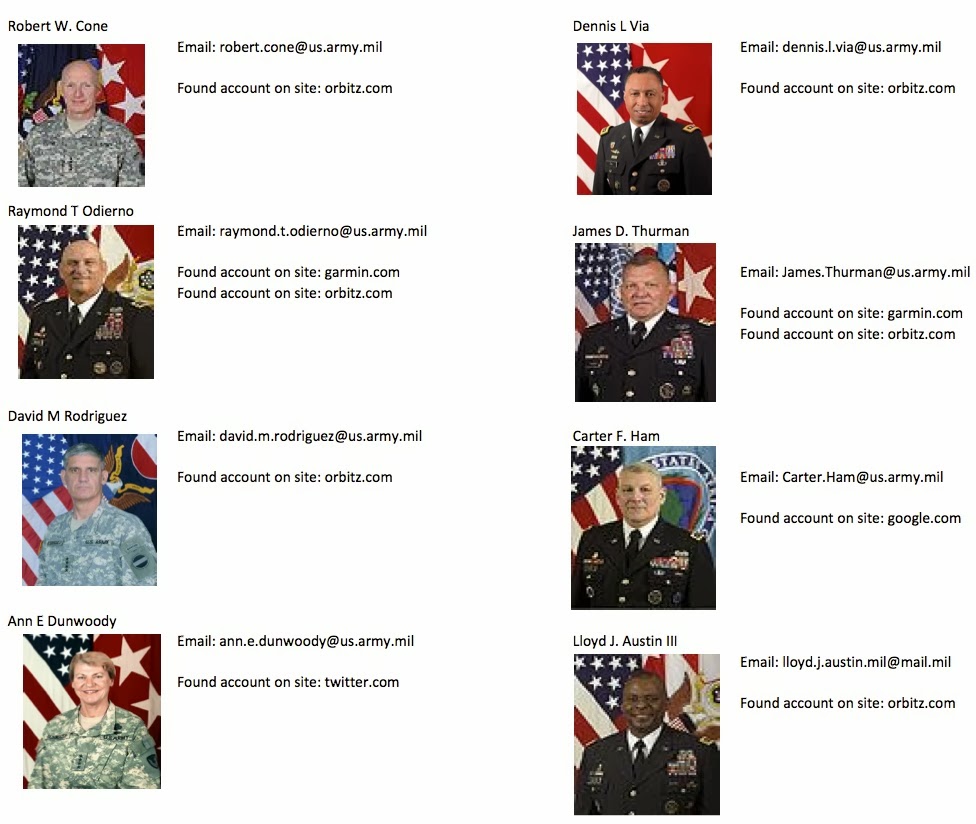
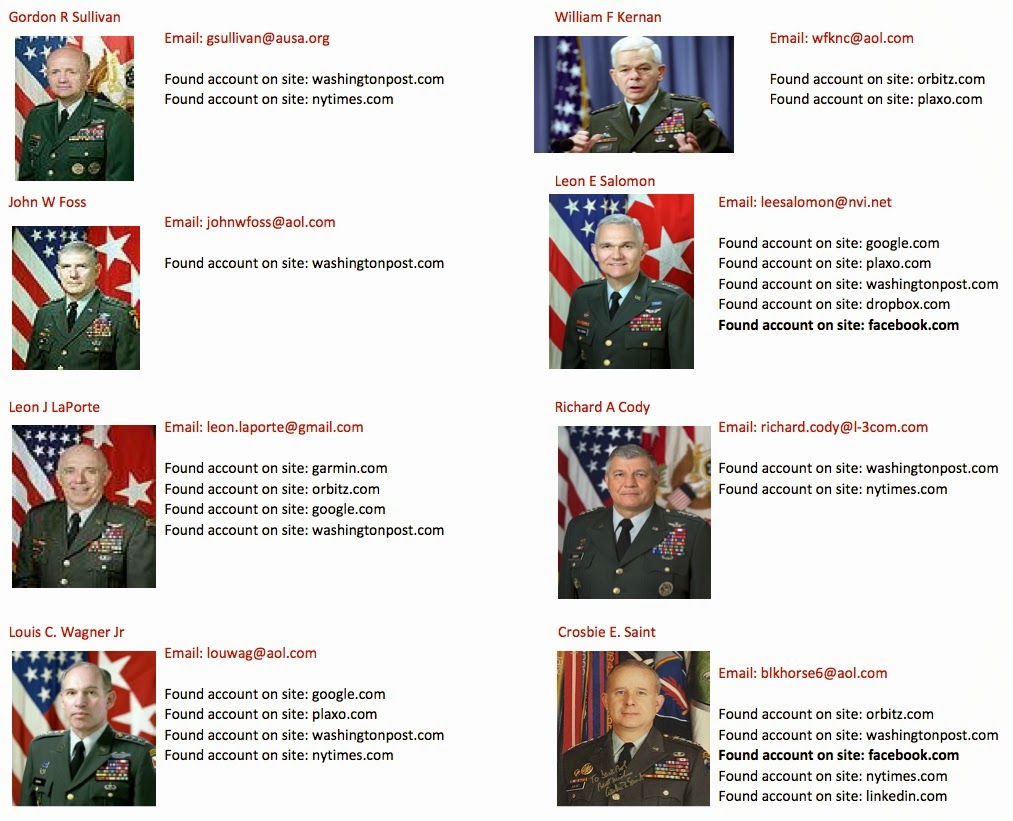
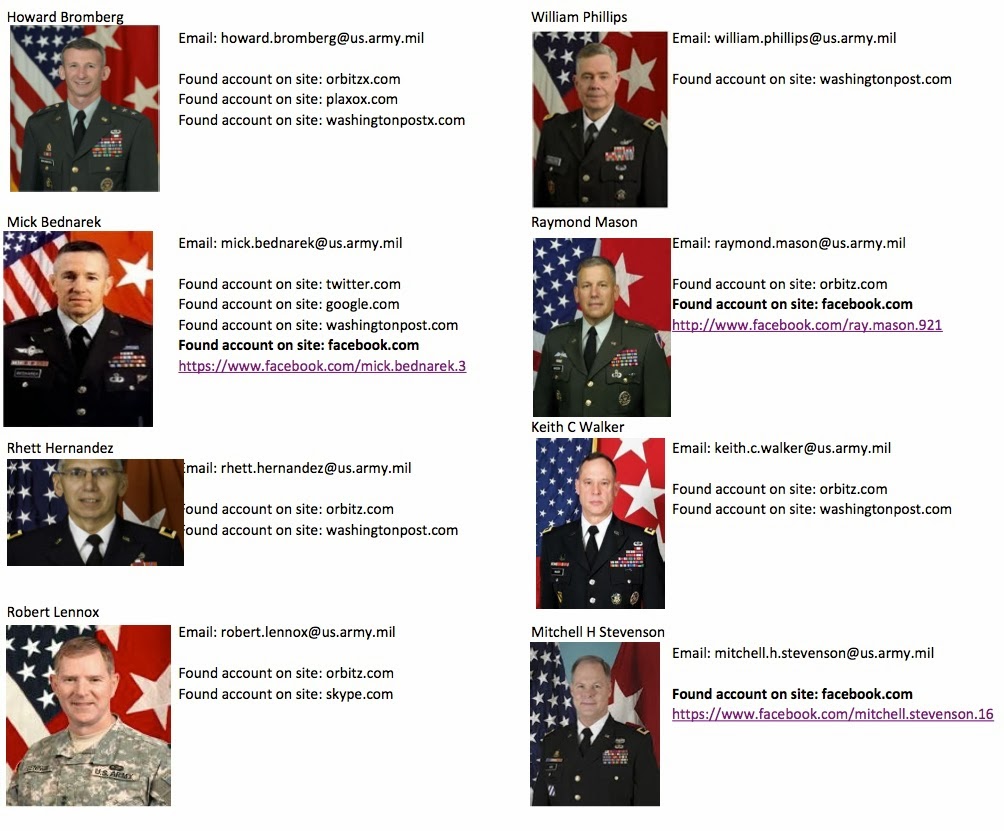
- Many have Facebook accounts exposing to public the family and friend relations that could be targeted by attackers.
- Most of them read and are probably subscribed to The Washington Post (makes sense, no?). This could be an interesting avenue for attacks such as phishing and watering hole attacks.
- Many of them use orbitz.com, probably for car rentals. Hacking this site can give attackers a lot of information about how they move, when they travel, etc.
- Many of them have accounts on google.com probably meaning they have Android devices (Smartphones, tablets, etc.).This could allow attackers to compromise the devices remotely (by email for instance) with known or 0days exploits since these devices are not usually patched and not very secure.
- And last but not least, many of them including Generals use garmin.com or nikeplus.com. Those websites are related with GPS devices including running watches. These websites allow you to upload GPS information making them very valuable for attackers for tracking purposes. They could know on what area a person usually runs, travel, etc.
A Short Tale About executable_stack in elf_read_implies_exec() in the Linux Kernel
#include <unistd.h>
char shellcode[] =
“x48x31xd2x48x31xf6x48xbf”
“x2fx62x69x6ex2fx73x68x11”
“x48xc1xe7x08x48xc1xefx08”
“x57x48x89xe7x48xb8x3bx11”
“x11x11x11x11x11x11x48xc1”
“xe0x38x48xc1xe8x38x0fx05”;
int main(int argc, char ** argv) {
void (*fp)();
fp = (void(*)())shellcode;
(void)(*fp)();
return 0;
}
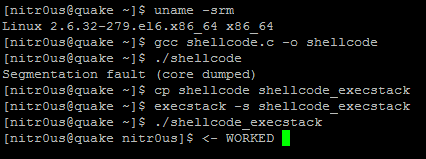
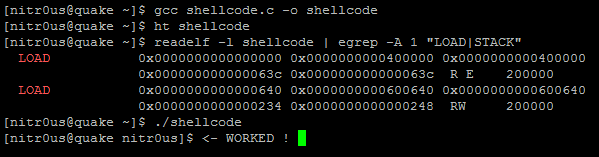
Immediately, I thought it was wrong because of the code to be executed would be placed in the ‘shellcode’ symbol in the .data section within the ELF file, which, in turn, would be in the data memory segment, not in the stack segment at runtime. For some reason, when trying to execute it without enabling the executable stack bit, it failed, and the opposite when it was enabled:
According to the execstack’s man-page:
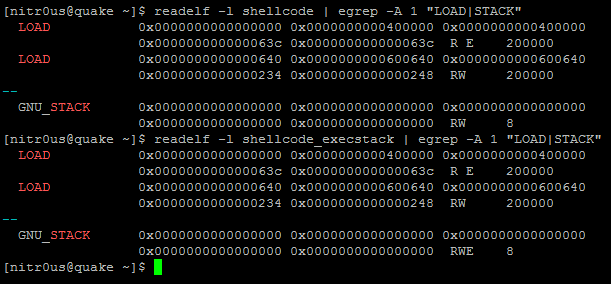
The first loadable segment in both binaries, with the ‘E’ flag enabled, is where the code itself resides (the .text section) and the second one is where all our data resides. It’s also possible to map which bytes from each section correspond to which memory segments (remember, at runtime, the sections are not taken into account, only the program headers) using ‘readelf -l shellcode’.
So far, everything makes sense to me, but, wait a minute, the shellcode, or any other variable declared outside main(), is not supposed to be in the stack right? Instead, it should be placed in the section where the initialized data resides (as far as I know it’s normally in .data or .rodata). Let’s see where exactly it is by showing the symbol table and the corresponding section of each symbol (if it applies):
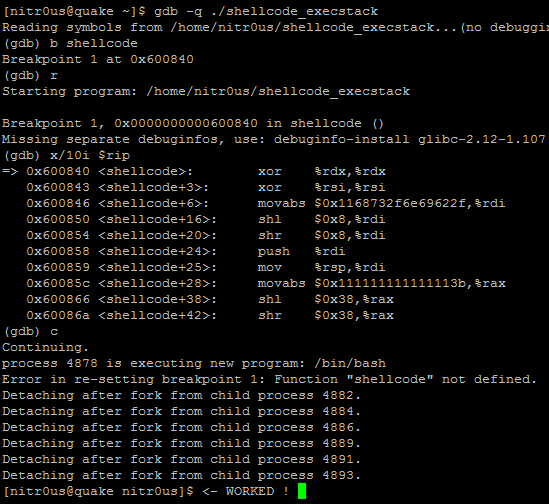
It’s pretty clear that our shellcode will be located at the memory address 0x00600840 in runtime and that the bytes reside in the .data section. The same result for the other binary, ‘shellcode_execstack’.
By default, the data memory segment doesn’t have the PF_EXEC flag enabled in its program header, that’s why it’s not possible to jump and execute code in that segment at runtime (Segmentation Fault), but: when the stack is executable, why is it also possible to execute code in the data segment if it doesn’t have that flag enabled?
Is it a normal behavior or it’s a bug in the dynamic linker or kernel that doesn’t take into account that flag when loading ELFs? So, to take the dynamic linker out of the game, my fellow Ilja van Sprundel gave me the idea to compile with -static to create a standalone executable. A static binary doesn’t pass through the dynamic linker, instead, it’s loaded directly by the kernel (as far as I know). The same result was obtained with this one, so this result pointed directly to the kernel.
Now, for the interesting part, what is really happening in the kernel side? I went straight to load_elf_binary()in linux-2.6.32.61/fs/binfmt_elf.c and found that the program header table is parsed to find the stack segment so as to set the executable_stack variable correctly:
int executable_stack = EXSTACK_DEFAULT;
…
elf_ppnt = elf_phdata;
for (i = 0; i < loc->elf_ex.e_phnum; i++, elf_ppnt++)
if (elf_ppnt->p_type == PT_GNU_STACK) {
if (elf_ppnt->p_flags & PF_X)
executable_stack = EXSTACK_ENABLE_X;
else
executable_stack = EXSTACK_DISABLE_X;
break;
}
Keep in mind that only those three constants about executable stack are defined in the kernel (linux-2.6.32.61/include/linux/binfmts.h):
/* Stack area protections */
#define EXSTACK_DEFAULT 0 /* Whatever the arch defaults to */
#define EXSTACK_DISABLE_X 1 /* Disable executable stacks */
#define EXSTACK_ENABLE_X 2 /* Enable executable stacks */
Later on, the process’ personality is updated as follows:
/* Do this immediately, since STACK_TOP as used in setup_arg_pages may depend on the personality. */
SET_PERSONALITY(loc->elf_ex);
if (elf_read_implies_exec(loc->elf_ex, executable_stack))
current->personality |= READ_IMPLIES_EXEC;
if (!(current->personality & ADDR_NO_RANDOMIZE) && randomize_va_space)
current->flags |= PF_RANDOMIZE;
…
elf_read_implies_exec() is a macro in linux-2.6.32.61/arch/x86/include/asm/elf.h:
/*
* An executable for which elf_read_implies_exec() returns TRUE
* will have the READ_IMPLIES_EXEC personality flag set automatically.
*/
#define elf_read_implies_exec(ex, executable_stack)
(executable_stack != EXSTACK_DISABLE_X)
In our case, having an ELF binary with the PF_EXEC flag enabled in the PT_GNU_STACK program header, that macro will return TRUE since EXSTACK_ENABLE_X != EXSTACK_DISABLE_X, thus, our process’ personality will have READ_IMPLIES_EXEC flag. This constant, READ_IMPLIES_EXEC, is checked in some memory related functions such as in mmap.c, mprotect.c and nommu.c (all in linux-2.6.32.61/mm/). For instance, when creating the VMAs (Virtual Memory Areas) by the do_mmap_pgoff() function in mmap.c, it verifies the personality so it can add the PROT_EXEC (execution allowed) to the memory segments [1]:
/*
* Does the application expect PROT_READ to imply PROT_EXEC?
*
* (the exception is when the underlying filesystem is noexec
* mounted, in which case we dont add PROT_EXEC.)
*/
if ((prot & PROT_READ) && (current->personality & READ_IMPLIES_EXEC))
if (!(file && (file->f_path.mnt->mnt_flags & MNT_NOEXEC)))
prot |= PROT_EXEC;
And basically, that’s the reason of why code in the data segment can be executed when the stack is executable.
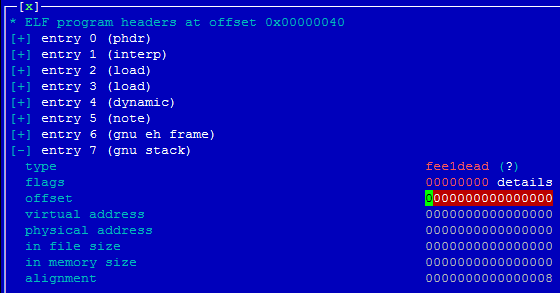
On the other hand, I had an idea: to delete the PT_GNU_STACK program header by changing its corresponding program header type to any other random value. Doing that, executable_stack would remain EXSTACK_DEFAULT when compared in elf_read_implies_exec(), which would return TRUE, right? Let’s see:
The program header type was modified from 0x6474e551 (PT_GNU_STACK) to 0xfee1dead, and note that the second LOAD (data segment, where our code to be executed is) doesn’t have the ‘E’xecutable flag enabled:
#define elf_read_implies_exec(ex, executable_stack)
(executable_stack == EXSTACK_ENABLE_X)
Anyway, perhaps that’s the normal behavior of the Linux kernel for some compatibility issues or something else, but isn’t it weird that making the stack executable or deleting the PT_GNU_STACK header all the memory segments are loaded with execution permissions even when the PF_EXEC flag is not set?
#define elf_read_implies_exec(ex, executable_stack) (executable_stack != EXSTACK_DISABLE_X)
#define INTERPRETER_NONE 0
#define INTERPRETER_ELF 2
heapLib 2.0
- heapLib2.js => The JavaScript library that needs to be imported to use heapLib2
- heapLib2_test.html => Example usage of some of the functionality that is available in heapLib2
- html_spray.py => A Python script to generate static HTML pages that could potentially be used to heap spray (i.e. heap spray w/o JavaScript)
- html_spray.html => An example of a file created with html_spray.py
- get_elements.py => An IDA Python script that will retrieve information about each DOM element with regards to memory allocation in Internet Explorer. Use this Python script when reversing mshtml.dll. Yes, this is really bad. I’m no good at IDAPython. Make sure to check the ‘start_addr’ and ‘end_addr’ variables in the .py file. If you are having trouble finding the right address do a text search in IDA for “<APPLET>” and follow the cross reference. You should see similar data structure listings for HTML tags. The ‘start_addr’ should be the address above the reference to the string “A” (anchor tag).
- demangler.py => Certainly the worst C++ name demangler you’ll ever see.
Change of guard at Infineon
We have come across samples of the über-secure & über-hyped SLE78/97. It would appear new engineers are at the core of these design series. It’s a shame they have sacrificed physical security replacing it with over-hyped so called “secure core” designs. This whole scenario makes an person miss the good old trustable SLE66P.
Practical and cheap cyberwar (cyber-warfare): Part I
The idea of this post is to raise awareness. I want to show how vulnerable some industrial, oil, and gas installations currently are and how easy it is to attack them. Another goal is to pressure vendors to produce more secure devices and to speed up the patching process once vulnerabilities are reported.
Hacking a counterfeit money detector for fun and non-profit
Recently I took a look at one of these devices, Secureuro. I chose this device because it is widely used in Spain, and its firmware is freely available to download.
- RESET == Main Entry Point
- TIMERs
- UARTs
- SPI
- LPM (Load Program Memory)
- SPM (Store Program Memory)
- IN
- OUT
NCSAM – Lucas Apa explains the effects of games cheating, 3D modeling, and psychedelic trance music on IT security
I got involved with computers in 1994 when I was six years old. I played games for some years without even thinking about working in the security field. My first contact with the security field was when I started to create “trainers” to cheat on games by manipulating their memory. This led me to find many tutorials related to assembly and cracking in 2001, when my security research began.
The thin line of legality at that time was blurred by actions not considered illegal. This allowed an explosion of hacking groups, material, and magazines. Many of the hacking techniques that still prevail today started in the early century. At that time I lacked good programming skills and an Internet connection in my homeland, Argentina. I got interested in packers and solved many crackmes because I wondered how commercial games built anti-cracking protections. At that time pirated games were heavily distributed in my country. Having some experience with debuggers allowed me to quickly learn the foundations of programming languages. Many years of self-education and a soon to finish computer engineering degree finally gave me sufficient insight to comprehend how modern software works.
When I was a teenager, I also had the opportunity to explore other areas related to computers, such as 3D modeling (animated short films) and producing psychedelic trance music. All these artistic and creative expressions help me appraise and seize an opportunity, especially when seeing how a new exploitation technique works or providing a new innovative solution or approach to a problem.
There was a moment that I realized the serious effort and true thirst I needed to achieve what could be impossible for other people. The security industry is highly competitive, and it sometimes requires extreme skills to provide a comprehensive response or a novel methodology for doing things. The battle between offensive and defensive security has always been entertaining, pushing the barrier of imagination and creativity every time. This awakens true passion in the people who like being part of this game. Every position is important, and the most interesting part is that both sides are convinced that their decisions are right and accurate.
I like to research everything that could be used to play a better offense in real-world scenarios. Learning about technologies and discovering how to break them is something I do for a living. Defensive security has become stronger in some areas and requires more sophisticated techniques to reliably and precisely defeat. Today, hacking skills in general are more difficult to master because of the vast amount of information that is available out there. Great research demands a conceptual vision and being reckless when facing past experiences that show that something is not achievable. My technical interests involve discovering vulnerabilities, writing exploits, and playing offensive in CTF’s; something close to being inside the quicksand but behind defensive lines. This is one of my favourite feelings, and why I choose to work on security everyday.
My first advice to someone who would like to become a pen tester or researcher is to always maintain patience, dedication, and effort. This is a very satisfying career, but requires a deep and constant learning phase. Having a degree in Computer Science/Engineering will help you get a general overview of how the technology world works, but much of the knowledge and abilities can only be learned and mastered with personal intensive training. Technology changes every year, and future systems could be much different than today’s. The key is to not focus too much on one thing without tasting other fields inside the security world. Fortunately, they can be combined since in this career all the subjects have the same goal. Learn to appreciate other investigative works, blog posts, and publications; every detail is sometimes a result of months or weeks worth of work. Information is relatively available to everyone, you just need to dive in and start your journey with the topics you like most.