

Key Takeaways
- AI will expand security exposure through speed, scale, data access, and automated action. Its use requires clear operating boundaries.
- Connected technologies will extend enterprise exposure through IoT, IIoT, OT, edge systems, cellular modems, and supplier-managed access.
- Critical infrastructure security will be measured through continuity, safety, recovery time, and the ability to maintain trusted operations.
- Offensive security will test whether controls perform across realistic attack paths, detection events, response decisions, and recovery actions.
- Supply chain risk will require evidence across software, hardware, firmware, data, cloud services, and specialist providers.
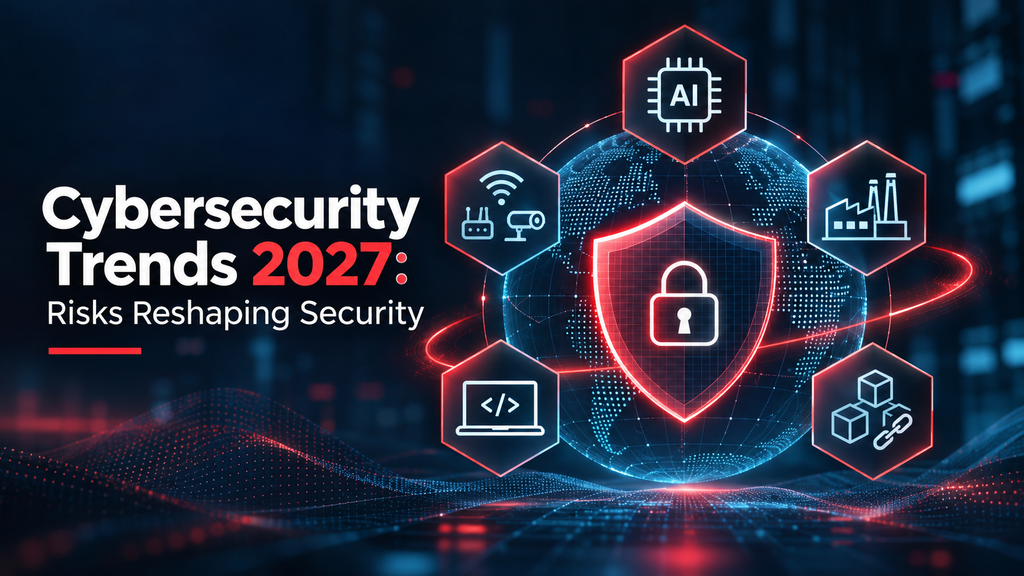
Five shifts will define cybersecurity trends 2027: bounded AI, connected technologies, critical infrastructure exposure, offensive validation, and supply chain risk. Recent CISA alerts put those shifts in operational terms. In July 2026, CISA warned that threat actors were targeting internet-exposed programmable logic controllers in water systems. In August, a related advisory described actors using AI-generated exploitation scripts against exposed PLCs.
These incidents show why 2027 planning must connect emerging technology to evidence about real-world exposure. A joint Five Eyes statement warns that frontier AI is changing cyber risk on a timeline measured in months, not years. The following sections examine the five shifts most likely to affect enterprise exposure and the planning questions security leaders should use for 2027.
Cybersecurity Trends 2027 Risk Map
| Trend | Where exposure is moving | Planning changes for 2027 | Priority validation question |
| Bounded AI | Models, agents, data, tool access, and deployment pipelines | Define permitted actions, data boundaries, human review, and rollback paths | Can the system fail safely when inputs, permissions, or model behavior change? |
| Connected technologies | IoT, IIoT, OT, edge systems, cellular modems, and supplier-managed access | Maintain an accurate external exposure register and secure remote access | Which assets are reachable, who can reach them, and what can they change? |
| Critical infrastructure | Operational systems with safety, uptime, and public-service consequences | Link cyber risk to continuity plans, engineering constraints, and recovery time | What is the operational consequence of compromise, lost visibility, or lockout? |
| Offensive security | Identity, cloud, endpoints, applications, physical access, and response processes | Test realistic attack paths, detection, response, and recovery | Can defenders contain an intrusion before it reaches a critical business process? |
| Supply chain risk | Open-source software, firmware, silicon, cloud services, integrators, and data | Demand evidence across suppliers and lifecycle stages | Which dependency could change the trust boundary without internal approval? |
This is a categorized risk map, not a ranked list. Its purpose is to show where enterprise exposure is moving and which validation question belongs to each trend. The first priority is AI, where adoption speed can exceed assurance.
Cybersecurity Trends 2027 Start With Bounded AI
AI will remain central to the cybersecurity trends shaping 2027. The useful question is where AI can act, what it can access, how its output is verified, and how quickly a human or system can stop it.
The World Economic Forum’s Global Cybersecurity Outlook 2026 found that 87% of respondents viewed AI-related vulnerabilities as the fastest-growing cyber risk during 2025. The report also found that 64% of organizations had a process to assess AI tools before deployment. Those figures point to a control gap between adoption and assurance. In 2027, that gap is likely to matter more as organizations connect AI to sensitive data, business workflows, and automated actions.
For 2027, AI security should be governed as an engineering discipline. Security teams need threat models for model inputs, training data, retrieval sources, plugins, APIs, identities, and automated actions. They also need operational tests for degraded performance, malicious instructions, data leakage, and unsafe tool use.
AI security lens: the 2027 shift
- Authority: By 2027, define which actions require human approval and which actions can run automatically.
- Data: By 2027, map sensitive data into prompts, context windows, training sets, logs, and model outputs.
- Recovery: By 2027, maintain a tested rollback path for model, prompt, policy, and integration changes.
By 2027, bounded AI should distinguish durable security controls from product hype. Teams that can define authority, data boundaries, and recovery paths will be better positioned to deploy AI without turning speed into unmanaged exposure. That shift creates a bridge to the next priority: connected technologies and the paths they create into enterprise operations.
Connected Technologies Will Turn Asset Visibility Into Resilience
The attack surface in 2027 will extend to systems that many enterprise security teams do not directly own. Cellular modems, engineering workstations, cloud control planes, embedded devices, smart facilities, and supplier-managed connections can provide entry points to high-consequence environments.
CISA’s Internet Exposure Reduction Guidance states that internet-accessible IT, IIoT, SCADA, ICS, and remote access technologies continue to grow. The guidance recommends identifying accessible systems, removing unnecessary exposure, securing necessary remote access, and reviewing exposure on a routine basis.
The broader lesson applies across industries. Asset inventories need ownership, reachability, software and firmware status, remote-access paths, and operational consequences. A vulnerability register without exposure context will struggle to rank the paths that matter most.
Connected technology lens: the 2027 shift
- Reachability: By 2027, identify every internet-facing asset, remote-access method, and supplier-managed connection.
- Change authority: By 2027, record who can alter configuration, credentials, logic, firmware, or network paths.
- Consequence: By 2027, map each asset to safety, uptime, revenue, regulatory, and recovery requirements.
By 2027, exposure management will need to move from periodic discovery to a continuous view of how technology connects to operations. That means tracking reachability, change authority, and consequence as conditions change—not only when an inventory is refreshed.
Critical Infrastructure Risk Will Be Measured in Operational Consequence
Critical infrastructure operators carry security requirements that extend beyond data protection. A compromised system can affect safety, public services, production, environmental controls, or the ability to operate manually during recovery.
CISA’s July 2026 alert reported that threat actors targeting exposed PLCs had modified passwords, changed IP addresses, and caused loss of monitoring and control functionality. The alert also warned that exposed OT assets can create risks involving operational disruption and physical damage. That pattern is expected to remain relevant in 2027 as exposed OT assets, remote access, and internet-connected control systems continue to create paths into operational environments.
For 2027, security planning should connect technical controls to engineering constraints and recovery time. Leaders need to know which systems can be isolated, which processes can run manually, which backups are trusted, and which suppliers can restore affected equipment.
Critical infrastructure lens
- Continuity: Identify the essential process that must continue during a cyber incident.
- Safety: Map how loss of control, visibility, or configuration integrity could affect people and equipment.
- Recovery: Test restoration procedures against actual dependencies, access requirements, and operating conditions.
This perspective gives critical infrastructure risk a measurable business context. It also creates the basis for offensive testing that reflects real operational pressure.
Offensive Security Will Test Control Performance
Security programs increasingly need evidence that controls work under pressure. A tool deployment, policy document, or completed assessment provides limited assurance when teams have not tested a realistic attack sequence.
For 2027, mature programs will connect threat intelligence to threat emulation. The shift is from periodic, point-in-time testing to scenario-based validation of identity compromise, cloud privilege escalation, lateral movement, data access, physical entry, and recovery decisions in environments that reflect the organization’s technology and operating model.
Red and purple team exercises can reveal detection gaps, response delays, authority problems, and process constraints. In 2027, those exercises will need to connect more directly to business-critical outcomes, while penetration testing continues to examine technical weaknesses across applications, infrastructure, cloud, mobile, and embedded systems.
Offensive security lens: the 2027 shift
- Path: Can an attacker move from an exposed service to a critical business process?
- Signal: Which attacker actions create useful telemetry, and how long does triage take?
- Decision: Who can isolate systems, suspend access, or accept operational impact during an incident?
By 2027, security testing should function as a management instrument, producing evidence for investment, prioritization, and risk acceptance—not simply a list of technical findings.
Supply Chain Risk Will Reach Below the Application Layer
Supply chain risk will continue to expand across software, hardware, firmware, cloud services, data, and specialist providers. The World Economic Forum’s 2026 report identifies supply chain opacity and concentration as core forces shaping cyber resilience.
For 2027, third-party risk programs will need to examine how dependencies are built, updated, configured, and retired. That includes open-source packages, CI/CD runners, model repositories, semiconductor components, device firmware, managed service accounts, and the people who maintain them.
The practical test is traceability. Security leaders should know which dependencies support critical processes, which parties can change them, what evidence supports their security, and how the organization will operate if a dependency becomes unavailable or untrustworthy.
Supply chain risk lens: the 2027 shift
- Provenance: Can the organization verify where software, firmware, data, and components originated?
- Privilege: Which suppliers, integrators, and service accounts can change production systems?
- Continuity: What is the tested fallback if a provider is compromised, unavailable, or subject to geopolitical disruption?
By 2027, supply chain programs will need to move beyond point-in-time reviews toward evidence of provenance, privilege, and continuity across the dependency lifecycle. The resulting program connects procurement, architecture, engineering, incident response, and executive risk decisions.
What Security Leaders Should Prepare for in 2027
A strong 2027 security strategy will be built around validation. Set a short list of high-consequence scenarios, then test the assumptions behind them. Confirm that teams can see the relevant activity, make decisions quickly, and recover without relying on undocumented expertise.
2027 readiness check
- Evidence: Can leaders see proof that priority controls work under realistic conditions?
- Exposure: Can teams identify reachable assets, trust paths, and high-consequence dependencies?
- Consequence: Can the organization contain disruption and recover within its operational limits?
How IOActive Can Help Prepare for 2027
IOActive’s analysis of the Five Eyes cyber risk statement identifies practical actions for organizations looking to minimize risk in 2027: reduce attack surface, accelerate patching, address legacy systems, strengthen identity and access controls, and prepare for incidents.
A research-led security partner can extend that work across AI, software, hardware, connected technologies, and critical infrastructure. IOActive’s AI/ML Security Services assess AI systems across architecture, code, applications, devices, and infrastructure. Its Red Team and Purple Team Services examine realistic attack paths and defensive response. Its penetration testing practice applies attacker perspective across cloud, mobile, embedded, infrastructure, and web services.
Build 2027 priorities around evidence, exposure, and operational consequence. To discuss an independent assessment of emerging risk, contact IOActive’s security experts and turn cybersecurity trends 2027 into a testable security plan.