
INSIGHTS | October 13, 2026

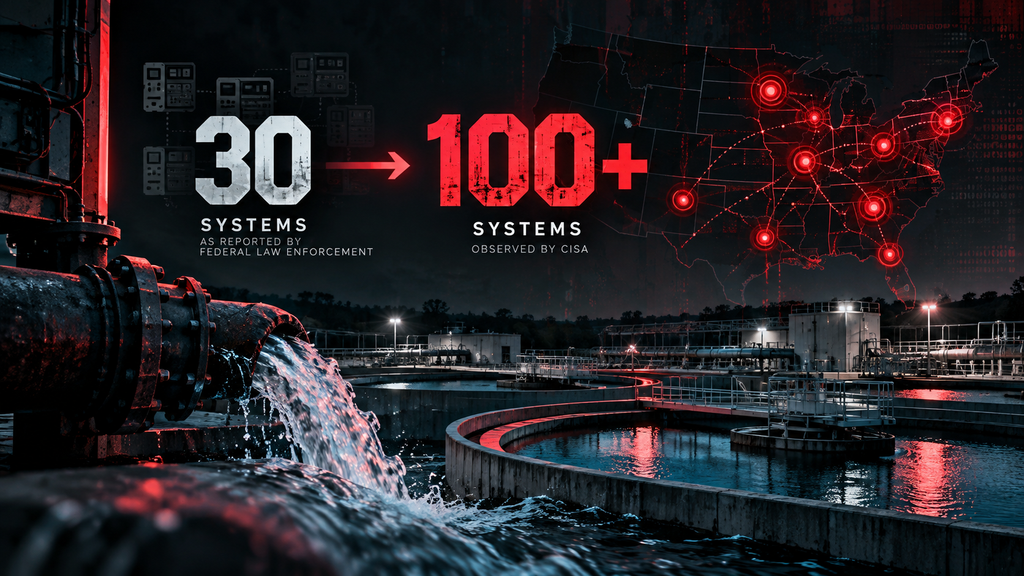
From 30 Systems to Over 100: What CISA’s Revised Water Sector Figures Reveal About the OT Detection Gap

Key Takeaways

  • CISA has revised the scale of the July 2026 water sector campaign from the roughly 30 systems described by federal law enforcement at the time to more than 100 internet-exposed systems across at least 12 US states [1] [3].
  • The revised figure originated with CISA’s own observation, published on 21 August 2026 in exposure reduction guidance, rather than with incident reports submitted by the affected utilities [1] [3].
  • CISA has warned that the cellular modems involved may have been installed by operators, vendors or system integrators, and may not be documented or included in routine attack surface scans [4].
  • The UK position is structurally similar. The Drinking Water Inspectorate received five cyber incident reports from water suppliers between January 2024 and October 2025, all concerning systems outside NIS scope and all submitted voluntarily rather than under a legal duty [5].
  • Reporting obligations under the UK NIS Regulations, the Cyber Security and Resilience Bill and EU NIS2 are all triggered by the operator becoming aware of an incident. Lowering a reporting threshold does not close a detection gap.

Why Do the Revised Figures Matter Now?

Malicious activity against US water and wastewater systems began on 26 July 2026 [2]. In the weeks that followed, federal law enforcement described a campaign affecting approximately 30 water systems in Minnesota and a small number of other states [2].

On 21 August 2026, CISA published internet exposure reduction guidance stating that during July 2026 it had observed malicious cyber activity targeting over 100 internet-exposed systems in the Water and Wastewater Systems (WWS) Sector, commonly via programmable logic controllers connected directly to a cellular modem [1] [6]. Until that publication, federal agencies had not publicly quantified the number of systems affected [3].

The figure moved by a factor of more than three, roughly four weeks after the activity began, and it moved on the strength of an agency observation rather than a sector disclosure.

Reporting has linked the campaign to Iranian threat actors, and federal law enforcement indicated at the time that the activity was consistent with previous Iranian state-sponsored operations [2] [3]. CISA’s exposure reduction guidance describes the activity without naming an actor [1]. Attribution in this case remains contested rather than settled, and the analysis that follows does not depend on it.

The geographic picture is similarly incomplete. The US government has not stated how many states were affected, although at least 12 appears to be the working figure, with Minnesota, Michigan, South Dakota, Georgia, New Jersey and Alabama confirmed publicly [3]. Illinois does not appear on the list, but Illinois also has no regulation requiring water systems to notify law enforcement or the public of a computer intrusion [2]. Absence from a published list is not evidence of absence where no duty to report exists.

What Does the Revision Actually Show?

The number did not change because the campaign grew. It changed because the observer’s picture improved. Three features of the revision are worth separating.

The figure came from the observer, not the observed.

CISA stated that it observed the activity. That language points to agency telemetry, scanning and partner reporting rather than to aggregated victim notifications. A figure derived from what the observer could see is a measure of the observer’s reach, and it sets a floor rather than a ceiling.

The assets were not in the inventory.

In its 30 July 2026 alert, CISA advised that even water organisations with mature cyber security processes should validate their external connections, because the targeting included cellular modems installed by operators, vendors or system integrators that may not be documented or included in routine attack surface scans [4]. This is the mechanism behind the revision. A controller connected directly to a cellular modem has no route through the corporate network. It is internet-facing without being enterprise-facing, so an external attack surface management tool working from the organisation’s registered domains and IP ranges will not enumerate it.

Detection depended on process behaviour rather than security monitoring.

In the Minnesota incidents, utilities appear to have avoided serious consequences largely because staff noticed abnormal control behaviour and reverted to manual operation [7]. That is a real outcome and it reflects operational competence, but it is a thin margin, and it is not a security control in any repeatable sense. It also flatters the failure mode. Abnormal automation is an availability signal, and availability signals announce themselves. As we argued in Rethinking the CIA Triad in Operational Technology Environments, integrity failures behave differently, persisting undetected precisely because nothing stops working. An actor who had altered controller logic without disturbing the process would not have been found by the mechanism that found this one.

The structural explanation sits in the shape of the sector. Nearly 49,500 US community water systems fall under the Safe Drinking Water Act, and the EPA classifies around 81 per cent of them as small, meaning they serve 3,300 people or fewer [14]. The statutory duty to conduct a risk and resilience assessment under Section 1433 applies only to systems serving more than 3,300 people, which leaves roughly four in five community water systems outside the requirement altogether [14]. Reporting on the campaign indicates it fell mainly on small and rural utilities [6]. A sector composed predominantly of organisations with no assessment duty and no security function is a sector that will be counted by somebody else.

Who is Affected by the OT Detection Gap?

Water and wastewater operators.

Small and rural US utilities are the most acutely exposed, but the underlying condition is not specific to the United States. UK and EU water companies operate large estates of remote, unstaffed assets including pumping stations, reservoirs and treatment works, many of which report telemetry over cellular links precisely because a fixed connection is impractical. The asset class that CISA describes is the same asset class deployed across British and European water networks.

CNI operators outside the water sector.

Energy, transport and other operators of essential services run comparable distributed estates on comparable connectivity. Joint advisory AA26-097A named Government Services, Water and Wastewater Systems and Energy as directly affected sectors, and expanded the vendor scope from Rockwell Automation to Schneider Electric and Siemens [8]. The inventory blind spot travels with the architecture, not with the sector. Our analysis of the Polish energy sector incident documented the same dynamic through a different exposure route, where a single repeated configuration weakness across more than 30 facilities turned a site-level problem into a fleet-level one, and the full extent only became clear after the fact.

Boards and risk functions.

A sector risk figure that changes by a factor of three within four weeks is not a stable basis for board reporting, insurance placement or investment prioritisation. Anyone who briefed a board in early August on the basis of the initial figure understated the scale of the campaign by more than 70 systems, through no fault of their own. The relevant board question is not what the number is, but how much confidence attaches to it and what would have to be true for it to move again.

Suppliers, system integrators and equipment manufacturers.

CISA specifically identified connectivity installed by vendors and integrators as a category that may not be documented [4]. Remote access introduced during commissioning, or added to support a maintenance contract, can persist long past project handover without appearing in any register the asset owner maintains.

What Challenges Does This Create for Operators and Regulators?

Asset inventories do not contain the assets.

Cellular-connected controllers are frequently procured operationally, by engineering or maintenance functions and against an operational budget, rather than through an IT asset management process. They may never reach a configuration management database. In some estates they exist only in a project file or in an integrator’s records.

External attack surface management does not reach them.

Commercial attack surface tooling starts from an organisation’s known domains and address ranges. A controller sitting behind a mobile network operator’s address space is not in any of them, which means an operator can hold a clean external exposure report and still be internet-reachable. The NCSC made the same point in its alert of 27 August 2026, advising that organisations should not assume their OT is inaccessible from the internet without verifying it, because unintended exposure can arise through misconfigurations, legacy connections or unmanaged assets [13].

Reporting thresholds exclude the activity.

The UK NIS Regulations 2018 limit formally reportable cyber incidents to those that actually result in disruption to an essential service [5]. The July 2026 US campaign did not cause significant service disruption [3]. An equivalent UK campaign would, in many cases, generate no mandatory report at all. The Drinking Water Inspectorate’s experience illustrates this directly. Of 15 reports received from suppliers between January 2024 and October 2025, five concerned cyber security incidents affecting what the Inspectorate described as out-of-NIS-scope systems, and were shared for information because they were considered related to water supply resilience risks rather than because a duty required it [5].

Reform addresses the threshold but not the trigger.

The Cyber Security and Resilience Bill widens the definition of a reportable incident beyond significant disruption to capture incidents capable of significant impact, including pre-positioning, and introduces a two-stage process of initial notification within 24 hours and a full report within 72 hours to the competent authority and the NCSC [9] [10]. EU NIS2 already imposes a 24-hour early warning, a 72-hour notification and a final report within one month on essential entities, a category that includes drinking water and wastewater [11]. Both regimes start the clock when the entity becomes aware of the incident. Where the affected asset is undocumented and unmonitored, awareness may never arrive, and a widened threshold produces no report.

How IOActive Can Help

The revision from roughly 30 systems to more than 100 describes a measurement failure rather than a control failure. Nobody in the sector could state the scale of the campaign while it was running, and the figure that eventually emerged came from an agency looking in rather than from operators looking at themselves. Closing that gap means answering two questions with evidence rather than with documentation. What is actually connected, and would anyone notice if it were used.

IOActive has worked in industrial control environments since publishing the first proof-of-concept worm against the smart grid in 2009. The services below map onto the two questions this campaign leaves open.

Full Stack Security Assessments

The assets at the centre of this campaign were not hidden. They were undocumented, which is a different problem and a harder one, because no amount of scanning an organisation’s own address ranges will surface a controller that reaches the internet through a mobile network. Our Full Stack assessments examine an environment across its layers rather than at a single tier, covering internet-facing controllers and HMIs, the OT and IT boundary, the cellular modem paths that often give a field site its only route out, and the firmware and silicon of the devices themselves. The output is an inventory that has been verified rather than asserted, which is the precondition for every other step recommended below.

Red Team and Purple Team Services

The more uncomfortable question this campaign raises is not whether operators were exposed but whether they would have known. In Minnesota, detection came from control room staff noticing that automation was behaving abnormally [7]. That is a credit to the operators involved and it is not a control any organisation should expect to rely on twice. Adversarial testing answers the question directly, by establishing whether an intrusion at an unstaffed remote site produces a signal that anyone acts on. It is particularly suited to integrity attacks such as altered controller logic, which availability-focused monitoring is not built to catch. Purple team work then converts those findings into detection that the operator’s own staff can maintain, which matters more in operational environments than in enterprise ones because the meaningful signal is frequently a process anomaly rather than a network event. We set out the distinction between the two approaches in Red vs Purple Team, what’s the difference?.

Supply Chain Integrity

CISA was explicit that the cellular modems involved may have been installed by operators, vendors or system integrators, and may never have been documented [4]. That places part of the inventory problem outside the operator’s own records entirely. Our Supply Chain Integrity work assesses the security posture of technology providers and critical third parties, covering firmware, embedded systems, remote access arrangements and procurement processes, so that connectivity introduced during commissioning or under a maintenance contract is identified before it becomes someone else’s route in. For UK operators this maps onto the designated critical supplier powers in the Cyber Security and Resilience Bill [9].

If you would like to discuss how your organisation’s remote OT connectivity and detection coverage measure up against the activity described here, we welcome the conversation.

  1. Enumerate cellular and out-of-band connectivity as a separate exercise from the IT asset inventory. Network discovery will not find these assets, so the exercise has to be conducted through engineering teams, maintenance schedules and site records.
  2. Interrogate procurement and project documentation for purchases of modems, industrial routers and remote telemetry units, including those made under capital projects and maintenance contracts rather than IT budgets.
  3. Ask every OEM, system integrator and maintenance supplier directly whether connectivity was installed to support their own access, and whether that connectivity remains active.
  4. Apply CISA’s exposure reduction measures to whatever the exercise finds. Disconnect controllers from direct internet exposure, route remote access through a VPN or gateway rather than to the controller itself, enable and change default passwords, allowlist permitted source addresses, and hold a known clean controller image in case an actor changes the device password [1] [4].
  5. Treat process anomalies as a security signal. Define in advance which operational deviations trigger a security escalation rather than only an engineering response, and make sure control room staff know that route exists.
  6. Rehearse the 24-hour notification decision against a scenario involving unauthorised access with no service disruption. Establish who holds the decision that such an event is reportable, and how quickly that decision can be reached out of hours.
  7. Re-baseline the board risk picture once the inventory work is complete, and state explicitly what confidence attaches to the new figure and what would cause it to change.

Conclusion

The revision from roughly 30 systems to more than 100 is the most useful finding to come out of the July 2026 campaign, and it has little to do with the actors involved. It demonstrates that a sector could be targeted at scale, across at least a dozen jurisdictions, without the targeted organisations being the ones to establish how widely it had happened.

Regulatory reform on both sides of the Atlantic is moving in the right direction, widening what must be reported and shortening the time in which it must be reported. None of it changes the fact that a reporting obligation begins with an operator knowing something has occurred. For operators running remote assets on connectivity that nobody has catalogued, the work that closes the gap is inventory work, and it is available to be started now. As we set out in Cyber Attack Trends 2026, the environments an organisation depends on most are routinely the ones it monitors least, and that ordering is a choice rather than a constraint.

References

[1] CISA. Internet Exposure Reduction Guidance. https://www.cisa.gov/resources-tools/resources/exposure-reduction

[2] Goudie, C., Capitanini, L. and Halder, N. Government admits water system cyberattacks were worse than first reported. NBC Chicago, 26 August 2026. https://www.nbcchicago.com/investigations/government-admits-water-system-cyberattacks-were-worse-than-first-reported/3980961/

[3] Kovacs, E. CISA: Over 100 Internet-Exposed Water Systems Targeted in July Cyberattacks. SecurityWeek, 26 August 2026. https://www.securityweek.com/cisa-over-100-internet-exposed-water-systems-targeted-in-july-cyberattacks/

[4] CISA. CISA Urges Water and Wastewater Systems Sector to Protect OT Against Activity Targeting PLCs, 30 July 2026. https://www.cisa.gov/news-events/alerts/2026/07/30/cisa-urges-water-and-wastewater-systems-sector-protect-ot-against-activity-targeting-plcs

[5] Martin, A. Hackers are attacking Britain’s drinking water suppliers. The Record, 3 November 2025. https://therecord.media/britain-water-supply-cybersecurity-incident-reports-dwi-nis

[6] More than 100 water systems were hit in July cyberattacks. The Register, 26 August 2026. https://www.theregister.com/cyber-crime/2026/08/26/more-than-100-water-systems-were-hit-in-july-cyberattacks/

[7] IOActive. When the Advisory Arrives First: Minnesota’s Water Utilities and the Limits of Warning. https://www.ioactive.com/when-the-advisory-arrives-first-minnesotas-water-utilities-and-the-limits-of-warning/

[8] CISA, FBI, NSA and partner agencies. Iranian-Affiliated Cyber Actors Exploit Programmable Logic Controllers Across US Critical Infrastructure (AA26-097A), originally published 7 April 2026, updated 22 July 2026. https://www.cisa.gov/news-events/cybersecurity-advisories/aa26-097a

[9] House of Commons Library. Cyber Security and Resilience (Network and Information Systems) Bill 2024-26, 2026-27, research briefing CBP-10442. https://commonslibrary.parliament.uk/research-briefings/cbp-10442/

[10] Department for Science, Innovation and Technology. Cyber Security and Resilience (Network and Information Systems) Bill factsheets: Summary of the Bill. https://www.gov.uk/government/publications/cyber-security-and-resilience-network-and-information-systems-bill-factsheets/summary-of-the-bill

[11] Directive (EU) 2022/2555 (NIS2), Article 23. Incident reporting obligations for essential and important entities.

[12] Federal News Network. CIRCIA, other big cyber rules expected to get finalized this fall, 10 July 2026. https://federalnewsnetwork.com/cybersecurity/2026/07/circia-other-big-cyber-rules-expected-to-get-finalized-this-fall/

[13] NCSC. Disruptive cyber activity highlights risk from internet-exposed systems and edge devices, 27 August 2026. https://www.ncsc.gov.uk/news/disruptive-cyber-activity-highlights-risk-from-internet-exposed-systems-and-edge-devices

[14] Congressional Research Service. Cybersecurity of the Municipal Water Sector: Background and Issues for Congress, report R48556. https://www.congress.gov/crs-product/R48556


INSIGHTS | September 25, 2026

One Exposure, Many Actors: What the NCSC’s OT Alert Adds to the AA26-097A Picture

Key Takeaways

  • On 27 August 2026, the NCSC published an Alert warning of increased targeting of operational technology (OT) systems across multiple sectors globally, including in the UK, carried out by a range of threat actors and resulting in some limited real-world disruption [1].
  • The Alert is deliberately unattributed. It should not be read as an extension of joint advisory AA26-097A, which attributes a separate and well-documented PLC exploitation campaign to Iranian-affiliated actors [2].
  • Three separate bodies of reporting published between April and August 2026, covering Iranian-affiliated PLC exploitation, Russian FSB Centre 16 router targeting, and unattributed activity against water sector controllers, converge on the same access route of systems reachable directly from the public internet.
  • The FBI and EPA have reported that similarities in network configurations supplied by third parties allowed attackers to repeat successes across multiple victims, making integrator and supplier architecture a first-order concern rather than a downstream one [3].
  • The Alert lands five days before the UK Cyber Security and Resilience Bill reaches Lords Committee Stage on 1 September 2026, placing OT exposure in front of regulators, boards and legislators simultaneously [4].

Why the NCSC’s Alert Matters Now

The NCSC classified its 27 August publication as an Alert rather than guidance. That distinction carries weight. The organisation states that it has been engaging with affected sectors directly in response to recent targeting and is publishing the material to support national resilience efforts, which indicates that the advice follows live incident handling rather than horizon scanning [1].

The substance is uncomfortable for anyone who has treated OT exposure as a solved problem. The NCSC reports increased targeting of OT systems across multiple sectors globally, including in the UK, conducted by a range of threat actors, with some limited real-world disruption already recorded [1]. It also sets out a broader judgement. Against a backdrop of technology-enabled uplifts in offensive capability and increased geopolitical instability, the threat from state use of offensive cyber, including outside of conflict, has almost certainly increased [1].

The timing compounds the message. The Alert arrives within four months of joint advisory AA26-097A, seven weeks after an international advisory on Russian state targeting of network devices, and four weeks after an FBI and EPA announcement describing degraded water operations in at least seven US states [2][3][5]. Regulators are moving in parallel. The Cyber Security and Resilience Bill is scheduled to enter Lords Committee Stage on 1 September 2026, with Royal Assent expected later in the year [4].

What Does the NCSC Alert Actually Say?

The Alert sets out eight actions. Several restate established practice:

  • Build a definitive view of OT architecture including all assets, communications pathways and external connections
  • Replace default credentials and enforce unique administrator accounts with multi-factor authentication where supported
  • Harden the OT boundary and keep gateways, firewalls, routers and remote access appliances within vendor support
  • Segment OT, management and business networks
  • Maintain tested, ransomware-resistant backups of configurations, controller logic and critical engineering data [1]

Two items deserve closer attention because they move beyond network-layer control.

The first concerns device state. The NCSC advises that OT devices be operated in a condition that prevents remote programming during normal operations, ensuring PLCs are not left in PROGRAM or other maintenance modes and that controller logic uses password-based write protection or equivalent mechanisms to prevent unauthorised changes from malicious endpoints [1]. This is a control on the device itself, not on the path to it, and it assumes the network boundary may fail.

The second concerns protocols. The Alert recommends migrating industrial protocols to secure variants where available, naming DNP3 to DNP3-SAv5, CIP to CIP Security, Modbus to Modbus Security, and OPC DA to OPC UA, while removing telnet and SNMP versions 1 and 2 from management use [1]. Where no secure alternative exists, insecure protocols should be confined to isolated network segments.

The Alert also addresses organisations without OT estates, noting a continuing pattern of disruptive activity against internet-exposed systems and edge devices across all sectors, and directing readers to maintain an accurate inventory of internet-facing systems, retire end-of-life equipment and monitor for unexpected configuration changes or outbound connections [1]. It points UK organisations towards the NCSC’s free Early Warning service and frames the Cyber Assessment Framework as the mechanism through which boards should seek assurance [1].

Notably, the Alert names no threat actor.

How Does This Connect to AA26-097A, and Where Does It Not?

This is the point at which analysis most often goes wrong, and the distinction matters more than the similarity.

Advisory AA26-097A, first published on 7 April 2026 and updated on 22 July 2026, attributes an active campaign to Iranian-affiliated APT actors exploiting internet-connected PLCs across US critical infrastructure. The July update broadened the observed manufacturer scope from Rockwell Automation/Allen-Bradley to include Schneider Electric and Siemens controllers, added detection guidance for malicious changes in reusable code modules within Rockwell PLC programs, and brought the Department of the Treasury onto the authoring byline alongside CISA, the FBI, NSA, EPA, the Department of Energy and US Cyber Command’s Cyber National Mission Force [2].

Separately, an international advisory published in July 2026, co-sealed by the NCSC alongside 18 partner agencies from 12 countries, attributes sustained targeting of poorly configured routers to Russian Federal Security Service Centre 16, tracked variously as Berserk Bear, Energetic Bear, Dragonfly, Ghost Blizzard and Static Tundra. That activity centres on internet-wide scanning for devices accepting default or weak SNMP community strings, followed by exfiltration of device configuration files [5].

Separately again, the FBI and EPA issued a public service announcement on 30 July 2026 describing unattributed malicious cyber actors targeting internet-facing Rockwell Automation/Allen-Bradley MicroLogix 1100 and 1400 PLCs. Water and wastewater utilities in at least seven states reported incidents from 27 July 2026 onwards. The actors changed device IP addresses and set passwords, producing loss of view and, in some cases, loss of function. Reported operational effects included loss of pressure and flooding, with the announcement noting that pressure loss in water systems could potentially allow untreated groundwater to seep into pipes [3].

Four publications carry three different attribution states. One names Iranian-affiliated actors, one names a Russian intelligence unit, and two describe activity the authoring agencies have chosen not to attribute. Collapsing these into a single narrative would be an analytical error, and one that regulated operators cannot afford to make in reporting or board briefings.

What survives the separation is the access route. In every case the initial condition is the same, namely a control system, a management interface or an edge device reachable from the public internet and frequently protected by default, weak or absent credentials. The NCSC’s phrasing, that this activity is being carried out by a range of threat actors, is the more useful framing for defenders precisely because it removes the actor from the risk calculation. Exposure is exploitable by whoever finds it first.

Who is Affected by the NCSC’s OT Alert?

CNI operators with field-deployed OT

Any organisation with internet-exposed OT could be affected. The NCSC is explicit that organisations should not assume their OT is inaccessible from the internet without verifying it, since unintended exposure can arise through misconfigurations, legacy connections or unmanaged assets [1]. Water, wastewater and energy operators with geographically distributed sites and cellular field connectivity carry the highest concentration of this risk.

System integrators and managed service providers

The FBI and EPA observed that across several victims, similarities in network setups provided by third parties may give attackers the opportunity to multiply successes where vulnerable configurations recur across a supplier’s customer base [3]. A single integrator’s default deployment pattern becomes a repeatable attack template. This finding maps directly onto the critical supplier designation powers in the Cyber Security and Resilience Bill.

Organisations without OT

The Alert is explicit that the broader pattern of disruptive activity against internet-exposed systems and edge devices affects all sectors [1]. Routers, firewalls, VPN concentrators and remote access appliances present the same fundamental exposure.

Boards and regulated entities across jurisdictions

UK operators face the CAF as the assurance framework of record and the Cyber Security and Resilience Bill as the coming statutory instrument [1][4]. EU operators are working to NIS2. US operators sit within the CISA advisory and directive framework, including binding requirements on end-of-support edge devices [6]. The technical remediation is common across all three, and only the reporting obligations differ.

What Makes This Exposure So Difficult to Eliminate?

The mitigations in the NCSC Alert are not novel, and that is the difficulty. Every one of the eight actions was recognised practice before August 2026. Their repeated publication indicates a gap between recommendation and implementation rather than a gap in knowledge.

Three factors sustain that gap.

Asset visibility remains hard in OT. Exposure is frequently unintended, arising from a commissioning shortcut, a supplier’s remote support link, or a cellular modem installed to solve an operational problem years earlier. An operator can hold an accurate architecture diagram and still be exposed through an asset that diagram never captured.

Integrity attacks defeat availability-focused monitoring. AA26-097A describes actors using legitimate vendor engineering software to alter controller logic and falsify operator displays, and the FBI reported at least one organisation discovering modified PLC project files after noticing ladder logic discrepancies across several sites [2][3]. Where the control room’s picture of the process is itself manipulated, conventional uptime monitoring will report normality.

Remediation carries operational cost. Removing a PLC from direct internet exposure, migrating a protocol, or replacing an end-of-life gateway involves planned downtime in environments where downtime is the primary risk being managed. This is where technical recommendation meets capital planning, and where accountability for the outcome frequently disperses.

How IOActive Can Help

The NCSC’s Alert describes a condition rather than an incident. That condition is assets reachable from the internet that the owner did not know were reachable, protected by credentials the owner did not know were still default. Verifying that condition is an assessment problem before it is a remediation problem, and it spans the OT estate, the edge estate and the third parties with standing access to both.

IOActive has operated in industrial control environments since building the first proof-of-concept worm against the smart grid in 2009 [9], and has helped define standards and best practices including NIST 800-53 and 800-37. The services below map to the specific gaps this Alert exposes.

Full Stack Security Assessments

The Alert’s first action, to build a definitive view of OT architecture and not assume OT is unreachable without verifying it, is precisely the work most assessments stop short of. Our Full Stack assessments examine the whole environment rather than a single layer, covering internet-facing controllers and HMIs, the OT/IT boundary, the cellular modem paths that frequently provide field sites with their only route to the internet, and the firmware and silicon of the devices themselves through penetration testing, reverse engineering, side-channel analysis and fault injection.

Two of the Alert’s actions sit at the device rather than the network layer. Those are confirming controllers are not left in PROGRAM mode, and migrating industrial protocols to secure variants such as DNP3-SAv5, CIP Security, Modbus Security and OPC UA. These are testable conditions, not policy statements, and they are where an assessment either produces evidence or produces reassurance. As we set out in Cyber Attack Trends 2026, the environments organisations depend on most are routinely the ones they monitor least.

Supply Chain Integrity

The FBI and EPA finding that similar third-party network configurations allowed attackers to repeat successes across a supplier’s customer base is the most consequential detail in the current reporting, and the least addressable by any single operator acting alone [3]. It also has a direct precedent in our analysis of the Polish energy sector incident, which documented more than 30 facilities breached through the same pattern of internet-facing VPN portals without MFA, where credential reuse across sites turned one compromised account into a fleet-wide problem.

Our Supply Chain Integrity work assesses the security posture of technology providers and critical third parties, covering firmware, embedded systems, remote access arrangements and procurement processes, so that inherited risk is identified before it becomes a shared incident. For UK operators, this maps onto the critical supplier designation powers in the Cyber Security and Resilience Bill [4].

Red Team and Purple Team Services

The Alert notes that OT environments are typically static and predictable, which makes baseline monitoring highly effective at identifying unauthorised activity [1]. The question is whether a given deployment actually achieves that in practice. Adversarial testing is how an operator finds out before an adversary does, particularly against integrity attacks such as altered controller logic and falsified operator displays, which availability-focused monitoring is not built to catch. Our Purple Team work translates those findings into measurable detection improvements, and we set out the distinction between the two approaches in Red Team vs Penetration Testing.

Advisory Services

The eight actions in this Alert have all been published before, in various forms, and that is the problem worth solving. When we examined the Minnesota water utilities in When the Advisory Arrives First, the gap was not the absence of a warning but the absence of an owner for acting on it.

Our Advisory Services cover programmatic security review, security programme development and management, and Virtual CISO support. They turn an alert into a prioritised remediation plan with named accountability, and produce the evidence boards need for CAF or equivalent regulatory assurance. That work is increasingly shaped by converging regimes across all three jurisdictions, as we examined in our analysis of the UK Energy Sector Cyber Security Strategy and the Five Eyes statement on AI and cyber risk. The latter is directly relevant to the NCSC’s judgement here that technology-enabled uplifts in capability are part of why the threat has increased [1].

If you would like to discuss how your organisation’s internet-facing OT and edge exposure measures up against the activity described in this Alert, we welcome the conversation.

  1. Verify exposure rather than assuming its absence. Build or refresh a definitive view of the OT architecture covering all assets, communications pathways and external connections, and validate it against external scanning results rather than against documentation [1].
  2. Remove control system devices from direct internet reachability. Broker all remote access through a secure gateway or jump host so that OT is never directly exposed to external networks, and secure cellular modems used for field connectivity with strong authentication and logging [1][3].
  3. Eliminate default and shared credentials on OT and edge devices. Enforce unique administrator accounts, enable multi-factor authentication where supported, and use key-based authentication in preference to passwords where the protocol allows [1].
  4. Enforce device-level write protection. Confirm that PLCs are not left in PROGRAM or maintenance modes during normal operations and that controller logic is protected against unauthorised modification [1].
  5. Validate controller logic integrity. Use vendor integrity checking tools to compare running programs against known-good logic, and verify that backups are free of malicious logic before restoration [3].
  6. Retire or isolate end-of-support edge devices. Maintain a rolling replacement forecast reviewed against ownership and procurement, and apply compensating controls with firm decommission dates where replacement is delayed [3][6].
  7. Baseline and monitor OT network traffic. OT environments are typically static and predictable, which makes baseline monitoring effective at identifying communication with PLCs and HMIs from unexpected devices, networks or routes [1].
  8. Rehearse manual operation and recovery. Test the capability to revert to manual control, isolate affected systems and restore from trusted backups, and treat those exercises as evidence for CAF or equivalent regulatory assurance [1][3].

Conclusion

The NCSC’s August Alert does not describe a new technique, a new vulnerability class or a new adversary. It describes a durable condition that a widening set of actors continues to find and exploit, namely control systems and edge devices reachable from the open internet. The value in reading it alongside AA26-097A is not in merging the two, but in observing that campaigns with entirely different sponsors, objectives and levels of sophistication are arriving at the same door.

That has a practical consequence for how operators prioritise. Attribution shapes the diplomatic and sanctions response, but it does not change the remediation. An internet-facing PLC with a default password represents identical risk whether the entity that finds it is a state intelligence service or an opportunistic scanner. As the UK’s statutory regime moves towards Royal Assent and the EU and US frameworks tighten in parallel, the operators best positioned will be those who can evidence what they expose to the internet, and who owns the answer.

References

  1. National Cyber Security Centre, Disruptive cyber activity highlights risk from internet-exposed systems and edge devices, 27 August 2026. https://www.ncsc.gov.uk/news/disruptive-cyber-activity-highlights-risk-from-internet-exposed-systems-and-edge-devices
  2. CISA, FBI, NSA, EPA, DOE, US Cyber Command CNMF and Department of the Treasury, Joint Cybersecurity Advisory AA26-097A, Iranian-Affiliated Cyber Actors Exploit Programmable Logic Controllers Across US Critical Infrastructure, published 7 April 2026, updated 22 July 2026. https://www.cisa.gov/news-events/cybersecurity-advisories/aa26-097a
  3. Federal Bureau of Investigation and Environmental Protection Agency, Malicious Cyber Actors Targeting Water and Wastewater Sector Internet-Facing Programmable Logic Controllers, Causing Operational Disruptions, 30 July 2026. https://www.fbi.gov/investigate/cyber/alerts/2026/malicious-cyber-actors-targeting-water-and-wastewater-sector-internet–facing-programmable-logic-controllers-causing-operational-disruptions
  4. UK Parliament, Cyber Security and Resilience (Network and Information Systems) Bill, HL Bill 32, Lords Second Reading 14 July 2026, Committee Stage 1 September 2026. https://bills.parliament.uk/bills/4035
  5. National Cyber Security Centre, UK and Allies urge critical sectors to improve defences against Russian intelligence targeting, July 2026. https://www.ncsc.gov.uk/news/uk-and-allies-urge-critical-sectors-to-improve-defences-against-russian-intelligence-targeting
  6. CISA, Reducing the Attack Surface for End-of-Support Edge Devices and Binding Operational Directive 26-02. https://www.cisa.gov/resources-tools/resources/reducing-attack-surface-end-support-edge-devices
  7. NCSC-UK, FBI and CISA, Secure Connectivity Principles for Operational Technology. https://www.ncsc.gov.uk/collection/operational-technology/secure-connectivity
  8. National Cyber Security Centre, Cyber Assessment Framework. https://www.ncsc.gov.uk/collection/cyber-assessment-framework
  9. M. Davis, IOActive, Advanced Metering Infrastructure (Smart Grid) Device Security, Black Hat USA 2009. https://blackhat.com/presentations/bh-usa-09/MDAVIS/BHUSA09-Davis-AMI-SLIDES.pdf
INSIGHTS | August 10, 2026

When the Advisory Arrives First: Minnesota’s Water Utilities and the Limits of Warning

Key Takeaways

  • More than 30 Minnesota community water systems were targeted across July 26 and 27, 2026 in what Minnesota IT Services (MNIT) has characterized as a coordinated cyberattack. Automated control functions were affected at several utilities, and the City of Braham briefly took its water treatment plant offline [4][6][9].
  • No attribution has been made. Officials have not named a threat actor, identified an exploited vulnerability, confirmed which products were affected, or established whether data was taken [4][7].
  • The incidents followed four days after the July 22 update to joint advisory AA26-097A, which widened observed Iranian-affiliated targeting of internet-facing programmable logic controllers (PLCs) from Rockwell Automation equipment to include Schneider Electric and Siemens devices [1][3].
  • The City of Plymouth reported that impact was confined to equipment reached over cellular links. Remote assets — water towers, lift stations, pump stations — frequently sit outside the boundary of formal risk and vulnerability assessments [4][10].
  • The consequence class here is loss or manipulation of view and control, not data loss. Operators in the UK and Europe carry equivalent exposure, under a regulatory regime that is tightening as the UK Cyber Security and Resilience Bill progresses through Parliament [16].

Why This Incident Matters Now

A joint advisory told critical infrastructure operators, in specific terms, that state-linked actors were reaching internet-facing PLCs at water and wastewater utilities and manipulating what those controllers do. Four days later, more than 30 water systems in a single US state reported disrupted automated controls over a 48-hour period.

Whether the two events are connected has not been established publicly, and this analysis does not assume they are. The more useful question for security leaders is what the sequence reveals about the distance between a warning being issued and a warning being actioned. Advisory AA26-097A has been in circulation since April 7, 2026 [1]. Its July update did not describe a novel technique. It broadened the list of affected manufacturers and added detection guidance. For any operator running an internet-reachable controller from one of the named vendors, the required response was already documented, already free, and already several months old.

The Minnesota incidents are therefore worth examining less as a novel threat and more as a measurement of how much of the sector is positioned to act on advisories at the speed at which they are now being issued.

What Actually Happened in Minnesota

MNIT confirmed that more than 30 community water systems were targeted on July 26 and 27, 2026, and activated a statewide cybersecurity incident response [4][6][8]. The agency is coordinating with CISA, the Environmental Protection Agency (EPA), the FBI, state agencies and affected utilities [5][6]. The FBI has confirmed it is in contact with victims [6].

Four cities disclosed incidents publicly: Braham, Maple Plain, Plymouth and South St. Paul [4][9][10][11][12]. The reported pattern is consistent across them. Automated control functions were affected; contingency procedures were activated; in most cases water and wastewater operations continued. Braham took its treatment plant offline after detecting the incident and asked residents to limit water use, later reporting that the attackers had shut down operating controls, taking the well and treatment plant with them [4][9]. Maple Plain declared a local state of emergency to support its response [5][12]. South St. Paul reported that manual intervention by public works staff maintained normal operations despite the loss of some automated controls [4][11]. Plymouth attributed communications problems at two water towers and multiple lift stations to the incident, and stated that the impact was limited to equipment connected via cellular communications [4][10].

The affected cities have consistently informed residents that drinking water remains safe. MNIT stated on July 28 that it was aware of no active requests for residents to alter their water use [5].

Several material facts remain unpublished. MNIT has not released a full list of affected systems. No exploited vulnerability, affected product line or exfiltration finding has been made public. No actor has been named. Iranian-affiliated groups such as CyberAv3ngers and Handala fit the profile of the activity, and several outlets have noted the resemblance, but investigators have stressed that formal attribution has not been made [4][7]. Analysts should treat the attribution question as open.

What Changed in Advisory AA26-097A on July 22

Advisory AA26-097A was first published on April 7, 2026 by the FBI, CISA, the NSA, the EPA, the Department of Energy and US Cyber Command’s Cyber National Mission Force. It documented Iranian-affiliated advanced persistent threat (APT) actors exploiting internet-connected operational technology (OT) devices across the Government Services and Facilities, Water and Wastewater Systems, and Energy sectors, with confirmed disruption at victim organizations since at least March 2026 [1][2].

The July 22 update made three substantive changes [1][2][3].

Manufacturer Scope Widened

Observed targeting now extends beyond Rockwell Automation and Allen-Bradley controllers to Schneider Electric and Siemens PLCs, and potentially other branded devices. Specific models are named in the advisory, including Rockwell CompactLogix and Micro850, Schneider Modicon M340, and the Siemens S7-1200 series [3].

Detection Guidance for Reusable Code Modules

The update adds guidance on identifying malicious modifications to reusable logic — Add-On Instructions within Rockwell programs, for example — including validating project files and comparing running logic against a known-good baseline [3].

A Refreshed Indicator Set and a New Co-Authoring Agency

The update publishes a refreshed set of indicators of compromise, and the Department of the Treasury is added as a co-authoring agency [1][17].

The access method described in the advisory is the part that should concern operators most, because it is not a vulnerability in the conventional sense. Actors reach internet-exposed controllers from leased overseas hosting infrastructure and connect using the manufacturers’ own engineering software — Studio 5000 Logix Designer, EcoStruxure Control Expert, TIA Portal — the same tooling legitimate engineers use [1][3]. Connections made this way are difficult to separate from authorized administrative activity. From there, the advisory documents modification of control logic, disabling of alarm and shutdown functions, and alteration of data presented on operator displays [3].

Water and Wastewater Systems is named explicitly among the targeted sectors, and internet-exposed PLCs remain the primary access point [3].

Who Is Affected by Internet-Exposed OT?

US Water and Wastewater Operators

The sector’s risk profile varies enormously by resource level. Large municipal utilities often run segmented networks, dedicated security staff and formal asset lifecycle management. Most community water systems are small municipal utilities or rural cooperatives, some serving only a few hundred customers, without dedicated cybersecurity personnel or continuous monitoring [14]. A technique that a well-resourced utility would contain quickly can cause prolonged operational impact in a small system. The EPA leads federal water sector cybersecurity efforts but has no explicit statutory authority to mandate cybersecurity measures, relying on voluntary engagement and technical assistance [15].

UK and European Operators

Drinking water is an in-scope sector under the UK’s NIS Regulations 2018, and the UK Cyber Security and Resilience (Network and Information Systems) Bill would expand obligations, incident reporting requirements and regulatory powers across those sectors [16]. The Bill received its second reading in the House of Lords on July 14, 2026 [16]. The technical exposure is not materially different: the same vendors, the same engineering tooling, and the same practice of reaching remote assets over public networks.

Critical National Infrastructure (CNI) Operators in Other Sectors

Energy and government facilities are named alongside water in AA26-097A. Any organization running the named controller families in an internet-reachable configuration is within the described targeting scope, regardless of sector [1][3].

System Integrators and OT Suppliers

Where control system architecture is delivered by an integrator, the connectivity decisions — including secondary and backup communication paths — are frequently made outside the asset owner’s direct visibility. Under the Cyber Security and Resilience Bill, suppliers to regulated entities face obligations of their own [16].

What Are the Practical Challenges for Operators?

Remote Assets Are the Architecture’s Blind Spot

Plymouth’s disclosure that impact was limited to cellular-connected equipment is the most operationally instructive detail released so far. Water towers, lift stations and pump stations commonly report back to supervisory control and data acquisition (SCADA) systems over cellular modems, and these secondary or alternative communication links are routinely omitted from risk and vulnerability assessments [4]. This is not a new failure mode. In the 2020 attacks on Israeli water facilities, actors linked to the Iranian government used vulnerable cellular routers as the point of entry [4]. An assessment scoped to the plant boundary will not find a modem on a tower six miles away.

The Relevant Consequence Is Not Data Loss

In MITRE ATT&CK for industrial control systems (ICS) terms, the consequences at stake are denial or loss of view, denial or loss of control, and manipulation of view or control [4]. A physical process can continue running while operators lose the ability to see or influence it. Manipulation is the more dangerous case, because the process may be in a state that differs from what the screens report — precisely the scenario AA26-097A describes when it documents altered operator display data [1][3]. Detection strategies built around data exfiltration will not register any of this.

Advisory Volume Exceeds Absorption Capacity

Four days is a short interval between an advisory update and a sector-wide incident, but the underlying advisory was nearly four months old. The constraint is not awareness. It is the engineering time to inventory controllers, establish logic baselines, remove internet exposure and rehearse manual operation — work that competes with statutory obligations for water quality, capital works and day-to-day service delivery.

Attribution Absorbs Attention That Belongs Elsewhere

Whether the Minnesota incidents prove to be Iranian-affiliated changes very little about the required response. The controls that reduce exposure to this activity are the same controls regardless of who is behind it, and waiting for attribution before acting concedes time to the adversary.

How IOActive Can Help

IOActive’s work in critical infrastructure spans the technical and strategic worlds of OT and ICS security, from the semiconductor inside a controller to the governance program around it. Our team has operated in ICS environments since building the first proof-of-concept worm against the smart grid in 2009 [20], and has helped define standards and best practices including NIST 800-53 and 800-37. The two gaps this incident exposes are assessment problems before they are tooling problems: assessment scope that stops at the plant boundary and misses remote, cellular-connected assets, and the absence of an authoritative baseline against which controller logic can be validated. The services below address each directly.

Full Stack Security Assessments

Most providers scan at the network or application layer only. Our Full Stack Security Assessments examine the entire environment, drilling down to the facility and silicon level and up through the personnel, process, and supply-chain layers around it. For a water or wastewater operator, that means scoping to the whole estate rather than the plant boundary — the towers, lift stations and pump stations that report back over cellular modems, the OT/IT boundary, and the third-party managed links that are frequently the only route in. Drawing on our hardware research background, it also extends to the firmware and silicon of PLC and human-machine interface (HMI) devices themselves through penetration testing, reverse engineering, side-channel analysis, and fault injection. It is the same class of work behind our research Compromising Industrial Facilities from 40 Miles Away, which showed how a memory-corruption flaw in widely deployed industrial wireless automation devices could be exploited remotely to disable field sensor nodes — exactly the kind of remotely reachable field connectivity that Plymouth’s disclosure points to [18].

Red Team and Purple Team Services

Manipulation of view and control is the consequence class that matters here, and it is precisely what adversarial testing exists to surface. Our Red Team engagements emulate the tradecraft AA26-097A describes, including the “living off the land” use of vendors’ own engineering software in place of exploits, while our Purple Team work translates those findings into measurable improvements in whether your operators and analysts would actually detect unauthorized logic changes in time to act. It is the tabletop in step 6 below, run against the live environment rather than a whiteboard. IOActive research has repeatedly shown how attackers can blind the humans in the loop: our study SCADA and Mobile Security in the IoT Era found that more than 20% of the vulnerabilities identified across dozens of ICS mobile applications could let an attacker misinform operators or influence the industrial process directly [19].

Supply Chain Integrity

Where control system architecture is delivered by an integrator, connectivity decisions — including secondary and backup communication paths — are frequently made outside the asset owner’s visibility, and AA26-097A documents the vendors’ own configuration software being used as the access channel. Our Supply Chain Integrity service assesses the security posture of technology providers and critical third parties, reviewing firmware, embedded systems, remote-access arrangements, and procurement processes for inherited risk before it becomes an incident vector. Under the UK Cyber Security and Resilience Bill, suppliers to regulated entities will carry obligations of their own [16].

Secure Development Lifecycle

The advisory urges device manufacturers to adopt secure-by-default design rather than leaving operators to compensate for exposed controllers [1]. For the vendors and OEMs in the PLC, remote terminal unit (RTU) and HMI supply chain, our Secure Development Lifecycle work embeds security review into design and engineering — from threat modeling through code review and pre-release testing — so that the next generation of devices does not ship with the internet-reachable defaults this campaign depends on.

Advisory Services

Removing internet exposure is an architectural program, not a one-time patch, and there is no CVE here to wait for. Our Advisory Services — spanning programmatic security review, security program development and management, and Virtual CISO support — help water sector leaders and boards turn an advisory into a prioritized remediation plan, close the gap between a warning being issued and a warning being actioned, and prepare for the reporting obligations that arrive with an incident: Cyber Incident Reporting for Critical Infrastructure Act (CIRCIA) timelines in the US, and current and forthcoming NIS duties in the UK [15][16].

  1. Establish whether any controller is reachable from the internet. This means verification against the live estate, not a review of the network diagram. Include devices reached over cellular, satellite, radio and any third-party managed link, in line with the joint NCSC-UK, CISA and FBI secure connectivity principles for OT [13].
  2. Extend assessment scope to every remote asset. Towers, lift stations, pump stations and any site with an independent communications path. Where an integrator built the connectivity, request the full inventory of links in writing.
  3. Capture an offline logic and configuration baseline for every controller. This is both a detection capability and a recovery capability. Without it, comparing running logic to known-good logic — the core of the advisory’s new detection guidance — is not possible.
  4. Apply the AA26-097A mitigations directly. Remove direct internet exposure, change default credentials on PLCs and HMIs, enforce multi-factor authentication on all remote OT access, and enable controller key switches or run/program mode protections where the platform supports them [1][3].
  5. Ingest the refreshed indicators and hunt for engineering software activity. Look specifically for vendor engineering tooling running on hosts that are not designated engineering workstations, and for connections to controllers from unexpected sources [1].
  6. Rehearse the manipulation scenario, not the outage scenario. Run a tabletop in which operator displays report normal conditions while the process deviates. The exercise should establish how staff would detect the discrepancy, what independent instrumentation exists, and how manual operation would be initiated and sustained.
  7. Verify that incident reporting obligations are understood before they are triggered. For US utilities, CIRCIA reporting timelines; for UK operators, current and forthcoming NIS obligations under the UK Cyber Security and Resilience Bill [15][16].

Conclusion

The Minnesota utilities appear to have avoided serious consequences largely because staff reverted to manual operation and contingency plans held. That is a real result, and it reflects institutional competence that deserves acknowledgment. It is also a thin margin, and it depended on operators noticing that something was wrong.

The uncomfortable element of this incident is not that it happened without warning. It is that the warning was issued, updated, distributed through federal channels and sector information sharing and analysis centers (ISACs), and reported in the trade press — and the interval between that warning and disrupted controls in more than 30 communities was four days. Advisories are only a control if the organization receiving them has the capacity to act. For much of the water sector, on both sides of the Atlantic, that capacity is the constraint that needs addressing, and it will not be resolved by another advisory.

If you would like to discuss how your organization’s controller exposure and remote-asset connectivity measure up against the activity described here, or how IOActive can support your OT/ICS resilience program, we welcome the conversation.

References

[1] CISA, FBI, NSA, EPA, DOE, CNMF and US Department of the Treasury. Iranian-Affiliated Cyber Actors Exploit Programmable Logic Controllers Across US Critical Infrastructure (AA26-097A), published April 7, 2026, updated July 22, 2026. https://www.cisa.gov/news-events/cybersecurity-advisories/aa26-097a

[2] Internet Crime Complaint Center (IC3). Advisory AA26-097A (PDF), July 22, 2026. https://www.ic3.gov/CSA/2026/260722.pdf

[3] WaterISAC. (TLP:CLEAR) CISA Updates Iranian-Affiliated PLC Targeting Advisory (AA26-097A), July 2026. https://www.waterisac.org/tlpclear-cisa-updates-iranian-affiliated-plc-targeting-advisory-aa26-097a

[4] E. Kovacs. Dozens of Minnesota Water Utilities Targeted in Coordinated OT Attacks, SecurityWeek, July 29, 2026. https://www.securityweek.com/dozens-of-minnesota-water-utilities-targeted-in-coordinated-ot-attacks/

[5] Coordinated Cyberattack Targets 30+ Minnesota Water Systems as One Plant Goes Offline, The Hacker News, July 2026. https://thehackernews.com/2026/07/coordinated-cyberattack-targets-30.html

[6] Authorities investigating a coordinated cyberattack against Minnesota water systems, Cybersecurity Dive, July 28, 2026. https://www.cybersecuritydive.com/news/authorities-investigating-a-coordinated-cyberattack-against-minnesota-water/826427/

[7] Coordinated cyberattack disrupts water utilities in 30+ Minnesota communities, StateScoop, July 28, 2026. https://statescoop.com/coordinated-cyberattack-disrupts-water-utilities-in-30-minnesota-communities/

[8] Hackers target over 30 Minnesota water utilities in coordinated OT attack, BleepingComputer, July 29, 2026. https://www.bleepingcomputer.com/news/security/hackers-target-over-30-minnesota-water-utilities-in-coordinated-ot-attack/

[9] City of Braham. Cyber security incident statements, July 2026. https://brahammn.gov/

[10] City of Plymouth. News release, July 2026. https://www.plymouthmn.gov/Home/Components/News/News/8977/542

[11] City of South St. Paul. News release, July 2026. https://www.southstpaulmn.gov/m/newsflash/Home/Detail/900

[12] City of Maple Plain. Press Release: Cyber Security Incident, July 2026. https://www.mapleplainmn.gov/administration/page/press-release-cyber-security-incident

[13] NCSC-UK, CISA, FBI and international partners. Secure Connectivity Principles for Operational Technology, January 2026. https://www.cisa.gov/news-events/news/cisa-uk-ncsc-fbi-unveil-principles-combat-cyber-risks-ot

[14] Testimony before the US Senate Committee on Environment and Public Works. The Cybersecurity State of the Water Sector, February 4, 2026. https://www.epw.senate.gov/public/_cache/files/5/3/53d93dfe-ed8c-4e48-b705-0b16cb92c90a/FA38A32EE48D7F3D4B0C069FDC08A69E6327376EB85838A03310B2E91C8582C1.02-04-2026-dr.-simonton-testimony.pdf

[15] Nossaman LLP. Water Utilities: Congress Temporarily Extends Cyber Laws, EPA Releases New Guidance, November 2025. https://www.nossaman.com/newsroom-insights-water-utilities-congress-temporarily-extends-cyber-laws-epa-releases-new-guidance

[16] House of Lords Library. Cyber Security and Resilience (Network and Information Systems) Bill: HL Bill 32 of 2026–27, June 2026. https://lordslibrary.parliament.uk/research-briefings/lln-2026-0032/

[17] ComplianceHub. CISA Updates AA26-097A: Iranian-Affiliated PLC Targeting Widens to Schneider and Siemens, July 2026. https://compliancehub.wiki/cisa-aa26-097a-update-iranian-plc-targeting-critical-infrastructure-july-2026/

[18] IOActive. Compromising Industrial Facilities from 40 Miles Away (white paper). https://www.ioactive.com/wp-content/uploads/2018/05/IOActive_Compromising_Industrial_Facilities_from_40_Miles_Away.pdf

[19] IOActive (A. Bolshev, I. Yushkevich). SCADA and Mobile Security in the IoT Era. https://www.ioactive.com/scada-and-mobile-security-in-iot-era/

[20] M. Davis, IOActive. Advanced Metering Infrastructure (Smart Grid) Device Security, Black Hat USA 2009. https://blackhat.com/presentations/bh-usa-09/MDAVIS/BHUSA09-Davis-AMI-SLIDES.pdf