
INSIGHTS | November 2, 2025

Cybersecurity Assessment Methodology

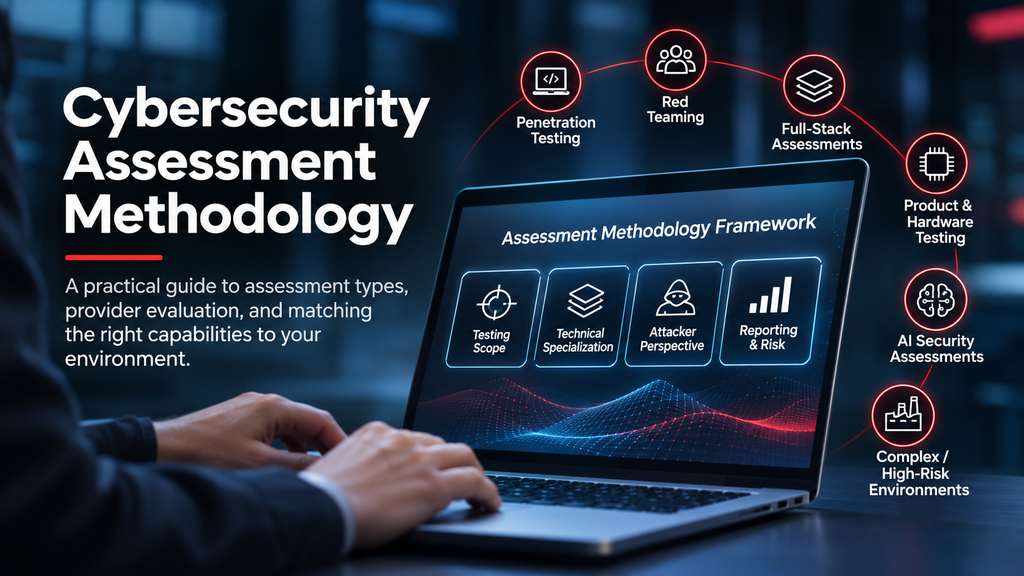
Enterprise security team reviewing a cybersecurity assessment methodology framework across testing scope, technical specialization, and reporting quality

“Cybersecurity assessment providers should be compared by the depth and relevance of their testing, not simply by the number of assessments they offer.” – IOActive Security Team

Not all security assessments are built the same, and neither are the providers that deliver them. For enterprise security teams evaluating external partners, it’s essential to examine each partners’ cybersecurity assessment methodology: what gets tested, how it is tested, and whether the approach reflects how real attackers actually operate. This piece covers the major assessment types available to enterprise organizations, the criteria that separate higher-capability providers from lower ones, and a structured framework for matching your environment to the right approach.

Types of Cybersecurity Assessments

Not every organization needs the same type of assessment. Understanding what each engagement involves, including what to look for in a provider’s approach to executing it, is the first step in evaluating whether a firm’s methodology fits your actual security needs.

Cybersecurity Assessment Types

Assessment TypePrimary PurposeBest Fit For
Penetration TestingIdentify and exploit vulnerabilities within a defined scopeCompliance mandates, foundational control validation
Red Team ExercisesSimulate targeted adversaries pursuing real objectivesOrganizations with mature controls and an active SOC
Full-Stack AssessmentsTest the entire technology stack from silicon to cloudComplex, multi-layer enterprise environments
AI Security AssessmentsTarget AI/ML-specific attack surfaces and infrastructureOrganizations integrating AI into critical systems
Product and Hardware TestingAssess physical devices, firmware, and siliconDevice manufacturers, IoT and OT deployments
Code Review and Reverse EngineeringSurface vulnerabilities at source-code and binary levelsSoftware development lifecycle, acquired or legacy code
Critical Infrastructure / OT TestingAssess ICS/SCADA and OT environments safelyEnergy, utilities, manufacturing, industrial sectors
Purple Team ExercisesCollaborative red/blue testing for detection improvementTeams ready to operationalize red team findings

The sections below define each assessment type and explain what to look for in a provider’s methodology when executing each one.

Penetration Testing

What it is: A time-boxed, authorized engagement in which ethical hackers identify and exploit vulnerabilities across a defined set of systems, applications, or networks.

What it does: Finds exploitable weaknesses, demonstrates real-world impact, and delivers remediation guidance tied to specific findings.

When to use: Most valuable for meeting compliance mandates (PCI DSS, HIPAA, SOC 2 Type II) or validating foundational security controls.

What to look for in a provider: Manual exploitation performed alongside automated scanning, not in place of it. Consultants capable of chaining multi-step attack sequences, not just cataloging isolated findings. Remediation guidance sequenced by exploitability and business impact, not solely by CVSS score.

Red Team Exercises

What it is: A covert engagement that simulates targeted adversaries pursuing specific objectives, using the same tactics, techniques, and procedures (TTPs) as real-world threat actors.

What it does: Generates realistic data on detection timelines and incident response effectiveness, testing people, processes, and technology together rather than in isolation.

When to use: Most valuable when foundational controls are already in place and an organization needs to know whether its security operations can detect and contain a sophisticated, motivated attacker.

What to look for in a provider: Defined engagement objectives tied to your organization’s actual crown jewels. Threat actor TTPs specific to your industry and threat landscape, not generic attack playbooks. Documented experience conducting covert operations against mature security teams.

Full-Stack Assessments

What it is: An engagement extending beyond application and network layers to examine the entire technology stack, from silicon, firmware, and embedded systems through software, cloud environments, and organizational processes.

What it does: Surfaces vulnerabilities that exist across layer boundaries and cannot be found when components are tested in isolation.

When to use: Most valuable for organizations whose risk environment spans hardware, software, and cloud infrastructure, or where a single compromise could cascade across multiple layers.

What to look for in a provider: Verifiable technical expertise at every layer of the stack. Dedicated physical labs for hardware and embedded device testing. A methodology that integrates silicon, firmware, application, and cloud assessment into a unified risk picture rather than a series of disconnected engagements.

AI Security Assessments

What it is: An engagement targeting the attack surfaces introduced by AI and machine learning systems, including adversarial inputs, prompt injection, model extraction, data poisoning, and compromised training pipelines.

What it does: Identifies vulnerabilities in AI/ML infrastructure that standard penetration testing frameworks do not address.

When to use: Most valuable for organizations integrating AI into critical systems, customer-facing products, or consequential decision-making workflows.

What to look for in a provider: Specific technical familiarity with ML architecture, LLM systems, and AI infrastructure, not general offensive security experience reapplied to an AI context. Testing that reaches the model layer, not only the surrounding application interface.

Product and Hardware Security Testing

What it is: An examination of the physical and logical security of connected devices, embedded systems, firmware, and silicon, including side-channel analysis, fault injection, reverse engineering of proprietary protocols, and cryptographic implementation review at the hardware level.

What it does: Identifies vulnerabilities below the software layer that application and network testing cannot detect.

When to use: Critical for device manufacturers, industrial equipment providers, and organizations deploying connected hardware at scale.

What to look for in a provider: A dedicated physical hardware lab. Documented experience with embedded system analysis and silicon-level techniques, including fault injection and side-channel attacks. A testing methodology covering hardware, firmware, and protocol layers together, rather than firmware in isolation.

Code Review and Reverse Engineering

What it is: A deep examination of software security at the source-code and binary levels, surfacing business logic flaws, implementation errors, and vulnerabilities in proprietary or legacy code that automated tools miss.

What it does: Provides visibility into software defects invisible to dynamic testing approaches.

When to use: Most valuable during software development lifecycles, before major product releases, or when evaluating acquired or third-party code.

What to look for in a provider: Reviewers with development backgrounds capable of identifying logic flaws alongside security vulnerabilities. Language and platform coverage relevant to your codebase. A methodology combining automated analysis with intensive manual review rather than relying on either alone.

Critical Infrastructure / OT Testing

What it is: Security assessment of industrial control systems (ICS), SCADA environments, and operational technology (OT) networks. These environments operate under constraints that standard IT security methodology cannot accommodate: proprietary protocols, extreme availability requirements, and physical safety implications.

What it does: Identifies vulnerabilities in OT/ICS environments without disrupting live operations.

When to use: Essential for organizations in energy, utilities, manufacturing, water systems, and other sectors where digital and physical systems converge.

What to look for in a provider: Sector-specific OT/ICS expertise, not IT security methodology adapted to an OT context. A testing approach designed for operational continuity constraints. Documented experience conducting assessments in live environments where testing itself carries operational risk. A 2024 CISA red team assessment of a U.S. critical infrastructure organization found simulated attackers went undetected for months, underscoring the gap between generic assessment methodology and the specialized expertise these environments require.

Purple Team Exercises

What it is: A collaborative engagement pairing red team offensive expertise with an organization’s own security team, focused on real-time detection rule tuning, playbook validation, and skills transfer between attacker and defender.

What it does: Improves detection and response capability directly, rather than documenting gaps for a team to address independently.

When to use: Most valuable for security teams that have completed initial red team engagements and want to operationalize findings in a collaborative format.

What to look for in a provider: Consultants capable of operating in both attacker and advisor roles simultaneously. A structured methodology for real-time feedback and control validation, not a loosely coordinated simulation.

Key Criteria for Evaluating Cybersecurity Assessment Methodology

The assessment type defines what gets tested. The methodology defines how, and this is where provider capability differences become most consequential. These six criteria help distinguish providers whose testing delivers genuine security insight from those whose engagements produce reports without materially improving security posture.

Assessment Scope and Technical Specialization

Most security firms assess network and application layers. Far fewer can credibly test hardware, silicon, embedded firmware, AI systems, or OT environments. A provider may list broad services without maintaining the specialized expertise to execute them.

Look for:

  • A dedicated physical lab for embedded device and hardware testing
  • Documented capability for silicon-level testing, including side-channel analysis and fault injection
  • AI security testing that reaches the model layer, not just the application interface
  • Sector-specific references for OT/ICS environments

Provider Scope Coverage by Capability Level

Scope LayerStandard ProviderHigh-Capability Provider
Application and NetworkYesYes
Cloud EnvironmentsSometimesYes
Embedded / IoT DevicesRarelyYes
Hardware / SiliconRarelyYes: dedicated physical lab required
AI/ML SystemsRarelyYes: with dedicated AI expertise
OT / ICSRarelyYes: specialized sector knowledge required

The gap between standard and high-capability providers widens significantly below the application layer. For organizations whose risk environment includes hardware, AI, or OT systems, scope coverage and technical specialization are the threshold criteria, not price or brand recognition.

Testing Methodology: Attacker-Driven vs. Checklist-Driven

There is a meaningful difference between providers who work through a checklist of known vulnerability categories and providers who approach testing with the mindset of an actual adversary. The latter requires consultants who can chain vulnerabilities across layers, reason about attacker objectives, and adapt in real time.

Look for:

  • Manual exploitation is performed alongside automated tooling, not replaced by it
  • Demonstrated ability to chain multi-step vulnerabilities across components
  • Threat actor TTPs specific to your industry, not generic attack frameworks
  • Engagement objectives tied to your organization’s actual crown jewels

Vulnerability Research Capability

The highest-capability providers generate original vulnerability research rather than relying exclusively on public CVE databases and commercial tooling. Firms with active research programs bring a more current understanding of attack surfaces, including weaknesses not yet publicly disclosed.

Look for:

  • Published CVEs attributed directly to the provider’s research team
  • Peer-reviewed technical research or presentations at Black Hat, DEF CON, or IEEE S&P
  • Publicly documented discoveries in hardware, AI, automotive, industrial, or other specialized domains
  • A research function that feeds directly into assessment methodology

Reporting Quality and Risk Translation

A rigorous assessment methodology produces findings that drive decisions, not simply findings that document vulnerabilities. Enterprise security teams and executive stakeholders need reports that prioritize risk in business terms.

Look for:

  • Findings mapped to business impact, not only to technical severity scores
  • Remediation guidance that is specific, practical, and sequenced by risk priority
  • Findings contextualized to the organization’s actual environment, not offered generically
  • Metrics supporting ongoing measurement: detection timelines, mean-time-to-compromise, and control coverage gaps

Environment Complexity Fit

For organizations running conventional enterprise IT, environment fit is rarely the differentiating factor. For organizations in regulated industries, manufacturing, energy, defense, or sectors where physical and digital systems converge, it is often the deciding one.

Look for:

  • References from engagements in your sector
  • A stated methodology for testing within operational continuity constraints
  • Documented experience in environments where the testing itself introduces operational risk

All six criteria above feed directly into the selection framework below: assessment scope, testing methodology, technical specialization, vulnerability research capability, reporting quality, and environment complexity fit.

A Framework for Selecting the Right Cybersecurity Assessment Provider

Provider Selection Framework: Seven Steps to the Right Fit

StepQuestion to AnswerWhat to Look For
1. Define what you’re protectingWhat are your organization’s crown jewels, and where do they live?Environments may span IT, OT, hardware, cloud, and AI
2. Identify the assessment typeWhat question does this engagement need to answer?Compliance gap? Detection readiness? Hardware risk? AI exposure?
3. Evaluate scope coverageCan the provider credibly assess every relevant layer?Documented capability, not listed services
4. Assess testing methodologyDoes the provider test with genuine attacker perspective?Manual exploitation, TTPs, multi-vector attack chains
5. Check vulnerability research credentialsDoes the provider generate original research?Published CVEs, conference presentations, specialized domain expertise
6. Review reporting examplesDoes the report drive decisions, not just list findings?Business-impact framing, prioritized remediation, and executive readability
7. Evaluate environment complexity fitHas the provider operated in environments like yours?Sector-specific references, OT/hardware/AI-specific experience

Matching Provider Capability to Organizational Maturity

Organizational maturity also shapes which type of engagement makes sense. Security programs early in their development benefit most from penetration testing and code review. Programs with mature controls and functioning SOCs get more from red team exercises, purple team exercises, and adversarial simulation. Providers capable of operating across that full maturity range, and advising on which engagement fits the current stage, offer more strategic value than specialists limited to a single methodology.

When Standard IT Methodology Is Not Enough

For organizations whose environments extend to hardware, AI systems, embedded devices, or critical infrastructure, Steps 3, 5, and 7 carry the most weight. The provider pool narrows significantly once the risk environment extends beyond conventional IT. The right partner combines offensive testing expertise with active vulnerability research, physical lab capability, and documented experience in complex environments.

Evaluate a Provider’s Cybersecurity Assessment Methodology Before Signing a Statement of Work

Understanding the depth and rigor of a provider’s cybersecurity assessment methodology is a more reliable guide than reviewing their service catalog.

IOActive has spent over 25 years conducting assessments across the full technology stack, from silicon and embedded hardware to software, AI systems, and critical infrastructure, backed by a research team with a documented record of original vulnerability discovery. If your organization’s environment extends beyond conventional IT, contact IOActive to discuss an assessment approach matched to your actual attack surface.

INSIGHTS | September 15, 2025

Cybersecurity Testing Methodologies Compared

Cyber defenses blocking attacks from organizations and infrastructure.

The global average cost of a data breach reached $4.44 million in 2025, the first decline in five years. IBM attributes this largely to faster detection and containment, driven by AI-assisted security tooling and more mature incident response programs.¹ That decline is meaningful, but it does not erase the underlying question that keeps security leaders up at night: if an attacker came for your organization today, would your security program catch it in time?

For buyers comparing cybersecurity testing methodologies, the answer depends entirely on whether the testing approach they have chosen is aligned with the questions they most need to answer. This article compares cybersecurity testing methodologies so security leaders can build testing programs that reflect their risk profile.

Cybersecurity Testing Methodologies Compared

MethodologyPrimary Question AnsweredScopeEngagement DurationStakeholder AwarenessBest Suited For
Vulnerability AssessmentWhat weaknesses exist across our systems?Broad, automatedHours to daysHighBaseline hygiene, compliance inventory
Penetration TestingWhich weaknesses are actually exploitable?Targeted, manualDays to weeksHighTargeted risk reduction, audit requirements
Red Team ExerciseHow would a real attack on our organization play out?Full-scope, adversarialWeeks to monthsLow (exec only)Mature programs; resilience validation
Purple Team ExerciseHow can offensive findings improve our detection?Collaborative, controlledDays to weeksHighDetection engineering; SOC capability building
Adversary SimulationCan a specific known threat actor breach our defenses?Threat-actor specificWeeksLow to mediumHigh-risk sectors; critical asset protection
Security ValidationAre our controls still working the way we think?Continuous, platform-drivenOngoingHighControl drift detection; continuous assurance
Full-Stack Security AssessmentHow does our entire attack surface connect?Comprehensive: hardware, firmware, software, AIWeeks to monthsMediumComplex environments; hardware and embedded systems

Choosing the Right Cybersecurity Testing Methodology

The decision framework below matches organizational characteristics to the testing methodology most likely to answer the most pressing security questions. In practice, mature security programs combine multiple methodologies: vulnerability assessments for continuous hygiene, penetration testing for targeted risk validation, Red Team or adversary simulation for resilience measurement, and full-stack assessment where the attack surface extends into hardware and embedded systems.

If Your Organization…Start WithThen Add
Has no formal testing program yetVulnerability AssessmentPenetration Testing
Needs to meet a compliance requirementPenetration TestingVulnerability Assessment
Has a functioning security team and wants to test detectionRed Team ExercisePurple Team Exercise
Wants to improve SOC detection engineeringPurple Team ExerciseAdversary Simulation
Operates in critical infrastructure or OT/ICS environmentsFull-Stack AssessmentRed Team Exercise
Has hardware, embedded systems, or AI in productionFull-Stack AssessmentPenetration Testing (firmware/AI)
Needs to test against a specific known threat actorAdversary SimulationRed Team Exercise
Needs continuous visibility into control effectivenessSecurity ValidationPenetration Testing (periodic)
Is building a multi-year security testing roadmapPenetration TestingRed Team, then Adversary Simulation

Vulnerability Assessments

A vulnerability assessment is the foundational layer of any security testing program. Automated scanning tools cross-reference an organization’s systems and software against public databases of known vulnerabilities, producing a ranked list of unaddressed weaknesses. The output is fast and broad: an organization can scan thousands of assets within hours.

What a Vulnerability Assessment Actually Measures

The key limitation is that a vulnerability assessment identifies weaknesses without confirming whether they are exploitable in your specific environment. A critical-severity CVE may be present on a system protected by compensating controls, making its real-world impact far lower than its CVSS score implies. Conversely, a medium-severity finding on a system with elevated privileges may represent a far more serious risk than any automated tool will flag.

When a Vulnerability Assessment Is the Right Choice

Vulnerability assessments are most valuable as a continuous hygiene practice and as a pre-engagement baseline before any manual testing. Organizations pursuing compliance frameworks, including SOC 2, ISO 27001, PCI-DSS, and FedRAMP, typically require documented vulnerability assessments at defined intervals. They are also useful after infrastructure changes for quickly identifying new exposures.

Where It Falls Short

A vulnerability assessment cannot confirm whether your security controls would stop a determined attacker. It produces a list of targets, not a realistic picture of how those targets could be chained into a damaging attack path. Organizations that rely on vulnerability assessments as their primary testing methodology have identified their weaknesses without knowing which ones matter most under adversarial conditions.

AttributeVulnerability Assessment
Primary outputRanked list of CVEs and misconfigurations
Human expertise requiredLow to medium
Detection and response testingNone
Compliance valueHigh
Organizational maturity requiredLow
IOActive equivalentPre-assessment scanning embedded in full-scope engagements

Penetration Testing: Proving Exploitability

Penetration testing takes vulnerability assessment to the next level by adding the expert human element. A qualified ethical hacker is authorized to discover and exploit vulnerabilities within a defined scope, demonstrating how a real adversary might compromise systems, access sensitive data, or disrupt operations. The objective is not simply to find weaknesses but to confirm which ones carry genuine damage potential.

What Penetration Testing Measures

IOActive’s penetration testing methodology includes vulnerability scanning, brute-force testing, web application exploitation, and social engineering within the stated scope. Because exploitation is included, results show which vulnerabilities pose the most immediate risk, helping security teams prioritize remediation where it matters most. Unlike vulnerability assessments, penetration testing distinguishes confirmed risk from theoretical exposure.

When Penetration Testing Is the Right Choice

Penetration testing is the right methodology when your organization needs to address specific known risk areas, validate controls before or after a major deployment, satisfy a compliance requirement, or build an internal case for remediation investment. It is also the appropriate entry point for organizations that want to move beyond automated scanning but are not yet mature enough to benefit fully from Red Team exercises.

Where It Falls Short

Because internal stakeholders are generally aware that the test is occurring, penetration testing provides limited insight into detection and response capabilities. Security operations teams may respond differently during a known engagement than during an unannounced real-world attack. Penetration testing is also constrained by its defined scope, meaning attack paths that cross into hardware, embedded firmware, AI pipelines, or physical access controls are typically not evaluated unless the engagement is scoped to include them.

AttributePenetration Testing
Primary outputExploitability-confirmed vulnerability list with remediation guidance
Human expertise requiredHigh
Detection and response testingLimited (scope-dependent)
Compliance valueVery high
Organizational maturity requiredLow to medium
IOActive equivalentApplication, network, hardware, AI, and embedded systems penetration testing

Red Teaming: Testing Resilience, Not Just Vulnerabilities

A Red Team exercise is a full-scope adversarial simulation in which a group of expert ethical hackers emulates a real-world threat actor, attempting to compromise the organization’s most critical assets without detection. Unlike penetration testing, the Red Team operates covertly, its existence known only to select executives. It is not constrained by a predefined list of targets or a scoped attack surface.

What Red Team Exercises Measure

IOActive’s Red Team exercises use threat intelligence and threat modeling to create representative attack scenarios aligned to the organization’s industry, assets, and actual adversary landscape. The exercise tests not just whether vulnerabilities exist but whether your people, processes, and technologies work together to prevent, detect, and respond to a sophisticated, persistent attacker. The output is a realistic resilience scorecard, not a vulnerability inventory.

When Red Teaming Is the Right Choice

Red Team exercises deliver their highest value for organizations with mature security programs: those that already have a functioning vulnerability management process, a dedicated security operations function, and defined incident response procedures. Without this foundation, a Red Team exercise will surface the same basic issues that a penetration test would have identified at lower cost and in less time.

Where It Falls Short

Red Team exercises require significant time and investment, spanning weeks to months. They are also less effective at producing a comprehensive vulnerability inventory: the Red Team’s objective is adversarial impact, not exhaustive coverage. Organizations in earlier stages of security maturity often extract more value from a penetration test before committing to a full Red Team engagement.

AttributeRed Team Exercise
Primary outputAttack narrative, detection gap analysis, resilience scorecard
Human expertise requiredVery high
Detection and response testingComprehensive
Compliance valueMedium
Organizational maturity requiredHigh
IOActive equivalentFull-scope Red Team with threat intelligence, physical access, and social engineering

Purple Teaming: Turning Offense Into Defensive Improvement

Purple Teaming combines the offensive capabilities of a Red Team with the defensive knowledge of the organization’s security operations function in a structured, collaborative exercise. Rather than attacking covertly, the exercise operates transparently: the Red Team executes techniques, the Blue Team observes its own detection capability in real time, and both sides work together to improve visibility and response. The goal is to build detection capability directly from the findings.

What Purple Team Exercises Measure

Purple Team exercises answer the question: “Are our detection controls catching the techniques attackers are actually using against organizations like ours?” The output includes confirmed detections, confirmed gaps, SIEM tuning recommendations, alerting threshold adjustments, and an empirical measurement of SOC capability against specific attack techniques mapped to MITRE ATT&CK.

When Purple Teaming Is the Right Choice

Purple Teaming is the right methodology when your organization wants to improve its security operations capability, validate that new security tooling is correctly configured, or build internal detection engineering skills. It is particularly valuable as a structured follow-up after a Red Team engagement surfaces detection gaps, or as a more cost-efficient approach to testing specific threat scenarios without conducting a full covert Red Team exercise.

Where It Falls Short

Because the exercise is collaborative and transparent, it cannot test true detection capability under realistic conditions where defenders don’t know an attack is in progress. It also requires a sufficiently capable internal security team to be meaningful: organizations without a functioning SOC or detection engineering practice will find Purple Team exercises difficult to execute and difficult to learn from.

AttributePurple Team Exercise
Primary outputDetection gap analysis, control tuning recommendations, SOC capability benchmarks
Human expertise requiredHigh (both offensive and defensive)
Detection and response testingFocused and empirical
Compliance valueMedium
Organizational maturity requiredMedium to high
IOActive equivalentCollaborative red/blue exercises aligned to MITRE ATT&CK

Adversary Simulation: Testing Against the Threats That Target You Specifically

Adversary simulation is a targeted form of Red Teaming in which the testing team emulates the specific tactics, techniques, and procedures (TTPs) of a known threat actor relevant to the organization’s industry or threat landscape. Rather than operating as a generic attacker, the simulation team behaves as a specific threat group would: using the same initial access methods, persistence mechanisms, lateral movement techniques, and exfiltration approaches documented in real-world intelligence reporting.

What Adversary Simulation Measures

Adversary simulation answers the question: “Could the threat actors most likely to target our industry actually succeed against our defenses?” It is grounded in threat intelligence rather than generic attacker methodology, which makes the findings more directly actionable for security operations teams building detections and defenses against specific actor profiles.

When Adversary Simulation Is the Right Choice

Adversary simulation is the right methodology for organizations in high-risk sectors, including financial services, critical infrastructure, government, healthcare, and defense, where the threat actor landscape is well-defined, and the consequences of a successful targeted attack are severe. It is also appropriate for organizations that have completed multiple Red Team exercises and want to test against increasingly specific and sophisticated threat profiles.

Where It Falls Short

Adversary simulation requires high-quality, current threat intelligence to be effective. Simulations built on outdated or generic actor profiles may not reflect the organization’s actual threat landscape. Organizations operating in sectors where actor TTPs evolve rapidly need to ensure simulation frameworks are continuously refreshed to remain accurate.

AttributeAdversary Simulation
Primary outputThreat-actor-specific attack narrative and detection coverage assessment
Human expertise requiredVery high
Detection and response testingComprehensive and threat-specific
Compliance valueMedium to high (sector-specific frameworks)
Organizational maturity requiredHigh
IOActive equivalentThreat-intelligence-led emulation aligned to MITRE ATLAS and ATT&CK

Security Validation: Continuous Testing for Mature Programs

Security validation, often delivered through breach and attack simulation (BAS) platforms, is a continuous or high-frequency testing approach that regularly executes simulated attack techniques against an organization’s controls to confirm they are functioning correctly. Unlike periodic point-in-time assessments, security validation creates an ongoing signal about control effectiveness as the environment changes.

What Security Validation Measures

Security validation answers the question: “Are the controls we deployed still working the way we think they are?” Environments change constantly: new systems are added, configurations drift, patches create unexpected side effects, and threat actor techniques evolve. A control that was effective six months ago may have degraded without anyone noticing. Security validation surfaces that drift before an attacker exploits it.

When Security Validation Is the Right Choice

Security validation is the right methodology for organizations with mature, complex environments where control drift is a real operational risk, particularly those with large distributed infrastructure. It is most valuable as a complement to periodic manual testing, not as a replacement. Point-in-time penetration tests and Red Team exercises provide the depth and creative adversarial thinking that automated platforms cannot replicate; continuous validation fills the coverage gap between those engagements.

Where It Falls Short

Security validation platforms execute known, documented attack techniques. They cannot discover novel attack paths, evaluate physical access controls, test the human element, or assess the creative chained attack scenarios that skilled adversarial testers consistently identify. Treating security validation as a substitute for manual testing creates a significant and predictable coverage gap.

AttributeSecurity Validation
Primary outputControl effectiveness dashboard, drift alerts, trend benchmarks
Human expertise requiredLow to medium
Detection and response testingContinuous, technique-specific
Compliance valueHigh for continuous monitoring requirements
Organizational maturity requiredMedium to high
IOActive equivalentBaseline reference tool within broader assessment programs

Full-Stack Security Assessment: When Surface-Level Testing Isn’t Enough

Most cybersecurity testing engagements operate within a defined layer: application security, network infrastructure, or cloud environments. Full-stack security assessment examines how vulnerabilities and attack paths span multiple layers simultaneously, including hardware, firmware, embedded systems, AI and machine learning pipelines, physical infrastructure, and enterprise applications. It is the methodology appropriate for organizations whose risk surface extends beyond the software-defined perimeter.

Why the Full Stack Matters

Modern enterprise environments are not purely software-defined. Connected devices, industrial control systems, SATCOM terminals, autonomous vehicles, medical equipment, AI-enabled workflows, and physical access infrastructure all create attack paths that single-layer testing does not examine. When an attacker who compromises a network edge device can pivot into an operational technology environment, or when a manipulated AI model can influence production decisions, a network-only penetration test leaves the most consequential attack paths untested.

IOActive’s Full-Stack Advantage

This is where IOActive’s approach diverges from most security testing providers. With physical hardware labs in Seattle, Madrid, and Cheltenham, and 25-plus years of research spanning cloud stacks, connected vehicles, integrated circuits, SATCOM terminals, embedded firmware, and AI systems, IOActive provides full-stack assessments that few firms globally can replicate.² The AMD Sinkclose vulnerability, the Tesla Model Y NFC relay attack, the Raspberry Pi RP2350 challenge win, and the Reviver digital license plate jailbreak are examples of research that reflects this depth across hardware, firmware, and software layers simultaneously.²

When Full-Stack Assessment Is the Right Choice

Full-stack assessment is the right methodology for organizations in manufacturing, automotive, aerospace, critical infrastructure, healthcare, and financial services, where the attack surface includes physical systems, proprietary hardware, embedded software, and operational technology alongside enterprise infrastructure. It is also appropriate for any organization whose AI-enabled applications interact with production systems, financial workflows, or sensitive data at scale.

AttributeFull-Stack Security Assessment
Primary outputCross-layer attack path analysis, hardware and firmware findings, remediation roadmap
Human expertise requiredExceptional, cross-disciplinary
Detection and response testingComprehensive across all tested layers
Compliance valueHigh for regulated industries
Organizational maturity requiredMedium to very high
IOActive equivalentHardware, firmware, AI, embedded, network, application, and physical testing

With 25-plus years of independent security research and physical testing labs on three continents, IOActive brings the adversarial expertise and full-stack depth that complex security programs demand.

Frequently Asked Questions

How often should organizations conduct penetration tests?

Most security frameworks recommend annual penetration testing at a minimum. Organizations with active development pipelines, frequent infrastructure changes, or strict compliance requirements may need semi-annual or continuous testing. IBM’s 2025 breach cost data confirms that faster detection and containment produce measurable cost reduction, which makes regular, rigorous testing a direct financial risk management investment.¹

Is a Red Team exercise always more valuable than a penetration test?

No. A Red Team exercise answers different questions, not better ones. For organizations in early security maturity stages, a Red Team engagement will surface the same basic issues a penetration test would have identified at a fraction of the cost and duration. Red Team exercises deliver their highest value when an organization already has a functioning security operations capability and needs to validate it under realistic, sustained adversarial pressure.

Can a single engagement combine multiple methodologies?

Yes. A well-scoped full-program assessment from a firm like IOActive can combine penetration testing, adversary simulation, hardware assessment, and elements of Red Teaming within a single engagement. The key is scoping around the organization’s most important security questions, not selecting a methodology and fitting the questions to it afterward.

What distinguishes a full-stack security assessment from a standard penetration test?

A standard penetration test evaluates exploitability within a defined scope, typically application code, network infrastructure, or cloud configuration. Full-stack assessment examines how vulnerabilities and attack paths connect across hardware, firmware, embedded software, AI pipelines, physical infrastructure, and enterprise applications simultaneously. It is appropriate for any organization whose risk surface extends beyond software-defined boundaries, which now describes most Global 1000 enterprises with connected devices, operational technology, or AI-enabled business processes.

Sources

  1. IBM. “Cost of a Data Breach Report 2025.” ibm.com/reports/data-breach
  2. IOActive. “IOActive Research Timeline.” ioactive.com/ioactive-research-timeline/