

Key Takeaways
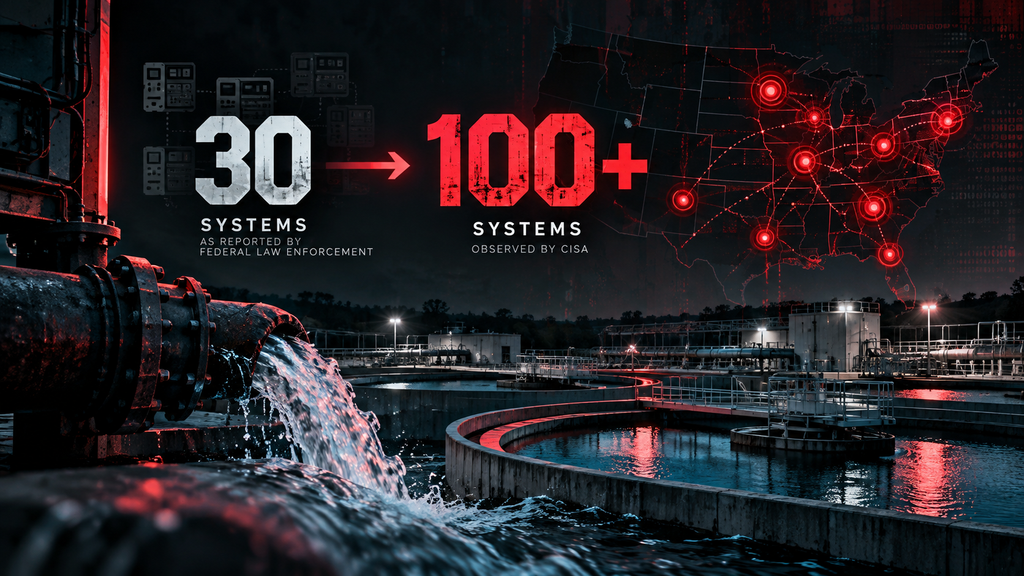
- CISA has revised the scale of the July 2026 water sector campaign from the roughly 30 systems described by federal law enforcement at the time to more than 100 internet-exposed systems across at least 12 US states [1] [3].
- The revised figure originated with CISA’s own observation, published on 21 August 2026 in exposure reduction guidance, rather than with incident reports submitted by the affected utilities [1] [3].
- CISA has warned that the cellular modems involved may have been installed by operators, vendors or system integrators, and may not be documented or included in routine attack surface scans [4].
- The UK position is structurally similar. The Drinking Water Inspectorate received five cyber incident reports from water suppliers between January 2024 and October 2025, all concerning systems outside NIS scope and all submitted voluntarily rather than under a legal duty [5].
- Reporting obligations under the UK NIS Regulations, the Cyber Security and Resilience Bill and EU NIS2 are all triggered by the operator becoming aware of an incident. Lowering a reporting threshold does not close a detection gap.
Why Do the Revised Figures Matter Now?
Malicious activity against US water and wastewater systems began on 26 July 2026 [2]. In the weeks that followed, federal law enforcement described a campaign affecting approximately 30 water systems in Minnesota and a small number of other states [2].
On 21 August 2026, CISA published internet exposure reduction guidance stating that during July 2026 it had observed malicious cyber activity targeting over 100 internet-exposed systems in the Water and Wastewater Systems (WWS) Sector, commonly via programmable logic controllers connected directly to a cellular modem [1] [6]. Until that publication, federal agencies had not publicly quantified the number of systems affected [3].
The figure moved by a factor of more than three, roughly four weeks after the activity began, and it moved on the strength of an agency observation rather than a sector disclosure.
Reporting has linked the campaign to Iranian threat actors, and federal law enforcement indicated at the time that the activity was consistent with previous Iranian state-sponsored operations [2] [3]. CISA’s exposure reduction guidance describes the activity without naming an actor [1]. Attribution in this case remains contested rather than settled, and the analysis that follows does not depend on it.
The geographic picture is similarly incomplete. The US government has not stated how many states were affected, although at least 12 appears to be the working figure, with Minnesota, Michigan, South Dakota, Georgia, New Jersey and Alabama confirmed publicly [3]. Illinois does not appear on the list, but Illinois also has no regulation requiring water systems to notify law enforcement or the public of a computer intrusion [2]. Absence from a published list is not evidence of absence where no duty to report exists.
What Does the Revision Actually Show?
The number did not change because the campaign grew. It changed because the observer’s picture improved. Three features of the revision are worth separating.
The figure came from the observer, not the observed.
CISA stated that it observed the activity. That language points to agency telemetry, scanning and partner reporting rather than to aggregated victim notifications. A figure derived from what the observer could see is a measure of the observer’s reach, and it sets a floor rather than a ceiling.
The assets were not in the inventory.
In its 30 July 2026 alert, CISA advised that even water organisations with mature cyber security processes should validate their external connections, because the targeting included cellular modems installed by operators, vendors or system integrators that may not be documented or included in routine attack surface scans [4]. This is the mechanism behind the revision. A controller connected directly to a cellular modem has no route through the corporate network. It is internet-facing without being enterprise-facing, so an external attack surface management tool working from the organisation’s registered domains and IP ranges will not enumerate it.
Detection depended on process behaviour rather than security monitoring.
In the Minnesota incidents, utilities appear to have avoided serious consequences largely because staff noticed abnormal control behaviour and reverted to manual operation [7]. That is a real outcome and it reflects operational competence, but it is a thin margin, and it is not a security control in any repeatable sense. It also flatters the failure mode. Abnormal automation is an availability signal, and availability signals announce themselves. As we argued in Rethinking the CIA Triad in Operational Technology Environments, integrity failures behave differently, persisting undetected precisely because nothing stops working. An actor who had altered controller logic without disturbing the process would not have been found by the mechanism that found this one.
The structural explanation sits in the shape of the sector. Nearly 49,500 US community water systems fall under the Safe Drinking Water Act, and the EPA classifies around 81 per cent of them as small, meaning they serve 3,300 people or fewer [14]. The statutory duty to conduct a risk and resilience assessment under Section 1433 applies only to systems serving more than 3,300 people, which leaves roughly four in five community water systems outside the requirement altogether [14]. Reporting on the campaign indicates it fell mainly on small and rural utilities [6]. A sector composed predominantly of organisations with no assessment duty and no security function is a sector that will be counted by somebody else.
Who is Affected by the OT Detection Gap?
Water and wastewater operators.
Small and rural US utilities are the most acutely exposed, but the underlying condition is not specific to the United States. UK and EU water companies operate large estates of remote, unstaffed assets including pumping stations, reservoirs and treatment works, many of which report telemetry over cellular links precisely because a fixed connection is impractical. The asset class that CISA describes is the same asset class deployed across British and European water networks.
CNI operators outside the water sector.
Energy, transport and other operators of essential services run comparable distributed estates on comparable connectivity. Joint advisory AA26-097A named Government Services, Water and Wastewater Systems and Energy as directly affected sectors, and expanded the vendor scope from Rockwell Automation to Schneider Electric and Siemens [8]. The inventory blind spot travels with the architecture, not with the sector. Our analysis of the Polish energy sector incident documented the same dynamic through a different exposure route, where a single repeated configuration weakness across more than 30 facilities turned a site-level problem into a fleet-level one, and the full extent only became clear after the fact.
Boards and risk functions.
A sector risk figure that changes by a factor of three within four weeks is not a stable basis for board reporting, insurance placement or investment prioritisation. Anyone who briefed a board in early August on the basis of the initial figure understated the scale of the campaign by more than 70 systems, through no fault of their own. The relevant board question is not what the number is, but how much confidence attaches to it and what would have to be true for it to move again.
Suppliers, system integrators and equipment manufacturers.
CISA specifically identified connectivity installed by vendors and integrators as a category that may not be documented [4]. Remote access introduced during commissioning, or added to support a maintenance contract, can persist long past project handover without appearing in any register the asset owner maintains.
What Challenges Does This Create for Operators and Regulators?
Asset inventories do not contain the assets.
Cellular-connected controllers are frequently procured operationally, by engineering or maintenance functions and against an operational budget, rather than through an IT asset management process. They may never reach a configuration management database. In some estates they exist only in a project file or in an integrator’s records.
External attack surface management does not reach them.
Commercial attack surface tooling starts from an organisation’s known domains and address ranges. A controller sitting behind a mobile network operator’s address space is not in any of them, which means an operator can hold a clean external exposure report and still be internet-reachable. The NCSC made the same point in its alert of 27 August 2026, advising that organisations should not assume their OT is inaccessible from the internet without verifying it, because unintended exposure can arise through misconfigurations, legacy connections or unmanaged assets [13].
Reporting thresholds exclude the activity.
The UK NIS Regulations 2018 limit formally reportable cyber incidents to those that actually result in disruption to an essential service [5]. The July 2026 US campaign did not cause significant service disruption [3]. An equivalent UK campaign would, in many cases, generate no mandatory report at all. The Drinking Water Inspectorate’s experience illustrates this directly. Of 15 reports received from suppliers between January 2024 and October 2025, five concerned cyber security incidents affecting what the Inspectorate described as out-of-NIS-scope systems, and were shared for information because they were considered related to water supply resilience risks rather than because a duty required it [5].
Reform addresses the threshold but not the trigger.
The Cyber Security and Resilience Bill widens the definition of a reportable incident beyond significant disruption to capture incidents capable of significant impact, including pre-positioning, and introduces a two-stage process of initial notification within 24 hours and a full report within 72 hours to the competent authority and the NCSC [9] [10]. EU NIS2 already imposes a 24-hour early warning, a 72-hour notification and a final report within one month on essential entities, a category that includes drinking water and wastewater [11]. Both regimes start the clock when the entity becomes aware of the incident. Where the affected asset is undocumented and unmonitored, awareness may never arrive, and a widened threshold produces no report.
How IOActive Can Help
The revision from roughly 30 systems to more than 100 describes a measurement failure rather than a control failure. Nobody in the sector could state the scale of the campaign while it was running, and the figure that eventually emerged came from an agency looking in rather than from operators looking at themselves. Closing that gap means answering two questions with evidence rather than with documentation. What is actually connected, and would anyone notice if it were used.
IOActive has worked in industrial control environments since publishing the first proof-of-concept worm against the smart grid in 2009. The services below map onto the two questions this campaign leaves open.
Full Stack Security Assessments
The assets at the centre of this campaign were not hidden. They were undocumented, which is a different problem and a harder one, because no amount of scanning an organisation’s own address ranges will surface a controller that reaches the internet through a mobile network. Our Full Stack assessments examine an environment across its layers rather than at a single tier, covering internet-facing controllers and HMIs, the OT and IT boundary, the cellular modem paths that often give a field site its only route out, and the firmware and silicon of the devices themselves. The output is an inventory that has been verified rather than asserted, which is the precondition for every other step recommended below.
Red Team and Purple Team Services
The more uncomfortable question this campaign raises is not whether operators were exposed but whether they would have known. In Minnesota, detection came from control room staff noticing that automation was behaving abnormally [7]. That is a credit to the operators involved and it is not a control any organisation should expect to rely on twice. Adversarial testing answers the question directly, by establishing whether an intrusion at an unstaffed remote site produces a signal that anyone acts on. It is particularly suited to integrity attacks such as altered controller logic, which availability-focused monitoring is not built to catch. Purple team work then converts those findings into detection that the operator’s own staff can maintain, which matters more in operational environments than in enterprise ones because the meaningful signal is frequently a process anomaly rather than a network event. We set out the distinction between the two approaches in Red vs Purple Team, what’s the difference?.
CISA was explicit that the cellular modems involved may have been installed by operators, vendors or system integrators, and may never have been documented [4]. That places part of the inventory problem outside the operator’s own records entirely. Our Supply Chain Integrity work assesses the security posture of technology providers and critical third parties, covering firmware, embedded systems, remote access arrangements and procurement processes, so that connectivity introduced during commissioning or under a maintenance contract is identified before it becomes someone else’s route in. For UK operators this maps onto the designated critical supplier powers in the Cyber Security and Resilience Bill [9].
If you would like to discuss how your organisation’s remote OT connectivity and detection coverage measure up against the activity described here, we welcome the conversation.
What Are the Recommended Next Steps for Water and CNI Operators?
- Enumerate cellular and out-of-band connectivity as a separate exercise from the IT asset inventory. Network discovery will not find these assets, so the exercise has to be conducted through engineering teams, maintenance schedules and site records.
- Interrogate procurement and project documentation for purchases of modems, industrial routers and remote telemetry units, including those made under capital projects and maintenance contracts rather than IT budgets.
- Ask every OEM, system integrator and maintenance supplier directly whether connectivity was installed to support their own access, and whether that connectivity remains active.
- Apply CISA’s exposure reduction measures to whatever the exercise finds. Disconnect controllers from direct internet exposure, route remote access through a VPN or gateway rather than to the controller itself, enable and change default passwords, allowlist permitted source addresses, and hold a known clean controller image in case an actor changes the device password [1] [4].
- Treat process anomalies as a security signal. Define in advance which operational deviations trigger a security escalation rather than only an engineering response, and make sure control room staff know that route exists.
- Rehearse the 24-hour notification decision against a scenario involving unauthorised access with no service disruption. Establish who holds the decision that such an event is reportable, and how quickly that decision can be reached out of hours.
- Re-baseline the board risk picture once the inventory work is complete, and state explicitly what confidence attaches to the new figure and what would cause it to change.
Conclusion
The revision from roughly 30 systems to more than 100 is the most useful finding to come out of the July 2026 campaign, and it has little to do with the actors involved. It demonstrates that a sector could be targeted at scale, across at least a dozen jurisdictions, without the targeted organisations being the ones to establish how widely it had happened.
Regulatory reform on both sides of the Atlantic is moving in the right direction, widening what must be reported and shortening the time in which it must be reported. None of it changes the fact that a reporting obligation begins with an operator knowing something has occurred. For operators running remote assets on connectivity that nobody has catalogued, the work that closes the gap is inventory work, and it is available to be started now. As we set out in Cyber Attack Trends 2026, the environments an organisation depends on most are routinely the ones it monitors least, and that ordering is a choice rather than a constraint.
References
[1] CISA. Internet Exposure Reduction Guidance. https://www.cisa.gov/resources-tools/resources/exposure-reduction
[2] Goudie, C., Capitanini, L. and Halder, N. Government admits water system cyberattacks were worse than first reported. NBC Chicago, 26 August 2026. https://www.nbcchicago.com/investigations/government-admits-water-system-cyberattacks-were-worse-than-first-reported/3980961/
[3] Kovacs, E. CISA: Over 100 Internet-Exposed Water Systems Targeted in July Cyberattacks. SecurityWeek, 26 August 2026. https://www.securityweek.com/cisa-over-100-internet-exposed-water-systems-targeted-in-july-cyberattacks/
[4] CISA. CISA Urges Water and Wastewater Systems Sector to Protect OT Against Activity Targeting PLCs, 30 July 2026. https://www.cisa.gov/news-events/alerts/2026/07/30/cisa-urges-water-and-wastewater-systems-sector-protect-ot-against-activity-targeting-plcs
[5] Martin, A. Hackers are attacking Britain’s drinking water suppliers. The Record, 3 November 2025. https://therecord.media/britain-water-supply-cybersecurity-incident-reports-dwi-nis
[6] More than 100 water systems were hit in July cyberattacks. The Register, 26 August 2026. https://www.theregister.com/cyber-crime/2026/08/26/more-than-100-water-systems-were-hit-in-july-cyberattacks/
[7] IOActive. When the Advisory Arrives First: Minnesota’s Water Utilities and the Limits of Warning. https://www.ioactive.com/when-the-advisory-arrives-first-minnesotas-water-utilities-and-the-limits-of-warning/
[8] CISA, FBI, NSA and partner agencies. Iranian-Affiliated Cyber Actors Exploit Programmable Logic Controllers Across US Critical Infrastructure (AA26-097A), originally published 7 April 2026, updated 22 July 2026. https://www.cisa.gov/news-events/cybersecurity-advisories/aa26-097a
[9] House of Commons Library. Cyber Security and Resilience (Network and Information Systems) Bill 2024-26, 2026-27, research briefing CBP-10442. https://commonslibrary.parliament.uk/research-briefings/cbp-10442/
[10] Department for Science, Innovation and Technology. Cyber Security and Resilience (Network and Information Systems) Bill factsheets: Summary of the Bill. https://www.gov.uk/government/publications/cyber-security-and-resilience-network-and-information-systems-bill-factsheets/summary-of-the-bill
[11] Directive (EU) 2022/2555 (NIS2), Article 23. Incident reporting obligations for essential and important entities.
[12] Federal News Network. CIRCIA, other big cyber rules expected to get finalized this fall, 10 July 2026. https://federalnewsnetwork.com/cybersecurity/2026/07/circia-other-big-cyber-rules-expected-to-get-finalized-this-fall/
[13] NCSC. Disruptive cyber activity highlights risk from internet-exposed systems and edge devices, 27 August 2026. https://www.ncsc.gov.uk/news/disruptive-cyber-activity-highlights-risk-from-internet-exposed-systems-and-edge-devices
[14] Congressional Research Service. Cybersecurity of the Municipal Water Sector: Background and Issues for Congress, report R48556. https://www.congress.gov/crs-product/R48556