IOActive recently attended the 2026 OCP APAC Summit in Taipei. Below are our key takeaways from two days with the Open Compute community, along with a short recap video from the show floor at the end of this post.
Key Takeaways
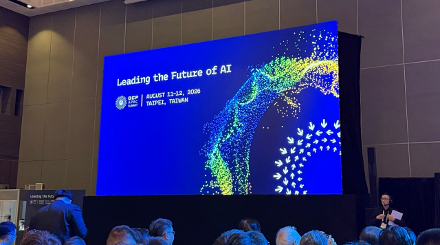
The 2026 OCP APAC Summit (August 11–12) drew hyperscalers, semiconductor companies, device manufacturers, and infrastructure providers under the theme “Leading the Future of AI.”
AI security conversations extended beyond compute performance to the full stack: networking, cooling, storage, power, firmware, and the security controls underneath all of it.
Openness was a recurring theme, anchored by a dedicated SONiC Workshop on the open-source network operating system.
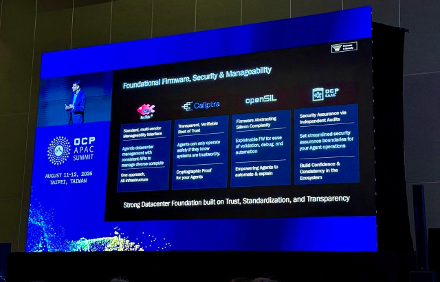
Multiple talks and vendor conversations pointed to growing interest in OCP S.A.F.E., the framework for independent security review of device firmware.
IOActive helped develop OCP S.A.F.E. from its early stages and continues to evaluate firmware security for device manufacturers today.
AI in the Agentic Era
AI was naturally at the center of this year’s summit, but the conversation went well past GPUs and raw compute performance.
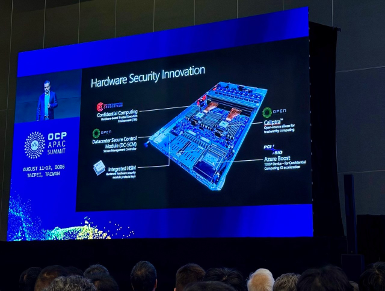
The future of AI depends as much on trustworthy infrastructure as it does on faster accelerators and larger clusters. That means thinking about security across the whole stack, from applications and operating systems down to the firmware and hardware controlling the physical devices.
Open Data Centers and Open Networking
Openness was the other constant. The Open Compute Project’s philosophy of open hardware specifications, interoperable architectures, open firmware increasingly extends to networking, and the summit’s dedicated SONiC Workshop was a good example. SONiC, the open-source network operating system, brought together developers, users, maintainers, and vendors to compare notes on real-world deployments.
The direction of travel is toward data centers built from a diverse ecosystem of components rather than a single vertically integrated platform. That shift raises a practical question for operators: as devices and firmware arrive from a wider set of suppliers, how do you know they were built securely?
OCP S.A.F.E. and the Case for Independent Security Review
That question was the throughline of many of our conversations at the summit. Multiple technical talks and device-vendor discussions pointed to growing interest in OCP S.A.F.E., which lets vendors have their products evaluated by independent security reviewers against an established methodology.
For manufacturers, that’s more than a compliance checkbox. An independent review can surface vulnerabilities in firmware and other security-critical components before devices ship at scale, and it gives customers a concrete basis for confidence in what they’re deploying. As the supply chain behind any given rack grows more diverse, security assurance needs to travel with it.
IOActive has been involved in developing the OCP S.A.F.E. framework since its early stages, and we continue to work with device manufacturers on firmware and security assessments across the infrastructure being deployed today.
Taipei as a Meeting Point
Taipei was a fitting location for these conversations. Taiwan sits at the center of the global technology supply chain, home to a dense concentration of semiconductor companies, server manufacturers, ODMs, component suppliers, and firmware developers—much of the ecosystem responsible for the infrastructure data centers worldwide run on.
The summit itself made room for those conversations to happen: networking lounges, meeting areas, and coffee stations throughout the venue, lunch on-site, and reception drinks in the Expo Hall on the first evening. Live translation kept the technical sessions accessible to an international audience.
If you’re a device vendor preparing for OCP S.A.F.E. or looking to strengthen your firmware’s security, contact IOActive. Our team supports OCP S.A.F.E. assessments and independent firmware source-code security reviews.
Watch Our OCP APAC Summit Recap
Want to see the event from the show floor? We captured some of the technologies, conversations, and demonstrations from our time at the 2026 OCP APAC Summit in Taipei.
As enterprise AI adoption accelerates in 2026, organizations are discovering that deploying AI responsibly requires a fundamentally different security approach. AI is now embedded in development pipelines, customer-facing applications, operational workflows, and automated decision-making systems. Each deployment extends the attack surface in ways that existing security controls were not built to detect or contain.
This article breaks down the most significant security challenges in AI adoption for Global 1000 enterprises, supported by current research and IOActive’s adversarial testing experience. Attackers are exploiting the risks documented here right now, and every one of them can be measured and tested. For security leaders building the internal case for AI security investment, the benchmarks and risk categories below provide the data to start that conversation.
Security Challenges in AI Adoption in 2026
Enterprise AI Security Challenges at a Glance
Security Challenge
Primary Attack Vector
Documented Exposure Rate
Detectable by Traditional Tools?
Assessment Method
AI-Generated Code Vulnerabilities
Insecure code deployed without security review
31.6% of AI-generated code samples are fully exploitable²
Employee input, RAG over-disclosure, memorized training data
50% of organizations expect a breach via AI tools in 12 months³
Rarely
Pipeline security review
Shadow AI Incidents
Unauthorized AI tool adoption outside approved channels
49% of organizations expect incidents in 12 months³
No
Inventory and governance review
Training Data Poisoning
Upstream supply chain contamination
Growing; no established baseline
Very difficult
Data provenance audit
Third-Party Model Risk
Pre-trained models, external inference APIs
97% of organizations had a supply chain breach in 2025⁴
No
Architecture review
Agentic AI Misuse
Prompt engineering, agent manipulation
40% of enterprise apps will include AI agents by end of 2026⁵
Very difficult
Threat modeling
AI Governance Gaps
Fragmented ownership, absent or ad hoc policy
70% of organizations lack optimized AI governance³
N/A
Program efficacy assessment
AI Application Security: Where Traditional Controls Fall Short
AI-enabled applications introduce attack surfaces that standard penetration testing was not designed to probe. When a model sits between user input and backend systems, the authorization boundary shifts in ways that static analysis and WAF rules cannot capture. Traditional security testing verifies that code executes as intended. AI security testing must verify that a model behaves as intended across adversarial inputs it was never built to anticipate.
How Tool-Calling Chains Expand the Attack Surface
Tool-calling features are pathways that allow AI models to take actions in connected systems, such as accessing files, querying databases, or triggering API calls. These are among the most exploitable surfaces in deployed AI stacks. A successful attack against a tool-calling chain does not require shell access; it requires a crafted input that persuades the model to act against its operator’s intent.
What the Research has Found in 2026
IOActive’s 2026 research quantifies how broadly this problem affects AI in production. In an evaluation of 27 leading AI models using 730 real-world programming prompts across 27 programming languages and 219 vulnerability categories, average security performance across all models was just 59%.² Nearly one-third of AI-generated code samples (31.6%) were fully exploitable, and no model achieved 100% secure output.² Even the best-performing configuration produced 90 vulnerabilities.² Infrastructure and DevOps code, including Dockerfiles, Terraform configurations, and CI/CD pipelines, exceeded 70 to 97% vulnerability rates.²
The practical takeaway is direct: organizations using AI in software development must treat AI-generated code as untrusted input requiring mandatory security review before deployment, particularly for authentication, cryptography, and infrastructure.
Traditional Application Security vs. AI Application Security
Dimension
Traditional Application Security
AI Application Security
Primary attack surface
Code logic, APIs, and user inputs
Prompts, model behavior, tool-calling chains
Testing approach
Static and dynamic analysis
Adversarial red-teaming, behavioral evaluation
Attack success prediction
Deterministic
Probabilistic
Authorization bypass method
Credential theft, injection
Prompt manipulation, context override
Data leakage path
Database exfiltration
Model output, RAG retrieval over-disclosure
Governing framework
OWASP Top 10
OWASP LLM Top 10, MITRE ATLAS
Prompt Injection: The Most Prevalent and Exploitable AI Vulnerability
Prompt injection holds the top position in OWASP’s LLM Top 10 (ranked LLM01:2025) for a measurable reason. It appears in over 73% of tested LLM deployments¹ and carries attack success rates of 50 to 84% against unprotected systems, depending on configuration.⁶ In 2025, researchers documented over 461,640 prompt injection submissions in a single dataset, confirming that this attack class is being weaponized at scale.⁷
Why Prompt Injection Is a Structural Problem
Prompt injection is the AI equivalent of social engineering the system itself. An attacker submits instructions disguised as normal input, and the model follows them instead of its original instructions. Because large language models process operator instructions and user input through the same channel, this vulnerability is structural, not a configuration error that can be patched away.
Direct and Indirect Injection: How Attacks Are Delivered
The two dominant variants are direct injection, arriving through the user interface, and indirect injection, embedded in content that the model retrieves as context, including documents, emails, and database records. IOActive’s AI application assessments test both variants, as well as chained injection across multi-step workflows and persistent injection that survives into model memory or session history. Every finding is delivered with prompts and replay harnesses so engineering teams can reproduce, regression-test, and track remediation.
“The greatest AI security risks rarely originate in the model itself; they emerge from how AI systems interact with data, applications, and business processes.”
Prompt Injection Types, Delivery Methods, and Risk Levels
Injection Type
Delivery Method
Potential Impact
Execution Difficulty
Direct injection
User input via chat interface
System prompt override, sensitive data disclosure
Low
Indirect injection
RAG context, documents, email content
Exfiltration, unauthorized API calls
Medium
Chained injection
Multi-step agent workflow
Full pipeline compromise
High
Persistent injection
Model memory or session history
Recurring unauthorized behavior
High
Data Leakage, Shadow AI, and Training Data Integrity
AI systems process, memorize, and sometimes reproduce sensitive data in ways that fall entirely outside traditional data loss prevention models. The risk operates at two distinct levels: what the model was trained on, and what it is exposed to at inference time.
Training-Level Risk: What Models Memorize
At the training level, models can memorize specific records from their training data, including personally identifiable information, internal documents, and proprietary source code. IOActive’s adversarial evaluation methodology includes membership inference testing, which determines whether specific data has been memorized by a model rather than inferred from general training patterns. In enterprise fine-tuned models, sensitive training data can surface in model outputs under targeted prompting conditions, and no application-layer control will catch it after deployment.
Inference-Level Risk: What Employees Share
At the inference level, 50% of organizations expect data loss caused by AI tools within the next 12 months.³ Employees entering customer records, regulated data, or internal strategy documents into third-party AI applications create a leakage path that exists entirely outside security visibility and DLP enforcement. Shadow AI compounds this exposure: 49% of organizations expect incidents from unauthorized AI tool adoption within the same timeframe.³ These tools process real business data while remaining invisible to security monitoring and data classification controls.
AI Data Leakage Pathways and Mitigation Approaches
Leakage Pathway
Source
Detectable by Standard DLP?
Mitigation
Training data memorization
Fine-tuned enterprise models
No
Membership inference testing
Inference-time user input
Employee-entered prompts
Partial
Policy enforcement, input filtering
RAG retrieval over-sharing
Vector database query results
No
Access scoping, retrieval audit
Model output over-disclosure
AI assistant or chatbot responses
Rarely
Output filtering, red-teaming
Shadow AI tool adoption
Unauthorized external applications
No
Inventory, governance, monitoring
Third-Party Model Risk and AI Supply Chain Exposure
Most enterprise AI deployments don’t start from scratch. They rely on pre-trained foundation models, open-source frameworks, third-party datasets, and external inference APIs. Each dependency introduces a trust assumption that few organizations have formally assessed.
Why AI Supply Chain Risk Is Broader Than Traditional Software Risk
OWASP’s LLM03:2025 Supply Chain classification identifies AI supply chain vulnerabilities across training data, models, and deployment platforms. The scope is broader than traditional software supply chain risk: a model’s behavior is directly shaped by its training provenance. A foundation model built on manipulated or low-quality data carries those defects into production, and application-layer security controls cannot correct them after deployment.
The Scale of Current Exposure
The broader supply chain risk baseline is severe. In 2025, 97% of organizations experienced at least one supply chain breach, a 20% increase from 2024.⁴ Software engineering teams account for nearly 50% of enterprise AI use,⁸ meaning AI-generated code is entering software supply chains at a volume that manual review alone cannot keep pace with.
How IOActive Assesses Third-Party Model Risk
IOActive’s third-party model risk assessments cover model signing and artifact lineage, access privileges around model weights, and deployment integrity testing. Threat modeling is aligned to MITRE ATLAS, the adversarial threat landscape framework built specifically for AI systems, so findings connect directly to real-world attack patterns rather than abstract risk categories.
Third-Party AI Risk Areas and Assessment Methods
Risk Area
Key Assessment Questions
Assessment Method
Foundation model provenance
Who trained it? On what data?
Architecture review
Model integrity
Is the model signed? Has it been modified in transit?
Integrity and custody testing
Inference API exposure
What data transits external inference endpoints?
Penetration testing
Open-source dependencies
Are framework vulnerabilities patched and tracked?
Dependency and code audit
Training data provenance
Is training data labeled, validated, and auditable?
Data pipeline security review
Artifact lineage
Can high-influence training samples be identified?
Pipeline assurance review
Agentic AI: When Autonomous Systems Inherit Your Risk Surface
Agentic AI refers to AI systems that take actions independently, without waiting for human approval at each step. They can browse the web, send emails, execute code, call APIs, and trigger workflows autonomously. Gartner predicts that 40% of enterprise applications will incorporate these task-specific AI agents by the end of 2026, up from fewer than 5% in 2025.⁵ Deloitte’s 2026 State of AI report anticipates that 75% of companies will use agentic AI to some degree by 2028.⁹
The Permission Problem: Why Agentic Systems Are Inherently High-Risk
To operate effectively, agents require broad cross-environment permissions, including access to files, APIs, email systems, payment workflows, and production databases. Many AI tools connecting to external systems currently operate in a trust-by-default mode, creating significant vulnerabilities.¹⁰ When an agent is manipulated through prompt injection, the blast radius extends to every system that agent can reach. In multi-agent systems, a compromised upstream agent can propagate malicious instructions to downstream agents before any human checkpoint has the opportunity to intervene.
What Agentic AI Attacks Look Like in Practice
Attack scenarios are concrete. Indirect prompt injection embedded in a retrieved document can cause an agent to forward sensitive files, execute unauthorized API calls, or authorize transactions, all without user interaction. Identity and access management risks expand dramatically in these environments: agent credentials and permissions require the same rigor as for human users, yet most organizations have not yet built that infrastructure.
IOActive’s threat modeling for agentic systems traces attacker paths across SDKs, agents, plugins, and the surrounding supply chain. Exposures are mapped to ATLAS-style TTPs, the AI-specific adversarial technique catalog, so that detections and guardrails emerge as engineering tasks with clear owners rather than policy abstractions without enforcement.
Agentic AI Attack Scenarios and Business Impact
Attack Scenario
Entry Point
Agent Action
Business Impact
Recommended Assessment
Prompt injection via retrieved document
RAG or email context
Forwards sensitive files externally
Data exfiltration
AI Application Security Assessment; Prompt Injection Testing
Chained agent manipulation
Compromised upstream agent
Propagates malicious task downstream
Cascading unauthorized system access
Agentic AI Threat Modeling; Red Team Exercise
RAG-based indirect injection
Vector database retrieval
Executes unauthorized API calls
Unauthorized transactions or data modifications
AI Pipeline Security Assessment; RAG Architecture Review
Excessive permissions abuse
Misconfigured agent identity
Deletes or modifies production data
Data loss, operational disruption
Agentic AI Architecture Review; Identity and Access Management Review
Multi-agent trust exploitation
Inter-agent communication channel
Escalates privileges across systems
Lateral movement, IP theft
Full-Scope Red Team Exercise; Agentic AI Threat Modeling
AI Governance: The Structural Security Challenge Behind Every AI Adoption Decision
Most AI security failures share a common root cause: governance structures that haven’t kept pace with deployment speed. Proofpoint’s 2025 State of AI Security research found that 70% of organizations lack optimized AI governance, and 39% operate with no AI-specific governance at all.³ These organizations are deploying AI while simultaneously expecting data loss events and shadow AI incidents within the next 12 months.
The Ownership Fragmentation Problem
Ownership fragmentation compounds the problem. CIOs control 29% of AI security decisions, while CISOs rank fourth at 14.5%.³ That distribution reflects an AI adoption curve that outran the security function entirely. Effective AI governance requires unified ownership, board-level risk visibility, and continuous monitoring. Those capabilities don’t emerge naturally from a model where each function applies different controls to different risk definitions.
Building the Internal Case for AI Security Investment
For security leaders working to build internal momentum around AI risk, the business case is now straightforward: nearly one-third (31%) of organizations are redirecting their largest security investment toward AI supply chain security over the next 12 months.³ Organizations deploying AI ahead of a governance framework are also accumulating compliance exposure as AI-specific audit requirements mature across financial services, critical infrastructure, and government sectors, including CREST-aligned assessments and Cyber Essentials mandates increasingly applied to vendor supply chains.
Establishing Your Baseline
Reaching a governed state requires knowing where you stand today. An independent AI security assessment establishes the baseline across model behavior, pipeline integrity, application security, and governance maturity so that improvements can be sequenced, budgeted, and measured.
Closest to secure; still requires adversarial validation
Frequently Asked Questions
What is the most commonly exploited AI security vulnerability in enterprise environments?
Prompt injection holds the top position in OWASP’s LLM Top 10 and appears in over 73% of tested LLM deployments.¹ Its success rate against unprotected systems ranges from 50 to 84%, making it the first vulnerability class to address in any structured AI security assessment.⁶
How does AI security testing differ from standard penetration testing?
Standard penetration testing validates code execution paths, authentication controls, and API security. AI security testing additionally requires adversarial evaluation of model behavior, prompt injection testing across direct and indirect attack vectors, membership inference analysis (which confirms whether sensitive data was memorized by the model rather than inferred), training data poisoning assessment, and model extraction simulation. IOActive’s AI security assessments cover the full stack, from model and pipeline through application and infrastructure, with findings delivered as reproducible, engineering-ready remediation tasks.
What governance steps should organizations prioritize before expanding AI deployment?
Establish an AI system inventory, assign unified ownership of AI security decisions to the CISO function, and define data handling policies for AI tools before expanding deployment. Treat AI-generated code as untrusted input requiring mandatory security review, particularly for authentication, cryptography, and infrastructure configurations. An independent assessment of existing deployments is the fastest path to identifying where governance gaps create measurable exposure and where emerging compliance requirements may impose near-term deadlines.
What makes agentic AI uniquely risky compared to traditional AI deployments?
Traditional AI deployments produce outputs that a human reviews before acting. Agentic systems take actions autonomously across multiple systems at machine speed. When a manipulated agent can send emails, authorize payments, delete files, and call APIs without a human approval step, the blast radius of a single successful injection attack is orders of magnitude larger than in a passive AI deployment.
Conclusion
The security challenges in AI adoption in 2026 are measurable, documented, and addressable with the right adversarial methodology. Prompt injection succeeds against 50 to 84% of unprotected systems. Nearly one-third of AI-generated code is fully exploitable by default. Seventy percent of organizations lack the governance structures needed to detect or contain AI-related incidents. Those are the current baselines, not the inevitable outcomes. Organizations that instrument their models, secure their pipelines, enforce governance, and apply adversarial testing as a standard part of AI delivery are the ones that move through enterprise AI adoption with the least exposure and the clearest audit trail.
With more than 25 years of independent security research, physical testing labs across three continents, and a track record of identifying emerging threats before they reach headline status, IOActive brings the depth that enterprise AI security demands.