

“Cybersecurity assessment providers should be compared by the depth and relevance of their testing, not simply by the number of assessments they offer.” – IOActive Security Team
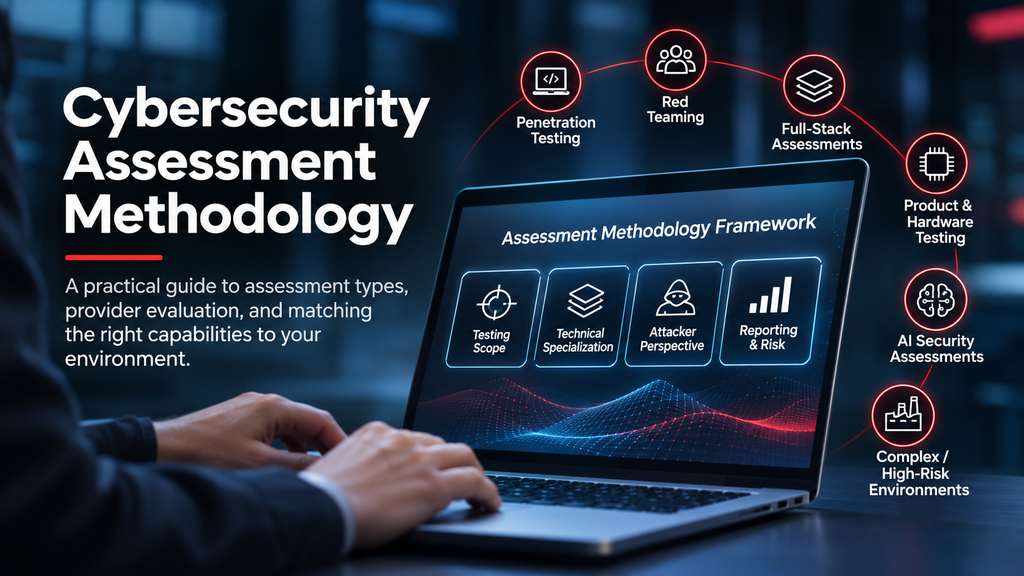
Not all security assessments are built the same, and neither are the providers that deliver them. For enterprise security teams evaluating external partners, it’s essential to examine each partners’ cybersecurity assessment methodology: what gets tested, how it is tested, and whether the approach reflects how real attackers actually operate. This piece covers the major assessment types available to enterprise organizations, the criteria that separate higher-capability providers from lower ones, and a structured framework for matching your environment to the right approach.
Types of Cybersecurity Assessments
Not every organization needs the same type of assessment. Understanding what each engagement involves, including what to look for in a provider’s approach to executing it, is the first step in evaluating whether a firm’s methodology fits your actual security needs.
Cybersecurity Assessment Types
| Assessment Type | Primary Purpose | Best Fit For |
| Penetration Testing | Identify and exploit vulnerabilities within a defined scope | Compliance mandates, foundational control validation |
| Red Team Exercises | Simulate targeted adversaries pursuing real objectives | Organizations with mature controls and an active SOC |
| Full-Stack Assessments | Test the entire technology stack from silicon to cloud | Complex, multi-layer enterprise environments |
| AI Security Assessments | Target AI/ML-specific attack surfaces and infrastructure | Organizations integrating AI into critical systems |
| Product and Hardware Testing | Assess physical devices, firmware, and silicon | Device manufacturers, IoT and OT deployments |
| Code Review and Reverse Engineering | Surface vulnerabilities at source-code and binary levels | Software development lifecycle, acquired or legacy code |
| Critical Infrastructure / OT Testing | Assess ICS/SCADA and OT environments safely | Energy, utilities, manufacturing, industrial sectors |
| Purple Team Exercises | Collaborative red/blue testing for detection improvement | Teams ready to operationalize red team findings |
The sections below define each assessment type and explain what to look for in a provider’s methodology when executing each one.
Penetration Testing
What it is: A time-boxed, authorized engagement in which ethical hackers identify and exploit vulnerabilities across a defined set of systems, applications, or networks.
What it does: Finds exploitable weaknesses, demonstrates real-world impact, and delivers remediation guidance tied to specific findings.
When to use: Most valuable for meeting compliance mandates (PCI DSS, HIPAA, SOC 2 Type II) or validating foundational security controls.
What to look for in a provider: Manual exploitation performed alongside automated scanning, not in place of it. Consultants capable of chaining multi-step attack sequences, not just cataloging isolated findings. Remediation guidance sequenced by exploitability and business impact, not solely by CVSS score.
Red Team Exercises
What it is: A covert engagement that simulates targeted adversaries pursuing specific objectives, using the same tactics, techniques, and procedures (TTPs) as real-world threat actors.
What it does: Generates realistic data on detection timelines and incident response effectiveness, testing people, processes, and technology together rather than in isolation.
When to use: Most valuable when foundational controls are already in place and an organization needs to know whether its security operations can detect and contain a sophisticated, motivated attacker.
What to look for in a provider: Defined engagement objectives tied to your organization’s actual crown jewels. Threat actor TTPs specific to your industry and threat landscape, not generic attack playbooks. Documented experience conducting covert operations against mature security teams.
Full-Stack Assessments
What it is: An engagement extending beyond application and network layers to examine the entire technology stack, from silicon, firmware, and embedded systems through software, cloud environments, and organizational processes.
What it does: Surfaces vulnerabilities that exist across layer boundaries and cannot be found when components are tested in isolation.
When to use: Most valuable for organizations whose risk environment spans hardware, software, and cloud infrastructure, or where a single compromise could cascade across multiple layers.
What to look for in a provider: Verifiable technical expertise at every layer of the stack. Dedicated physical labs for hardware and embedded device testing. A methodology that integrates silicon, firmware, application, and cloud assessment into a unified risk picture rather than a series of disconnected engagements.
AI Security Assessments
What it is: An engagement targeting the attack surfaces introduced by AI and machine learning systems, including adversarial inputs, prompt injection, model extraction, data poisoning, and compromised training pipelines.
What it does: Identifies vulnerabilities in AI/ML infrastructure that standard penetration testing frameworks do not address.
When to use: Most valuable for organizations integrating AI into critical systems, customer-facing products, or consequential decision-making workflows.
What to look for in a provider: Specific technical familiarity with ML architecture, LLM systems, and AI infrastructure, not general offensive security experience reapplied to an AI context. Testing that reaches the model layer, not only the surrounding application interface.
Product and Hardware Security Testing
What it is: An examination of the physical and logical security of connected devices, embedded systems, firmware, and silicon, including side-channel analysis, fault injection, reverse engineering of proprietary protocols, and cryptographic implementation review at the hardware level.
What it does: Identifies vulnerabilities below the software layer that application and network testing cannot detect.
When to use: Critical for device manufacturers, industrial equipment providers, and organizations deploying connected hardware at scale.
What to look for in a provider: A dedicated physical hardware lab. Documented experience with embedded system analysis and silicon-level techniques, including fault injection and side-channel attacks. A testing methodology covering hardware, firmware, and protocol layers together, rather than firmware in isolation.
Code Review and Reverse Engineering
What it is: A deep examination of software security at the source-code and binary levels, surfacing business logic flaws, implementation errors, and vulnerabilities in proprietary or legacy code that automated tools miss.
What it does: Provides visibility into software defects invisible to dynamic testing approaches.
When to use: Most valuable during software development lifecycles, before major product releases, or when evaluating acquired or third-party code.
What to look for in a provider: Reviewers with development backgrounds capable of identifying logic flaws alongside security vulnerabilities. Language and platform coverage relevant to your codebase. A methodology combining automated analysis with intensive manual review rather than relying on either alone.
Critical Infrastructure / OT Testing
What it is: Security assessment of industrial control systems (ICS), SCADA environments, and operational technology (OT) networks. These environments operate under constraints that standard IT security methodology cannot accommodate: proprietary protocols, extreme availability requirements, and physical safety implications.
What it does: Identifies vulnerabilities in OT/ICS environments without disrupting live operations.
When to use: Essential for organizations in energy, utilities, manufacturing, water systems, and other sectors where digital and physical systems converge.
What to look for in a provider: Sector-specific OT/ICS expertise, not IT security methodology adapted to an OT context. A testing approach designed for operational continuity constraints. Documented experience conducting assessments in live environments where testing itself carries operational risk. A 2024 CISA red team assessment of a U.S. critical infrastructure organization found simulated attackers went undetected for months, underscoring the gap between generic assessment methodology and the specialized expertise these environments require.
Purple Team Exercises
What it is: A collaborative engagement pairing red team offensive expertise with an organization’s own security team, focused on real-time detection rule tuning, playbook validation, and skills transfer between attacker and defender.
What it does: Improves detection and response capability directly, rather than documenting gaps for a team to address independently.
When to use: Most valuable for security teams that have completed initial red team engagements and want to operationalize findings in a collaborative format.
What to look for in a provider: Consultants capable of operating in both attacker and advisor roles simultaneously. A structured methodology for real-time feedback and control validation, not a loosely coordinated simulation.
Key Criteria for Evaluating Cybersecurity Assessment Methodology
The assessment type defines what gets tested. The methodology defines how, and this is where provider capability differences become most consequential. These six criteria help distinguish providers whose testing delivers genuine security insight from those whose engagements produce reports without materially improving security posture.
Assessment Scope and Technical Specialization
Most security firms assess network and application layers. Far fewer can credibly test hardware, silicon, embedded firmware, AI systems, or OT environments. A provider may list broad services without maintaining the specialized expertise to execute them.
Look for:
- A dedicated physical lab for embedded device and hardware testing
- Documented capability for silicon-level testing, including side-channel analysis and fault injection
- AI security testing that reaches the model layer, not just the application interface
- Sector-specific references for OT/ICS environments
Provider Scope Coverage by Capability Level
| Scope Layer | Standard Provider | High-Capability Provider |
| Application and Network | Yes | Yes |
| Cloud Environments | Sometimes | Yes |
| Embedded / IoT Devices | Rarely | Yes |
| Hardware / Silicon | Rarely | Yes: dedicated physical lab required |
| AI/ML Systems | Rarely | Yes: with dedicated AI expertise |
| OT / ICS | Rarely | Yes: specialized sector knowledge required |
The gap between standard and high-capability providers widens significantly below the application layer. For organizations whose risk environment includes hardware, AI, or OT systems, scope coverage and technical specialization are the threshold criteria, not price or brand recognition.
Testing Methodology: Attacker-Driven vs. Checklist-Driven
There is a meaningful difference between providers who work through a checklist of known vulnerability categories and providers who approach testing with the mindset of an actual adversary. The latter requires consultants who can chain vulnerabilities across layers, reason about attacker objectives, and adapt in real time.
Look for:
- Manual exploitation is performed alongside automated tooling, not replaced by it
- Demonstrated ability to chain multi-step vulnerabilities across components
- Threat actor TTPs specific to your industry, not generic attack frameworks
- Engagement objectives tied to your organization’s actual crown jewels
Vulnerability Research Capability
The highest-capability providers generate original vulnerability research rather than relying exclusively on public CVE databases and commercial tooling. Firms with active research programs bring a more current understanding of attack surfaces, including weaknesses not yet publicly disclosed.
Look for:
- Published CVEs attributed directly to the provider’s research team
- Peer-reviewed technical research or presentations at Black Hat, DEF CON, or IEEE S&P
- Publicly documented discoveries in hardware, AI, automotive, industrial, or other specialized domains
- A research function that feeds directly into assessment methodology
Reporting Quality and Risk Translation
A rigorous assessment methodology produces findings that drive decisions, not simply findings that document vulnerabilities. Enterprise security teams and executive stakeholders need reports that prioritize risk in business terms.
Look for:
- Findings mapped to business impact, not only to technical severity scores
- Remediation guidance that is specific, practical, and sequenced by risk priority
- Findings contextualized to the organization’s actual environment, not offered generically
- Metrics supporting ongoing measurement: detection timelines, mean-time-to-compromise, and control coverage gaps
Environment Complexity Fit
For organizations running conventional enterprise IT, environment fit is rarely the differentiating factor. For organizations in regulated industries, manufacturing, energy, defense, or sectors where physical and digital systems converge, it is often the deciding one.
Look for:
- References from engagements in your sector
- A stated methodology for testing within operational continuity constraints
- Documented experience in environments where the testing itself introduces operational risk
All six criteria above feed directly into the selection framework below: assessment scope, testing methodology, technical specialization, vulnerability research capability, reporting quality, and environment complexity fit.
A Framework for Selecting the Right Cybersecurity Assessment Provider
Provider Selection Framework: Seven Steps to the Right Fit
| Step | Question to Answer | What to Look For |
| 1. Define what you’re protecting | What are your organization’s crown jewels, and where do they live? | Environments may span IT, OT, hardware, cloud, and AI |
| 2. Identify the assessment type | What question does this engagement need to answer? | Compliance gap? Detection readiness? Hardware risk? AI exposure? |
| 3. Evaluate scope coverage | Can the provider credibly assess every relevant layer? | Documented capability, not listed services |
| 4. Assess testing methodology | Does the provider test with genuine attacker perspective? | Manual exploitation, TTPs, multi-vector attack chains |
| 5. Check vulnerability research credentials | Does the provider generate original research? | Published CVEs, conference presentations, specialized domain expertise |
| 6. Review reporting examples | Does the report drive decisions, not just list findings? | Business-impact framing, prioritized remediation, and executive readability |
| 7. Evaluate environment complexity fit | Has the provider operated in environments like yours? | Sector-specific references, OT/hardware/AI-specific experience |
Matching Provider Capability to Organizational Maturity
Organizational maturity also shapes which type of engagement makes sense. Security programs early in their development benefit most from penetration testing and code review. Programs with mature controls and functioning SOCs get more from red team exercises, purple team exercises, and adversarial simulation. Providers capable of operating across that full maturity range, and advising on which engagement fits the current stage, offer more strategic value than specialists limited to a single methodology.
When Standard IT Methodology Is Not Enough
For organizations whose environments extend to hardware, AI systems, embedded devices, or critical infrastructure, Steps 3, 5, and 7 carry the most weight. The provider pool narrows significantly once the risk environment extends beyond conventional IT. The right partner combines offensive testing expertise with active vulnerability research, physical lab capability, and documented experience in complex environments.
Evaluate a Provider’s Cybersecurity Assessment Methodology Before Signing a Statement of Work
Understanding the depth and rigor of a provider’s cybersecurity assessment methodology is a more reliable guide than reviewing their service catalog.
IOActive has spent over 25 years conducting assessments across the full technology stack, from silicon and embedded hardware to software, AI systems, and critical infrastructure, backed by a research team with a documented record of original vulnerability discovery. If your organization’s environment extends beyond conventional IT, contact IOActive to discuss an assessment approach matched to your actual attack surface.