SERVICES / AI SECURITY SERVICES

ONE PROMPT CAN TURN YOUR CHATBOT INTO AN EXFILTRATION CHANNEL.

We simulate like an attacker and report like an engineer.

FROM OUR 2026 RESEARCH

31.6%

of AI-generated code samples were fully exploitable when we tested 27 AI models and coding tools.

Read the research ->

METRICS & TELEMETRY

Cybersecurity research and AI model diagnostics.


real-world coding prompts in our 2026 AI code study
0

ransomware attacks that utilize AI
0 %

engagements across the full AI lifecycle
0 +

years of independent, research-fueled offensive security since
0 +

THE ATTACK SURFACE

NO SHELL REQUIRED.

RAG and tool calling turn one request into calls against files, APIs and production systems. Select a hop to see how attackers use it, and how we test it.

HOW ATTACKERS USE IT

Prompt injection, jailbreaks, obfuscated and encoded instructions, unexpected languages, long-context and multi-turn attacks.

HOW WE TEST IT

AI red teaming · AI model assessment

See the engagements

HOW ATTACKERS USE IT

Exploiting traditional application logic, middleware bypasses, manipulating session configurations, and input validation failures to send untrusted commands.

HOW WE TEST IT

Application logic auditing · Middleware & API validation

See the engagements

HOW ATTACKERS USE IT

Indirect prompt injection via untrusted data feeds, system prompt leaking, and exploiting weaknesses in structural formatting of contextual instructions.

HOW WE TEST IT

Prompt robustness evaluation · Injection mitigation testing

See the engagements

HOW ATTACKERS USE IT

Adversarial perturbations, exploiting training data biases, trigger words to bypass built-in safety alignment, and model poisoning.

HOW WE TEST IT

Adversarial robustness testing · Model parameter validation

See the engagements

HOW ATTACKERS USE IT

Poisoning the vector database context, metadata manipulation, causing unauthorized data retrieval, and bypassing document access controls.

HOW WE TEST IT

RAG pipeline architecture security audit · Vector DB access control matrix analysis

See the engagements

HOW ATTACKERS USE IT

Hijacking tools via malicious API payloads, parameter injection into external function calls, and manipulating multi-agent logic flows.

HOW WE TEST IT

Tool boundary enforcement assessment · Agent authorization chain validation

See the engagements

HOW ATTACKERS USE IT

Model weight exfiltration, container escape on inference nodes, side-channel attacks, and host level system compromise.

HOW WE TEST IT

Cloud configuration auditing · Hardened environment validation

See the engagements

AI AGENT SECURITY ASSESSMENT

YOUR AGENT CAN ACT.
SO CAN ANYONE WHO TALKS TO IT.

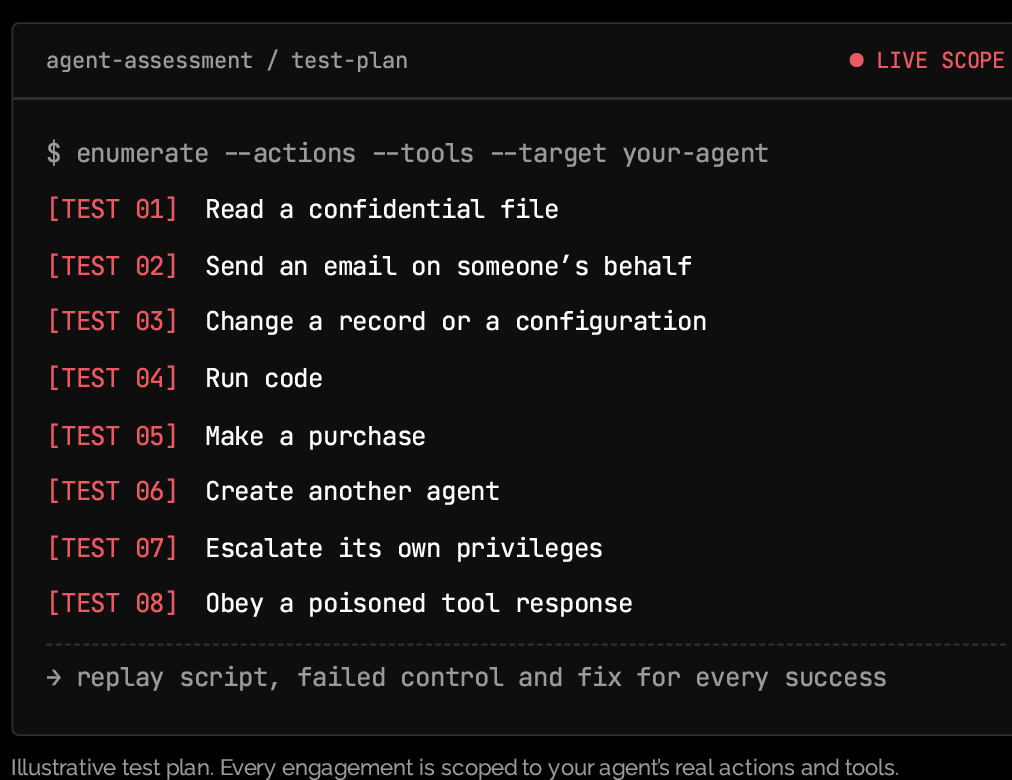
An agent can send email, change records and run code. We try to make it do every one of those things for us, including through another agent or a poisoned tool response. For each success, we show you which control failed and recommend the fix there.

FIND YOUR ENGAGEMENT

WHERE IS YOUR AI SYSTEM TODAY?

Fourteen engagements that follow the life of an AI system. Start wherever you are.

PROGRAM AND GOVERNANCE ASSESSMENT

Do you know what AI you run, who owns it, and what happens when it misbehaves?
An inventory of AI in use, with policies and controls assessed from acceptable use to incident response. EU AI Act issues flagged for legal review.

Mapped to NIST AI RMF

THREAT MODELING FOR AI

Where can this system be attacked, and what would the attacker gain?
Attack paths through your models, prompts, agents, plugins and suppliers, each tied to business impact.

Aligned to MITRE ATLAS

AI DEVELOPMENT LIFECYCLE REVIEW

Where is your build process open to abuse?
An end-to-end review of how models, data, prompts and tools reach production, with guardrails that fit how your teams work.

Guardrails for data and CI/CD

AI SECURE CODE REVIEW

Is the code that wraps the models as secure as the model?
Prompt construction, output handling, auth, RAG and vector DB access, tool integrations, agent orchestration, secrets and logging.

Extends your existing code review

SECURE CODING WITH AI

How do you keep AI-assisted speed without inheriting its defects?
Decide where a human sits relative to the loop,put policy and tooling in place, and trainengineers on real failure patterns.

Policy, tooling and training

TRIAGE OF AI-GENERATED FINDINGS

Your scanners report thousands of issues. Which ones are real?
Exploitability demonstrated, duplicates and false positives cleared, severity re-rated.

A short backlog you can act on

AI AGENT SECURITY ASSESSMENT

What happens if we convince your agent to do something it shouldn’t?
Every action and tool is a test case, including manipulation by another agent or a poisoned tool response.

Failed control and fix for every success

AI RED TEAMING

Can an objective-driven attackerget past your guardrails?
Prompt injection, jailbreaking, system-prompt extraction, tool abuse and exfiltration. Filters, moderation and approvals are part of the target.

Every bypass reproducible

AI APPLICATION SECURITY

Can the AI feature reach data or actions the user isn’t authorized for?
Each hop tested, from app and prompt to RAG, vector DB, tools and APIs, including tenant segregation and third-party integrations.

Devices and embedded in scope

AI MODEL ASSESSMENT

Can you trust the model to behave safely where it matters?
Unsafe output, leakage, hallucination and refusals, then hostile encoded, multilingual and multi-turn attacks. Vision and speech too.

Risk scorecard and roadmap

AI DATA AND PRIVACY

Can an attacker change what the model learns, or make it say what it shouldn’t?
Poisoning and provenance gaps on the way in. Leakage and extraction of personal data, credentials and prompts on the way out.

Inbound and outbound testing

INFRASTRUCTURE AND MODEL CUSTODY

Who can reach your model weights?
Deployment integrity, access boundaries, DoS controls, observability for anomalous use and tenant isolation.

Theft and tampering paths

RETEST AND REGRESSION HARNESS

Did the fix actually work?
Replay scripts, structured logs and pass/fail criteria with every engagement. After you fix, we run it again.

Measured change in attack success

CONTINUOUS AI ASSESSMENT

What changed since the last test?
The harness rerun on an agreed cadence and after every new model, tool or data source.

Quarterly evidence for AIUC-1

HOW WE WORK

WE DEMONSTRATE.
WE DON’T SPECULATE.

01

Demonstrate

We prove exploitability instead of listing possibilities.

02

Verify

Results are checked across seeds and decoding settings to separate durable failures from noise.

03

Reproduce

Every issue ships with the inputs and replay steps that reproduce it, and a named owner for the fix.

04

Retest

After you fix, we rerun the same harness and measure the change in attack success.

BACKED BY RESEARCH

OUR TEST CASES COME FROM OUR RESEARCH.

RESEARCH · APRIL 2026

The Security Gap in AI-Generated Code

730 prompts, 27 models and tools. Nearly a third of samples fully exploitable.

Read the study ->

TALK · CANSECWEST 2025

AI voice clones in a real red team engagement

How an IOActive consultant usedAI-generated voices against a livetarget.

Read more ->

FAQ

QUESTIONS CISOS ASK US


Don't see yours? Ask a consultant.

Model assessments evaluate specific training flaws, bias, and extraction risks. Application assessments target standard wrapper APIs, integration points, and user prompt filters. Agent assessments focus on structural dangers in autonomous execution, tool privileges, and systemic escape paths.

No, weights or code are not strictly required. We test in black-box configurations as well as white-box. While code and weight access speeds up identification of obscure architecture bugs, we routinely evaluate systems solely through runtime API and user interfaces.

Our testing matrices directly align with the security requirements of the EU AI Act, ISO/IEC 42001, and draft AIUC-1 guidelines. We supply the hard technical validation required to back up audit responses and confirm strict technical alignment.

You receive a rigorous, engineer-verified assessment report including functional proof-of-concept exploits, risk severities, clear remediation maps, and structured executive brief materials.

Yes, we analyze third-party LLMs and SaaS AI instances to trace potential data leaks, prompt injection vectors, and downstream systemic exposure in your technical ecosystem.

We typically build sandbox/staging assessments to avoid data corruption or operational disruption. Controlled testing against low-impact production paths is possible upon close operational review.

No, it is a specialized complement. Traditional penetration testing focuses on network protocol vulnerabilities and classic injection logic. AI safety testing focuses on context boundaries, model hallucinations, adversarial prompt manipulation, and logical bypasses.

Sizing is determined by model complexity, integration depth of agent execution loops, data pipeline sizes, and scope requirements (white-box weights review vs purely API-driven gray-box/black-box assessments).

READY WHEN YOU ARE

WHICH SYSTEM SHOULD WE ATTACK FIRST?


Findings demonstrated with evidence you can replay, fixes assigned to a named owner, and a retest once you’ve fixed them.