

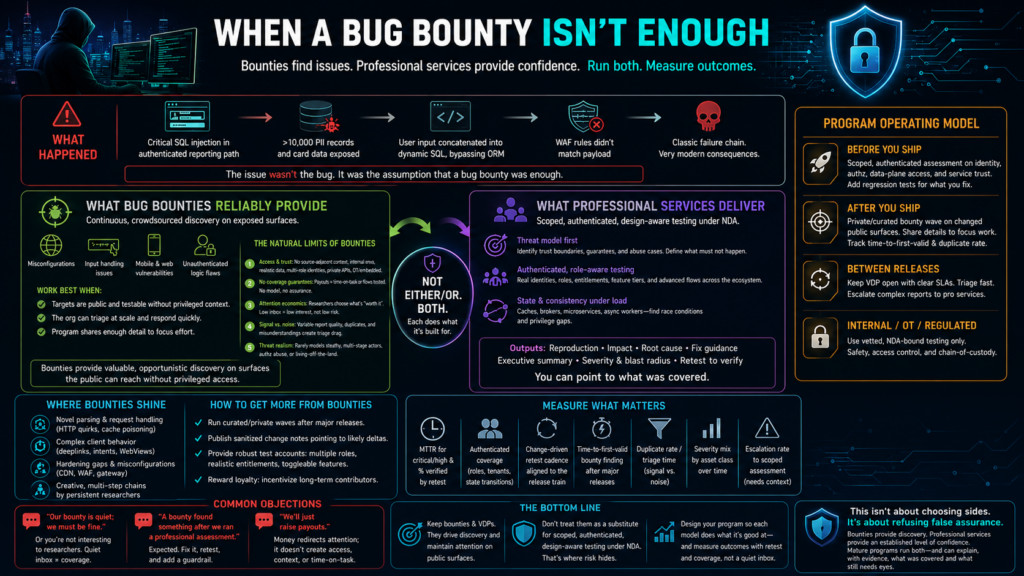
An enterprise with a long-running public bug bounty shipped a major release. Weeks later, a critical SQL injection surfaced in an authenticated reporting path. More than ten thousand PII records and clear-text card data were reachable via crafted queries. The vulnerable code sat behind role checks and a legacy admin flag; a helper function concatenated user input into a dynamic SQL fragment and bypassed the ORM’s protections. WAF rules didn’t match the payload shape. Classic failure chain; very modern consequences.
The surprise wasn’t the injection. It was the assumption that a bounty program made a professional, scoped assessment unnecessary. That premise shows up across the industry. It’s wrong.
This post is about how bug bounties and professional services actually work, where each is strong, and why neither replaces the other. No dunking on bounties, no hero worship of pen tests, just the operating reality.
What bug bounties reliably provide
Bug bounties and vulnerability disclosure programs (VDPs) deliver continuous external discovery on exposed surfaces. They create a safe intake path, reward useful reports, and sometimes attract brilliant researchers who invest weeks because a target is interesting. On internet-facing web and mobile, you’ll see wins on misconfigurations, straightforward input handling, direct object references, missing rate limits, unauthenticated logic, and the like. Private or curated bounties can improve signal by focusing experienced researchers on well-defined scopes.
Bounties work best when:
- Targets are public and testable without privileged context.
- The organization can triage at scale and respond quickly.
- The program shares enough detail to focus effort (new endpoints, known deltas, testing notes) without exposing sensitive internals.
The natural limits of bounties
Bounties are volunteer-driven. Researchers choose what to test, when to stop, and which scopes are “worth it.” You can influence attention with payouts, but you cannot guarantee time-on-task. That matters because many high-severity defects live behind authentication and require effort and context to reproduce.
Five practical limits show up repeatedly:
1) Access and trust
Crowds don’t get source-adjacent context, internal environments, realistic seeded datasets, multi-role identities, private APIs, or OT/embedded targets. Those require NDA, vetting, and clear handling expectations. Without that access, stateful, role-dependent paths remain opaque.
2) Coverage you can’t assert
A bounty payout total doesn’t map to hours of systematic scrutiny or to which flows were exercised. You don’t know which role matrices, token transitions, cache behaviors, or policy enforcement points were tested. No coverage model, no assurance claim.
3) Attention economics.
Public programs cluster attention around brands, “fun” scopes, and higher payouts. Low-profile assets can starve. A thin inbox reflects low researcher interest, not low risk.
4) Signal vs. noise
Report quality varies. Duplicates and misunderstandings create triage drag. Your team pays that tax. The question then becomes, ‘Does AI make bug bounty programs more efficient, or does AI fill reports with information that isn’t relevant, further slowing down the review process?’
5) Threat realism
Opportunistic bounties rarely model stealthy, multi-stage actors. Techniques like valid account abuse, authz abuse, and “living off the land” often require scenario-driven testing.
None of this makes bounties bad. It defines what they are: valuable, opportunistic discovery on surfaces the public can reach without privileged access.
What professional services deliver
Professional assessments, by contrast, are scoped, authenticated, and design-aware. They guarantee time-on-asset and let the client organization direct priority. They run under NDA to unlock views bounties can’t: the code and configs that implement authorization, pre-production with realistic identities and data, device and embedded paths, internal networks, and regulated systems.
The difference is method:
- Threat model first. Identify trust boundaries, intended guarantees, and abuse cases. Decide what must not happen (e.g., cross-tenant reads, stale claims elevating privilege, replay windows).
- Authenticated, role-aware testing. Ecosystem-wide evaluation covering hybrid systems and hosted subscription levels with a focus on real identities, feature tiers, entitlement models, and advanced features that get scant scrutiny in most bug bounty programs.
- State and consistency under distributed load. Assess how caches, message brokers, microservices, and async workers coordinate identity and access decisions, especially in areas where consistency or propagation missteps can spawn privilege gaps, race conditions, or unexpected cross-service behavior.
- Data-access fidelity. Examine how systems construct and execute data operations across SQL, NoSQL, and service-based data-access patterns. Reconcile data returns with user authorization policies and verify underlying storage behavior matches API or UI responses.
- End-to-end trust across services and devices. Examine how cloud services, internal systems, and connected/embedded devices establish trust and enforce identity and integrity. Uncover assumptions between services as well as between devices and backend systems especially in places where access or identity is inferred rather than explicitly checked. Gaps here are rarely revealed in bounty programs.
Outputs are different too: developer-ready reproduction, precise impact, root cause, and fix guidance tied to design; an executive summary with severity and blast radius; and retest to close the loop. You can point to what was covered, not hope it was looked at.
Where bounties miss
In this anonymized case, the vulnerable path lived behind authentication and required design context to exercise correctly. Public bounty researchers set their own priorities and typically lack the vetted access needed to test multi-role, stateful flows with confidence. You can raise payouts or share hints, but you still don’t control time-on-task or achieve coverage you can assert across authorization logic and internal data paths. That mismatch, not researcher skill, explains why critical issues in authenticated, design-dependent areas can survive a long-running public program.
These conditions don’t always exist on public tenants, and the effort required to discover them without access to code or design may keep them unscrutinized for long periods. At some point you’re trying to crowdsource a design review without giving the crowd the design.
Where bounties outperform, and how to let them
Bug bounties are not without significant intrinsic value, however. There’s a class of issues where public researchers consistently shine:
- Internet-facing edges with novel parsing or request handling (e.g., HTTP desync quirks, cache poisoning).
- Complex client behavior in mobile and web apps where deeplinks, intents, URL handlers, and WebViews interact.
- Hardening gaps and misconfigurations exposed by competition between services (e.g., CDN, WAF, gateway).
- Creative chains pieced together over time by a researcher “obsessed” with a target.
If you want that strength, there are steps you can take to make the programs more attractive and valuable to participants while also making them more effective for your organization.
- Run curated or private waves after major releases to focus attention on changed surfaces.
- Publish sanitized change notes that point researchers toward likely deltas.
- Provide robust test accounts (even if not full NDA access): multiple roles, realistic entitlements, toggleable features.
Introduce a loyalty program that adds incentives on top of the gamification already built into most bug bounties. This rewards the efforts of long-term participants and makes them want to keep coming back.
You’ll still lack coverage guarantees, but you’ll get better discovery where bounties are strong.
Program design that treats both as first-class
You need an operating model.
Before major releases or architectural change
Do a scoped, authenticated assessment on identity, authorization, data-plane access, and service-to-service trust. Focus first on those assets most recently updated. Capture abuse cases and add regression tests for anything you fix.
After you ship
Run a private or curated bounty wave on changed public surfaces. Share enough detail to focus work without exposing sensitive internals. Track time-to-first-valid and duplicate rate to gauge drift and attention.
Between releases
Keep VDP open with clear SLAs. Route valid reports quickly. Escalate ambiguous or systemic reports to professional services for root cause and verification.
For internal, OT/embedded, or regulated environments
Use vetted, NDA-bound testing only. These systems need access controls, chain-of-custody, and safety discipline the crowd can’t assume.
What to measure
You can’t declare systems “secure.” You can, however, track specific metrics to determine whether any program is mitigating risk.
- MTTR for critical/high and percentage verified by retest.
- Authenticated coverage: which roles, tenants, and state transitions were exercised.
- Change-driven retest cadence aligned to the release train.
- Time-to-first-valid bounty finding after major releases.
- Duplicate rate/triage time as a signal of bounty noise and focus.
- Severity mix by asset class over time.
- Escalation rate from bounty intake to scoped assessment (proxy for “needs design context”).
These numbers tell you if the mix you chose is working.
Common objections
“Our bounty is quiet; we must be fine.”
Or you’re not interesting to researchers. Quiet inbox does not equal coverage.
“A bounty found something after we ran a professional assessment.”
Expected. Environments change daily, and attacks always get better. Fix it, verify with retest, and add a guardrail (test, rule, or policy) to prevent recurrence.
“We’ll just raise payouts.”
Money redirects attention; it doesn’t create vetted access, design context, or guaranteed time-on-task behind auth. Know what you’re buying.
Bottom line for the industry
- Keep bounties and VDPs. They are the right way to engage the external community and maintain attention on public surfaces.
- Don’t treat them as a substitute for scoped, authenticated, design-aware testing under NDA. That’s where authorization, business logic, and safety-critical guarantees live.
- Design your program so each model does what it’s good at, and measure outcomes with retest and coverage, not with a quiet inbox.
This is not about choosing sides. It’s about refusing false assurance. Bounties provide discovery. Professional services provide an established level of confidence. Mature programs run both, and can explain, with evidence, what was covered and what still needs eyes.